All recordingsPrices shown exclude VAT. (UK tax is not payable for deliveries to United States.) See Terms & Conditions for p&p rates. | |  | R. Strauss: Don Quixote & Till Eulenspiegel
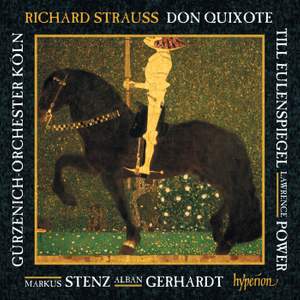
Strauss’s ‘Fantastic variations on a theme of knightly character’, as Don Quixote is subtitled, is one of the composer’s most popular tone poems, principally because of the beautifully drawn central characters of the Don (performed by a solo cellist) and Sancho Panza (viola). These roles are luxuriously cast in this new recording, being taken by Hyperion artists Alban Gerhardt and Lawrence Power. The merry tale of Till Eulenspiegel completes this release. The Gürzenich-Orchester Köln, the very orchestra which gave the premieres of both works in the 1890s, is conducted by Markus Stenz, who has held the position of Principal Conductor since 2003. He visited China with the orchestra in early 2008 and conducted their first ever BBC Prom at the Royal Albert Hall in August 2008. In September 2010 he returned to China with the Gürzenich Orchestra and the Opera of Cologne to conduct the first ever production of Wagner’s ‘Ring’ in Shanghai. Among other posts he is Chief Guest Conductor of the Hallé. “the playing here is first-rate, and Alban Gerhardt and Lawrence Power are vivid soloists.” Sunday Times, 7th April 2013 “Stenz gets the proportions exactly right. He plunges us into the delirium of the melancholy hero's addled brain with a clarity pointing forward to Schoenberg's First Chamber Symphony...Adventurous Alban Gerhardt is vivid as Quixote takes several tumbles...The peerless viola player Laurence Power is luxury casting as an equally human Sancho Panza. No stars needed to be drafted in for one of the best Till Eulenspiegels on disc...an irrepressible performance.” BBC Music Magazine, May 2013 ***** “Gerhardt and Power convey the complex nature of the relationship between the two...Stenz's conducting is all about the cumulative impact of small gestures rather than grand statements. We're conscious throughout of the classical form at the work's heart, though Stenz is also marvellous when it comes to those astonishing moments when the Don's fantasies assume a transcendent reality greater than anything on earth. It's nigh-on perfect.” The Guardian, 11th April 2013 ***** “[Power and Gerhardt are] both magnificent, and neither distorts the work's shape with excessive ego displays. This is a sublime, idiomatically phrased performance, given by the very orchestra which premiered the work. So you’d expect something special. The moments of quiet rapture are divine...The high points are too numerous to list” The Arts Desk, 13th April 2013 “an excellent account of Don Quixote. The catalogue isn’t exactly short of fine recordings but this one competes with the best. Gerhardt and Power are marvellous principals but they manage to project their characters splendidly while giving us a sense also that they are primus inter pares, as Strauss intended.” MusicWeb International, 22nd April 2013 “pictorial points are in general well made; the scenes are colourfully set; and both Gerhardt and Power are such fine, sensitive and expressive musicians that they encapsulate the varied moods of their protagonists poignantly and purposefully. Markus Stenz attacks Till Eulenspiegel with vigour” Gramophone Magazine, May 2013 BBC Music Magazine
Disc of the month - May 2013 |
| 
| | | In stock - usually despatched within 1 working day. |
|
|
| |  | Strauss, R: Don Quixote, Op. 35
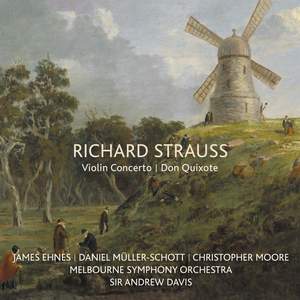
Friedemann Pardall (cello), Mathias Feger (viola) Duisburger Philharmoniker, Jonathan Darlington Jonathan Darlington was music director of the Duisburg Philharmonic until 2011 having graduated from Durham University and the Royal Academy of Music. He began his career as a freelance pianist and he made his conducting debut in 1984 at the Parisian Theatre de Champs Elysees. He remains a Laureate of the RAM and also holds the position of Fellow of the RAM and here conducts the Duisburg Philharmonic Orchestra in this stunning performance of Richard Strauss’ tone poem, Don Quixote. “Friedemann Pardall is an excellent soloist, and he is ably abetted by his Sancho Panza, the violist Mathias Feger. While their contributions make a suitably strong impression, they are not brought as far forward in the sound-perspective as in some other performance” MusicWeb International, May 2013 | 
| | | In stock - usually despatched within 1 working day. |
|
|
| |  | The Very Best of Paul Tortelier
Bach, J S: | Cello Suite No. 1 in G major, BWV1007 | Haydn: | Cello Concerto No. 2 in D major, Hob. VIIb:2 (Op. 101): Rondo | Karjinsky: | Esquisse | Nin: | Granadina (from Cantos populares españoles) | Paganini: | Introduction & Variations on 'Dal tuo stellato soglio' from Rossini's 'Mosé in Egitto', MS23 (Op. 24) | Rachmaninov: | Vocalise, Op. 34 No. 14 | Ravel: | Vocalise-étude en forme de habanera | Rimsky Korsakov: | Flight of the Bumble Bee | Saint-Saëns: | Allegro Appassionato in B minor Op. 43 Mon cœur s'ouvre à ta voix (from Samson et Dalila) Le carnaval des animaux: Le Cygne | Sarasate: | Danza Española No. 6: Zapateado, Op. 23, No. 2 | Strauss, R: | Don Quixote, Op. 35 | Tchaikovsky: | Variations on a Rococo Theme, Op. 33 | Tortelier: | Miniatures (3) |
and movements from cello sonatas by Beethoven and Brahms and the Walton and Elgar Concertos
Paul Tortelier had the lean, ascetic look of an El Greco saint, yet possessed the turbulent idealism of Don Quixote, whom he portrayed so memorably in Richard Strauss’s tone poem. Tortelier was born in Paris in 1914, months before the outbreak of the Great War. Though the family knew poverty, it was his mother’s dream that her son should be a cellist. He started to learn the instrument at the age of six and at 12 he entered the Paris Conservatoire where he won several prizes before leaving at 16 to play freelance in cafés and cinemas in the days of silent films. A year later he made his professional debut playing Lalo’s Concerto at the Concerts Lamoureux. In 1935 he went to the Monte-Carlo Orchestra as principal cellist and two years later played Don Quixote under Strauss’s own direction. He began his solo career in 1938 in Boston, but this was interrupted by the war, during which he remained in Paris. In 1947 he played Don Quixote in Beecham’s Richard Strauss festival in London to great acclaim. This effectively relaunched his international career and he went on to become one of the world’s most distinguished cellists. He died suddenly in 1990 at the age of 76. Bach’s solo Cello Suites were always an integral part of Tortelier’s repertoire and CD 1 opens with the first three movements of Suite No.1 in G. Following this is another Baroque work, the Cello Concerto in D by Vivaldi, in which Tortelier also directs the English Chamber Orchestra. Next comes the finale from Haydn’s Cello Concerto No.2 in D recorded with Jörg Faerber conducting the Wurtemburg Chamber Orchestra in Heilbronn. We then hear movements from Beethoven’s Cello Sonata No.4 in C with the French pianist Eric Heidsieck, and Brahms’s Cello Sonata No.2 in F in which the pianist is Tortelier’s daughter, Maria de la Pau. The CD ends with Tortelier’s third EMI recording of his signature work, Don Quixote by Richard Strauss with the Staatskapelle Dresden under Rudolf Kempe. CD 2 begins with the first two movements of another of the works central to Tortelier’s repertoire, Elgar’s Cello Concerto, a performance of which won him a prize while he was studying at the Paris Conservatoire. This is followed by an extract from the Walton Cello Concerto conducted by Paavo Berglund and then Paganini’s variations on an operatic aria by Rossini to show off Tortelier’s technical skill as a virtuoso of his instrument, this recording conducted by Tortelier’s cellist wife, Maud Tortelier. Next comes a group of encore pieces, including the inevitable ‘Flight of the Bumblebee’ and ‘Le Cygne’, culminating in Three Miniatures for two cellos composed by Tortelier himself and played here with his wife Maud as the second cellist. The programme finishes with a spirited performance of Tchaikovsky’s ‘Rococo’ Variations with the Northern Sinfonia of England conducted by Tortelier’s son Jan Pascal Tortelier. | | | In stock - usually despatched within 1 working day. |
|
|
| |  | Richard Strauss: Works for Cello
| | | In stock - usually despatched within 1 working day. |
|
|
| |  | Strauss: Don Quixote
Rudolf Kempe’s excellent reputation as a conductor of Richard Strauss is justly deserved. In this recording, he is joined by the inimitable Paul Tortelier in Strauss’ whimsical Don Quixote. He conducts the Berlin Philharmonic in a superb recording of Till Eulenspiegels lustige Streiche and the CD also features the same orchestra in an unjustly neglected performance of Don Juan conducted by Fritz Lehmann. ‘This is one of the great classics of the gramophone........... Highly recommended.’ Gramophone of Don Quixote and Til Eulenspiegels | | | In stock - usually despatched within 1 working day. |
|
|
| |  | Rostropovich - Life and Art
Recording Place & Date: Bloch & Schumann: Paris, Theatre Des Champ Elysees, 1976 & Strauss: Berlin, Berliner Philharmonie, 1975 | | | In stock - usually despatched within 1 working day. |
|
|
| |  |
| | | In stock - usually despatched within 1 working day. |
|
|
| |  |
“Cellists are apt to 'come of age' in recordings of the Elgar. Isserlis was no exception. This is a wonderful account of the Concerto – brave, imaginative, individual – indeed, quite the most personal in its perception of the piece since the treasurable du Pré on EMI. And that, you'll appreciate, is saying something though not, we hasten to add, that the two readings are in any outward sense similar. Far from it. With Isserlis, the emotional tug is considerably less overt, the emphasis more on shadow and subtext than open heartache. Yet the inner light is no less intense, the phrasing no less rhapsodic in manner than du Pré. On the contrary. This is freerange Elgar all right, and like du Pré it comes totally without affectation. Both Isserlis and du Pré take an appropriately generous line on the first movement's sorrowful song, with Isserlis the more reposeful, the more inclined to open out and savour key cadences. The Scherzo itself is quite simply better played than on any previous recording; the articulation and definition of the semiquaver 'fours' would, we're sure, have astonished even the composer himself. From a technical point of view Isserlis is easily the equal, and more, of any player currently before us. And if you still feel that du Pré really did have the last word where the epilogue is concerned, then listen to Isserlis sinking with heavy heart into those pages preceding the return of the opening declamation. He achieves a mesmerising fragility in the bars marked lento – one last backward glance, as it were – and the inwardness of the final diminuendo is something to be heard and remembered. Hickox and the LSO prove model collaborators. Don't on any account miss these performances.” Gramophone Classical Music Guide, 2010 | | | In stock - usually despatched within 1 working day. |
|
|
| |  |
Beginning with two rascally characters - the deluded Don Quixote and the prankster Till Eulenspiegel, this set includes remarkable recordings from the catalogues of Philips and Deutsche Grammophon, with some recordings appearing on CD internationally for the first time - Haitink's "Don Quixote", Jochum's blazing "Till Eulenspiegel" and shimmering Rosenkavalier Waltzes (both sets) and Munchinger's recording of the sextet from Capriccio. Sinopoli's "Metamorphosen", previously coupled with Bruckner's Eighth symphony and long unavailable, finds its rightful place in this Strauss collection. In addition to the Rosenkavalier and Capriccio moments, we have other orchestral music from Strauss's operas, all conducted by Sinopoli and concluding with one of the most exciting and thrillingly-recorded versions of the Dance of the Seven Veils. | | | In stock - usually despatched within 1 working day. |
|
|
| |  | Eugene Ormandy conducts Brahms & Strauss
| | | Usually despatched in 2 - 3 working days. |
|
|
| |
|