Prices shown exclude VAT. (UK tax is not payable for deliveries to United States.) See Terms & Conditions for p&p rates. | |  | Liszt: Tasso. Lamento E Trionfo & Le Triomphe Funèbre du Tasse
This is the fourth volume in the critically-acclaimed series “Liszt: The Sound of Weimar” which NCA is releasing as part of the celebrations to mark the 200th anniversary of the composer’s birth. These recordings are being made by the Vienna Academy Orchestra under its esteemed Austrian conductor Martin Haselböck and, as with the first three discs, the music is performed on original instruments from the 19th century. Included here are three more of the Symphonic Poems: No. 2 - Tasso, No. 8 - Héroïde funèbre, and No. 12 - Die Ideale, as well as the orchestral piece, Le Triomphe funèbre du Tasse. The orchestral project “The Sound of Weimar” will include all the orchestral works of Franz Liszt in the original orchestration of the live premieres in Weimar. The recordings are taking place at the Austrian Liszt Raiding Centre, and will all be made at performances in seven concerts during 2011 and 2012 by the Vienna Academy Orchestra under the direction of Martin Haselböck. The first three CDs in the series were of the Dante Symphony (60234), released at the end of last year, and a disc which included the Symphonic Poems Les Preludes, Orpheus, and the Berg-Symphonie (60246). The third volume, released in March, featured Hunnenschlacht, Hungaria, and Mazeppa. The renowned Austrian conductor Martin Haselböck is the musical director of Musica Angelica in Santa Monica, California, and the musical director and founder of the Vienna Academy Orchestra. He is also a professor at the University of Vienna, where he teaches organ. “Period performances of real interest: Liszt's scoring sounds more focused than on modern instruments. The octane-level of the playing varies (like the music itself).” BBC Music Magazine, October 2012 *** “If at first you miss the visceral drama and volume offered by modern drama instruments en masse, do persevere. Time and again Haselböck's approach reveals aspects of Liszt's scoring that would otherwise go unnoticed...Haselböck will have taught you how to 'listen through' as well as merely 'listening to'. You will have known Liszt's sound world as he knew it, more or less” Gramophone Magazine, November 2012 “all [are] given with the right fervency of spirit.” Sunday Times, 16th September 2012 “These players produce colours bold and pungent enough to make you forget the music’s shortcomings – what could sound like aimless romantic gloop feels taut, vibrant...All well worth hearing – beautifully recorded, well-annotated, historically important music..” The Arts Desk, 27th October 2012 | | | Usually despatched in 4 - 5 working days. |
|
|
| |  | Denis Matsuev plays Liszt
Denis Matsuev's triumphant victory at the eleventh International Tchaikovsky Competition has given him celebrity status on the international concert platform. He has appeared at prestigious concert halls like the Carnegie Hall and Lincoln Center in New York, the Kennedy Center in Washington, D.C., the Salle Gaveau in Paris, the Mozarteum in Salzburg, the Musikhalle in Hamburg, the Great Hall of Moscow Conservatory and the Great Hall of the St Petersburg Philharmonia, to name but a few. “Matsuev and Mikhail Pletnev demonstrate immaculate good taste and refinement without ever losing the sense of drama and display that is so inherent to these three concerto works...What really singles these performances out is the range and the variety of orchestral colour...with each intstrument heard to maximum effect. This is an outstanding release.” International Record Review, May 2012 “[Matsuev is] one of the most exciting pianists around. Partnered by one of the great pianist/conductors of the day, we can expect the sparks to fly. They do - but only after a measured opening to the First Concerto...[Héroïde funèbre] is one of Liszt's most extraordinary utterances...Is there a more desolate, unsettling opening to a work from the 19th century? Pletnev would have us think not.” Gramophone Magazine, June 2012 “Here is an authentically Russian, hairy-chested take on all three of Liszt's piano-orchestral works. If you like your Liszt concertos to sound like Tchaikovsky (and there's no final reason why you shouldn't), then the First Concerto's opening bars will here have you purring happily away.” BBC Music Magazine, June 2012 ***/**** | | | Usually despatched in 3 - 4 working days. |
|
|
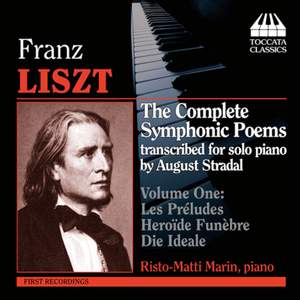
| |  | Liszt - The Complete Symphonic Poems for Solo Piano Volume 1transcribed by August Stradal
Risto-Matti Marin (piano) Liszt’s thirteen symphonic poems are among his best-known and most characteristic works, giving a graphic impression of the sheer versatility and manysidedness of his personality, as well as his astonishing creative range. But though he made many piano transcriptions, he never transcribed his symphonic poems for solo piano. The Bohemian pianist, composer and writer, August Stradal (1860–1930) was considered a leading interpreter of Liszt’s music and made many transcriptions of orchestral and chamber works for the piano, from the Baroque era to the late nineteenth century. Stradal’s transcriptions of Liszt’s symphonic poems transform these revolutionary orchestral compositions into viable and effective piano works, faithfully preserving their masterly musical substance. In his transcriptions Stradal scrupulously indicates the instruments playing in the orchestral score at any given time, and devises many ingenious solutions to representing their sound in terms of the keyboard. This is the first of four CDs presenting all thirteen symphonic poems as well as other Stradal Liszt transcriptions, all but one in their first recordings. | | | (also available to download from $10.75) | Usually despatched in 2 - 3 working days. (Available now to download.) |
|
|
| |  | Liszt - Symphonic Poems Volume 3
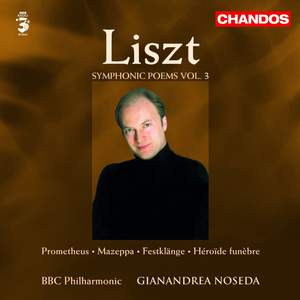
“Here, once more, is one dramatic gesture after another to startle and provoke Liszt's contemporaries who, indifferent to such generosity, quibbled over the length of the massive Héroïde funèbre and dismissed Mazeppa as vulgar and meretricious. …the BBC Philharmonic under Gianandrea Noseda... achieve a special sense of exultance rather than bombast in Festklänge, written to celebrate Liszt's planned marriage to the Princess Carolyne Sayn-Wittgenstein. And they are no less successful in the vast spans of the Héroïde funèbre, a still desolating tribute to those who suffered "throughout the whole spectrum of human carnage" (Liszt). Fluent and eloquent as ever, Noseda and his orchestra have once more been superbly recorded.” Gramophone Magazine, July 2007 “Mazeppa is the most familiar of these works, and Noseda gives it a rousing performance… Noseda deals well with the often episodic nature of this music… He does this by an acute sense of pacing, so that each section seems to inhabit its natural tempo, and move smoothly into the next one.” BBC Music Magazine, July 2007 **** “No one could accuse Liszt of a lack of largesse. Here, once more, is one dramatic gesture after another to startle and provoke Liszt's contemporaries who, indifferent to such generosity, quibbled over the length of the massive Héroïdefunèbre and dismissed Mazeppa as vulgar and meretricious. Again, it is possible to see in all these works Liszt's lifelong preoccupation with the triumph of good over evil and, more personally, the recognition due to him long after his death. True, there are times when his reliance on sequence and chromaticism to intensify his themes can seem like so much padding and it says much for the BBC Philharmonic under Gianandrea Noseda that they once more temper drama with discretion. They achieve a special sense of exultance rather than bombast in Festklänge, written to celebrate Liszt's planned marriage to the Princess Carolyne Sayn-Wittgenstein. And they are no less successful in the vast spans of the Héroïdefunèbre, a still desolating tribute to those who suffered 'throughout the whole spectrum of human carnage' (Liszt). Fluent and eloquent as ever, Noseda and his orchestra have once more been superbly recorded.” Gramophone Classical Music Guide, 2010 “The highlight here is Mazeppa...Noseda and the BBC Philharmonic Orchestra give it plenty of life and vividly re-create the evocation of the horse galloping across the countryside with the eponymous hero strapped to its back.” Penguin Guide, 2011 edition | | | (also available to download from $10.75) | Usually despatched in 2 - 3 working days. (Available now to download.) |
|
|
| |  | Liszt - Symphonic Poems Volume 4
| | | (also available to download from $6.00) | Usually despatched in 2 - 3 working days. (Available now to download.) |
|
|
| |  |
Recorded 1976/78 | | | Usually despatched in 4 - 5 working days. |
|
|
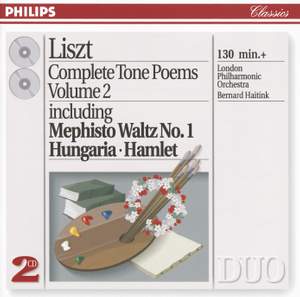
| |  | Liszt - Complete Tone Poems
| | | Usually despatched in 2 - 3 working days. |
|
|
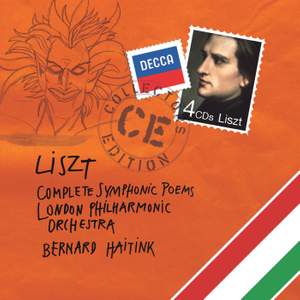
| |  | Liszt: Symphonic Poems (Complete Edition)
This 5-CD set comprises a series of live recordings made by the Orchester Wiener Akademie and its conductor Martin Haselböck of orchestral music by Franz Liszt. They were released to mark the 200th anniversary of the composer’s birth. It features all of the Symphonic Poems, the Dante Symphony and the beautiful Évocation à la Chapelle Sixtine. These critically-acclaimed performances from 2011 and 2012 are unique in that the orchestra performs on the original instruments or copies of the original instruments that were used at concerts conducted by the composer himself. For “The Sound of Weimar” project, Liszt expert Martin Haselböck deployed the orchestra Wiener Akademie in exactly the size adopted for the original performances given by the Weimar Hofkapelle, and for the recordings made use of instruments that had either been played in concerts conducted by Franz Liszt himself or were faithful copies of such instruments. When the early CDs of the series appeared they were immediately described in such terms as “definitive recording”, “exemplary editions”, “a resounding success” or “a tonal phenomenon”. In addition to the symphonic poems this special edition also includes the Dante symphony, a work that was also composed at Weimar, and Évocation à la Chapelle Sixtine. Volumes 1 to 4 of the series won the International Franz Liszt Record Grand Prix in 2011 and 2012, and the series has received outstanding reviews in specialist magazines around the world. | 
| | | (also available to download from $42.25) | Usually despatched in 4 - 5 working days. (Available now to download.) |
|
|
| |  | Liszt: Symphonic Poems (complete)
| | | This item is currently out of stock at the UK distributor. You may order it now but please be aware that it may be six weeks or more before it can be despatched. |
|
|
| |  | Liszt: Orchestral Works and Piano and Orchestra
Liszt: | Symphonic Poems Nos. 1-13 A Faust Symphony, S108 Episoden (2) aus Lenaus Faust S100 Dante Symphony, S. 109 Piano Concerto No. 1 in E flat major, S124 Piano Concerto No. 2 in A major, S125 Wandererfantasie (Schubert), S366 Polonaise brillante, S367 Fantasy on Hungarian Folk-tunes, S123 Fantasia on a theme from Beethoven's 'Ruins of Athens', S122 Grande fantaisie symphonique on themes from Berlioz's ‘Lelio', S120 Malédiction, S121 Op. 452 Totentanz, S126 for piano & orchestra |
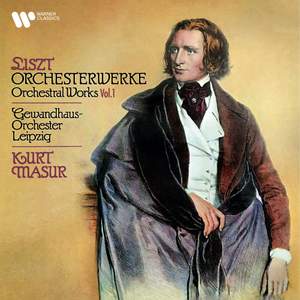
Among the 25 orchestral works that Liszt wrote, the thirteen tone poems make up the biggest single category. He gave these works of ideas their final form during his years as kapellmeister at the Weimar court (1843–59), and dedicated them to his beloved, Princess Carolyne von Sayn-Wittgenstein. The numbering of the first editions doesn’t reflect the order of composition: the first tone poem that Liszt composed was Tasso (first performance: 28. August 1849); it was followed (in the order of the first performance) by Bergsinfonie and Prometheus (1850), Orpheus, Les Préludes, Mazeppa and Festklänge (1854), Hungaria (1856), Die Ideale, Héroide funèbre and Hunnenschlacht (1857), and finally Hamlet (1876). Nearly all the tone poems are based on literary sources or historic myths and reflect philosophical ideas, with the exception of Festklänge, which was intended to be the wedding march for Liszt’s planned wedding to Carolyne, and Hungaria, which extols the praises of the composer’s native country. Von der Wiege bis zum Grabe (1881/2) was not written during the Weimar years: this later addition can be seen as an epilogue penned in the wisdom of old age. Liszt treated the character of Faust in his music in a variety of forms: in the two orchestral episodes after Nikolaus Lenau’s poem of the same name, and in the different Mephisto Waltzes. The Faust Symphony is a study of the three main characters in the Goethe drama, but it also represents a picture "of the nature of Man with his aspirations and flaws, with his fluctuation between guilt and redemption" (Hans Jürgen Meinerts), culminating in the challenge to find true love. Here Liszt introduces the closing chorus with a tenor solo: "Everything transient is but an allegory, the inadequate becomes reality, the indescribable is done; eternal femininity draws us upwards". The Dante Symphony, which is dedicated to Wagner, reflects the process of understanding described in the Divine Comedy, which Dante completed shortly before his death in 1321. In the ‘Inferno’ Liszt sends the Romantic idea of love to hell in the example of Francesca da Rimini qnd Paolo. The opening of ‘Purgatorio’ puts Dante’s words into music: "A gentle blue, poured like oriental sapphire on to the bright firmament"; later follows a fugue marked ‘Lamentoso’ that portrays the process of purification. Liszt originally wanted to add a final section corresponding to Dante’s ‘Paradiso’, but Wagner convinced him that this couldn’t be depicted in music. Thus Liszt left the piece in two movements; however, the ‘Magnificat’ essentially represents Paradise, for the Gregorian magnificat he quotes here with its ethereal female choir is in keeping with the central message of Man finding his fulfilment in the divine. Liszt subsequently added a closing apotheosis to the work. Nowadays, this later addition often falls victim to the tendency to favour the original version, but doing so actually distorts our view of the connections between the two symphonies: ‘Mephisto’ and ‘Inferno’ correspond inversely with one another, as do ‘Faust’ and ‘Purgatorio’. Admittedly, the Dante Symphony goes one step further: where Gretchen was still a real person in the Faust Symphony, Liszt makes Beatrice, whom Dante tries to find in hell, into a mere ideal that no longer appears. Of Liszt’s ten original compositions for piano and orchestra, at least four can be described as piano concertos, among them Malédiction S. 121. But Liszt only numbered two of them for publication. Listened to one after the other, they create an impression of extreme opposites. This much is apparent from the basic keys of E flat major and A major, which couldn’t be farther away from one another. The majestic Piano concerto no.1 is clearly structured in three movements, while the second concerto has a single movement with a six-part structure that superimposes variation and sonata form. Notwithstanding, the two works seem to refer to each other. As Liszt also appeared for many years as a concert pianist, he also left quite a number of arrangements for piano and orchestra of other composers’ works. In most such fantasias, he used well-known themes by composers like Berlioz and Beethoven for musical reflections that are formally independent. Schubert’s Wanderer Fantasy, on the other hand, he turned into a captivating piano concerto, even though it does stick for the most part to the form of the original. The first complete German recording of Franz Liszt's 13 tone poems, his two symphonies and the big works for piano and orchestra. Recorded by the Leipzig Gewandhaus under Kurt Masur in 1980–81, this issue set international standards in the Liszt discography. | | | In stock - usually despatched within 1 working day. |
|
|
| |
|