Despres: In te Domine speravi

This page lists all recordings of In te Domine speravi, by Josquin Despres (c.1440-1521) on CD & download (MP3 & FLAC). Generally, more recent releases are listed first, but with priority given to those that are in stock.

Prices shown exclude VAT. (UK tax is not payable for deliveries to United States.)
See Terms & Conditions for p&p rates.

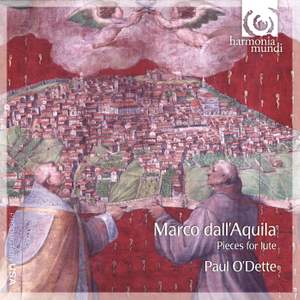
Marco dall’Aquila - Pieces for Lute

Marco dall’Aquila - Pieces for Lute


La Rosée du moys de may

Rousee

Aquila:

Ricercars 2-6, 13, 15, 17- 20, 26

La Cara Cossa Nos.1-6, 10, 11

Fantasias 7, 9, 27, 28

Saltarello ‘La Traditora’ Nos.1, 2 & 3

Pioverin

Il Marchese di Saluzzo

Fantasia (28)

Pomo

Pavana

Piva

Tocha tocha la canella

Carnalesca

Donne impresteme il vostro burato da buratare la mia farina

Despres:

Plus nulz regretz grans, moyens ne menuz

In te Domine speravi

Janequin:

Pavana 'La Battaglia'

Nous bergiers

Passereau:

Il est bel et bon

Sermisy:

C’est à grand tort


Paul O’Dette (lute: 6-course lute by Paul Thomson, London, 1984, after Magno Tieffenbrucker, c. 1550; 6-course alto lute by Grant Tomlinson, Vancouver, 1997, after Italian models)

Star lutenist Paul O’Dette turns his focus on Marco dall’Aquila, a composer of remarkable individuality and creativity. In the lute’s transition from late-medieval style into fully formed Renaissance idiom, Marco was a pivotal figure and his trademark style brisé influenced the development of instrumental music for the next 200 years.

“If the lute could be said to have a star performer, then Paul O'Dette must surely be it. He's the most sought-after lute performer at music festivals round the world, his recordings are always showered with awards, and he has a virtuoso touch and musical intelligence that I've rarely seen matched.” The Daily Telegraph

"Nestled at the foot of the Gran Sasso, in the rugged Apennines northeast of Rome, lies the picturesque medieval city of L’Aquila. In 1569, the city commissioned a series of triumphal arches decorated with portraits of the most important citizens of L’Aquila in honor of the arrival of Margaret of Austria, who claimed governorship over the region. Two musicians were included among the most celebrated natives, Serafino Aquilano, the famous song stylist and lutenist of the late 15th-century, and the lute virtuoso Marco dall’Aquila (c.1480-1544). Marco appears to have spent most of his professional career in Venice. In 1505, he obtained a privilege from the Venetian Signoria to publish lute music, but Ottaviano Petrucci seems to have objected and Marco’s publication apparently never appeared but is now housed in the Bavarian State Library, Munich Mus Ms. 266. The pieces included here represent a selection from Munich 266, as well as the three works included in Casteliono’s print, arranged into sets alternating Ricercars or Fantasias with intabulations and dances as suggested by various 16th-century sources. The dances have also been arranged into suites, either involving variations of the same dance, or groups of dances of different meters and characters. Although not all of these works are attributed to Marco in the manuscript, they are all contained in a single fascicle in which the anonymous works are wedged in between works bearing Marco’s name. At 3:32 am on April 6, 2009, a powerful earthquake struck L’Aquila, destroying much of the historic town center and many of the beautiful medieval villages that surround the city. The producers and I originally planned to make this recording in L’Aquila, but when this proved impossible, we chose a medieval church near Capestrano, 45 kilometers south of L’Aquila. Shortly before our arrival it was discovered the church had also sustained structural damage and required immediate repairs. At the last minute, the Castello Piccolomini in Capestrano was kindly made available to us by the mayor, Antonio D’Alfonso. While the acoustics of the Castello are perhaps more reverberant than one is accustomed to hearing on lute recordings it is nevertheless a venerable edifice that Marco may well have known, and it lends a special air of historical presence to the sound. This recording is dedicated to the victims of the earthquake, those kind and brave Aquilani whose richly distinctive culture has nourished my exploration of Marco’s music for the past decade." Paul O’Dette, Capestrano, (AQ), 3 August 2009

“O’Dette, whose playing is always beguilingly eloquent, presents as many dimensions of Dall’Aquila’s output as he can. Josquin’s In te Domine speravi is an appropriate conclusion given that the disc is dedicated to the [L'Aquila] earthquake’s victims.” Sunday Times, 11th April 2010 ***

Harmonia Mundi - HMU907548

(CD)

$17.50

In stock - usually despatched within 1 working day.

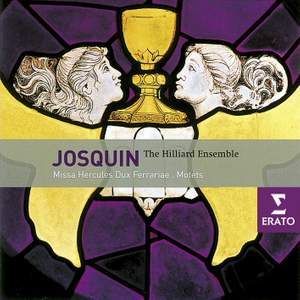
Josquin Desprez - Motets & Chansons

Josquin Desprez - Motets & Chansons


Despres:

Ave Maria ... Virgo serena

Absalon Fili Mi

Veni, Sancte Spiritus

De profundis clamavi

Scaramella va alla guerra

Loyset Compère: Scaramella fa la galla

In te Domine speravi

El Grillo

Mille Regretz

Petite camusette

Je me complains

En l'ombre d'ung buissonet

Je ne me puis tenir d'aimer

Missa Hercules dux Ferrariae

Pater noster

Lugebat David Absalon

Miserere

Tu solus qui facis mirabilia


Virgin Veritas - 5623462

(CD - 2 discs)

$11.25

In stock - usually despatched within 1 working day.

Josquin Desprez: Motets & Chansons

Josquin Desprez: Motets & Chansons


Despres:

Ave Maria ... Virgo serena

Absalon Fili Mi

Veni, Sancte Spiritus

De profundis clamavi

Scaramella va alla guerra

In te Domine speravi

El Grillo

Mille Regretz

Petite camusette

Je ne me puis tenir d'aimer

La Déploration de Johannes Ockeghem


Hilliard Ensemble

Virgin - 5613022

(CD)

$13.25

In stock - usually despatched within 1 working day.

Music for Emperor Charles V (1500-1558)

Music for Emperor Charles V (1500-1558)


anon.:

Dit le Bourguygnon

Verbum caro factum est

Chanson: L'homme armé

Tourdion

L'amor, dona, ch'io te porto

Ay Luna Que Reluces

Propinán de Melyor

Antiphon Requiem aeternam

Adoramoste, Senor

Arbeau:

Belle que tiens ma vie

Cabezón, A:

Si par souffrir

Triste depart

Despres:

In te Domine speravi

Guerrero:

Simile est regnum Caelorum: Gloria

Hombres, Victoria!

Milán:

Pavana & Galliarda

Narvaez:

Mille regretz (after Josquin)

Parabosco:

Da Pacem Domine

Praetorius, M:

Pavane de Spaigne (30)

Senfl:

Non morir, sed vivam (Psalm-Motette)

Susato:

Pavane La Bataille

Torre, F:

Danza alta

Verdelot:

Italia mia bench' el parlar'

Walther, J:

Ein feste Burg ist unser Gott


Matthias Gerchen (bass)

Capella de la Torre

The Emperor Charles V was surrounded by music from his childhood onwards. When Charles left the Netherlands to take up his inheritance of the Spanish throne he was accompanied by the Flemish musicians who later became the ‘Capilla Flamenca’ This recording sets a new focus and presents ceremonial wind music from the ‘Golden Age’ of the Spanish Renaissance, as it would have sounded in Charles V’s lifetime. The only probable comparison point for a recording like this which is centred around an historical figure is one by David Munrow in 1972.

Coviello - COV20701

(CD)

$18.50

(also available to download from $10.50)

Usually despatched in 4 - 5 working days. (Available now to download.)

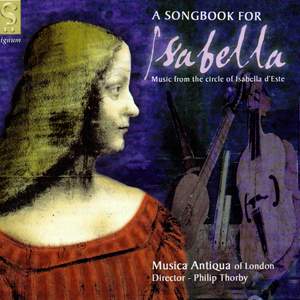
A Songbook for Isabella

A Songbook for Isabella

Music from the circle of Isabella d’Este


Includes:

Agricola, A:

Si dedero

Busnois:

Fortuna desperata

Caron:

Helas que poura devenir

Despres:

In te Domine speravi

Isaac:

La mi à 4

Absque verbis à 3

Gratis acceptistis à 4

La morra

Ockeghem:

Prenez sur moi vostre exemple amoureux

Plice:

A la pesca à 4

Tromboncino:

Or che son di pregion à 4


Clare Wilkinson (mezzo-soprano)

Musica Antiqua of London, Philip Thorby

Isabella d’Este was brought up in the midst of an extremely active musical court. After her marriage in 1490 to Francesco Gonzaga Duke of Mantua she began to remodel the Duke's relatively modest musical establishment in imitation of that of her father, Hercule. She was herself a gifted musician and favoured above all the viol. Not only was the viol the favourite vehicle for aristocratic instrumental performance, but it was the ideal accompaniment to the voice.

Under Isabella’s patronage the tradition of improvised song accompanied by the singer on a lira da braccio developed into the frottola, shared between two, three or even four viols. In employing Italian composers, and herself performing their music, Isabella played a key role in the development of this new music, and of the consort of viole which developed alongside it.

This disc presents a selection of music from the circle of Isabella. The repertoire is centred around the Milliare Songbook - a hand written songbook compiled in 1502 by, or for, one Ludovico Milliare. This contains a wonderfully rich cross section of the vocal and instrumental repertoire loved by the d’Este family of Mantua. An attractive feature of the collection is the inclusion of sacred pieces, mostly non-liturgical and apparently intended for private devotional use.

The instruments used for this recording have been thoroughly researched by examining documented and iconographic evidence - for example contemporary paintings of the period. The custom-made viols are cannot be called "copies"; they are recreations using the best information and scholarship available. This CD offers a rare opportunity to hear the very different sound these instruments make - rather different from their more modern counterparts from the seventeenth and eighteenth centuries.

Signum - SIGCD039

(CD)

$16.75

Usually despatched in 3 - 4 working days.

Copyright © 2002-13 Presto Classical Limited, all rights reserved.