All recordingsPrices shown exclude VAT. (UK tax is not payable for deliveries to United States.) See Terms & Conditions for p&p rates. | |  | Best of Vesselina Kasarova
Bellini: | Arresta! Qual mesto suon echeggia? (from I Capuleti) Ramon Vargas (tenor) Munchner Rundfunkorchester, Roberto Abbado | Bizet: | L'amour est un oiseau rebelle 'Habanera' (from Carmen) Munchner Rundfunkorchester, Giuliano Carella | Gluck: | Che faro' senza Euridice? (from Orfeo ed Euridice) Munchner Rundfunkorchester, Friedrich Haider | Handel: | Bella sorge la speranza (Arianna in Creta) Il Complesso Barocco, Alan Curtis Sento brillar nel sen (from Il Pastor Fido) Il Complesso Barocco, Alan Curtis | Mozart: | Non so più cosa son, cosa faccio (from Le nozze di Figaro) Staatskapelle Dresden, Sir Colin Davis Già dagli occhi il velo è tolto (from Mitridate, rè di Ponto) Staatskapelle Dresden, Sir Colin Davis Il Tenero Momento (from Lucio Silla) Staatskapelle Dresden, Sir Colin Davis | Offenbach: | Bonjour, Monsieur, je suis la bonne (from Pomme d'api) Munchner Rundfunkorchester, Ulf Schirmer Ah! quel dîner je viens de faire (from La Perichole) Munchner Rundfunkorchester, Ulf Schirmer | Rossini: | Ah, vieni, nel tuo sangue (from Otello) Juan Diego Florez (tenor) Arthur Fagen | Schubert: | Auf dem Wasser zu singen, D774 Friedrich Haider (piano) | Thomas, Ambroise: | Connais-tu le pays (from Mignon) Munchner Rundfunkorchester, Frederic Chaslin | Verdi: | O don fatale (from Don Carlo) Munchner Rundfunkorchester, Giuliano Carella |
| | | In stock - usually despatched within 1 working day. |
|
|
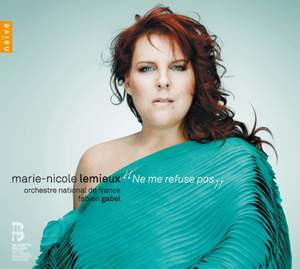
| |  | Ne me refuse pas: French Opera Arias
In 2000 the contralto Marie-Nicole Lemieux became the first Canadian to win the First Prize as well as the Special Prize for Lieder at the Queen Elisabeth International Music Competition in Belgium. She has recorded for numerous labels, and now enjoys an exclusive contract with the Naïve label, for which she has recorded the title roles in Vivaldi’s operas Griselda and Orlando furioso. Her first recital CD of French mélodies (L’Heure exquise) was much praised by the critics. In 2008 Naïve released a recording of Vivaldi sacred works in which she sings the famous Stabat Mater. This was followed by the same composer’s La fida ninfa. In 2009 Naïve released a recital of Schumann songs with the pianist Daniel Blumenthal and a programme of Vivaldi arias with the Ensemble Matheus under Jean-Christophe Spinosi. The programme chosen for this recording by Marie-Nicole Lemieux is dedicated to the finest arias from the French opera, recorded with one of the finest orchestras in this repertoire and featuring both popular and more specialised works by, amongst others, Massenet, Berlioz, Saint-Saëns, and Bizet. “The programme is formidably intelligent: well-known items are placed alongside some terrific music by composers we rarely hear (Halévy and Wormser, for instance), the aim being to remind us that the dividing line between success and oblivion can sometimes be painfully thin.” The Guardian, 11th November 2010 *** “This is an attractive record and its appeal may well be felt before a note of it is heard. Many who take a particular interest in singing find themselves drawn to the French repertoire...and this young singer - perhaps still new to some - so provocatively classified as "contralto" also has the kind of name and background that attract the attention of traditional record collectors.” Gramophone Magazine, March 2011 “[In the Letter Scene] Lemieux is awake to the changes of mood as she moves between a lovely quiet opening section to more ecstatic utterances. The interpretation is first-rate...The wistfulness and sense of longing with which Lemieux recalls Mignon's past are feelingly expressed...The playing under Fabien Gabel is fine all through.” International Record Review, March 2011 “This procession of femmes fatales, schemers and innocents has a point to make, and it's not just the singer's ability to get under their skin...it shows them as part of a larger movement: the rise of the 19th-century French mezzo...Marie-Nicole Lemieux is equal to them all, adjusting vibrato and shading an essentially contralto colour according to dramatic demands.” BBC Music Magazine, April 2011 ***** | | | (also available to download from $10.50) | In stock - usually despatched within 1 working day. |
|
|
| |  | Vesselina Kasarova: A Portrait & French Opera Arias
Bellini: | Ascolta! Se Romeo t'uccise un figlio...La tremenda ultrice spada (from I Capuleti) | Berlioz: | Ah! Je vais mourir (from Les Troyens) | Donizetti: | Fia dunque vero…O mio Fernando (from La Favorita) Sposa a Percy...Per questa fiamma indomita (from Anna Bolena) | Gluck: | Che faro' senza Euridice? (from Orfeo ed Euridice) | Gounod: | Ô ma lyre immortelle (from Sapho) Depuis hier je cherche en vain mon maître...Que fais-tu, blanche tourterelle (from Roméo et Juliette) Nuit resplendissante (from Cinq-Mars) | Handel: | Or la tromba (Rinaldo) | Lalo: | De tous côtes j'apercois...Lorsque je t'ai vu soudain (from Le Roi d'Ys) | Massenet: | De cet affreux combat…Pleurez, mes yeux ! (from Le Cid) | Meyerbeer: | Non, non, non, vous n'avais jamais, je gage (from Les Huguenots) Donnez, donnez (from Le Prophète) | Mozart: | Voi che sapete (from Le nozze di Figaro) Batti, batti, o bel Masetto (from Don Giovanni) | Rossini: | Nacqui all'affanno, al pianto...Non più mesta (from La Cenerentola) Pensa alla patria (from L'Italiana in Algeri) Una voce poco fa (from Il barbiere di Siviglia) | Saint-Saëns: | Amour, viens aider ma faiblesse (Samson et Dalila) | Thomas, Ambroise: | Connais-tu le pays (from Mignon) |
“[Portrait] is the stuff of legends: I can't recall the last time I heard a debut opera recital that has given me so much pleasure. The vibrant richness of Kasarova's tone allied to her totally uninhibited manner before the microphone allow her to bring to astonishing life each of the characters portrayed within.” Gramophone Magazine, February 2007 | | | In stock - usually despatched within 1 working day. |
|
|
| |  | Claire Dux - RecitalThis CD features recordings made on the Grammophon label between 1911 and 1920 including arias from Tosca, Madam Butterfly, Il Trovatore and Rigoletto.
| | | In stock - usually despatched within 1 working day. |
|
|
| |  | Xenia Belmas
Xenia Belmas (soprano) Kitschin (Alexander) | | | In stock - usually despatched within 1 working day. |
|
|
| |  | Giulietta Simionato - Portrait of a Legendrecordings 1949-1960
Bellini: | Deh! Tu bell'anima (from I Capuleti) recorded in 1954 | Berlin, I: | Anything you can do I can do better (from Annie Get Your Gun) recorded in 1956 Luciano Bettarini (piano) | Bizet: | L'amour est un oiseau rebelle 'Habanera' (from Carmen) recorded in 1951; sung in Italian as 'E l'amore uno strano augello' | Donizetti: | O mio Fernando (from La Favorita) recorded in 1955 Orchestra Maggio Musicale Fiorentino, Alberto Erede | Gordigiani: | L’addio del pastore recorded in 1960 (taken from a complete performance of Die Fledermaus) Ettore Bastianini (baritone) Wiener Philharmoniker, Herbert von Karajan | Mascagni: | Voi lo sapete o mamma (from Cavalleria rusticana) recorded in 1954 Orchestra RAI Torino, Arturo Basile | Massenet: | Va! Laisse couler mes larmes (from Werther) recorded in 1951; sung in Italian as 'Va non e mal se piango' | Paër: | Il bacio della partenza recorded in 1956 Luciano Bettarini (piano) | Rossini: | Nacqui all'affanno, al pianto...Non più mesta (from La Cenerentola) recorded in 1949 Orchestra RAI Torino, Mario Rossi Una voce poco fa (from Il barbiere di Siviglia) recorded in 1950 Orchestra RAI Milano, Fernando Previtali Cruda sorte! Amor tiranno! (from L'Italiana in Algeri) recorded in 1954 Orchestra del Teatro alla Scala Milano, Carlo Maria Giulini O patria...Di tanti palpiti (from Tancredi) recorded in 1956 Orchestra RAI Milano, Nino Sanzogno | Saint-Saëns: | Printemps qui commence (from Samson et Dalila) recorded in 1951; sung in Italian as 'O Aprile foriero' | Thomas, Ambroise: | Connais-tu le pays (from Mignon) recorded in 1949; sung in Italian as 'Non conosci il bel suol?' | Verdi: | O don fatale (from Don Carlo) recorded in 1954 Stride la vampa (from Il Trovatore) recorded in 1956 Orchestre du Grand Théâtre de Genève, Alberto Erede Re dell’abisso affretati (Un ballo in maschera) recorded in 1960 Orchestra and Chorus of the Accademie Santa Cecilia Roma, Sir Georg Solti |
| | | Usually despatched in 2 - 3 working days. |
|
|
| |  | French & Italian Arias
Bizet: | L'amour est un oiseau rebelle 'Habanera' (from Carmen) West Australian Symphony Orchestra, Geoffrey Arnold | Donizetti: | O mio Fernando (from La Favorita) West Australian Symphony Orchestra, Geoffrey Arnold | Gluck: | Che faro' senza Euridice? (from Orfeo ed Euridice) West Australian Symphony Orchestra, Geoffrey Arnold | Rossini: | Una voce poco fa (from Il barbiere di Siviglia) West Australian Symphony Orchestra, Geoffrey Arnold | Saint-Saëns: | Printemps qui commence (from Samson et Dalila) West Australian Symphony Orchestra, Geoffrey Arnold Amour, viens aider ma faiblesse (Samson et Dalila) West Australian Symphony Orchestra, Geoffrey Arnold Mon cœur s'ouvre à ta voix (from Samson et Dalila) West Australian Symphony Orchestra, Geoffrey Arnold | Thomas, Ambroise: | Connais-tu le pays (from Mignon) West Australian Symphony Orchestra, Geoffrey Arnold Me voici dans son boudoir 'Gavotte' (from Mignon) West Australian Symphony Orchestra, Geoffrey Arnold | Verdi: | Stride la vampa (from Il Trovatore) West Australian Symphony Orchestra, Geoffrey Arnold Condotta ell’era in ceppi (from Il Trovatore) Sydney Symphony Orchestra, Eric Clapham Nei giardin del bello saracin ostello 'Veil Song' (from Don Carlo) Narelle Davidson (soprano - Tebaldo) Sydney Symphony Orchestra, Eric Clapham |
| | | Usually despatched in 2 - 3 working days. |
|
|
| |  | Mezzo Soprano Arias Vol. 2Complete versions and orchestral backing tracks
| | | Usually despatched in 2 - 3 working days. |
|
|
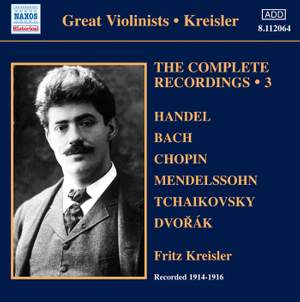
| |  | Kreisler: The Complete Recordings Volume 3Recorded 1914-1916
Bach, J S: | Concerto for Two Violins in D minor, BWV1043 with Efrem Zimbalist (violin) Partita for solo violin No. 3 in E, BWV1006: Gavotte | Chaminade: | Sérénade espagnole, Op. 150 arr. F. Kreisler for violin and piano | Chopin: | Mazurka No. 45 in A minor, Op. 67 No. 4 rr. F. Kreisler for violin and piano | Dvorak: | Sonatina for violin and piano in G major, Op. 100: Larghetto arr. F. Kreisler for violin and piano Slavonic Dance No. 10 in E minor, Op. 72 No. 2 arr. F. Kreisler for violin and piano Humoresque in G flat major, Op. 101 No. 7 version for piano solo | Gärtner: | Viennese Melody 'Aus Wien' arr. F. Kreisler for violin and piano | Godowsky: | Viennese (from Twelve Impressions) arr. F. Kreisler for violin and piano | Handel: | Ombra mai fu (from Serse) arr. F. Kreisler for violin and piano | Haydn: | Gott erhalte den Kaiser! arr. F. Kreisler for violin and piano | Kreisler: | Slavonic Dance in G minor arr. F. Kreisler from Dvorak's Op. 46, No. 2 and Op. 72, No. 1 for violin and piano Tambourin Chinois, Op. 3 | Mendelssohn: | Song without Words, Op. 62 No. 1 in G major 'May Breezes' arr. F. Kreisler for violin and piano | Nevin, E W: | The Rosary arr. F. Kreisler for violin and piano Mighty Lak' a Rose arr. for voice, violin and orchestra | Tchaikovsky: | Souvenir de Hapsal, Op. 2: No. 3. Song without Words in F major arr. F. Kreisler for violin and piano | Thomas, Ambroise: | Connais-tu le pays (from Mignon) arr. for voice, violin and orchestra |
For the main work on this album of American recordings made at the time of the Great War, Bach’s Double Concerto in D minor (slightly abridged to fit on three 78rpm sides, Kreisler is joined by the Russian violinist Efrem Zimbalist. The Appendix features three tracks with soprano Geraldine Farrar and the only surviving recording of Kreisler-as-pianist, playing Dvorak’s Humoresque. Producer and Audio Restoration Producer: Ward Marston | | | (also available to download from $9.00) | Usually despatched in 2 - 3 working days. (Available now to download.) |
|
|
| |  | Elisabeth Grümmer Sings Opera
| | | Usually despatched in 2 - 3 working days. |
|
|
| |
|