This page lists all recordings of Socrate - Drame Symphonique, by Erik Alfred Leslie Satie (1866-1925) on CD & download (MP3 & FLAC). Generally, more recent releases are listed first, but with priority given to those that are in stock. |
Prices shown exclude VAT. (UK tax is not payable for deliveries to United States.) See Terms & Conditions for p&p rates. | |  | DeConstructionTzenka Dianova plays Satie & Cage
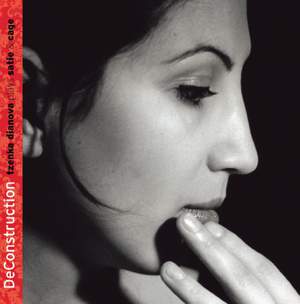
Tzenka Dianova (piano, prepared piano & celesta) Leading prepared piano exponent Tzenka Dianova presents her original approach to the piano. It began with the word deconstruction, which was “merely a pun” (Cage’s phrase) on John Cage’s construction. Originally, it was the title of a sound-recycling piece of mine, written to accompany his “Perilous Night.” Later on, the word inspired the idea of a collection of “deconstructed” works of Satie and Cage – works reinvented by unusual means, a respectful tribute to the two composers. | | | In stock - usually despatched within 1 working day. |
|
|
| |  | Orchestral Music of Erik Satie
Total CD time 47.39 | | | In stock - usually despatched within 1 working day. |
|
|
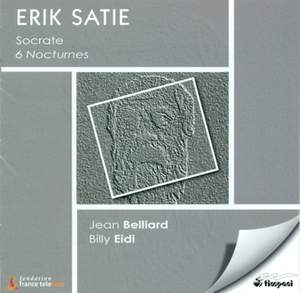
| |  | Satie: Socrate & Six Nocturnes
Jean Belliard (tenor) Billy Eidi (piano) | | | (also available to download from $10.50) | Usually despatched in 2 - 3 working days. (Available now to download.) |
|
|
| |  | Erik Satie - Socrateand other French song cycles
| | | Usually despatched in 4 - 5 working days. |
|
|
| |  | The Music of SatieWorks for Piano, Orchestra and Voice
Elaine Bonazzi (mezzo-soprano), Frank Glazer (piano), Millard Taylor (violin), Richard Dias (piano) Orchestra of Radio Luxembourg, Ensemble 'Die Reihe', Louis de Froment, Friedrich Cerha | | | Usually despatched in 8 - 10 working days. |
|
|
| |  |
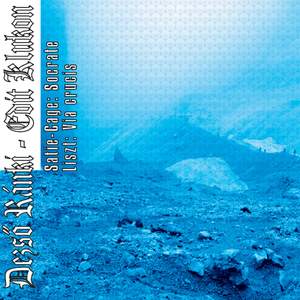
Dezso Ránki (piano), Edit Klukon (piano) “The way John Cage arranged Erik Satie's Socrate for two pianos is simple and quite ingenious. He dovetails Satie's original piano accompaniment between both instruments and generally replicates the vocal line in unison octaves deployed in different registers. As a result, together with the loss of text, we get no sense of the original's dry, declamatory drama. But we do get Satie's ambling gait, pretty harmonies and, especially in the final pages, stark simplicity. Without choral forces and the organ's sustaining power, Liszt's Via Crucis (based on the 14 Stations of the Cross) emerges as a rather severe exercise where bare-bone single lines shuttle between bleak block chords and tremolos. Sometimes it sounds static, yet certain moments prove quite effective, such as Station 11's pounded-out opening chords that mirror Christ being nailed to the Cross. The Ránki/Klukon duo make the best case for these arrangements and play with sustained, long-lined concentration and intelligent dynamic scaling that is far more difficult to achieve than it appears to the casual ear. In any event, if you're interested in these works without singers, this excellently engineered release recommends itself.” Gramophone Classical Music Guide, 2010 “Two great choral works reduced to two pianos still make an impact. The Ránki/Klukon duo make the best case for these arrangements and play with sustained, long-lined concentration and intelligent dynamic scaling that is far more difficult to achieve than it appears to the casual ear.” Gramophone Magazine, July 2006 | | | Usually despatched in 4 - 5 working days. |
|
|
| |  |
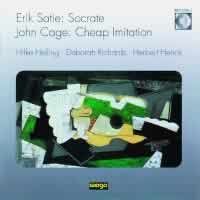
"The aesthetic of this work is dedicated to clarity; simplicity accompanies, directs it. That is all. I wanted nothing more." This is the way Satie concluded a short text on his "Socrate", with which he presented the work he had finished in 1918 to the public. The text to this "symphonic drama" was compiled from three dialogues of Plato by Satie (Symposium, Phaedrus and Phaedo) which in some way represented Socrates' person and character biographically. The reproduction of the four male roles by one female voice suited Satie's aestetic purposes, because it helped to clearly limit the distance between text and listener, between past and present. The booklet of the CD is supplied with the complete texts of the three parts in French, German and English. John Cage, who has been propagating Satie's music his life long and who has repeatedly referred to Satie in his own work, created his "Cheap Imitation" in 1969. He subjected the entire score of "Socrate" to a type of metamorphosis with the aid of chance processes which had become characteristic for his compositions since the early 50s. The result was an almost completely one-voice composition, which in a certain way underlined Satie's striving for transparency, unadornment and clarity. | | | Usually despatched in 3 - 4 working days. |
|
|
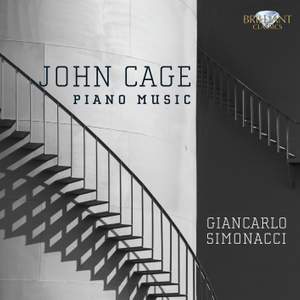
| |  | Cage: Music for Piano Volume 3Piano Works & Cello Works
Marco Simonacci (cello) & Giancarlo Simonacci (piano) Recording: June 2009, Fazioli Hall, Sacile, Italy John Cage (1912–92) is regarded as one of the most influential and controversial composers of the 20th century. It is not only his music that this reputation is based on – his ideas were revolutionary, and he cast doubt on the supremacy of European art, and music when it was unchallenged and such views were considered heretic. Cage rejected the status held by harmony, instrumentation, and even the development of music from one point to another. He disconnected harmony from rhythm to liberate western music from its hitherto privileged hierarchies – iconoclastic stuff for 1940s America! Cage studied with Schoenberg in Los Angeles, and although he adopted the 12-tone technique he abandoned Schoenberg’s expressionist style. Cage was also influenced the maverick composer – Erik Satie. Satie had also ridiculed the musical establishment, and Cage arranged Satie’s longest work Socrate (a monodrama for piano and voice) for two pianos. It is worth mentioning that Cage’s favourite Satie composition was Vexations, a short work for piano, with instructions that it may be performed 840 times without pause or change. Recording made in 2009. Important repertoire and an ideal introduction to John Cage. | | | Usually despatched in 4 - 5 working days. |
|
|
| |
|