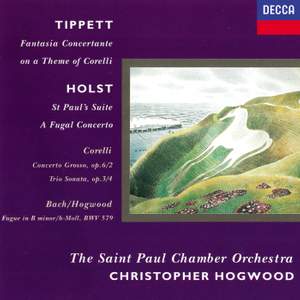
Holst: A Fugal Concerto, H152 Op. 40 No. 2

This page lists all recordings of A Fugal Concerto, H152 Op. 40 No. 2, by Gustav Theodore Holst (1874-1934) on CD & download (MP3 & FLAC). Generally, more recent releases are listed first, but with priority given to those that are in stock.

Prices shown exclude VAT. (UK tax is not payable for deliveries to United States.)
See Terms & Conditions for p&p rates.

Holst: The Planets, Egdon Heath, The Perfect Fool & St. Paul’s Suite

Holst: The Planets, Egdon Heath, The Perfect Fool & St. Paul’s Suite


Holst:

The Planets, Op. 32

London Philharmonic Orchestra, Bernard Herrmann

The Perfect Fool, Op. 39/H 150: Ballet Music

London Philharmonic Orchestra, Sir Adrian Boult

Egdon Heath, a homage to Thomas Hardy, Op.47

London Philharmonic Orchestra, Sir Adrian Boult

A Moorside Suite

Grimethorpe Colliery Band, Elgar Howarth

Suite No. 1 for Military Band in E flat major, Op. 28 No. 1, H105

Eastman Wind Ensemble, Frederick Fennell

Suite No. 2 for Military Band in F major, Op. 28 No. 2, H106

Eastman Wind Ensemble, Frederick Fennell

St Paul's Suite, Op. 29 No. 2

Saint Paul Chamber Orchestra, Christopher Hogwood

A Fugal Concerto, H152 Op. 40 No. 2

Julia Bogorad (flute) & Kathryn Greenbank (oboe)

Saint Paul Chamber Orchestra, Christopher Hogwood


A collection of prized Decca recordings of the music of Holst, including a rare – and controversial! – recording by film score supremo Bernard Herrmann, released internationally for the first time on CD. Also included are two orchestral works (The Perfect Fool and Egdon Heath) conducted by Sir Adrian Boult, recorded in 1961 and much praised at his first appearance and its subsequence recurrences on CD. Much of Holst’s life was spent teaching and the St. Paul’s Suite was written for his pupils to play in their school orchestra. The finale – where Holst cleverly counterpoints ‘The Dargason’ with ‘Greensleeves’ is an arrangement of the parallel movement in his Second Suite for military band, composed two years earlier. The legendary recording by Frederick Fennell and the Eastman Wind Ensemble of the two Suites, made in 1955, here reappears, and is complemented with another suite for brass band, the Moorside Suite, commissioned by the BBC and the National Brass Band Festival Committee.

Recording producers: Tony D’Amato, Gavin Barratt (The Planets); Ray Minshull (Egdon Heath, The Perfect Fool); Paul Myers (St. Paul’s Suite, Fugal Concerto); James Mallinson (Moorside Suite); Wilma Cozart Fine (Suites Nos. 1 & 2)

Recording engineers: Arthur Lilley (The Planets); Kenneth Wilkinson (The Perfect Fool); Jonathan Stokes (St. Paul’s Suite, Fugal Concerto); Michael Mailes (Moorside Suite); C. Robert Fine (Suites)

Recording locations: Eastman Theater, Rochester, New York, United States, May 1955 (Suites Nos. 1 & 2); Kingsway Hall, London, UK, March 1961 (Egdon Heath, The Perfect Fool), February 1970 (The Planets); Town Hall, Huddersfield, United Kingdom, June 1976 (Moorside Suite); Ordway Music Theater, Saint Paul, Minnesota, USA, May 1992 (St. Paul’s Suite, Fugal Concerto)

“Egdon Heath is a masterpiece of evocation, the counterpart in sound of the sombre scene of Thomas Hardy's tale The Return of the Native … and I cannot imagine a better performance than this one with the London Philharmonic Orchestra” Gramophone Magazine

“Outer portions of The Perfect Fool ballet music have superb sparkle and bite, while the poise of the central "Dance of Spirits of Water" is surely no less memorable.” Gramophone Magazine

“an unqualified success” Gramophone Magazine (Suites 1 & 2)

Australian Eloquence - 4802323

(CD - 2 discs)

$14.25

In stock - usually despatched within 1 working day.

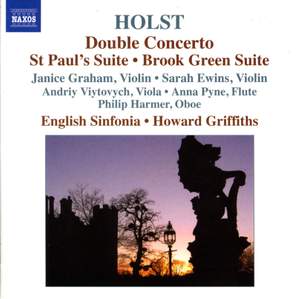
Holst - Double Concerto

Holst - Double Concerto


Holst:

Brook Green Suite

A Song of the Night, Op. 19 No. 1

St Paul's Suite, Op. 29 No. 2

Lyric Movement

for Viola and Chamber Orchestra

A Fugal Concerto, H152 Op. 40 No. 2

Double Concerto, Op. 49


Janice Graham (violin), Sarah Ewins (violin), Andriy Viytovych (viola), Anna Pyne (flute) & Philip Harmer (oboe)

English Sinfonia, Howard Griffiths

“It’s no wonder the English Sinfonia has earned such a prominent place on the international musical scene.” The Strad

20% off Naxos

Naxos - 8570339

(CD)

Normally: $8.25

Special: $6.60

(also available to download from $6.00)

In stock - usually despatched within 1 working day.

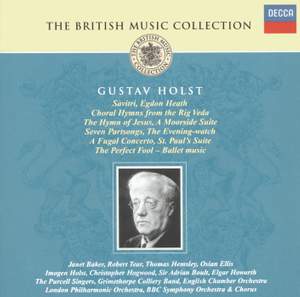
British Music Collection - Gustav Holst

British Music Collection - Gustav Holst


Holst:

Savitri

Choral Hymns from the Rig Veda, Op. 26: 3rd Group, H99

The Hymn of Jesus, H140

A Moorside Suite

Seven Part-songs, H162

The Evening-watch, H159

A Fugal Concerto, H152 Op. 40 No. 2

St Paul's Suite, Op. 29 No. 2

The Perfect Fool, Op. 39/H 150: Ballet Music


Decca British Music Collection - 4701912

(CD - 2 discs)

$15.25

In stock - usually despatched within 1 working day.

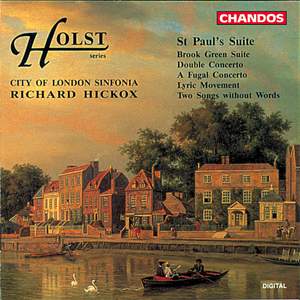
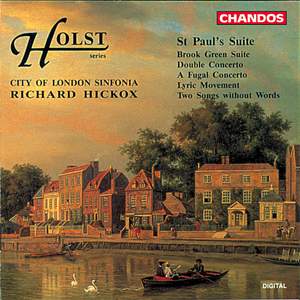
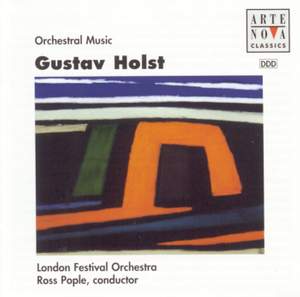
Holst: Double Concerto, Op. 49, etc.

Holst:

Double Concerto, Op. 49

Andrew Watkinson, Nicholas Ward (violins)

Two Songs without Words, Op. 22

Lyric Movement

Stephen Tees (viola)

Brook Green Suite

A Fugal Concerto, H152 Op. 40 No. 2

Duke Dobing (flute), Christopher Hooker (oboe)

St Paul's Suite, Op. 29 No. 2


Chandos - CHAN9270

(CD)

$16.75

(also available to download from $10.50)

Usually despatched in 2 - 3 working days. (Available now to download.)

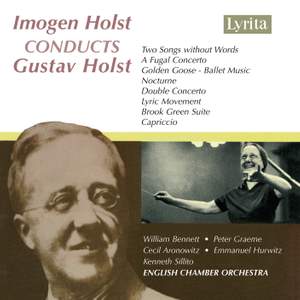
Imogen Holst conducts Gustav Holst

Imogen Holst conducts Gustav Holst


Holst:

Two Songs without Words, Op. 22

A Fugal Concerto, H152 Op. 40 No. 2

The Golden Goose, Op. 45 No. 1

Nocturne

Double Concerto, Op. 49

Lyric Movement

Brook Green Suite

Capriccio, edited Imogen Holst


William Bennett (flute), Peter Graeme (oboe), Cecil Aronowitz (viola), Emmanuel Hurwitz (violin) & Kenneth Sillito (violin)

English Chamber Orchestra, Imogen Holst

“This generous programme (75 minutes) contains many interesting rarities...All the performances are sympathetically authentic and the recording is well to Lyrita's usual high standard.” Penguin Guide, 2011 edition

Lyrita - SRCD223

(CD)

$17.25

Usually despatched in 4 - 5 working days.

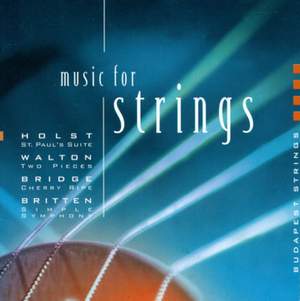
Music for Strings

Music for Strings


Bridge:

Sally in Our Alley

Cherry Ripe

Britten:

Simple Symphony, Op. 4

Holst:

St Paul's Suite, Op. 29 No. 2

A Fugal Concerto, H152 Op. 40 No. 2

János Balint (flute), Lajos Lencses (oboe)

Walton:

Henry V: Passacaglia "Death of Falstaff"

Henry V: Touch her soft lips and part


Budapest Strings, Karoly Botvay

Capriccio - C10584

(CD)

$6.50

(also available to download from $10.50)

Usually despatched in 2 - 3 working days. (Available now to download.)

Holst: Collectors' Edition

Holst: Collectors' Edition


Holst:

The Planets, Op. 32

London Philharmonic Orchestra & Geoffrey Mitchell Choir, Sir Adrian Boult

The Perfect Fool, Op. 39/H 150: Ballet Music

London Symphony Orchestra, André Previn

Egdon Heath, a homage to Thomas Hardy, Op.47

London Symphony Orchestra, André Previn

A Somerset Rhapsody, Op.21 No. 2

Bournemouth Sinfonietta, Norman del Mar

Brook Green Suite

Bournemouth Sinfonietta, Norman del Mar

A Fugal Concerto, H152 Op. 40 No. 2

Jonathan Snowden (flute) & David Theodore (oboe)

English Chamber Orchestra, Yehudi Menuhin

Beni Mora, Op. 29 No. 1

BBC Symphony Orchestra, Sir Malcolm Sargent

St Paul's Suite, Op. 29 No. 2

Royal Philharmonic Orchestra, Sir Malcolm Sargent

Choral Hymns from the Rig Veda, Op. 26: 2nd Group, H98

London Symphony Chorus, women’s voices

Ode to Death, H144

London Symphony Chorus & London Philharmonic Orchestra, Sir Charles Groves

Psalm 86

Ian Partridge (tenor) & Ralph Downes (organ)

A Choral Fantasia, H177

Dame Janet Baker (mezzo-soprano) & Ralph Downes (organ)

The Purcell Singers & English Chamber Orchestra, Imogen Holst

Suite No. 1 for Military Band in E flat major, Op. 28 No. 1, H105

Central Band of the Royal Air Force, Imogen Holst

Suite No. 2 for Military Band in F major, Op. 28 No. 2, H106

Central Band of the Royal Air Force, Imogen Holst

A Moorside Suite

BMC (Oxford) Band, Imogen Holst

Hammersmith - Prelude and Scherzo, H178, Op. 52

Central Band of the Royal Air Force, Wing Commander J.L. Wallace

Choral Hymns from the Rig Veda, Op. 26: 4th Group, H100: Hymn to Manas

Baccholian Singers of London

The Homecoming, H120 (Hardy)

Baccholian Singers of London

A Dirge for Two Veterans, H121

Baccholian Singers of London & Philip Jones Brass Ensemble, Ian Humphris

Choral Folksongs (6), Op. 36b, H136

Baccholian Singers of London

Six Choruses for male voices, H186

Baccholian Singers of London & English Chamber Orchestra, Ian Humphris

Eight Canons, H187: The Fields of Sorrow

Baccholian Singers of London

Eight Canons, H187: David’s Lament for Jonathan

Baccholian Singers of London

Eight Canons, H187: Truth of all Truth

Baccholian Singers of London

Bring us in good ale

The King’s Singers

Vedic Hymns, Op. 24: Varuna

Frederick Harvey (baritone) & Gerald Moore (piano)

Turn back, O man

Richard Seal (organ)

Choir of Chichester Cathedral, John Birch

Lullay my liking, H129, Op. 34 No. 2

Arranged for boys’ voices by Imogen Holst

London Boy Singers, Jonathan Steele

Personent Hodie

Bach Choir & Jacques Orchestra, Sir David Willcocks

In the Bleak Mid-winter (Cranham)

Edwin Bates (organ)

Rodney Christian Fellowship Festival Choir, Rodney Smith Bishton

The Hymn of Jesus, H140

Choristers of St. Paul’s Cathedral Choir, London Symphony Chorus & London Philharmonic Orchestra, Sir Charles Groves

Short Festival Te Deum, H145

London Symphony Chorus & London Philharmonic Orchestra, Sir Charles Groves

First Choral Symphony, Op. 41, H155

Felicity Palmer (soprano)

London Philharmonic Choir & London Philharmonic Orchestra, Sir Adrian Boult

The Wandering Scholar, Op. 50

Michael Rippon (Louis), Norma Burrowes (Alison), Michael Langdon (Father Philippe) & Robert Tear (Pierre)

English Opera Group & English Chamber Orchestra, Steuart Bedford

At the Boar’s Head – A musical interlude in one act, Op. 42

Philip Langridge (Prince Hal), John Tomlinson (Falstaff), Elise Ross (Hostess), Felicity Palmer (Doll Tearsheet), David Wilson-Johnson (Pistol), Peter Hall (Peto), Richard Suart (Bardolph) & Michael George (Poins)

Men’s voices of the Liverpool Philharmonic Choir & Royal Liverpool Philharmonic Orchestra, David Atherton


Renowned above all for the colour and splendour of The Planets, Holst created a uniquely idiosyncratic and outward-looking body of work, informed by his personal enthusiasms; for education, native folksong, the European avant-garde and Indian mysticism. This collection surveys all the musical genres in which he made his mark, from brass band to opera, in performances by some of his most noted champions.

Gustav Holst was born in Cheltenham on 21st September 1874. He learnt the piano from early age but, suffering from asthma and short sight, he found it hard. At the age of seven his mother died. He began to compose at Cheltenham Grammar School with Berlioz’s treatise on instrumentation as his guide and at seventeen he was conducting local village choirs. The neuritis in his right arm had convinced his father that he would never become a solo pianist so he was allowed a few months in Oxford to learn counterpoint before moving to London to study composition with Stanford.

He entered the Royal College of Music in 1893 but did not win a scholarship until two years later – Stanford found him hardworking rather than brilliant. His compositions tended to be saturated with imitations of Wagner. In 1895 he met Vaughan Williams and for the rest of his life they would play sketches of their latest compositions to each other.

He was invited to conduct the Hammersmith Socialist Choir in William Morris’s house where he met his future wife. He became fascinated by Hindu literature and philosophy to such an extent that he decided to learn Sanskrit – his Rig Veda settings are testament to this interest. He had also studied the trombone at college and it was this which brought him employment, with the Carl Rosa Opera and the Scottish Orchestra, if detracting him from his wish to compose.

Luckily he was appointed a teacher first in Dulwich and then at St. Paul’s in Hammersmith where he would be director of music, a position he held for the rest of his life. With security of income he was able to devote himself more to composition and a string of works by which he is best known, chief of which is The Planets, appeared. Their success made publishers want to revisit his earlier works and he found the extra work of correcting proofs time-consuming. His later works were more intense and the public found them harder to understand and it is only now, with a greater chance to listen to them, that we can fathom their genius.

His final years were blighted by illnesses which started after falling from the rostrum and hitting his head, he suffered from headaches and sleeplessness. In 1927 Cheltenham gave him his own festival and in 1930 he accepted the gold medal of the Royal Philharmonic Society. In 1932 he went to Harvard University to lecture but a severe attack of haemorrhagic gastritis caused him to return home and spent the next eighteen months in and out of clinics and, although In frequent pain, he kept on composing. In May 1934 he had an operation in London died on the 25th.

“This adroitly assembled set should sell like a bonfire and fully deserves to.” MusicWeb International, June 2012

“[Boult's 'Planets'] remains one the finest around” The Guardian, 28th June 2012

EMI - 4404712

(CD - 6 discs)

$29.00

In stock - usually despatched within 1 working day.

Copyright © 2002-13 Presto Classical Limited, all rights reserved.