All recordingsPrices shown exclude VAT. (UK tax is not payable for deliveries to United States.) See Terms & Conditions for p&p rates. | |  | Schubert Lieder Volume 7: Erlkönig
Schubert: | Im Abendrot, D799 Der Wanderer, D493 Nachtviolen D752 (Mayrhofer) Im Walde D834 Normans Gesang D846 (Scott, Storck) Der Geistertanz D116 (Matthisson) Schatzgräbers Begehr D761 (Schober) An den Mond, D259 (Goethe) Erlkönig, D328 Am See, D746 (Bruchmann) Alinde, D904 Widerschein, D949 Die Forelle, D550 Der Fluss, D693 Abendröte, D690 Klage D415 (Matthisson) Der Strom, D565 (poet unknown) Fischerweise, D881 (Schlechta) Auf der Bruck, D853 |
Matthias Goerne presents the seventh volume of his hm Schubert survey, which has confirmed him as one of the most gifted exponents of lieder repertoire and programming. Andreas Haefliger joins Matthias in music he has been singing for most of his career. “Sometimes in the more agitated reveries Goerne seems to be musing with himself rather than singing to an audience. However, cloudy intonation usually vanishes when the songs are calm and gentle. The prayerful ecstasy of Im Abendrot is an absolute wonder. Klage, another nature song, isn’t far behind, each word shaped and pitched with the sort of delicacy” The Times, 8th February 2013 **** “This is a most interesting and instructive Schubert recital, performed throughout with tact and great musical intelligence” International Record Review, February 2013 “Goerne’s latest Schubert recital, mostly comprised of little-known songs, is one of the baritone’s most accomplished...German baritone animates [Erlkönig] with a wonderful range of voices and inflections: his timbre has lost none of its wraparound warmth and depth but is equally capable of tenurial lightness.” Financial Times, 15th February 2013 **** “With his dark, nutty baritone and powers of characterisation, he is a near-ideal interpreter of Erlkönig; with the sublime Haefliger as his pianist, he revels in the gentler panoramas, too.” Sunday Times, 24th February 2013 “Though often idiosyncratic, his readings are never less than thoughtful – and his original takes on well-known (and less well-known) songs frequently offer intelligent and bold new insight...Goerne and Haefliger rarely seem to break a sweat, an attitude that can sometimes come over as lack of effort...But their refined style demonstrates its own supreme skill, and there is no shortage of illumination and pleasure to be had” Graham Rogers, bbc.co.uk, 13th February 2013 “His darkly mellow baritone, soft-grained yet with reserves of power, is a perfect instrument for the pantheistic reveries and barcarolles on this new disc...even doubters might have to concede that no singer cares more than Goerne for the beauty and eloquence of Schubert's melodies” Gramophone Magazine, March 2013 “The narrative songs are perhaps the most convincing of all. Erlkönig crackles with excitement: the thrill of the chase rumbles through the piano while Goerne imbues the narrative with passion and intensity, depicting the three characters with admirably individualistic sound colours...It’s a joy that Goerne and Haefliger have given us a recital that shows off so many facets of his artistry in such an admirably skilful way.” MusicWeb International, March 2013 “This is a wonderful recital, in almost all respects. The first thing to grab my attention was the mesmerisinly lovely playing Andreas Haefliger, one of the greatest living pianists...[in Erlkönig] Haefliger's accompaniment is so vivid that I'd enjoy it by itself; Goerne doesn't characterise the three persons as much as many singers, but he still packs a stunning punch...I would rank this among the finest discs I have ever heard.” BBC Music Magazine, April 2013 ***** | 
| | | In stock - usually despatched within 1 working day. |
|
|
| |  | Schubert: Willkommen und Abschied
Schubert: | Heidenröslein, D257 Schlaflied D527 (Mayrhofer) Wiegenlied D867 (Seidl) Geheimes, D719 (Goethe) Ganymed, D544 (Goethe) Auf der Bruck, D853 Der Fischer, D225 (Goethe) Dass sie hier gewesen! D775 (Rückert) Bei dir allein, D866/2 Der Schiffer, D536 (Mayrhofer) Willkommen und Abschied, D767 Der Wanderer, D493 Im Walde D834 Wandrers Nachtlied I 'Der du von dem Himmel bist', D224 Der Einsame, D800 Der Winterabend (Es ist so still), D938 Herbst, D945 Rosamunde, D797: Romance 'Der Vollmond Strahlt auf Bergeshöh'n' Nachtstück, D672 (Mayrhofer) |
Werner Güra (tenor) & Christoph Berner (fortepiano Rönisch) Born in Munich, Werner Güra has a reputation especially as an interpreter of lieder. His recordings for harmonia mundi, including the great cycles of Schubert, Schumann and Wolf and vocal ensembles by Brahms and Schumann, have all been widely acclaimed. “It comprises 19 songs, all stylishly and beautifully sung by the tenor Werner Güra. The six Goethe settings include such familiar contrasts as Heidenröslein and Ganymed, while Willkommen und Abschied itself, more of a rarity, is heroically sung. The strength of Güra’s tone without any loss of quality has always been his strong point.” Sunday Telegraph, 29th January 2012 “His fresh lyric tenor combines well with Berner’s bright yet warm-toned fortepiano — he twinkles at Goethe’s ironic description of a water nymph as “eine feuchtes Weib”, literally a “damp woman” — while Berner brings drama to the piano parts of Auf der Bruck, Willkommen und Abschied and the haunting, yearning Herbst.” Sunday Times, 12th February 2012 “Berner, playing an 1872 Rönisch fortepiano, shows keen attention to every detail. Güra, outstanding in his unfussy, intense delivery, is a formidable, rousing guide.” The Observer, 26th February 2012 “Gura's strong, unaffected tenor voice is a pleasure to listen to, and Berner, who has an impressive keyboard freedom grounded in reliable technical skill, is a responsive accompanist: they perform as one, although too often their approach to a song somehow misses an essential quality of that particular piece of music.” International Record Review, March 2012 **** “Gura and his fortepianist, Christoph Berner, have mapped out a trajectory of the Romantic view of human emotional life...At each stage, both musicians show perfect sympathy with Schubert's own engagement, ideal empathy with each other, and a shrewd sensitivity to musical and expressive scale.” BBC Music Magazine, May 2012 ***** “Gura is never dull. 'Der Wanderer' is intensely 'lived', the opening bleak and desiccated...One of the most eloquent performances of all is the last song, 'Nachtstuck'...Here, singer and pianist show an acute sensitivity to harmonic colour that characterises this whole rewarding recital.” Gramophone Magazine, May 2012 | | | In stock - usually despatched within 1 working day. |
|
|
| |  | Christopher Maltman & Julius DrakeSongs by Warlock, Debussy, Duparc, Schubert and Wolf
“It's Maltman's superb breath control which gives shape and sensuous beauty to Debussy and Dupare. And, thanks to Drake's restraining pace, Warlock's Captain Stratton's Fancy' has real swagger. Flanders and Swann's little masterpiece… about the Honeysuckle and the Bindweed, ends the recital in raptuous applause.” BBC Music Magazine, February 2008 **** “Christopher Maltman… is remarkably skilful in the management of his voice, dealing wonderfully well with Debussy's high tessitura and still plumbing the depths with ease as he does at the end of "Der Wanderer" and "La vague et la cloche". Julius Drake is his perfect counterpart...” Gramophone Magazine, Janurary 2008 | | | In stock - usually despatched within 1 working day. |
|
|
| |  | The Hyperion Schubert Edition - Complete Songs Volume 32An 1816 Schubertiad
Lynne Dawson, Christine Schäfer (sopranos), Ann Murray (mezzo soprano), John Mark Ainsley, Daniel Norman, Christoph Prégardien, Michael Schade, Toby Spence (tenors), Christopher Maltman, Stephen Varcoe (baritones), Patricia Rozario Soprano, Catherine Wyn-Rogers Mezzo (soprano), Paul Agnew, Jamie Macdougall, Philip Langridge (tenors), Simon Keenlyside, Maarten Koningsberger, Stephan Loges (baritones), Neal Davies, Michael George (basses) The London Schubert Chorale, Stephen Layton 'As ever, illuminating words complement revelatory music-making' (BBC Music Magazine) “Like the previous Schubertiads in the Edition, this disc mixes solo songs and partsongs, famil- iar and unfamiliar. The only really famous work here is Der Wanderer, that archetypal expression of romantic alienation whose popularity in Schubert's lifetime was eclipsed only by that of Erlkönig. Some of the partsongs – Zum Punsche, Naturgenuss and Schlachtgesang – cultivate a vein of Biedermeier heartiness that wears a bit thin today. Nor will Schubert's consciously archaic tribute to his teacher Salieri have you itching for the repeat button – though, like several other numbers, it shows the 19-year-old composer rivalling Mozart in his gift for musical mimicry. To compensate, though, there are partsongs like the sensual Der Entfernten, with its delicious languid chromaticisms, and the colourful setting of Gott im Ungewitter. The slight but charming setting of Das war ich is appealingly done by the light-voiced Daniel Norman, and Ann Murray brings her usual charisma and dramatic conviction to the pathetic Italian scena Didone Abbandonata. Christine Schäfer is equally charismatic in the unjustly neglected Die verfehlte Stunde (recorded here for the first time), catching perfectly the song's mingled yearning and ecstasy and negotiating the mercilessly high tessitura with ease. Other happy discoveries include Schubert's virtually unknown third setting of Des Mädchens Klage, with its soaring lines, a melancholy tale of courtly love, sung by Christoph Prégardien with as much drama and variety as the music allows, and the surging Entzückung ('music for an infant Lohengrin,' as Graham Johnson puts it), for which Toby Spence has both the flexibility and the necessary touch of metal in the tone. Doubts were fleetingly raised by Lynne Dawson's slight tremulousness in Des Mädchens Klage, and by Christopher Maltman's prominent vibrato at forte and above in an otherwise involving performance of Der Wanderer. But, these cavils apart, no complaints about the singing or the vivid accompaniments.” Gramophone Classical Music Guide, 2010 | | | In stock - usually despatched within 1 working day. |
|
|
| |  | Schubert - An Die Musik
Schubert: | Gruppe aus dem Tartarus, second version, D583 (Schiller) Litanei auf das Fest Allerseelen, D343 An die Leier, D737 (Bruchmann) Die Forelle, D550 Lachen und Weinen, D777 Ständchen 'Leise flehen meine Lieder', D957 No. 4 Das Fischermädchen D957 No. 10 Die Taubenpost, D965A (D957 No. 14) Meeres Stille, D216, Op. 3 No. 2 (Goethe) Der Wanderer, D493 Erlkönig, D328 Der Tod und das Mädchen, D531 Heidenröslein, D257 Wandrers Nachtlied II 'Über allen Gipfeln ist Ruh', D768 An die Musik D547 Auf der Bruck, D853 Schäfers Klagelied, D121 (Goethe) An Sylvia, D891 Du bist die Ruh D776 (Rückert) An die Laute D905 Rastlose Liebe, D138 Ganymed, D544 (Goethe) Der Musensohn, D764 (Goethe) |
“Terfel's gift […] is a generous, individual voice, a natural feeling for German and an inborn ability to go to the heart.” Gramophone Magazine “one of his first recordings to confirm his exceptional gift of projecting his magnetic personality with keen intensity...[he] is daring in confronting you face to face, very much as the young Fischer-Dieskau did, using the widest range of dynamics and tone.” Penguin Guide, 2010 edition *** | | | (Sorry, download not available in your country) | Usually despatched in 2 - 3 working days. |
|
|
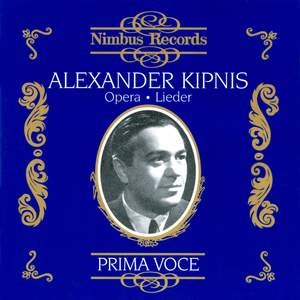
| |  | Alexander KipnisOpera and Lieder
Brahms: | Auf dem Kirchhofe, Op. 105 No. 4 Immer leiser wird mein Schlummer, Op. 105 No. 2 Feldeinsamkeit, Op. 86 No. 2 Sapphische Ode, Op. 94 No. 4 | Cornelius: | Der Barbier von Baghdad: So schwärmet Jugend | Flotow: | Martha: Lasst mich euch fragen (Porterlied) | Gounod: | Vous qui faîtes l'endormie (from Faust) | Handel: | Al sen ti stringo e parto (from Ariodante) Si, tra i ceppi (from Berenice) | Lortzing: | Der Windschütz: Fünftausend Taler | Mozart: | Wer ein Liebchen hat gefunden (from Die Entführung aus dem Serail) La vendetta (from Le nozze di Figaro) Sung in German with Else Ruziczka (soprano) Madamina, il catalogo è questo (from Don Giovanni) | Rossini: | La calunnia è un venticello (from Il barbiere di Siviglia) Sung in German as 'Die Verleumdung, sie ist ein Lüftchen' | Schubert: | Heidenröslein, D257 Ungeduld (No. 7 from Die schöne Müllerin, D795) Erlkönig, D328 Der Wanderer, D493 Der Lindenbaum (No. 5 from Winterreise, D911) Der Wegweiser (No. 20 from Winterreise, D911) Aufenthalt D957 No. 5 Am Meer, D 957 No. 12 Der Doppelgänger D957 No. 13 | Schumann: | Die beiden Grenadiere, Op. 49 No. 1 | Verdi: | A te l'estremo addio ... Il lacerato spirito (from Simon Boccanegra) Ella giammai m'amò (from Don Carlo) O tu Palermo (from I Vespri Siciliani) Ella giammai m'amò (from Don Carlo) | Wagner: | Das schöne Fest, Johannistag (from Die Meistersinger) Verachtet mir die Meister nicht (from Die Meistersinger von Nürnberg) Parsifal: Good Friday Music with Fritz Wolff (tenor) Leb wohl, du kühnes, herrliches Kind! (from Die Walküre) | Weber: | Hier im ird'schen Jammertal (from Der Freischütz) |
Recorded 1922-1939 | | | Usually despatched in 4 - 5 working days. |
|
|
| |  | Schubert - Lieder
Schubert: | Auf dem Wasser zu singen, D774 Lachen und Weinen, D777 Du bist die Ruh D776 (Rückert) Der Wanderer, D493 Ständchen 'Leise flehen meine Lieder', D957 No. 4 Der Einsame, D800 Im Abendrot, D799 An Sylvia, D891 Ständchen 'Horch! Horch! die Lerch!', D889 Sei mir gegrüsst! D741 (Rückert) Seligkeit D433 (Holty) Der Lindenbaum (No. 5 from Winterreise, D911) Die Forelle, D550 Rastlose Liebe, D138 Heidenröslein, D257 An Schwager Kronos, D369 Wandrers Nachtlied I 'Der du von dem Himmel bist', D224 Erlkönig, D328 Der König in Thule, D367 Jägers Abendlied, Second Setting, D368 Der Musensohn, D764 (Goethe) Wandrers Nachtlied II 'Über allen Gipfeln ist Ruh', D768 |
“This superb collection makes the perfect entree into the world of Schubertian song.” Penguin Guide, 2010 edition **** | | | Usually despatched in 8 - 10 working days. |
|
|
| |  | Volume 11 - North German Poets
| | | (also available to download from $6.00) | Usually despatched in 2 - 3 working days. (Available now to download.) |
|
|
| |  | The Low Bass: Great Art Songs from the Bass Repertoire
Beeson: | The Sinister Potato | Brahms: | Verrat, Op. 105 No. 5 | Flégier: | Le Cor | Joio: | The Assassination | Mussorgsky: | Sadly rustled the leaves | Rachmaninov: | Morning, Op. 4 No. 2 | Saint-Saëns: | Danse macabre (song) | Schubert: | Der Tod und das Mädchen, D531 Erlkönig, D328 Der Wanderer, D493 | Strauss, R: | Im Spätboot, Op. 56, No. 3 Der Einsame, Op. 51 Das Tal, Op. 51 | Wolf, H: | Songs (3) on poems by Michelangelo Buonarroti |
Kevin Maynor (bass), Richard Woitach (piano) | | | Usually despatched in 8 - 10 working days. |
|
|
| |  | Thomas Stewart in Recital
Brahms: | Dein blaues Auge, (No. 8 from Acht Lieder und Gesänge, Op. 59) Nicht mehr zu dir zu gehen, Op. 32 No. 2 Wie Melodien zieht es mir, Op. 105 No. 1 Immer leiser wird mein Schlummer, Op. 105 No. 2 | Mahler: | Lob des hohen Verstandes (Des Knaben Wunderhorn) Rheinlegendchen (Des Knaben Wunderhorn) Des Antonius von Padua Fischpredigt (Des Knaben Wunderhorn) | Schubert: | Erlkönig, D328 Das Rosenband, D280 (Klopstock) Der Wanderer, D493 | Wagner: | Was duftet doch der Flieder (from Die Meistersinger von Nürnberg) Wahn! Wahn! Überall Wahn! (from Die Meistersinger von Nürnberg) | Wolf, H: | Songs (3) on poems by Michelangelo Buonarroti Ein Ständchen Euch zu bringen kam ich her (No. 22 from Italienisches Liederbuch) Wie viele Zeit verlor ich, dich zu lieben (No. 37 from Italienisches Liederbuch) Was für ein Lied soll dir gesungen? (No. 23 from Italienisches Liederbuch) Ihr seid die Allerschönste weit und breit (No. 3 from Italienisches Liederbuch) Wenn du mich mit den Augen streifst (No. 38 from Italienisches Liederbuch) Der Musikant (No. 2 from Eichendorff-Lieder) Harfenspieler III (No. 3 from Goethe-Lieder) Der Tambour (No. 5 from Mörike-Lieder) |
| | | Usually despatched in 4 - 5 working days. |
|
|
| |
|