Borodin: Prince Igor: Polovtsian Dances

This page lists all recordings of Prince Igor: Polovtsian Dances, by Alexander Profirevich Borodin (1833-87) on CD, SACD, DVD, Blu-ray & download (MP3 & FLAC). Generally, more recent releases are listed first, but with priority given to those that are in stock.

Prices shown exclude VAT. (UK tax is not payable for deliveries to United States.)
See Terms & Conditions for p&p rates.

Dances and Waves: Sommernachtskonzert Schonbrunn 2012

Dances and Waves: Sommernachtskonzert Schonbrunn 2012


Borodin:

Prince Igor: Polovtsian Dances

Debussy:

La Mer

Giménez:

La boda de Luis Alonso: Intermedio

Mussorgsky:

Khovanshchina: Dance of the Persian Slaves

Ponchielli:

Dance of the Hours (from La Gioconda)

Strauss, R:

Salome: Dance of the Seven Veils

Tchaikovsky:

Polonaise (from Eugene Onegin, Op. 24)


Gustavo Dudamel, Gramophone magazine’s "Artist of the Year" 2011 and Grammy award winner 2012, leads the classical summer live and TV event of 2012: The Summer Night Concert with the Vienna Philharmonic.

The concert takes place on June 7th in the gardens of Schönbrunn Palace. Last year’s Summer Night Concert was a huge success.

In 2012 a total of 62 countries on five continents will share in the spectacle, including a BBC4 broadcast in the UK.

This year the main theme is Dances and Waves, a programme showcasing symphonic and operatic highlights.

“Dudamel conducts a popular but substantial programme, evoking the VPO's vividness and warmth” BBC Music Magazine, Christmas 2012 *****

DG - 4764717

(CD)

$16.75

In stock - usually despatched within 1 working day.

Dances and Waves: Sommernachtskonzert Schonbrunn 2012

Dances and Waves: Sommernachtskonzert Schonbrunn 2012


Borodin:

Prince Igor: Polovtsian Dances

Debussy:

La Mer

Giménez:

La boda de Luis Alonso: Intermedio

Mussorgsky:

Khovanshchina: Dance of the Persian Slaves

Ponchielli:

Dance of the Hours (from La Gioconda)

Strauss, R:

Salome: Dance of the Seven Veils

Tchaikovsky:

Polonaise (from Eugene Onegin, Op. 24)


Gustavo Dudamel, Gramophone magazine’s "Artist of the Year" 2011 and Grammy award winner 2012, leads the classical summer live and TV event of 2012: The Summer Night Concert with the Vienna Philharmonic.

The concert takes place on June 7th in the gardens of Schönbrunn Palace. Last year’s Summer Night Concert was a huge success.

In 2012 a total of 62 countries on five continents will share in the spectacle, including a BBC4 broadcast in the UK.

This year the main theme is Dances and Waves, a programme showcasing symphonic and operatic highlights.

“Dudamel conducts a popular but substantial programme, evoking the VPO's vividness and warmth.” BBC Music Magazine, Christmas 2012 *****

DVD Video

Region: 0

Format: NTSC

DG - 0762819

(DVD Video)

$20.00

In stock - usually despatched within 1 working day.

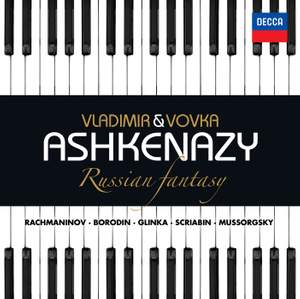
Vladimir and Vovka Ashkenazy: Russian Fantasy

Vladimir and Vovka Ashkenazy: Russian Fantasy


Borodin:

Prince Igor: Polovtsian Dances

arranged by Vovka Ashkenazy

Glinka:

Valse-Fantaisie in B minor for piano, G. vi193

arranged for two pianos by Vovka Ashkenazy

Mussorgsky:

A Night on the Bare Mountain (piano version)

arranged by Vovka Ashkenazy

Rachmaninov:

Suite No. 1 for Two Pianos, Op. 5

Scriabin:

Fantasy in A minor Op. post.


Following their album of French music for two pianos, father and son Vladimir and Vovka Ashkenazy revel in their musical heritage with this dazzling programme by the great composers of Russia. Three of the works have been arranged by Vovka Ashkenazy himself, including Mussorgsky's Night On The Bald Mountain and the album's virtuosic finale, Borodin's Polovtsian Dances from his opera Prince Igor. His two-piano arrangement of Glinka's lilting Valse-fantaisie is itself based on Sergei Lyapunov's arrangement for four hands.

“It's terrific to hear Ashkenazy playing Russian Romantic repertoire again. The performance of the Rachmaninov Suite is more reflective and mellow than Ashkenazy's version with Previn - there seems to be greater expansiveness and flexibility in the phrasing...The result is a delightful and entertaining disc, and one that's sumptuously recorded too” International Record Review, February 2012

“full of taut and virtuosic double pianism.” BBC Music Magazine, April 2012 ****

Decca - 4782940

(CD)

$16.75

In stock - usually despatched within 1 working day.

Ballets Russes

Ballets Russes

Russian Dances and Ballets


Borodin:

Prince Igor: Polovtsian Dances

Glazunov:

Raymonda, Op. 57: Entr'acte act I (Intermezzo)

Glinka:

Valse-Fantaisie in B minor for orchestra, G. ii213

Khachaturian:

Masquerade: Waltz

Sabre Dance from Gayane

Liadov:

Dance of the Amazon, Op. 65

Prokofiev:

The Love for Three Oranges: March

Romeo and Juliet: Dance of the Knights

Shostakovich:

Polka from The Golden Age, Op. 22

Jazz Suite No. 2 - Waltz No. 2

Tahiti Trot (Tea for Two), Op. 16

Tchaikovsky:

Polonaise (from Eugene Onegin, Op. 24)

The Nutcracker: Waltz of the Flowers

Waltz from Eugene Onegin, Op. 24


Although folk dances have a special place in Russian music, being raised to the status of character dances in works for the stage, the more classical forms taken over from the west are not neglected. During the nineteenth century the waltz, for example, tended more and more towards ‘pure’ music, giving rise to some highly virtuosic works in the manner of those by Weber or Liszt.

Thus, in 1856 Glinka (1804-1857), founder of the Russian nationalist school, produced the definitive version of a Valse which had already aroused the enthusiasm of Berlioz. Its slightly melancholy principal theme reappears as a refrain between episodes in various keys, which give rise to passages of instrumental dialogue and to such bold strokes such as the cantabile for solo trombone in the third episode. Witty or ironic comments by the flutes or strings turn it virtually into a fantasia – which Shostakovich was to recall later.

Scenes at parties and balls abound in opera. Tchaikovsky composed the waltz for Act Two of Eugene Onegin (1877) – with a chorus in its original version – so as to reflect the humdrum pretentiousness of the lesser, countrified aristocracy: it is closer to the waltz in Faust than to those he was to write for his ballets. This is in clear contrast to the majestic Act Three Polonaise, with its trio incorporating the traditional mazurka, which as the dance of aristocratic St Petersburg receptions is in a differ­ent class altogether.

Marius Petipa, who became chief ballet master at the imperial ballet in 1869, restored to the art of dance the nobility and charm which had been killed off by an emphasis on technique. Tchaikovsky provided him with music suffused with the poetic inspiration lacking in the more straightforwardly rhythmic scores of composers like Drigo and Pugni. He was, however, criticised by those ballet-lovers who found his music too symphonic; his waltzes, refined rather than brilliant and frivolous, are often tinged with dramatic lyricism, even a sense of anxiety. The unusual flavour of the Waltz of the Flowers from The Nutcracker (1892) is largely created by the mysterious other-worldly horn-calls answered by rippling clarinet figures.

Raymonda (1898) is a medieval romance choreographed by Petipa to music by Glazunov. Always melodious, subtle and graceful, it is sometimes highly evocative, as in the trance-like atmosphere in the dreamy slow-motion accompanying the heroine’s sleep (andante sostenuto) in the interlude before the second scene.

The tradition of the grand ballet d’action persisted right up to the revolution brought about by Sergei Diaghilev. Reacting against the ‘double pirouettes and detestable sets of thirty-two fouettés’, the director of the Ballets Russes sought the character of the various folk-dances of Russia and other countries, which he remodelled for the stage using a basically classical technique. In his Parisian season in 1909 he presented the second act of Prince Igor (1887) against the background of a tawny-coloured desert steppe. The Polovtsian Dances, alternating spellbinding movements for the women and pounding, savage rhythms for the warriors, were directed by Mikhail Fokine: when a tumultuous wave of dancers rushed downstage at the end, stopping dead just short of the foot­lights, it brought the house down!

Even Anatole Liadov, the composer of backwoods Russia, gave in to the infatuation of the Russian intelligentsia of around 1900 with ancient Greece. His Dance of the Amazon (1910), for Ida Rubinstein, employs two Greek chants, heavily reworked: the first theme suggests the Amazon riding on horseback, the second (meno mosso) emphasises the oriental atmosphere; brass and percussion suggest warlike activity – ushered in by a fanfare.

After the 1917 Revolution it was thought that the creations of the Tsarist era would be unappealing to the sensibilities of the new Bolshevik listener. New themes and characters – stadiums and factories, sportsmen and workers – figured in ‘futurist’ (that is, revolutionary) musical experiments. In Shostakovich’s ballet The Golden Age (1930), which portrays the misadventures of a Soviet football team in a capitalist country, a clownish polka caricatures decadent western society. In Tahiti Trot (1928) Shostakovich pulled off the challenge of re-orchestrating Vincent Youmans’ Tea for Two in record time, and in so doing exploited all the expressive and comic possibilities, as well as the shock tactics, of avant-garde experiments. But offerings like these, from an enfant terrible ‘who had nothing to say to the people’, led the Communist Party, around 1932, to rein back cultural activity and reinstate a classical, academic aesthetic, which also extended to opera and ballet.

The music of Prokofiev’s Love for Three Oranges (Chicago, 1921; Leningrad, 1927), precise, sturdily constructed and freshly coloured – as in the festive march from Act Two – was perfectly accessible, and yet it was later ignored in the USSR because of its libretto, which makes a feature of absurdity. Romeo and Juliet (1935/6, staged in 1940), on the other hand, with its universal subject, gained unanimous acceptance. The characterisation was exemplary: in the sombre, hieratic Dance of the Knights, with its great sweeps of sound, the menacing thrusts of the basses and brass powerfully convey the arrogance of a clan – as against the fresh sensitivity of youth portrayed by the central theme.

Although Khachaturian was also suspected of ‘formalism’, his artistic approach always coincided with that of the regime. His incidental music for a 1940 production of Lermontov’s The Masked Ball portrays well the spiritual emptiness of imperial society: the entirely unsentimental waltz turns like a roundabout, relentlessly driven forward by the pursuit of pleasure. With Gayaneh (1943) Khachaturian goes back to his native Armenia. Part of the ballet’s final celebrations honouring the upbeat heroine of the ‘happy collective farm’ is the frenzied Sabre Dance, the middle section of which recalls an earlier pas de deux. It is an authentic piece of Transcaucasian folklore.

Following his Lady Macbeth of the Mtsensk district, Shostakovich had fallen victim, in 1936, to official criticism. He attempted to redeem himself, or at least to behave himself, by writing lighter works, frothier, more facile – i.e. proletarian – for films, ballets, variety stages and what the USSR referred to as ‘jazz’ orchestras, which are more like our light music ensembles. The Suite No.2 for jazz orchestra (1938) was composed for one such group, run by Victor Knushevitsky. The main, somewhat sentimental, theme in its Waltz No.2, played on the saxophone, ends in a sort of good-natured refrain. This piece was used as music for film commercials in the West – and then as title music for Stanley Kubrick’s last film: what finer example of popularity could there be?

Virgin Premium - 0293192

(CD)

$11.25

In stock - usually despatched within 1 working day.

Mussorgsky: Pictures at an Exhibition, etc.

Borodin:

Symphony No. 2 in B minor

Prince Igor: Polovtsian Dances

Mussorgsky:

Pictures at an Exhibition


The works on this album will be recorded at the famous Silvesterkonzert (New Year’s Concert) on New Year’s Eve at the Philharmonie, Berlin. The concert will be televised by major stations in Germany, Austria, Japan and other licensees. The turnaround of this recording will be extremely fast to allow the CD and download to be available in the shops in January.

“In Pictures at an Exhibition I cannot imagine a performance truer to the finesse of Ravel's scoring. In the opening "Promenade" alone there are myriad subtleties of phasing and dynamics. What we have here is a sequence of exquisitely crafted miniatures; the French-ness of Ravek's fastidious work is everywhere.” Gramophone Magazine, July 2008

EMI - 5175822

(CD)

$13.25

In stock - usually despatched within 1 working day.

Mussorgsky: Pictures at an Exhibition

Mussorgsky: Pictures at an Exhibition


Borodin:

Symphony No. 2 in B minor

Prince Igor: Polovtsian Dances

Mussorgsky:

Pictures at an Exhibition


EMI - 5002732

(CD)

$11.25

In stock - usually despatched within 1 working day.

Borodin: Prince Igor Overture, etc.

Borodin:

Prince Igor Overture

Prince Igor: Polovtsian Dances

Mussorgsky:

A Night on the Bare Mountain

Pictures at an Exhibition


Virgin Virgo - 5624832

(CD)

$7.25

In stock - usually despatched within 1 working day.

Ballets Russes

Ballets Russes

Russian Dances and Ballets


Borodin:

Prince Igor: Polovtsian Dances

Glazunov:

Raymonda, Op. 57: Entr'acte act I (Intermezzo)

Glinka:

Valse-Fantaisie in B minor for orchestra, G. ii213

Khachaturian:

Masquerade: Waltz

Sabre Dance from Gayane

Liadov:

Dance of the Amazon, Op. 65

Prokofiev:

The Love for Three Oranges: March

Romeo and Juliet: Dance of the Knights

Shostakovich:

Polka from The Golden Age, Op. 22

Jazz Suite No. 2 - Waltz No. 2

Tahiti Trot (Tea for Two), Op. 16

Tchaikovsky:

Polonaise (from Eugene Onegin, Op. 24)

The Nutcracker: Waltz of the Flowers


Virgin - 5456092

(CD)

$15.50

In stock - usually despatched within 1 working day.

Grand Opera Choruses

Grand Opera Choruses


Bizet:

Carmen Suite No. 1

Paul Davies (flute)

London Symphony Orchestra, Rafael Frühbeck de Burgos

Les voici, voici la quadrille (from Carmen)

A deux cuartos from Carmen

Carmen Suite No. 2

Paul Davies (flute)

London Symphony Orchestra, Rafael Frühbeck de Burgos

Borodin:

Prince Igor: Polovtsian Dances

Gounod:

Gloire immortelle de nos aïeux (from Faust)

Orff:

Carmina Burana: O Fortuna

Verdi:

Grand March from Aida

Gli arredi festivi (from Nabucco)

Anvil Chorus (from Il Trovatore)

Va, pensiero (from Nabucco)


Regis - RRC1137

(CD)

$7.25

In stock - usually despatched within 1 working day.

Borodin: Symphonies Nos. 1 - 3

Borodin: Symphonies Nos. 1 - 3


Borodin:

Symphonies Nos. 1-3 (complete)

Toronto Symphony Orchestra, Andrew Davis

Prince Igor Overture

Toronto Symphony Orchestra, Andrew Davis

Prince Igor: Polovtsian Dances

Toronto Symphony Orchestra, Andrew Davis

In the Steppes of Central Asia

New York Philharmonic, Leonard Bernstein

String Quartet No. 2: 3rd Movement (Notturno)

St Petersburg Camerata


Sony - SB2K62406

(CD - 2 discs)

$10.25

In stock - usually despatched within 1 working day.

Page: 

 1   2   3   4   5   6   7 

 Next >>

Copyright © 2002-13 Presto Classical Limited, all rights reserved.