Khachaturian: Masquerade: Waltz

This page lists all recordings of Masquerade: Waltz, by Aram Ilich Khachaturian (1903-78) on CD & download (MP3 & FLAC). Generally, more recent releases are listed first, but with priority given to those that are in stock.

Prices shown exclude VAT. (UK tax is not payable for deliveries to United States.)
See Terms & Conditions for p&p rates.

Piano Rarities Vol. 3: Transcriptions

Piano Rarities Vol. 3: Transcriptions


Borodin:

Prince Igor: Polovtsian Dance No. 17

trans. Felix Blumenfeld

Dvorak:

Songs My Mother Taught Me, Op. 55 No. 4

trans. Eduard Schutt

Karlowicz:

Dla zasmuconej

trans. Karol A Penson

Khachaturian:

Masquerade: Waltz

trans. Lev Soline/Cyprien Katsaris

Sabre Dance from Gayane

trans. Lev Soline/Cyprien Katsaris

Gayane: Adagio

trans. Alec Rowley

Gayane: Lullaby

trans. Oscar Levant

Spartacus: Adagio of Spartacus & Phrygia

trans. Emin Khachatourian

Moniuszko:

O Matko Moja

trans. Michael Marian Biernacki

Rachmaninov:

Suite No. 2 for Two Pianos, Op. 17

trans. Vladimir Leyetchkiss

Symphony No. 2 in E minor, Op. 27 - Adagio

trans. Georg Kirkor

Strauss, R:

Allerseelen, Op. 10 No. 8

trans. Karol A Penson

Tchaikovsky:

Sred' shumnogo bala (Amid the din of the ball), Op. 38 No. 3

trans. Earl Wild


With this third volume in the series “Piano Rarities”, Cyprien Katsaris continues exploring the almost limitless world of transcriptions for solo piano. This album, largely devoted to Russian and Central European composers, offers us tastes of the many aspects of the art of transcription.

Released or re-released in last 6 months

Piano 21 Piano Rarities - P21045

(CD)

$17.25

In stock - usually despatched within 1 working day.

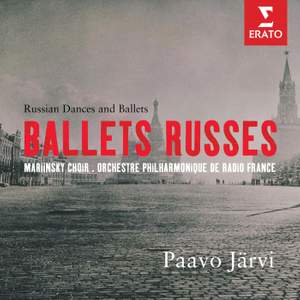
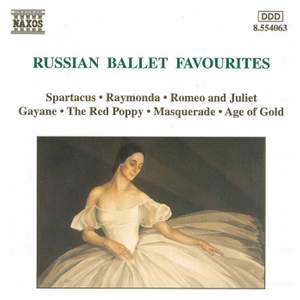
Ballets Russes

Ballets Russes

Russian Dances and Ballets


Borodin:

Prince Igor: Polovtsian Dances

Glazunov:

Raymonda, Op. 57: Entr'acte act I (Intermezzo)

Glinka:

Valse-Fantaisie in B minor for orchestra, G. ii213

Khachaturian:

Masquerade: Waltz

Sabre Dance from Gayane

Liadov:

Dance of the Amazon, Op. 65

Prokofiev:

The Love for Three Oranges: March

Romeo and Juliet: Dance of the Knights

Shostakovich:

Polka from The Golden Age, Op. 22

Jazz Suite No. 2 - Waltz No. 2

Tahiti Trot (Tea for Two), Op. 16

Tchaikovsky:

Polonaise (from Eugene Onegin, Op. 24)

The Nutcracker: Waltz of the Flowers

Waltz from Eugene Onegin, Op. 24


Although folk dances have a special place in Russian music, being raised to the status of character dances in works for the stage, the more classical forms taken over from the west are not neglected. During the nineteenth century the waltz, for example, tended more and more towards ‘pure’ music, giving rise to some highly virtuosic works in the manner of those by Weber or Liszt.

Thus, in 1856 Glinka (1804-1857), founder of the Russian nationalist school, produced the definitive version of a Valse which had already aroused the enthusiasm of Berlioz. Its slightly melancholy principal theme reappears as a refrain between episodes in various keys, which give rise to passages of instrumental dialogue and to such bold strokes such as the cantabile for solo trombone in the third episode. Witty or ironic comments by the flutes or strings turn it virtually into a fantasia – which Shostakovich was to recall later.

Scenes at parties and balls abound in opera. Tchaikovsky composed the waltz for Act Two of Eugene Onegin (1877) – with a chorus in its original version – so as to reflect the humdrum pretentiousness of the lesser, countrified aristocracy: it is closer to the waltz in Faust than to those he was to write for his ballets. This is in clear contrast to the majestic Act Three Polonaise, with its trio incorporating the traditional mazurka, which as the dance of aristocratic St Petersburg receptions is in a differ­ent class altogether.

Marius Petipa, who became chief ballet master at the imperial ballet in 1869, restored to the art of dance the nobility and charm which had been killed off by an emphasis on technique. Tchaikovsky provided him with music suffused with the poetic inspiration lacking in the more straightforwardly rhythmic scores of composers like Drigo and Pugni. He was, however, criticised by those ballet-lovers who found his music too symphonic; his waltzes, refined rather than brilliant and frivolous, are often tinged with dramatic lyricism, even a sense of anxiety. The unusual flavour of the Waltz of the Flowers from The Nutcracker (1892) is largely created by the mysterious other-worldly horn-calls answered by rippling clarinet figures.

Raymonda (1898) is a medieval romance choreographed by Petipa to music by Glazunov. Always melodious, subtle and graceful, it is sometimes highly evocative, as in the trance-like atmosphere in the dreamy slow-motion accompanying the heroine’s sleep (andante sostenuto) in the interlude before the second scene.

The tradition of the grand ballet d’action persisted right up to the revolution brought about by Sergei Diaghilev. Reacting against the ‘double pirouettes and detestable sets of thirty-two fouettés’, the director of the Ballets Russes sought the character of the various folk-dances of Russia and other countries, which he remodelled for the stage using a basically classical technique. In his Parisian season in 1909 he presented the second act of Prince Igor (1887) against the background of a tawny-coloured desert steppe. The Polovtsian Dances, alternating spellbinding movements for the women and pounding, savage rhythms for the warriors, were directed by Mikhail Fokine: when a tumultuous wave of dancers rushed downstage at the end, stopping dead just short of the foot­lights, it brought the house down!

Even Anatole Liadov, the composer of backwoods Russia, gave in to the infatuation of the Russian intelligentsia of around 1900 with ancient Greece. His Dance of the Amazon (1910), for Ida Rubinstein, employs two Greek chants, heavily reworked: the first theme suggests the Amazon riding on horseback, the second (meno mosso) emphasises the oriental atmosphere; brass and percussion suggest warlike activity – ushered in by a fanfare.

After the 1917 Revolution it was thought that the creations of the Tsarist era would be unappealing to the sensibilities of the new Bolshevik listener. New themes and characters – stadiums and factories, sportsmen and workers – figured in ‘futurist’ (that is, revolutionary) musical experiments. In Shostakovich’s ballet The Golden Age (1930), which portrays the misadventures of a Soviet football team in a capitalist country, a clownish polka caricatures decadent western society. In Tahiti Trot (1928) Shostakovich pulled off the challenge of re-orchestrating Vincent Youmans’ Tea for Two in record time, and in so doing exploited all the expressive and comic possibilities, as well as the shock tactics, of avant-garde experiments. But offerings like these, from an enfant terrible ‘who had nothing to say to the people’, led the Communist Party, around 1932, to rein back cultural activity and reinstate a classical, academic aesthetic, which also extended to opera and ballet.

The music of Prokofiev’s Love for Three Oranges (Chicago, 1921; Leningrad, 1927), precise, sturdily constructed and freshly coloured – as in the festive march from Act Two – was perfectly accessible, and yet it was later ignored in the USSR because of its libretto, which makes a feature of absurdity. Romeo and Juliet (1935/6, staged in 1940), on the other hand, with its universal subject, gained unanimous acceptance. The characterisation was exemplary: in the sombre, hieratic Dance of the Knights, with its great sweeps of sound, the menacing thrusts of the basses and brass powerfully convey the arrogance of a clan – as against the fresh sensitivity of youth portrayed by the central theme.

Although Khachaturian was also suspected of ‘formalism’, his artistic approach always coincided with that of the regime. His incidental music for a 1940 production of Lermontov’s The Masked Ball portrays well the spiritual emptiness of imperial society: the entirely unsentimental waltz turns like a roundabout, relentlessly driven forward by the pursuit of pleasure. With Gayaneh (1943) Khachaturian goes back to his native Armenia. Part of the ballet’s final celebrations honouring the upbeat heroine of the ‘happy collective farm’ is the frenzied Sabre Dance, the middle section of which recalls an earlier pas de deux. It is an authentic piece of Transcaucasian folklore.

Following his Lady Macbeth of the Mtsensk district, Shostakovich had fallen victim, in 1936, to official criticism. He attempted to redeem himself, or at least to behave himself, by writing lighter works, frothier, more facile – i.e. proletarian – for films, ballets, variety stages and what the USSR referred to as ‘jazz’ orchestras, which are more like our light music ensembles. The Suite No.2 for jazz orchestra (1938) was composed for one such group, run by Victor Knushevitsky. The main, somewhat sentimental, theme in its Waltz No.2, played on the saxophone, ends in a sort of good-natured refrain. This piece was used as music for film commercials in the West – and then as title music for Stanley Kubrick’s last film: what finer example of popularity could there be?

Virgin Premium - 0293192

(CD)

$11.25

In stock - usually despatched within 1 working day.

Khachaturian: Piano Works

Khachaturian: Piano Works


Khachaturian:

Toccata

Poem

Two Pieces

Sonatina

Childrens' Pieces

Masquerade: Waltz

Sonata

1961 original version


Alto - ALC1144

(CD)

$7.25

In stock - usually despatched within 1 working day.

Ballets Russes

Ballets Russes

Russian Dances and Ballets


Borodin:

Prince Igor: Polovtsian Dances

Glazunov:

Raymonda, Op. 57: Entr'acte act I (Intermezzo)

Glinka:

Valse-Fantaisie in B minor for orchestra, G. ii213

Khachaturian:

Masquerade: Waltz

Sabre Dance from Gayane

Liadov:

Dance of the Amazon, Op. 65

Prokofiev:

The Love for Three Oranges: March

Romeo and Juliet: Dance of the Knights

Shostakovich:

Polka from The Golden Age, Op. 22

Jazz Suite No. 2 - Waltz No. 2

Tahiti Trot (Tea for Two), Op. 16

Tchaikovsky:

Polonaise (from Eugene Onegin, Op. 24)

The Nutcracker: Waltz of the Flowers


Virgin - 5456092

(CD)

$15.50

In stock - usually despatched within 1 working day.

Waltzing Classics

Waltzing Classics


Delibes:

Sylvia - Pizzicato

Coppélia: Mazurka

Hérold:

La Fille mal gardée: Clog Dance

Khachaturian:

Masquerade: Waltz

Lanner:

Die Schönbrunner Waltzer, Op. 200

Lehár:

Ballsirenen (on themes from `Die lustige Witwe`)

Gold und Silber Walzer, Op. 79

Loewe, F:

I Could Have Danced All Night (My Fair Lady)

Meyerbeer:

Les Patineurs

Offenbach:

Orphée aux Enfers Overture

Piazzólla:

Libertango

Ponchielli:

Dance of the Hours (from La Gioconda)

Prokofiev:

Montagues And Capulets (from Romeo and Juliet)

Shostakovich:

Jazz Suite No. 1: Waltz

Jazz Suite No. 2 - Waltz No. 2

Strauss, J, I:

Radetsky March, Op. 228

Strauss, J, II:

An der schönen, blauen Donau, Op. 314

Tritsch-Tratsch Polka, Op. 214

Frühlingsstimmen Walzer Op. 410

Kaiser-Walzer, Op. 437

Champagner-Polka, Op. 211

Tchaikovsky:

Swan Lake - Waltz from Suite Op. 20, No. 2

The Nutcracker: Waltz of the Flowers

The Nutcracker: Dance of the Sugar Plum Fairy

Waltz from Eugene Onegin, Op. 24

Pas de quatre

The Sleeping Beauty, Op. 66: Rose Adagio

Waldteufel:

Les Patineurs - Valse, Op. 183

Weber:

Invitation to the Dance, Op. 65

Ziehrer:

Loslassen - Polka schnell, Op. 386


Classic FM is inviting you to the dance with its brand new double album Waltzing Classics, the ultimate collection of your favourite waltzes and other dances. This wonderful album is packed with the world’s most famous dancing pieces, with waltzes including Khachaturian’s ‘Waltz from Masquerade Ball’, Strauss’ ‘The Blue Danube’, and Meyerbeer’s ‘Skater’s Waltz’. Also included are many other famous dances, including Piazzolla’s fiery ‘Libertango’, Herold’s mischievous ‘Clog Dance’, Prokofiev’s powerful ‘Dance of The Knights’, Ziehrer’s elegant ‘Losslassen’ Polka, and beautiful pieces from the world of ballet including Tchaikovsky’s ‘The Nutcracker’ and ‘Swan Lake’. Waltzing Classics transports the listener to a magical world of the classical ballroom and will appeal to lovers of dancing and classical music alike.

“No duds here. The Gothenburg Symphony Orchestra under Neeme Järvi is smooth, glistening and joyous in Waldteufel's The Skater's Waltz, whilst Ashkenazy and the Royal Philharmonic Orchestra provide the tense contrast of Prokofiev's Dance of the Knights...The Vienna Philharmonic demonstrates its prowess as orchestra of the waltz capital of the world, playing Strauss's fizzing Champagne Polka with light, ebullient precision.” Classic FM Magazine, May 2011 ****

CFM - CFMD19

(CD - 2 discs)

$18.25

Usually despatched in 2 - 3 working days.

The Great Waltzes

The Great Waltzes


Adam:

Waltz from Giselle

Ivanovici:

The Danube Waves

Khachaturian:

Masquerade: Waltz

Lehár:

Gold und Silber Walzer, Op. 79

Lippen schweigen (from Die Lustige Witwe)

Strauss, J, II:

An der schönen, blauen Donau, Op. 314

Kaiser-Walzer, Op. 437

Geschichten aus dem Wienerwald, Op. 325

Frühlingsstimmen Walzer Op. 410

Wein, Weib und Gesang, Op. 333

Strauss, R:

Waltz Sequence No. 1 (from Der Rosenkavalier)

Tchaikovsky:

The Nutcracker: Waltz of the Flowers

Waltz from Act i, Swan Lake, Op. 20

Serenade for strings in C major, Op. 48: II. Waltz

Waltz from Swan Lake

Waltz from Eugene Onegin, Op. 24

Waldteufel:

Les Patineurs - Valse, Op. 183

Tres jolie, Op. 159

Estudiantina, Op. 191

Solitude, Op. 174


A delightful selection of some of classical music’s best loved waltzes, here presented as a sumptuous 2-CD set.

20% off Naxos

Naxos - 8578041-42

(CD - 2 discs)

Normally: $15.25

Special: $12.20

(also available to download from $11.00)

Usually despatched in 2 - 3 working days. (Available now to download.)

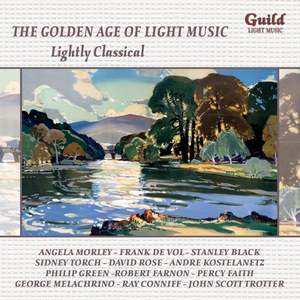
Lightly Classical

Lightly Classical


Includes

Black, S:

Overture To A Costume Comedy

Debussy:

Clair de Lune (from Suite Bergamasque)

Farnon:

Lake of the Woods

Grieg:

Våren, elegiac melody for strings, Op. 34 No. 2

Holst:

St Paul's Suite, Op. 29 No. 2: Dargason

Kabalevsky:

Galop from The Comedians, Op. 26

Khachaturian:

Masquerade: Waltz

Sabre Dance from Gayane

Lehár:

Zigeunerliebe (Gipsy Love): waltz

Massenet:

Meditation (from Thaïs)

Rimsky Korsakov:

Flight of the Bumble Bee

arr. Ralph Sterling, aka David Carroll

Stravinsky:

Rondo of the Princesses from The Firebird

The Firebird: Danse infernale du roi Kastchei

Berceuse from The Firebird

Finale from The Firebird

Tchaikovsky:

The Seasons, Op. 37b: June (Barcarolle)

Swan Lake: Scene (Swan Theme)

Walton:

Popular Song from 'Façade'

Wood, Haydn:

A brown bird singing

and adaptations of works by Ravel, Borodin, Luigini and Schumann


This collection has been prepared with three main aims: firstly to prove that the so-called boundaries between light and classical music are not as insurmountable as some people seem to imagine; secondly to illustrate that many composers, who may usually be associated with more serious works, also had their lighter moments; and thirdly to offer several examples of the tasteful way in which arrangers of the 20th century adapted the classics to make them more instantly appealing to their audience. For many years such ‘tampering with the classics’ was banned by the BBC in Britain, although commercial recordings could be freely purchased. However a lack of broadcasts obviously affected sales, which partly explains why such recordings were more common in the United States than in Britain. Among the leading US musicians who often strayed into classical territory were David Carroll, Andre Kostelanetz, Percy Faith, Clebanoff and even Ray Conniff. They are joined by Charles Williams, Angela Morley and other familiar figures on the UK scene.

Guild - The Golden Age of Light Music - GLCD5172

(CD)

$11.00

Usually despatched in 8 - 10 working days.

The Ultimate Ballet Album

The Ultimate Ballet Album


Adam:

Giselle (excerpts)

Debussy:

Prélude à l'après-midi d'un faune

Delibes:

Coppélia - Suite

Sylvia: Suite

Khachaturian:

Spartacus: Adagio of Spartacus & Phrygia

Masquerade: Waltz

Tchaikovsky:

Swan Lake, Op. 20 Suite

The Nutcracker Suite, Op. 71a


A collection of music from the five most popular ballets of all time – Swan Lake, The Nutcracker, Sylvia and Giselle as well as three of the most popular single dance works of all time – Khachaturian’s ‘Adagio’ from Spartacus, Debussy’s Prélude à l’après-midi d’un faune and the ‘Waltz’ from Khachaturian’s Masquerade.

Over 2 hours and 15 minutes playing time.

Full liner notes with synopsis of the featured ballets.

20% off Naxos

Naxos - 8570011-12

(CD - 2 discs)

Normally: $15.25

Special: $12.20

(also available to download from $11.00)

Usually despatched in 2 - 3 working days. (Available now to download.)

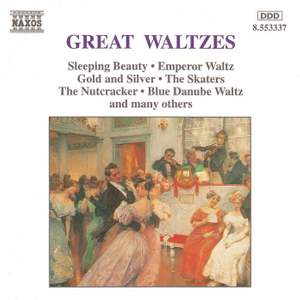
Great Waltzes

Great Waltzes


Berlioz:

Symphonie fantastique, Op. 14 - Un Bal

Ivanovici:

The Danube Waves

Khachaturian:

Masquerade: Waltz

Lehár:

Gold und Silber Walzer, Op. 79

Rosas:

Sobre las Olas

Strauss, J, II:

Kaiser-Walzer, Op. 437

An der schönen, blauen Donau, Op. 314

Tchaikovsky:

Waltz from Sleeping Beauty, Op. 66

Serenade for strings in C major, Op. 48

The Nutcracker: Waltz of the Flowers

Waldteufel:

Les Patineurs - Valse, Op. 183


Various

20% off Naxos

Naxos - 8553337

(CD)

Normally: $8.25

Special: $6.60

(also available to download from $6.00)

Usually despatched in 2 - 3 working days. (Available now to download.)

Novaya Opera in Carnegie Hall

Novaya Opera in Carnegie Hall


Includes

Albinoni:

Adagio for Strings and Organ in G minor

Caccini, G:

Ave Maria

Khachaturian:

Spartacus: Adagio of Spartacus & Phrygia

Masquerade: Waltz

Purcell:

When I am laid in earth (from Dido and Aeneas)

Schubert:

Ave Maria, D839


Evgeny Kolobov

DDD

Olympia - MKM218

(CD)

$16.75

Usually despatched in 8 - 10 working days.

Page: 

 1   2 

 Next >>

Copyright © 2002-13 Presto Classical Limited, all rights reserved.