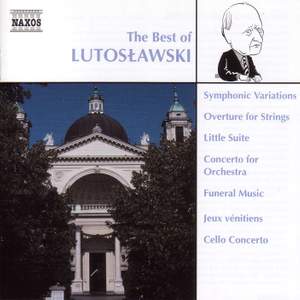
All recordingsPrices shown exclude VAT. (UK tax is not payable for deliveries to United States.) See Terms & Conditions for p&p rates. | |  | Lutoslawski: Orchestral Works
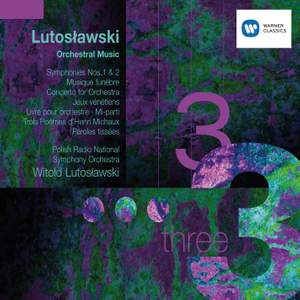
Witold Lutoslawski (1913-1994) was the pre-eminent member of a group of Polish composers that came to prominence after the Second World War and whose artistic advancement was given impetus by the death of Stalin in 1953. The works in this set cover four decades of Lutoslawski's career and include most of his important orchestral works, starting with the early Symphonic Variations, his first and second Symphonies and the Concerto for Orchestra, perhaps his best-known work. “Classic recordings under the composer's taut direction, which remain consistently impressive and, in the Concerto for Orchestra and later masterpieces such as Livre Mi-parti, truly thrilling.” BBC Music Magazine, August 2011 ***** | | | In stock - usually despatched within 1 working day. |
|
|
| |  |
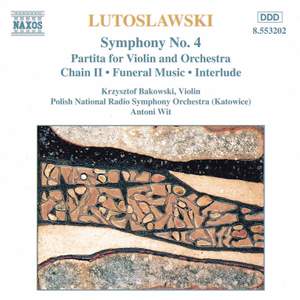
“Naxos's super-bargain price foray into the contemporary repertory is all the more commendable for managing to include Lutoslawski's finest late work, the Symphony No.4 (1992)...Antoni Wit's shaping of the symphony's satisfying substantial structure is well conceived.” Gramophone Magazine | | | (also available to download from $6.00) | In stock - usually despatched within 1 working day. |
|
|
| |  | Perspectives (69°42’ North - 19°00’ East)
Tromsø Chamber Orchestra, Kolbjørn Holthe 69°42’ north - 19°00’ east represent the map coordinates of the town of Tromsø in Norway, and therefore also of the orchestra featured on Perspectives. It is from this vantage point that its perspective on five European composers is applied, five composers who in turn exist in mutual contrast and perspective. The varied works by Webern, Pärt, Lutoslawski, Kurtág, and Fredrik Högberg embrace 99 years of European music history and are balanced by paradoxical opposites. The programme is dominated by moods of the long, arctic winter night - grief, longing, absence - and the midnight sun’s unceasing orgy of light and life. Tromsø Chamber Orchestra is the only full-time professional chamber orchestra in Norway. It has become well-known as a modern and versatile ensemble of high international standard. The orchestra gives weekly concerts in Tromsø, and the musicians also serve regularly as a part of the Arctic Philharmonic Orchestra, through the organisation NOSO AS. They appear with some of the most sought after soloists and artistic leaders from all over the world. Musically their range is from chamber ensembles and chamber orchestra to bigger symphonic productions. In addition to this, the orchestra has a high reputation in crossover repertory, through several co-productions with some of Norway's most in demand pop and jazz artists. “Högberg's concerto is a jokey, hyperactive affair that demands an unexpected agility from its double-bass soloist, Dan Styffe, while the performances of the other works generally favour assertiveness and vigour over refinement...the Mahlerian influences on Webern's miniatures emerge much more strongly than usual.” The Guardian, 2nd August 2012 *** “this is a release whose perspective on the Tromso Chamber Orchestra is both enlightening and impressive.” Gramophone Magazine, November 2012 | | | Usually despatched in 4 - 5 working days. |
|
|
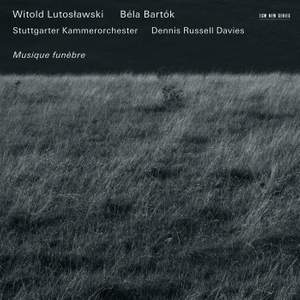
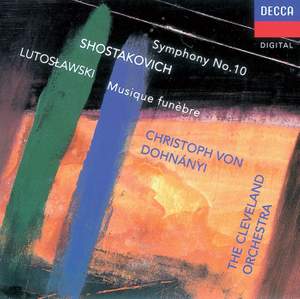
| |  | Musique funèbre
Dennis Russell Davies has had a long-running and highly productive association with the Stuttgart Chamber Orchestra – documented on exceptional ECM recordings of repertoire from Mozart via Stravinsky and Pärt to Kancheli – and is currently the orchestra’s Conductor Laureate. Here he leads them through spirited performances of Bartók’s Divertimento, the ever popular Romanian Folk Dances, and Seven Songs (for which the orchestra is joined by the Hungarian Radio Children’s Choir). This selection of lively Bartók pieces is viewed through the prism of Witold Lutoslawski’s Musique funèbre, written in memory of the great Hungarian composer, and first performed on the 10th anniversary of Bartók’s death. It’s an important, and moving, piece - and one which also led to international recognition for Lutoslawski, Bartók’s Polish kindred spirit. The Divertimento for strings was Bartók’s last composition in Europe before emigrating to the US. It adapts Hungarian local colour in a manner that documents his despondency and can still cause shivers in listeners today. He was probably aware that with this work in 1939 he was not only taking leave of Europe and his traditions. He must also have sensed that Europe as he knew it was about to disappear into the darkness of history. The least known works here are undoubtedly the Seven Songs, taken from a collection of 27 by Bartók. These choruses on folk texts were created for Kodály’s educational programme. Like the Romanian Folk Dances of 1915 (which were orchestrated a couple of years later), they are not folksong arrangements but rather original compositions “in the style of folk music”. Wolfgang Sandner comments in his booklet notes: “They reveal a personality trait that one rarely comes across to such an extent in his other compositions: serenity; one is tempted to call it a sunny disposition, not clouded by social adversity. “Hey, life, glorious life, / This is the life, the glorious life!” are the last lines of the wooing song Csujogató, and that is how Bartók’s original music sounds: joyous, beautiful and pure.” “Russell Davies gives both pieces with the intensity they demand, the sound of the Stuttgart Kammerorchester warm and heard in a generously resonant acoustic.” Sunday Times, 20th May 2012 “Bringing together three Bartók suites with the funeral music composed in his memory by his admirer Witold Lutoslawski, Dennis Russell Davies here offers convincing confirmation of the former's influence on the latter. The “Romanian Folk Dances” are by turns impishly ebullient and wistfully nostalgic” The Independent, 19th May 2012 *** “Pairing these composers always makes good sense. Bartók’s brilliant absorption of Hungarian folk idioms into a radical modernist style is one of 20th-century music’s greatest achievements, and it’s surprising how few great composers followed his lead – an exception being Lutosławski..Predictably [Musique Funebre is] not a joyous listening experience but still a compelling, impressive one.” The Arts Desk, 16th June 2012 “a programme infused with nostalgia...the Hungarian Radio Children's Choir joins the Stuttgarter Kammerorchester for a selection of seven choruses, sheer and vibrant of sound.” The Independent on Sunday, 8th July 2012 **** “Dennis Russell Davies elicits finely judged and very refined performances from the Stuttgart Chamber Orchestra. Their measured account of Lutoslawski's Funeral Music is deeply felt and, while not displacing the composer's own, gets to the heart of the matter. Ensemble is slick in the Romanian Folk Dances...Well worth investigating.” Gramophone Magazine, September 2012 “This intelligent and satisfying programme features three contrasting miniature masterpieces by Bartok...[Lutoslawski's tone-row] is appealingly earthy, and the 12-note chords at the climax have a powerful scrunch, especially in this searing performance from the Stuttgart Chamber Orchestra under Dennis Russell Davies.” BBC Music Magazine, September 2012 **** “Superbly performed and recorded on this CD, Lutosławski’s Musique funèbre builds in counterpoint and concentration with startling clarity and needle-sharp accuracy under Dennis Russell Davies’s directorship.” MusicWeb International, July 2012 | | | (Sorry, download not available in your country) | Usually despatched in 4 - 5 working days. |
|
|
| |  | Witold Lutoslawski: Selected Works
| |
|
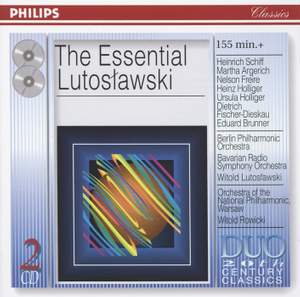
| |  | The Essential Lutoslawskia compilation of over 40 years of the composer's career including some of his most significant works
| | (Sorry, download not available in your country) | |
|
|
| |  |
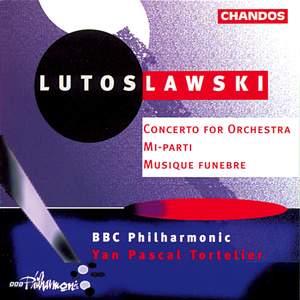
“Tortelier's virtues as a conductor – expressive warmth allied to a special rhythmic buoyancy – are apparent in a sizzling account of the Concertofor Orchestra. The musical flow is firmly controlled, yet the effect is never inflexible, and the technical precision and the alertness of the playing is something for the listener to revel in. The sound is bright, well differentiated dynamically, and even if the BBC's Manchester studio lacks some of the depth and atmosphere of Chicago's Orchestra Hall, as caught in Barenboim's version, this recording is generally more vivid, in keeping with a performance which has precisely the kind of bite and energy that the score demands. It's good that Chandos and Tortelier chose Mi-parti to complete the disc, since of all Lutospawski's later instrumental works this one makes out the best possible case for his radical change of technique around 1960.” Gramophone Classical Music Guide, 2010 | | | (also available to download from $10.50) | Usually despatched in 2 - 3 working days. (Available now to download.) |
|
|
| |  | Lutoslawski - Orchestral Works
The Polish composer Lutoslawski is one of the towering figures of 20th century music. His Concerto for Orchestra can stand comparison to the famous example by Bartók, and Mi-parti from 1976 has become a modern classic.These recordings, directed by the composer in 1976/7 contain all the orchestral music he had written up to that point, and are essential listening for all that are interested in 20th century music. ‘It’s my guess that posterity will judge Witold Lutowslaski among the supreme twentieth century musical colourists. All in all, this must surely count as the introduction to Lutoslawski s symphonic world.’ Gramophone reviewing the original release | | | In stock - usually despatched within 1 working day. |
|
|
| |  | Lutoslawski - Symphonies & Concerto for Orchestra
“this programme offers a well-planned demonstration of the composer's breadth of achievement, with performances so obviously authoritative and of a high standard, and the recording exceptionally vivid.” Penguin Guide, 2011 edition | | | In stock - usually despatched within 1 working day. |
|
|
| |
|