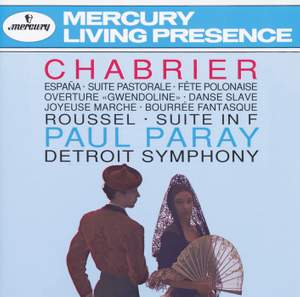
All recordingsPrices shown exclude VAT. (UK tax is not payable for deliveries to United States.) See Terms & Conditions for p&p rates. | |  | Jean Morel conducts Albéniz, Ravel, Chabrier & Bizet
These unique recordings make their first appearance on CD. Some make their first ever appearance on Decca! Jean Morel (1903–75) counted among his teachers Isidore Philipp, Gabriel Pierné and Reynaldo Hahn. He established a connection with the United States early on, teaching at the American Conservatory in Fontainebleu between 1921 (when he was just eighteen!) and 1936. his conducting pupils included James Levine and Leonard Slatkin. Morel’s conducting bore many similarities to that of his countryman Pierre Monteux. His style was bright, clear and energetic, and he always gave the music’s colour its due. Appearing here is the only recording in the Decca catalogue of the complete orchestral version of Albéniz’s Iberia – in orchestrations by Arbós and Surinach. Completing this Spanish-flavoured program is music by Chabrier, Bizet and Ravel. The legendary Decca engineer Kenneth Wilkinson is responsible for the great ‘Decca Sound’. “An attractive Iberia in the orchestration by Enrique Fernandez Arbos” BBC Music Magazine, April 2012 **** “Vigorous, straightforward performances of these chevaux de bataille (or French warhorses) … The recorded sound is bright and full” Gramophone Magazine (Bizet, Chabrier) | | | In stock - usually despatched within 1 working day. |
|
|
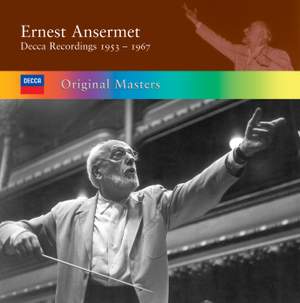
| |  | Ernest Ansermet conducts Lalo & Chabrier
It used to be fashionable to include the music of Lalo in concert in the mid-20th century. At the start of the 21st century, however, his works has fallen completely into neglect, in France as much as elsewhere. This is a cruel injustice for music full of sensuality and very highly inspired, quality orchestration. This unique 2CD collection brings together all of Ansermet's Lalo recordings for Decca, including a fiery account of the Symphonie espagnole with Ruggiero Ricci, as well as the much-praised stereo Chabrier recordings which first appeared on a delightful Decca CD in its 'Classic Sound' series. The Lalo recordings were made at various times during the composer's long tenure with the Orchestre de la Suisse Romande, starting in March 1959 with the Symphonie espagnole and ending with the little Scherzo in September 1968, during his last Decca session with his Swiss orchestra. And 'classic sound' is as much an epithet for the Chabrier recordings as they are for the Lalo. While so many current Chabrier recordings are notable for their elan and elegance, Ansermet emphasises the works' earthy, comic side with a just a hint of oafishness - all reflecting the conductor's brotherly affection for his dear Chabrier, after whom he named his country house 'Le Chabriere'. The collection also includes the rare 'Habanera'. Ansermet's 1955 recording of this piece was made in both mono and stereo, and the stereo version is published for the very first time as part of this anthology. “the dramatic overture to Le Roi d'Ys has seldom sounded more brilliant than in Ansermet's hands...it is for the character of the performance that Ansermet provides in the famous Espana that this recording is so famous and for its technical brilliance. The bass drum is captured here by Decca (in 1964) as no other company could” Penguin Guide, 2011 edition | | | In stock - usually despatched within 1 working day. |
|
|
| |  |
| | | In stock - usually despatched within 1 working day. |
|
|
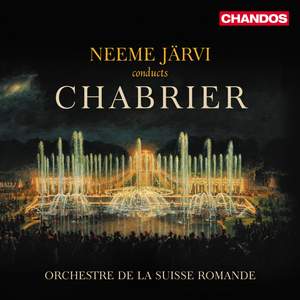
| |  | Neeme Järvi conducts Emmanuel Chabrier
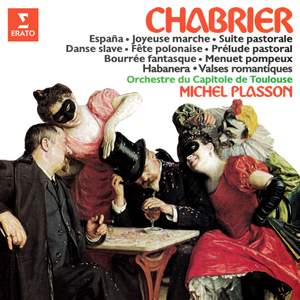
This disc of popular works by Emmanuel Chabrier marks the beginning of a new series of French repertoire, performed by the Orchestre de la Suisse Romande under its newly appointed Artistic Director, Neeme Järvi. After three attempts at comic opera, Chabrier finally achieved success in 1877 with L’Étoile, the plotline of which is set in the court of the somewhat emotionally unstable King Ouf. A couple of years previously, Chabrier had written a short Lamento for orchestra, a work which would not perhaps be considered revolutionary by today’s audiences, but which caused the committee of the Société nationale de musique to hum and haw over it for eighteen long months before finally letting it loose on the Parisian public in 1878. From July to December 1882, Chabrier took his family on an extended holiday to Spain, during which he kept himself busy by noting down the Spanish folk tunes and dance rhythms he encountered on his way. He put many of them into his orchestral masterpiece España, a work overwhelming in its orchestral colour, which is such a characteristic feature of this composer. The impressions of his Spanish holiday can also be heard in the Habanera. For six years Chabrier worked on Gwendoline, a two-act dramatic opera on a libretto by Catulle Mendès, set in Britain in what he called ‘barbarous times’. Inspired by Wagner and Berlioz, the Overture sets the scene perfectly for a drama of violence, treachery, and passion. A month after Gwendoline was premiered in Brussels in April 1886 the Opéra-Comique in Paris agreed to put on Chabrier’s next opera, Le Roi malgré lui, a melting pot of complex political intrigue, cheerful arias, and vivacious dances. In 1880 Chabrier had written his Dix Pièces pittoresques for piano, and over the next few years he orchestrated four of them to form the Suite pastorale, with its gently pulsing ‘Idylle’ movement (which inspired Poulenc to become a composer), the raucous ‘Danse villageoise’, the sultry ‘Sous-bois’, and last but not least the sunny, high-spirited ‘Scherzo-valse’. Also on this disc is the Joyeuse marche, one of Chabrier’s most popular works, and the Bourrée fantasque, based on a dance from the Auvergne region in France where the composer had spent his childhood. | 
| | | (also available to download from $10.50) | Usually despatched in 2 - 3 working days. (Available now to download.) |
|
|
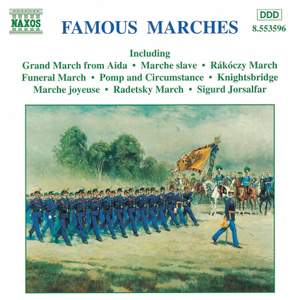
| |  | Demilitarised Zones: Marches
This re-release on Capriccio contains music picked by HR-brass. As with most brass band ensembles, they stand in the old tradition of music with ‘trumpets and drums’. HR-brass has taken a stand with their own CD on the subject of marches. This disc includes a varied programme from 10 Marches to miss the victory by Mauricio Kagel and demilitarised zone by HK Gruber to Beethoven’s Marschlied from “Egmont” and Wagner’s Funeral March from “Götterdämmerung”. “This brass-band sequence is at once a relishing of the sonorous medium and a sly critique. HR Brass is the brass section of the Frankfurt Radio Symphony Orchestra, fine players alert to sophisticated repertory.” Sunday Times, 28th October 2012 | | | (also available to download from $10.50) | Usually despatched in 2 - 3 working days. (Available now to download.) |
|
|
| |  | Chabrier: Orchestral, Vocal and Piano Works
On a recent music forum the question was posed ‘What music makes you smile?’ The immediate answer ‘Anything by Chabrier’ initiated a chorus of approval as others responded with their favourite Chabrier pieces. Everyone knows Espana, many will recognise Joyeuse marche and an increasing number are now familiar with the exquisitely crafted L’étoile. This CD celebrates these works and much else besides in performances that have attracted the highest praise. Every emotion from the stormy (Gwendoline Overture) to the life-affirming (L’île heureuse) as well as the inevitable laugh out loud works, is covered, Chabrier’s genial nature, earthy sense of humour, unconventional keyboard technique and wide-ranging interests ensured that he moved easily in C19 artistic circles and amongst his closest friends were the finest composers, painters and writers of the day. His influence on twentieth century music was immense and if you enjoy Stravinsky, Debussy, Ravel, Satie, Poulenc and de Falla, then you will love this disc! “this is a fascinating collection which will have you going back to other recordings of these works to compare and contrast their approaches to the music of this most fascinating and surprising composer.” MusicWeb International, August 2012 | | | Usually despatched in 4 - 5 working days. |
|
|
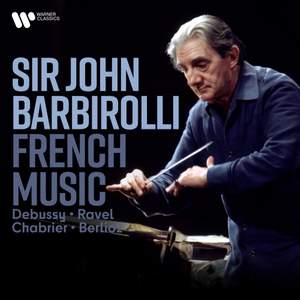
| |  | Hallé Favourites - Volume 1
Beecham had his 'lollipops', short works he used as encores and Sir John Barbirolli had his favourites, too, but more often than not he included them in his lighter Hallé programmes or as Promenade Concert encores. He never regarded popular pieces as beneath his notice or in any snobbish light – they were pieces thousands of people liked to hear and their popularity was a sign of how good they were as music. He grew up in Edwardian London where the theatre orchestras revelled in the music of Edward German and Lionel Monckton. As a child he listened to the band playing in Lincoln’s Inn Gardens and that was where he decided he wanted to be a conductor. We can be sure that it was there he first heard the William Tell ballet music, the Intermezzo from Cavalleria Rusticana and the Dance of the Hours. He loved them then and he loved them all his life. So when he conducted them – as the performances on this disc eloquently testify – he lavished as much artistry on them as he did on symphonies by Elgar and Mahler. No one in the audience could fail to know that he loved these pieces, he communicated his affection with a smile, with a little extra touch of showmanship, with a glance round at the audience to see if they were enjoying it as much as he was. The last two tracks of this disc comprise a brief snatch of Sir John rehearsing for a stereophonic test ‘take’ of Shepherd’s Hey, which is here issued for the first time. | | | Usually despatched in 4 - 5 working days. |
|
|
| |  |
| | | Usually despatched in 4 - 5 working days. |
|
|
| |  | Herbert von Karajan: Philharmonia Pop Concert
| |
|
| |  | French Bon-Bons
| | | (also available to download from $10.50) | Usually despatched in 2 - 3 working days. (Available now to download.) |
|
|
| |
|