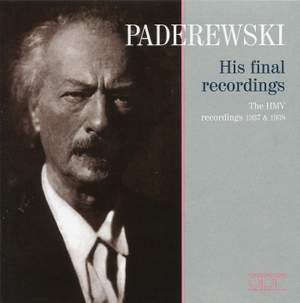
Prices shown exclude VAT. (UK tax is not payable for deliveries to United States.) See Terms & Conditions for p&p rates. | |  | Paderewski - His final RecordingsThe complete HMV Recordings 1937 & 1938
Beethoven: | Piano Sonata No. 14 in C sharp minor, Op. 27 No. 2 ‘Moonlight' recorded on 30 January 1937 | Chopin: | Nocturne No. 5 in F sharp major, Op. 15 No. 2 recorded on 30 January 1937 Nocturne No. 17 in B major, Op. 62 No. 1 recorded on 15 November 1938 Waltz No. 7 in C sharp minor, Op. 64 No. 2 recorded on 15 November 1938 Mazurka No. 38 in F sharp minor, Op. 59 No. 3 recorded on 15 November 1938 Polonaise No. 6 in A flat major, Op. 53 'Héroïque' recorded on 30 January 1937 | Haydn: | Andante & Variations in F minor, Hob.XVII:6 (Sonata - un piccolo divertimento) recorded on 29 January 1937 | Liszt: | Isolde's Liebestod (after Wagner), S447 recorded on 15 November 1938 | Mozart: | Rondo in A minor, K511 recorded on 30 January 1937 | Paderewski: | Melody in G Op. 8 No. 3 recorded on 15 November 1938 Minuet in G major, Op. 14 No. 1 recorded on 30 January 1937 | Schubert: | Moments Musicaux, D780: No. 2 in A flat recorded on 15 November 1938 |
Ignacy Jan Paderewski (piano) A year ago we issued, to great critical acclaim. A double album of Paderewski’s first recordings, made in Europe in 1911-12 (APR6006). Between 1914 and 1931 the pianist recorded for Victor in the US but in 1937, after it appeared Paderewski had retired from the studio, he was persuaded to return to the HMV studios in London to make a final series of recordings. At first the plan was to record the repertoire which featured in the film ‘Moonlight Sonata’, a huge blockbuster success at the time which featured Paderewski playing himself, but in addition to this repertoire Paderewski went on to record works by Haydn and Mozart which were new to his discography. It has often been said that in later life Paderewski’s technique was not what it had been, and to an extent the is undoubtedly true, but this is not an issue in the classical works featured here, and the Haydn, Mozart and Beethoven in particular reveal the extreme poetry that had mesmerised audiences for fifty years and had made Paderewski the most famous pianist of his generation. This is the first time all Paderewski’s 1930’s HMV recordings have been assembled together and two unissued tracks from the 1938 sessions are also included. “Paderewski is Paderewski and this disc brings fascinating insights in terms of tempos, sound and imagination. He is technically past it in the Chopin A flat Polonaise, but there's enough magic in the Nocturnes to buy the disc just for those.” BBC Music Magazine, Christmas 2009 **** | | | Usually despatched in 2 - 3 working days. |
|
|
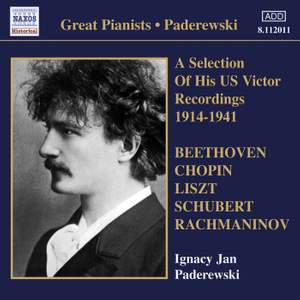
| |  | Paderewski - A Selection of his US Victor Recordings 1914-1941
Beethoven: | Piano Sonata No. 14 in C sharp minor, Op. 27 No. 2 ‘Moonlight': Adagio sostenuto | Chopin: | Waltz No. 5 in A flat major, Op. 42 Nocturne No. 5 in F sharp major, Op. 15 No. 2 Mazurka No. 37 in A flat major, Op. 59 No. 2 Mazurka No. 38 in F sharp minor, Op. 59 No. 3 Étude Op. 25 No. 7 in C sharp minor Étude Op. 25 No. 8 in D flat major Étude Op. 25 No. 9 in G flat major 'Butterfly' | Debussy: | Préludes - Book 1: No. 12, Minstrels | Liszt: | Ständchen - Horch, horch! die Lerch (No. 9 from Zwölf Lieder von Franz Schubert, S558) La leggierezza - Étude de concert No. 2, S144 Spinnerlied aus Der fliegende Holländer S440 | Mendelssohn: | Song without Words, Op. 67 No. 4 in C major 'Spinning Song' or 'Bee's Wedding' | Paderewski: | Melody in G Op. 8 No. 3 Minuet in G major, Op. 14 No. 1 Recorded address on the observance of the golden anniversary of Ignacy Jan Paderewski’s American début | Rachmaninov: | Prelude Op. 32 No. 12 in G sharp minor Prelude Op. 3 No. 2 in C sharp minor | Schubert: | Impromptu in B flat major, D935 No. 3 | Schumann: | Warum, Op. 12, No. 3 | Wagner: | Tristan und Isolde: Prelude to Act 1 arr. by E. Schelling |
Ignacy Jan Paderewski (piano) Jan Paderewski enthralled the world with his artistry for more than half a century. Immensely popular as a recitalist (he played in Madison Square Garden to 20,000 people), he came to recording as late as 1911, leaving an important legacy. These recordings, mostly from the 1920s and some unpublished on 78rpm, show Paderewski as a uniquely eloquent interpreter of Beethoven, his compatriot Chopin, Schubert, Mendelssohn, Schumann, Liszt, Wagner, Rachmaninov, Debussy and his own compositions. Whether performing in grand Romantic style, with scintillating virtuosity, or as if confiding intimate secrets, Paderewski possessed what Henry James memorably described as “exhilarating goodness”. “Systematic treatment of Paderewski's large discography is long overdue….it is bound to entice historic piano recording collectors.” Classics Today “The oddities were odd: the out-of-synch hands, the sometimes bemusing understatement. But what artistry and grace… Gorgeous tonal range too (as in Beethoven's Moonlight Sonata) from the ageing master-pianist - surprisingly good sound.” BBC Music Magazine, February 2009 ***** “Despite (and often because of) such old-fashioned devices as the asynchronisation of hands and exaggerated rubato, there is playing of incomparable beauty on these 20 discs; many pianists today could learn much from listening to Paderewski's clarity of line, luminous tone and artful use of the pedals. All in all, much to treasure...” Gramophone Magazine, March 2009 “A choice selection of the Polish master's prolific recorded output Despite (and often because of) such old-fashioned devices as the asynchronisation of hands and exaggerated rubato, there is playing of incomparable beauty on these 20 discs; many pianists today could learn much from listening to Paderewski's clarity of line, luminous tone and artful use of the pedals. These (mainly) electrical sides were the first to approach capturing successfully the pianist's unique sound (Ward Marston has done the audio restoration here) though the earliest, a 1914 acoustic of Schumann's “Warum?”, is astonishingly successful for its time. Producer Jonathan Summers has chosen short pieces representative of the more than 70 titles Paderewski recorded in America between 1914 and 1931. The most substantial works are Schubert's B flat Impromptu (9'06”), lyrical and heartfelt, and of the Prelude to Tristan und Isolde (7'38”) arranged by Paderewski's pupil Ernest Schelling. Elsewhere there are the celebrated recordings of the Wagner-Liszt Spinnerlied and one of many of the pianist's own ubiquitous Minuet in G; of particular interest are the two Chopin studies and Rachmaninov titles unpublished on 78rpm, the first (and only) movement of the Moonlight in which bars 34-42 are played with an accelerando and crescendo – an interesting idea – and Rachmaninov's famous Prelude the final page of which is executed with surprising ferocity. All in all, much to treasure.” Gramophone Classical Music Guide, 2010 | | | (also available to download from $9.00) | Usually despatched in 2 - 3 working days. (Available now to download.) |
|
|
| |  | Polish Piano Music
| | | Usually despatched in 4 - 5 working days. |
|
|
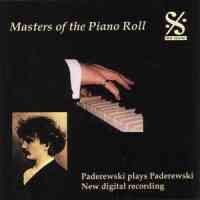
| |  | Paderewski Plays Paderewski
Ignace Paderewski (piano roll) | | | Usually despatched in 8 - 10 working days. |
|
|
| |  | Paderewski: Piano Works
| | | Usually despatched in 4 - 5 working days. |
|
|
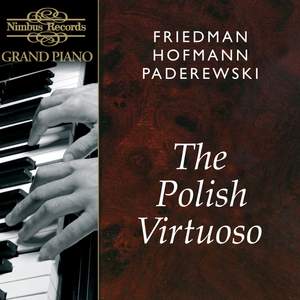
| |  | The Polish Virtuoso
Friedman, I: | Viennese Dance No. 1 (after Eduard Gärtner) Ignaz Friedman Estampe, Op. 22 No. 2 Ignaz Friedman Estampe, Op. 22 No. 4 Ignaz Friedman Viennese Dance No. 2 (after Eduard Gärtner) Ignaz Friedman Viennese Dance No. 3 (after Eduard Gärtner) Ignaz Friedman Elle danse, Op. 10 No. 5 Ignaz Friedman Viennese Dance No. 4 (after Eduard Gärtner) Ignaz Friedman | Hofmann, J: | Sanctuary Josef Hofmann Kaleidoscope, Op. 40 No. 4 Josef Hofmann | Moszkowski: | La Jongleuse, Op. 52 No. 4 Josef Hofmann Étincelles, Op. 36 No. 6 Josef Hofmann Serenata in D major, Op. 15 No. 1 Ignaz Friedman Guitare, Op. 45. No. 2 Josef Hofmann Spanish Caprice Josef Hofmann | Paderewski: | Minuet in G major, Op. 14 No. 1 Ignaz Jan Paderewski Caprice a la Scarlatti in G major, Op. 14 No. 3 Ignaz Jan Paderewski Melody in G Op. 8 No. 3 Ignaz Jan Paderewski Cracovienne fantastique, Op. 14 No. 6 Ignaz Jan Paderewski Nocturne in B flat Op. 16 No. 4 Ignaz Jan Paderewski Legenda in A flat major, Op. 16 No. 1 Ignaz Jan Paderewski |
Piano roll ('Reproducing Piano') recordings from the early 20th century, replayed on a modern Steinway Concert Grand. | | | Usually despatched in 4 - 5 working days. |
|
|
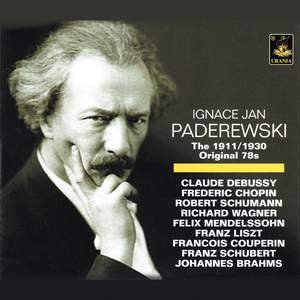
| |  | Ignace Paderewski: The Original 78rpm Records 1911-1930
Beethoven: | Piano Sonata No. 14 in C sharp minor, Op. 27 No. 2 ‘Moonlight': Adagio sostenuto | Brahms: | Hungarian Dance No. 6 in D flat major | Chopin: | Mazurka No. 23 in D major, Op. 33 No. 2 Mazurka No. 37 in A flat major, Op. 59 No. 2 Mazurka No. 41 in C sharp minor, Op. 63 No. 3 Nocturne No. 2 in E flat major, Op. 9 No. 2 Polonaise No. 2 in E flat minor, Op. 26 No. 2 | Debussy: | Préludes - Book 1: No. 1, Danseuses de Delphes Préludes - Book 1: No. 2, Voiles Préludes - Book 1: No. 3, Le vent dans la plaine Préludes - Book 1: No. 12, Minstrels | Mendelssohn: | Song without Words, Op. 67 No. 4 in C major 'Spinning Song' or 'Bee's Wedding' | Paderewski: | Melody in G Op. 8 No. 3 | Schelling: | Nocturne à Ragusa | Schubert: | Impromptu in A flat major, D935 No. 2 | Stojowski: | By The Brookside Chant d'Amour, Op. 26, No. 3 |
and excerpts from works by Brahms, Couperin, Schumann, Johann Strauss II and Wagner
Ignace Paderewski (piano) | | | Usually despatched in 8 - 10 working days. |
|
|
| |
|