All recordingsPrices shown exclude VAT. (UK tax is not payable for deliveries to United States.) See Terms & Conditions for p&p rates. | |  | The Very Best of Daniel Barenboim
Bartók: | Piano Concerto No. 1, BB 91, Sz. 83 | Beethoven: | Fantasia for Piano, Chorus and Orchestra in C minor, Op. 80 | Bizet: | Jeux d'enfants (Petite Suite), Op. 22 | Brahms: | Piano Concerto No. 2 in B flat major, Op. 83, 2nd movement | Bruckner: | Te Deum in C major, WAB 45 | Chopin: | Prelude Op. 28 No. 4 in E minor | Fauré: | Pavane, Op. 50 | Mozart: | Piano Concerto No. 23 in A major, K488 Piano Trio No. 6 in G major K564 Variations (10) in G major on Gluck's 'Unser dummer Pöbel meint', K455 Don Giovanni: excerpts Act 1 Scene 4 Symphony No. 41 in C major, K551 'Jupiter' - Finale |
Daniel Barenboim was born in Buenos Aires in 1942 and received his first piano lessons at age five from his mother. Later, he studied under his father, who would remain his only piano teacher. He gave his first public concert when he was seven and in 1952, he moved with his parents to Israel. At the age of ten, Barenboim gave his international debut performance as a solo pianist in Vienna and Rome, followed by Paris (1955), London (1956) and New York (1957). He began his recording career in 1954 as a pianist. He signed exclusively to EMI in 1966 and in the space of a few years he recorded the Beethoven Piano Sonatas, the Beethoven Piano Concertos (with Otto Klemperer), the Brahms Piano Concertos (with Sir John Barbirolli), and all the Mozart piano concertos with the English Chamber Orchestra, directing from the keyboard. Ever since his conducting debut in 1967 in London with the New Philharmonia Orchestra, Daniel Barenboim has been in great demand with leading orchestras around the world. He made his debut as an opera conductor at the Edinburgh Festival in 1973 with Mozart’s Don Giovanni and in 1981 he conducted for the first time in Bayreuth, where he would conduct every summer until 1999. His career continues to flourish with even-increasing success and he is now one of the most respected and admired musicians in the world. The first CD is devoted to Barenboim performing music by Mozart, beginning with the Piano Concerto No.23 in A (K488) with the English Chamber Orchestra directed from the keyboard by the young Barenboim soon after he began recording for EMI. Then we hear Barenboim in chamber music, in Mozart’s Piano Trio in G K564, recorded almost 40 years later, with the outstanding Danish violinist Nikolaj Znaider and the young Belarusian cellist Kyril Zlotnikov, whom Barenboim admires so much that he has loaned him the Peresson cello that had belonged to Barenboim’s wife, the late Jacqueline du Pré. Next comes Mozart’s set of Variations on ‘Les hommes pieusement’ by Gluck, and then Barenboim moves to the role of operatic conductor with the Mask Trio from Don Giovanni, recorded with the cast he conducted at the Edinburgh Festival in 1973. The CD concludes with the finale from Mozart’s famous ‘Jupiter’ Symphony in which Barenboim conducts the Orchestre de Paris, of which he was principal conductor from 1975 to 1989. CD 2 presents Barenboim in a wide range of contrasting repertoire, illustrating his extreme versatility as both pianist and conductor. The programme begins with Beethoven’s ‘Choral Fantasy’ which Barenboim conducts from the keyboard – no mean feat since the work involves a full symphony orchestra, a chorus and six vocal soloists, as well as the piano! The two movements from Bizet’s charming Jeux d’enfants are a further reminder of Barenboim’s time with the Orchestre de Paris, and then the opening movement from Bartók’s powerful First Piano Concerto gives Barenboim the opportunity to demonstrate his keyboard virtuosity in music of the 20th century. Chopin’s Prelude No.4 in E minor is a brief glimpse of Barenboim’s understanding of the music of this Polish genius before we move to the romantic third movement of Brahms’s monumental Second Piano Concerto with Barenboim as an inspired soloist. The last two pieces put Barenboim back in the role of conductor, firstly in Fauré’s hauntingly beautiful Pavane recorded in Paris and then in Bruckner’s magnificent Te Deum with the forces of the New Philharmonia Chorus and Orchestra and four distinguished vocal soloists. | | | In stock - usually despatched within 1 working day. |
|
|
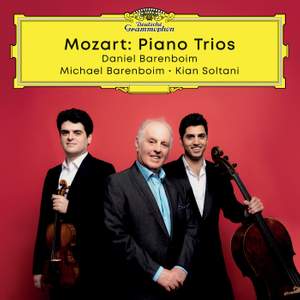
| |  | Mozart - Six Piano Trios
“The record companies fell over each other to bring out single discs or sets of piano trios during Mozart year. EMI offers a near-complete cycle, omitting the early Divertimento, K254, but including the wonderful Kegelstatt Trio for the (in 1786) unprecedented combination of clarinet, viola and piano. With Barenboim at the keyboard no Mozart performance is ever dull. And despite a recording that balances the violin too closely, sometimes giving a bright glare to Nikolaj Znaider's normally sweet tone, there is plenty to enjoy in these performances: the bold sweep of K496's opening Allegro, for instance, with Barenboim and Kyril Zlotnikov relishing Mozart's spirited dialogues between keyboard and the newly emancipated cello; the mingled grace and swagger of the outer movements in the underestimated K548, full of typically deft touches of shading and timing; or the popular-style finale of the final trio, K564, where Barenboim and his accomplices choose an ideal, relaxed allegretto and give a lusty kick to the rhythms in the rustic waltz. Appealing, too, is the mobile tempo and gentle flexibility of phrase in the not-so-slow movement of K542, perfectly poised between an ancienrégime gavotte and a Schubertian 'walking' andante. In contrast, the central movements of K502 and K548 are taken broadly, with moltoespressivo phrasing that some will find ideally soulful, others, including me, over-romanticised. The Andante first movement of the Kegelstatt is also dangerously slow and 'backward-leaning' but this proviso apart, the performance is warmly sung, with a notably rich, throaty viola.” Gramophone Classical Music Guide, 2010 “Barenboim's partners...are a natural and most musical team and their playing radiates an infectious pleasure in music-making.” Penguin Guide, 2011 edition | | | In stock - usually despatched within 1 working day. |
|
|
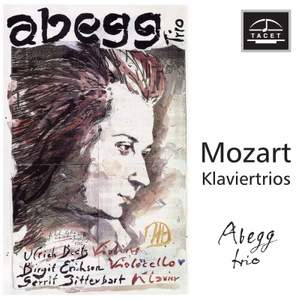
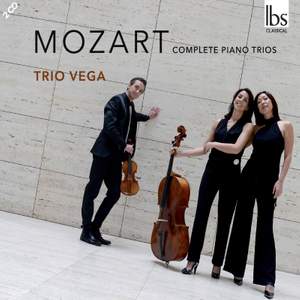
| |  | Mozart - Complete Piano Trios
| | | In stock - usually despatched within 1 working day. |
|
|
| |  | Mozart - The Complete Piano Trios & Clarinet Trio
| | | (Sorry, download not available in your country) | In stock - usually despatched within 1 working day. |
|
|
| |  | Mozart: Complete Piano Trios
The legendary recording is now back on the market in a splendid state of the Art re-mastering. The resultant sound is superb! A double CD. | 
| | | Usually despatched in 2 - 3 working days. |
|
|
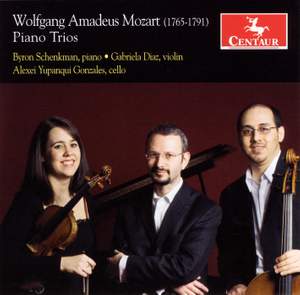
| |  | Mozart: Piano Trios
Byron Schenkman (piano), Alexei Gonzales (cello), Gabriela Diaz (violin) | |
|
| |  | Jerusalem International Chamber Music Festival
Elena Bashkirova and friends (Kirill Gerstein, Guy Braunstein, Michael Barenboim, Frans Helmerson,Alex Klein, Karl-Heinz Steffens and many more) The Jerusalem International Chamber Music Festival, held every year for two weeks in September, is renowned for an exceptional repertoire as well as unique meetings with first ranking soloists who do not usually meet each other on one stage in other frameworks.The Festival has achieved incredible success among Israeli audiences with concerts performed to packed halls. Medici Arts presents the highlights of the Jerusalem International Chamber Music Festival 2008. Elena Bashkirova, the artistic director, says: "Our festival has grown into an internationally acclaimed event". Bonus: Documentary about the Festival behind the scenes “Andy Sommer's cameras show us plenty of the ornate hall of the Jerusalem YMCA and allow us to sense and remotely join the relationship between performers and audience deepening during the course of a work - especially in slow movements - with a directness that the formal visual obstacles presented by orchestral music often obscure.” Gramophone Magazine, November 2009 | | | Usually despatched in 2 - 3 working days. |
|
|
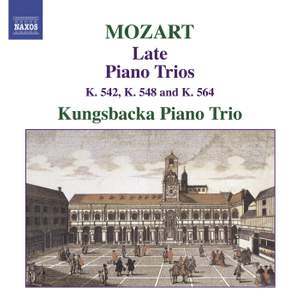
| |  | Mozart - Piano Trios Volume 2Late Piano Trios
Composed in 1788 at the peak of his creative powers, though at a time of both artistic success and looming personal crisis, Mozart’s last three piano trios are masterpieces whose prevailing character of congenial gaiety is heightened by poignant undercurrents of lyrical melancholy. The rarely heard Piano Trio K. 442 was completed by the composer’s friend, Maximilian Stadler. Volume 1 (8570518) also features the acclaimed young Kungsbacka Piano Trio, winners of the 3rd Melbourne International Chamber Music Competition and Associate Ensemble at London’s Guildhall School of Music & Drama. “Is there a better Trio ensemble in Western Europe?” The Strad on the Kungsbacka Piano Trio “Texture plays such an important part in Mozart's late trios and the Kungsbacka Trio clearly relish this aspect, notably in the buoyant finale of the G major Trio; the recording is a little on the hard side.” BBC Music Magazine, September 2009 **** “The Kungsbacka Piano Trio… are musicians of enlightened individual and collective probity who incorporate stylistic niceties into interpretations that are all the more authentic for being authentically felt, and absorbingly communicated.” Gramophone Magazine, May 2009 | | | (also available to download from $6.00) | Usually despatched in 2 - 3 working days. (Available now to download.) |
|
|
| |  | Mozart: Transcriptions for String Quartetby Johann André (1793)
Quartetto Luigi Tomasini (on period instruments) | | | Usually despatched in 4 - 5 working days. |
|
|
| |  | Mozart - Complete Piano Trios
Trio Stradivari (on period instruments) Isaac Stern himself stated, “The trio is one of the best chamber ensembles that I have heard in a long time; [they are] musicians on the highest level.” Yehudi Menuhin himself remarked that he had: “a great need from the bottom of my heart to point to their great and deserved success.” | | | (also available to download from $21.00) | Usually despatched in 2 - 3 working days. (Available now to download.) |
|
|
| |
|