All recordingsPrices shown exclude VAT. (UK tax is not payable for deliveries to United States.) See Terms & Conditions for p&p rates. | |  | Liszt: Tone Poems & Hungarian Rhapsodies
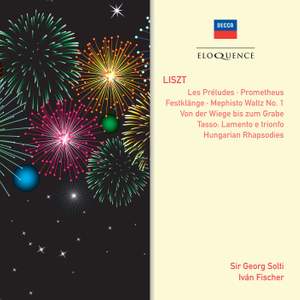
Liszt: | Les Préludes, symphonic poem No. 3, S97 London Philharmonic Orchestra, Sir Georg Solti Prometheus, symphonic poem No. 5, S99 London Philharmonic Orchestra, Sir Georg Solti Festklänge, symphonic poem No. 7, S101 London Philharmonic Orchestra, Sir Georg Solti Von der Wiege bis zum Grabe, symphonic poem No. 13, S107 Orchestra de Paris, Sir Georg Solti Mephisto Waltz No. 1 Orchestra de Paris, Sir Georg Solti Tasso, Lamento e trionfo, symphonic poem No. 2, S96 Orchestra de Paris, Sir Georg Solti Hungarian Rhapsodies, S244 Nos. 1-19: excerpts Budapest Festival Orchestra, Iván Fischer |
Having made revolutionary changes, during the 1830s and 40s, in both piano performance and composition, Liszt was hardly less innovative in his relationship with the orchestra. He is generally credited with having created the genre of the symphonic poem, in which a narrative or extra-musical idea is depicted within a structural framework usually associated with an abstract symphonic movement. In 1974 and 1977 Sir Georg Solti recorded five of the composer’s Tone Poems as well as the Mephisto Waltz No. 1 with the London Philharmonic and the Orchestre de Paris. With fabled ‘Decca Sound’, these recordings have been much sought after by collectors. Recently reissued in the (limited) Liszt Edition, they are now made available generally as a 2CD set. The coupling is a much-praised version of the Liszt Hungarian Rhapsodies, in orchestrations by both the composer as well as Doppler, by Iván Fischer, considered one of the most important conductors of our time. The interpretations were unforgettably described by Gramophone, on their first appearance, as ‘frisky as foals and as flavoursome as goulash’. Even though he grew up in a family in which German was spoken, and although he left Hungary at a young age, Liszt regarded himself as a Hungarian, and he took considerable pride in that fact. Nevertheless, Liszt and Hungary did not always understand each other. He promoted the idea that Hungary’s true national music was the music of the Gypsies, not realising that many of the melodies played by Gypsy bands were in fact composed (but not written down) by Hungarian landowners whose families did not appreciate Liszt’s misattributions – particularly because the Gypsies were not highly regarded in Hungary. This, however, does nothing to diminish the popularity of the Hungarian Rhapsodies, six of which were orchestrated in conjunction with Franz Doppler, a flute virtuoso and a composer in his own right who met Liszt in 1854 and began orchestrating several of his rhapsodies three years later. “Solti and Liszt are handsomely matched.” Gramophone Magazine (Solti) “wildly fiery, pressing things to their utmost limit when the music seems to warrant that, yet not at all without response to the more romantic episodes. [Solti] also has the power to make an orchestra sound like the best in the world and the Orchestre de Paris — this is his first recording with them—play as I have never heard them play before.
The Mephisto Waltz No. 1 is given for all it is worth… This is a stunning performance. … this is certainly very exciting record and I commend it without reservation.” Gramophone Magazine (Solti) “Fischer’s idiomatic foray into this well-worn repertoire is distinguished by tonal lustre and high spirits … Charm is in generous supply everywhere … There is plenty of power, too, with meaty brass and growling crescendos at the start of No. 4, and a riot of colour to close No. 6. Fischer’s Hungarian Rhapsodies are as frisky as foals and as flavoursome as goulash, and are further aided by excellent, full-bodied sound … as dashing and as dancing as anyone might want. Strongly recommended” Gramophone Magazine (Fischer) | | | In stock - usually despatched within 1 working day. |
|
|
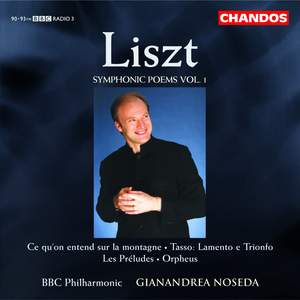
| |  | Liszt: Symphonic Poems, Vol. 1
| | | (also available to download from $6.00) | In stock - usually despatched within 1 working day. |
|
|
| |  | Liszt - The Complete Symphonic Poems for Solo Piano Volume 2transcribed by August Stradal
Risto-Matti Marin (piano) Liszt’s Czech student August Stradal (1860–1930) transcribed his thirteen Symphonic Poems for solo piano in versions which demand almost superhuman virtuosity. Stradal’s transcriptions transform these revolutionary orchestral compositions into viable and effective piano works, faithfully preserving their masterly musical substance. This series will present not only Stradal’s transcriptions of the Symphonic Poems but also a number of grandiose paraphrases, almost all in their first recordings. “Liszt-like in performance difficulty, not to mention prevalence of portentous tremolos, they reflect intense fidelity to his cause, one still needing advocacy...Marin’s spirited accounts make them always arresting, sometimes stunning.” Sunday Times, 24th February 2013 | 
| | | (also available to download from $10.50) | Usually despatched in 2 - 3 working days. (Available now to download.) |
|
|
| |  | Peeter Süda: Complete Organ Music
The music of the Estonian organist-composer Peeter Süda (1883–1920) combines contrapuntal mastery with a virtuosic command of the Romantic organ. Süda’s brief life and his perfectionism meant that his output – exclusively for the organ – remained small, but it is beautifully crafted and highly expressive. This handful of original works is complemented by a mighty transcription of Liszt’s symphonic poem Tasso. | | | (also available to download from $10.50) | Usually despatched in 2 - 3 working days. (Available now to download.) |
|
|
| |  | Liszt: Tasso. Lamento E Trionfo & Le Triomphe Funèbre du Tasse
This is the fourth volume in the critically-acclaimed series “Liszt: The Sound of Weimar” which NCA is releasing as part of the celebrations to mark the 200th anniversary of the composer’s birth. These recordings are being made by the Vienna Academy Orchestra under its esteemed Austrian conductor Martin Haselböck and, as with the first three discs, the music is performed on original instruments from the 19th century. Included here are three more of the Symphonic Poems: No. 2 - Tasso, No. 8 - Héroïde funèbre, and No. 12 - Die Ideale, as well as the orchestral piece, Le Triomphe funèbre du Tasse. The orchestral project “The Sound of Weimar” will include all the orchestral works of Franz Liszt in the original orchestration of the live premieres in Weimar. The recordings are taking place at the Austrian Liszt Raiding Centre, and will all be made at performances in seven concerts during 2011 and 2012 by the Vienna Academy Orchestra under the direction of Martin Haselböck. The first three CDs in the series were of the Dante Symphony (60234), released at the end of last year, and a disc which included the Symphonic Poems Les Preludes, Orpheus, and the Berg-Symphonie (60246). The third volume, released in March, featured Hunnenschlacht, Hungaria, and Mazeppa. The renowned Austrian conductor Martin Haselböck is the musical director of Musica Angelica in Santa Monica, California, and the musical director and founder of the Vienna Academy Orchestra. He is also a professor at the University of Vienna, where he teaches organ. “Period performances of real interest: Liszt's scoring sounds more focused than on modern instruments. The octane-level of the playing varies (like the music itself).” BBC Music Magazine, October 2012 *** “If at first you miss the visceral drama and volume offered by modern drama instruments en masse, do persevere. Time and again Haselböck's approach reveals aspects of Liszt's scoring that would otherwise go unnoticed...Haselböck will have taught you how to 'listen through' as well as merely 'listening to'. You will have known Liszt's sound world as he knew it, more or less” Gramophone Magazine, November 2012 “all [are] given with the right fervency of spirit.” Sunday Times, 16th September 2012 “These players produce colours bold and pungent enough to make you forget the music’s shortcomings – what could sound like aimless romantic gloop feels taut, vibrant...All well worth hearing – beautifully recorded, well-annotated, historically important music..” The Arts Desk, 27th October 2012 | | | Usually despatched in 4 - 5 working days. |
|
|
| |  | Dedicated to the 200th Anniversary of the birth of Franz Liszt
Liszt: | Mephisto Waltz No. 1 Vladimir Ashkenazy (piano) Tarantella, S. 162 No. 3 (from Venezia e Napoli) Lazar Berman (piano) Piano Sonata in B minor, S178 Vladimir Ovchinnikov (piano) Hungarian Rhapsody, S244 No. 2 in C sharp minor Gleb Akselrod (piano) Hungarian Rhapsody, S244 No. 6 in D flat major Alexander Slobodyanik (piano) Piano Concerto No. 1 in E flat major, S124 Pavel Serebryakov (piano) Moscow Philharmonic Orchestra, Kirill Kondrashin Les Préludes, symphonic poem No. 3, S97 Moscow Radio Symphony Orchestra, Gennady Rozhdestvensky Tasso, Lamento e trionfo, symphonic poem No. 2, S96 USSR Ministry of Culture Symphony Orchestra, Mark Ermler Orpheus, symphonic poem No. 4, S98 USSR Ministry of Culture Symphony Orchestra, Mark Ermler Prometheus, symphonic poem No. 5, S99 USSR Ministry of Culture Symphony Orchestra, Mark Ermler |
Dedicated to the 200th anniversary of Liszt’s birth, this release includes performances by some of the greatest musicians. The works include Mephisto Waltz, Tarantella, Sonata in B minor, Hungarian Rhapsodies Nos. 2 & 6 and Piano Concerto No. 1. | | | Usually despatched in 2 - 3 working days. |
|
|
| |  | Liszt: Orchestral and Solo Piano Works
The Beethoven Orchestra Bonn and the pianist Claudius Tanski present a collection celebrating the 200th anniversary of the birth of Liszt. Works include the Overture to Goethe’s Torquato Tasso and Totenanz. An orchestration of La lugubre gondola by John Adams is a finely nuanced extra. “Tanski plays the shorter pieces with deep, ringing tone and musical insight. He underlines the Expressionist aspects of the first La lugubre gondola, just as the orchestra did in the second...The piano registers handsomely throughout.” MusicWeb International, August 2012 | | | Usually despatched in 2 - 3 working days. |
|
|
| |  | Liszt: Hungarian Rhapsodies Nos. 1-6 / Symphonic Poems
Liszt: | Hungarian Rhapsody, S359 No. 1 in F minor Budapest Symphony Orchestra, Andras Korodi Hungarian Rhapsody, S244 No. 2 in C sharp minor (arr. G. Darvas) Budapest Symphony Orchestra, Andras Korodi Hungarian Rhapsody, S359 No. 3 in D major Hungarian Rhapsody, S359 No. 4 in D minor Hungarian Rhapsody, S359 No. 5 in E minor Hungarian Rhapsody, S359 No. 6 in D major Les Préludes, symphonic poem No. 3, S97 Hungarian State Orchestra, Janos Ferencsik Orpheus, symphonic poem No. 4, S98 Hungarian State Orchestra, Janos Ferencsik Tasso, Lamento e trionfo, symphonic poem No. 2, S96 Hungarian State Orchestra, Janos Ferencsik |
| |
|
| |  | Oleg Marshev plays Liszt
| | | (also available to download from $10.50) | Usually despatched in 4 - 5 working days. (Available now to download.) |
|
|
| |  | Liszt: Tasso, Festive Sounds and Hungarian Rhapsody No. 12
| | | This item is currently out of stock at the UK distributor. You may order it now but please be aware that it may be six weeks or more before it can be despatched. |
|
|
| |
|