Prices shown exclude VAT. (UK tax is not payable for deliveries to United States.) See Terms & Conditions for p&p rates. | |  | Kodály: Choral Works
Bartók: | Cantata Profana 'The Nine Enchanted Stags', BB 100, Sz. 94 Tamas Daroczy (tenor) & Alexandru Agache (baritone) Choir of Hungarian Radio & TV & Budapest Festival Orchestra, Sir Georg Solti | Kodály: | Psalmus hungaricus, Op. 13 Lajos Kozma (tenor) London Symphony Orchestra, Wandsworth School Boys’ Choir & Brighton Festival Chorus, István Kertész Missa brevis Elizabeth Gale, Sally le Sage, Hannah Francis (sopranos), Alfreda Hodgson (contralto), Ian Caley (tenor), Michael Rippon (bass), Christopher Bowers-Broadbent (organ) & Gillian Weir (organ) Brighton Festival Chorus, László Heltay Pange lingua Elizabeth Gale, Sally le Sage, Hannah Francis (sopranos), Alfreda Hodgson (contralto), Ian Caley (tenor), Michael Rippon (bass), Christopher Bowers-Broadbent (organ) & Gillian Weir (organ) Brighton Festival Chorus, László Heltay Geneva Psalm 114 Elizabeth Gale, Sally le Sage, Hannah Francis (sopranos), Alfreda Hodgson (contralto), Ian Caley (tenor), Michael Rippon (bass), Christopher Bowers-Broadbent (organ) & Gillian Weir (organ) Brighton Festival Chorus, László Heltay Hymn of Zrínyi Benjamin Luxon (baritone) Brighton Festival Chorus, László Heltay Laudes organi Fantasia on a 12th century sequence Gillian Weir (organ) Brighton Festival Chorus, László Heltay |
Zoltán Kodály and Béla Bartók were Hungary’s two most important composers in the 20th century. They were both friends and colleagues, working separately and together to document and preserve folk music from Hungary and its surrounding regions. The music they collected strongly influenced their own compositions. Decca was one of the first major record companies to invest in recordings of the choral music of Kodály. Perhaps spurred by the success of István Kertész’s recording of Psalmus Hungaricus, they continued to record a number of the composer’s choral works under the direction of László Heltay. All of these recordings are collected over a double-CD, coupled with Bartók’s Cantata Profana, one of Sir Georg Solti’s last recordings, for which he provides very moving commentary in the booklet. “Kertesz's intense Psalmus Hungaricus is the keeper here but Heltay's Missa Brevis and Weir playing the rarely heard Laudes Organi are among other considerable valuables.” BBC Music Magazine, February 2013 **** “The solo singers are all excellent as are the organist and the chorus” Gramophone Magazine (Kodály: Missa Brevis) “an invigorating performance” Gramophone Magazine (Kodály: Psalmus Hungaricus) “Heltay has been astonishingly successful in inspiring Benjamin Luxon (in admirable form) and his fresh-toned choir to the fervour and sensitivity they show in this patriotic work” Gramophone Magazine (Kodály: Hymn of Zrinyi) “Heltay conducts his chorus in a broad, sweeping performance that is impressive” Gramophone Magazine (Kodály: Pange Lingua) | 
| | | (Sorry, download not available in your country) | In stock - usually despatched within 1 working day. |
|
|
| |  | Kodály: Choral & Orchestra Works
Kodály's orchestral scores are full of what Bartók described as ‘the most perfect embodiment of the Hungarian spirit’. There's fierce virtuosity of his Sonata for Solo Cello, and haunting writing for voices in his choral works – the expression of his belief in the universal musical value of singing. | | | In stock - usually despatched within 1 working day. |
|
|
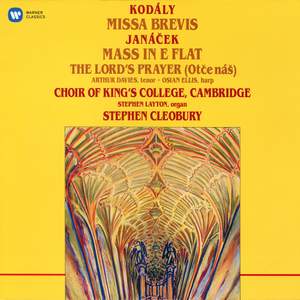
| |  | Kodály / Janacek - Masses
“Janácek began his Mass around 1908, left it to gather dust for 20 years, then turned it into the first draft of the Glagolitic Mass. Paul Wingfield's reconstruction draws substantially on the original draft of the Glagolitic Mass to the extent of including a complete movement (the Sanctus) from it. Clearly Janácek knew best, and the only distinguishing moments are those bits recognisably from the Glagolitic Mass. Unquestionably, though, both the Missa brevis and Laudes organi are among Kodály's most inspired creations. Yet new recordings of favourite works are prone to disappoint. Not this one. If anything, this stunning performance, crowned by Andrew Reid's masterly organ playing, raises this setting of dog-Latin verses in praise of the organ and commissioned by the American Guild of Organists even higher. About 20 years before Laudesorgani, the Missa brevis was first performed in this version for organ and chorus (it was originally an organ solo) in a bomb shelter during the 1944-5 Siege of Budapest. From such an inauspicious start, the work has fared remarkably well on record and this release represents an undoubted climax. It's a simply glorious performance and, in short, should not be missed.” Gramophone Classical Music Guide, 2010 | | | In stock - usually despatched within 1 working day. |
|
|
| |  | Kodaly - Te Deum & Missa Brevis
Eva Andor (soprano), Alice Ekert (soprano), József Gregor (bass), Klára Makkay (soprano), Eva Mohacsi (soprano), József Réti (tenor) & Mártha Szirmay (alto) Budapest Symphony Orchestra & Hungarian Radio and Television Chorus, János Ferencsik | | | In stock - usually despatched within 1 working day. |
|
|
| |  | Gloria
John Robinson (organ) The Choir of Canterbury Cathedral, David Flood | | | Usually despatched in 4 - 5 working days. |
|
|
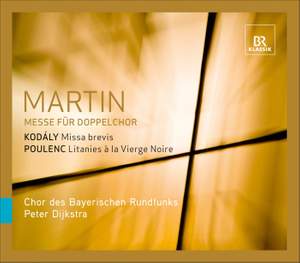
| |  | Martin - Mass for Double Choir
“Widely regarded as one of the world’s finest small professional choirs” (musicweb- international.com), “one of the best professional choruses on the international scene” (klassik-heute.com), “moments, which in their musical culture make the ensemble truly unique” (Münchner Merkur) – these comments and similar ones show that the Chor des Bayerischen Rundfunks is a leading figure in the world of choral music. Frank Martin was on the program of Peter Dijkstra’s inaugural concert in October of 2005, when he – an authentic shooting star on the choral scene – assumed the direction of the Chor des Bayerischen Rundfunks at the sensationally young age of 0nly 26. The same composer is now also featured at the beginning of a-cappella production for the BR-KLASSIK label, on which the chorus presents itself under its director Peter Dijkstra. Frank Martin’s Mass for Double Chorus, which was not given its world première until 40 years after it was composed, has nevertheless ranked since then as one of the Swiss composer’s major works. Zoltán Kodály’s Missa brevis is directly marked by powerless despair over the horrors of World War II. Francis Poulenc’s Litanies à la Vierge Noire was prompted by a far more personal motivation. He composed the work on the death of his composer friend Pierre-Octave Ferroud in 1936, a short time after Poulenc had found his own way to religion on a pilgrimage. “There is much stunning choral singing on this disc, beautifully blended tonally, precisely calibrated dynamically, and shaped with the measured skilfulness of a bespoke tailor.” BBC Music Magazine, April 2010 **** | | | (also available to download from $10.50) | Usually despatched in 2 - 3 working days. (Available now to download.) |
|
|
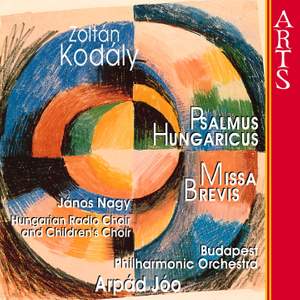
| |  |
| | | (also available to download from $10.50) | Usually despatched in 3 - 4 working days. (Available now to download.) |
|
|
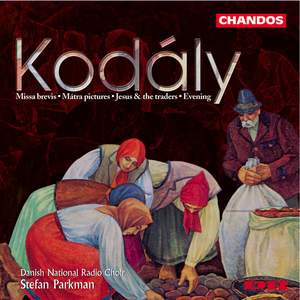
| |  |
Helle Charlotte Pedersen (soprano), Maria Streijffert (contralto), Lars Pedersen (tenor), Michael W. Hansen (bass), Torsten Nielsen (bass), Niels Henrik Nielsen (organ) Danish National Radio Choir, Stefan Parkman | | | (also available to download from $10.50) | Usually despatched in 2 - 3 working days. (Available now to download.) |
|
|
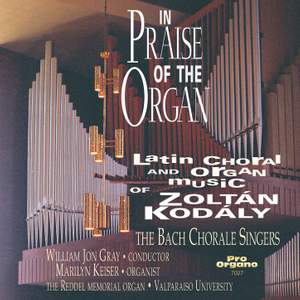
| |  | Choral Works by Zoltán Kodály
| | | Usually despatched in 8 - 10 working days. |
|
|
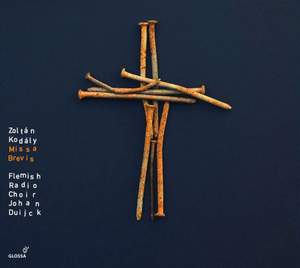
| |  |
| | | Usually despatched in 2 - 3 working days. |
|
|
| |
|