All recordingsPrices shown exclude VAT. (UK tax is not payable for deliveries to United States.) See Terms & Conditions for p&p rates. | |  | Prokofiev: Piano Sonatas Vol. 1
Recording the complete Prokofiev Sonatas with pianist Peter Donohoe had been a long-cherished ambition of SOMM’s Owner and Recording Producer, Siva Oke, who had followed his illustrious career with keen interest for many years. This has now been realised with the complete recording of the Sonatas for SOMM, enjoyably recorded at Southampton University’s Turner Sims Concert Hall on their magnificent Steinway Grand, which Peter considers ideally responsive to the composer’s demands, both technically and musically. Peter is no stranger to the Prokofiev Sonatas. He was asked by the publishers Boosey & Hawkes to prepare the definitive edition of the scores for them in 1985 and he also recorded Sonatas 6, 7 and 8 for EMI back in 1990. He has now added Sonatas 1 to 5 and 9 in this complete recording for the SOMM catalogue, for the first time. He has, however, performed all the Sonatas in recital at some time or other over the years, and he feels – or with typical humility he thinks – that he has come as close to them as is possible for works of such infinite depth and stylistic complexity. Peter has written the CD liner notes for this first volume as well as the rest of the cycle, in a relaxed, informed and affectionate manner. “Donohoe is an inescapable advocate of Prokofiev’s piano sonatas...No 5 opens with a memorable wiggle. He ensures that the slicing, acidulous felicity of Prokofiev’s writing is pure invigoration.” Sunday Times, 5th May 2013 | 
| | | In stock - usually despatched within 1 working day. |
|
|
| |  | Prokofiev: Piano Sonatas Nos. 2, 4 & 7
Evgeni Koroliov, born in 1949 in Moscow, although doubtless an outstanding phenomenon in the international pianists' scene, still remains an insider tip, albeit one who has long enjoyed cult status. With his recording of the 2nd, 4th and 7th Piano Sonatas of Sergei Prokofiev, we can now finally obtain an item that was not available for a long time. The 2nd Sonata, composed in 1912, is characteristic of Prokofiev's formally strict and sonically original personal style. It is marked by a modern aesthetic; numerous elements take up futuristic ideas of the period that "idolise speed and sing praises of modern machines", supporting the hypothesis that there is "a beauty of noises" as described in the magazine Muzika, the voice of the Moscow avantgarde consortium shortly after this Sonata was composed. The 4th Sonata of 1917 has a completely different character, its first movement beginning with restrain and archaic grace – the oppressive sounds are explained by the dedication to a friend who had recently committed suicide. After many years abroad, Prokofiev returned to the Soviet Union in the early 1930s with a downright naive optimism. The 7th Sonata was composed there a decade later, about which Glenn Gould had the following to say: "The first movement not only contains some of Prokofiev’s best music, but is, in open disregard of the Soviet musical maxim of direct accessibility, perhaps the closest to an atonal harmonic plan he ever applied." “There is plenty of raw energy and rhythmic bite in Evgeni Koroliov's rough-around-the-edges Prokofiev. At times exciting, the results are mixed.” BBC Music Magazine, May 2013 *** “Koroliov surely underlines a link rather than a break with the past, favouring much romantic leeway and rhythmic elasticity, with any opportunity to linger savoured to the full.” Gramophone Magazine, April 2013 | 
| | | (also available to download from $10.50) | Usually despatched in 3 - 4 working days. (Available now to download.) |
|
|
| |  | Prokofiev: Works for Piano
Abdel Rahman El Bacha (piano) An eminent Chopin specialist and also a feisty proponent of the Prokofiev concertos, Abdel Rahman El Bacha is the ideal interpreter for these piano works, which range from the futurist strains of the Toccata Op.11 (1912) to the 'fleeting visions' of Op.22 (1917), by way of the 'Gavotte' and 'Rigaudon' of the 'Ten Pieces' Op.12 and the 'Sarcasmes' Op.17. Amid this diversity, the Sonata No.2 Op.14 reverts to Classical models. Here on a single disc are all the solo piano works of the young Prokoviev's last years in Russia. “This rather stiff and deliberate playing works well for the clockwork grotesquery, but misses the joie de vivre and ferocity necessary to bring Prokofiev's music alive.” BBC Music Magazine, August 2012 *** “What's immediately striking is the sheer variety contained within these pieces...El Bacha imbues the Sarcasmes with sharply etched characterisations - though there is arguably more of an edge of danger in 'Smanioso' ('Raving').” Gramophone Magazine, July 2012 | | | Usually despatched in 3 - 4 working days. |
|
|
| |  | Ivana Gavrić: From The Street
Ivana Gavrić made her debut on Champs Hill Records in 2010, when her playing described as “altogether of an extraordinary calibre” by BBC Music Magazine who also made her Newcomer of the Year in their 2011 BBC Music Magazine Awards. Her second recording brings together works written between 1905 and 1912, by composers separated by nationality; but linked together in possibly the most exciting period in modern European culture. Completing her survey of Janáčekʼs major solo piano works, Ivana puts On an overgrown path and the Sonata, 1. X. 1905 in the context of Ravelʼs Valses nobles et sentimentales and Prokofievʼs Sonata No. 2. Ivana writes “Ever since my student years, the Ballets Russes have greatly fascinated me, in particular Prokofievʼs involvement with Diaghilev and the company. His second Sonata is a real statement by a young composer who has just formulated his style, full of his trademark soaring melodies and occasional sarcastic gestures.” At a similar time and as if in another world, Janáček was finding his unique style at his own pace. He uses Moravian folk melodies first in the opening numbers of the Path, and more confidently in the Sonata. His harmonies and textures develop, becoming far more daring and introverted in the later-composed and more obscure numbers of the Path. Like Prokofiev, melody was key for Janáček, although in a more fractured, febrile state. “ I have always been drawn to the brash, brass-like chords at the start of Ravelʼs Valses nobles et sentimentales” adds Ivana. “They open the work with such a rude gesture, later melting into more sensuous and quirky takes on the waltz which end in an epilogue: a hazy recollection of ʻthe night beforeʼ.” “although Janacek, Ravel and Prokofiev write in such different styles, Gavric draws some intriguing parallels between them, especially their preoccupation with piano timbre and texture....Particularly impressive is her pacing in the Piano Sonata 1.X.1905, where the use of silence in the second movement creates a feeling of impending doom.” BBC Music Magazine, December 2011 ***** “In the Sonata, she heightens the speech-like phrasing by overtly differentiating the composer's sometimes idiosyncratic articulation markings...The intimacy, finely honed nuance, conversational flow and subtle underlining of the composer's harmonic surprises that Gavric brings to each of the short pieces comprising On an Overgrown Path prove more memorable still...Gavric obviously revels in the piano-writing's sensuality and gentle resonance.” Gramophone Magazine, December 2011 “in both the Sonata and the miniatures of On an Overgrown Path she shows the same careful grading of Janác˘ek's textures, and perfect judgment of mood and manner that made her earlier performance so convincing...Technically, both [the Ravel & Prokofiev] are immaculate, but the Ravel remains just a little too strait-laced, though Gavric parades its range of keyboard colour exuberantly, while the Prokofiev just needs more bite. But it's still a fine disc.” The Guardian, 22nd September 2011 **** “The performances have clarity, subtlety and beautifully fluid phrasing, but little sense of emotional involvement...Yet there’s a keen intelligence at work, as well as formidable technique.” The Times, 17th September 2011 *** | | | Usually despatched in 2 - 3 working days. |
|
|
| |  | Russian Piano Music Series Volume 7 - Prokofiev
Prokofiev: | Piano Sonata No. 2 in D minor, Op. 14 Visions fugitives, Op. 22, No. 1 Visions fugitives, Op. 22, No. 3 Visions fugitives, Op. 22, No. 4 Visions fugitives, Op. 22, No. 7 Visions fugitives, Op. 22, No. 10 Visions fugitives, Op. 22, No. 6 Visions fugitives, Op. 22, No. 11 Visions fugitives, Op. 22, No. 17 Visions fugitives, Op. 22, No. 5 Ten Pieces from Romeo and Juliet, Op. 75 1937 Piano Version Piano Sonata No. 7 in B flat major, Op. 83 |
Prokofiev is regarded by many as one of the most complex and progressive composers of the early twentieth century. His catalogue of music numbers some 135 works in such varied genres as symphony, sonata, ballet, opera, art-song, string quartet and film music. He was one of the last in a long tradition of pianist-composers and the nine piano sonatas are all testament to the quality and fertility of the composer’s mind. Prokofiev’s output within the piano sonata genre represents the most important and influential in the Twentieth Century. His melodic, rhythmic and harmonic material encompasses a new world, far removed from the conventional romantic ideals of the time. The structure of this sonata is conventional but the unusual sonorities, juxtaposition of harmonies and syncopated rhythmic patterns all come together to produce a radical style of composition. However, despite all of these new ideas, tonality as a structural base is essential for Prokofiev in all his works. Sergei Dukachev was born in Magnitogorsk, a city in the Ural Mountains on the border between Europe and Asia, where he began to learn the piano at the age of six. In 1989, he distinguished himself by being a prize winner in the International Beethoven Competition in Vienna. Sergei developed close artistic links with Britain during his years at the Moscow Conservatoire, and in the late 1990s, began a series of annual visits to give concerts in England. Now a sought-after performer in England, Sergei’s appearances have included illustrated talks and masterclasses at many venues – in particular the Chetham’s Summer School in Manchester. “Dukachev [is] a virile interpreter of the music of his homeland. He races into a truly exciting reading of the second piano sonata before exploiting every opportunity offered by the 20 tiny pieces that make up Visions Fugitives to display his colourful pianistic palette.” The Observer, 14th August 2011 | | | (also available to download from $10.50) | Usually despatched in 4 - 5 working days. (Available now to download.) |
|
|
| |  | Prokofiev: Piano Sonatas Nos. 1-5
Alexandra Silocea (piano) Avie introduces the brilliant young Romanian pianist Alexandra Silocea who offers some of her signature repertoire on her debut recording, the first five Piano Sonatas of Prokofiev. Dubbed “Alexandra the Great” by Gramophone who announced her debut recording, the 26-year-old trained in Vienna and Paris, and is now resident in the UK. In 2003, while studying at Vienna University for Music and Performing Arts, she was awarded the Herbert von Karajan Scholarship, the latest in a string of prizes from competitions throughout Europe. Alexandra made her professional debut in 2008 with the Vienna Chamber Orchestra. Recital debuts followed in 2009 at the Musikverein in Vienna, Carnegie Hall’s Weill Recital Hall in New York, and le Salon de Musique in Paris. Alexandra says: “This debut recording serves as a journey through my own musical path. The aim of recording Prokofiev’s first five piano sonatas together was to show all the facets of Prokofiev's musical personality, from Op. 1 to Op. 138, which is the revised version of Sonata No. 5, one of the last works he completed before his death in 1953. Each Sonata is so different, so original, with such care for detail that whenever I play or listen to this music it's a revelation." This recording extends the legacy of the late producer John Barnes, who introduced the pianist to Avie. An insatiable scout for young talent, Barnes also worked for decades behind the scenes at Glyndebourne, recording every production for the company’s archives. His successor at Glyndebourne, Sebastian Chonion, has produced Alexandra’s debut recording. “Alexandra Silocea traces the shift in style with perceptiveness and panache. She characterises the blend of brooding and bravura in the “Fourth Sonata”, and brings out the melodic affinities that the “Fifth Sonata” has with the “Second Concerto”. These are fine, fresh, spirited performances.” The Telegraph, 28th April 2011 **** “[Silocea] plays with musical grace and fluency” Gramophone Magazine, July 2011 “On the evidence of this recording debut, Romanian pianist Alexandra Silocea is both musically tasteful and clearly devoted to Prokofiev's Sonatas. One rarely hears Prokofiev's often fiendish technical demands taken on so coolly and articulated so clearly as Silocea does here” BBC Music Magazine, August 2011 *** | | | Usually despatched in 4 - 5 working days. |
|
|
| |  | Richter plays Prokofiev
Svyatoslav Richter (piano) These are live recordings and this is the first time that they have been available on CD. Even in the early 1940s, Richter was acknowledged to be a unique interpreter of Prokofiev’s music. These recordings were made in 1961 and 1979. | | | Usually despatched in 2 - 3 working days. |
|
|
| |  | Emil Gilels: Early Recordings Volume 2All tracks recorded in the USSR, 1937-1954
Producer: Jonathan Summers Audio Restoration Engineer: Ward Marston “healthy doses of both tumultuousness and poignant delicacy” BBC Music Magazine, September 2010 **** “In large-scale sonatas by Glazunov, Medtner and Prokofiev, his playing glows with conviction and includes passagework spun off with an all-Russian legato. Then, his outwardly formidable and unsmiling demeanour on the concert platform is erased in a performance of Tchaikovsky's "Chant sans paroles" of a beguiling charm” Gramophone Magazine, October 2010 | | | (also available to download from $9.00) | Usually despatched in 2 - 3 working days. (Available now to download.) |
|
|
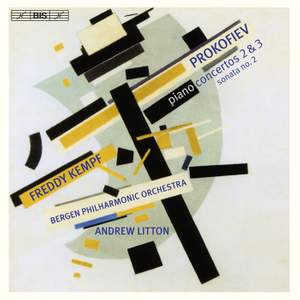
| |  | Prokofiev - Piano Concertos Nos. 2 & 3
Freddy Kempf’s 2003 Prokofiev solo recital was described as ‘a superb disc’ in Gramophone, whose critic went on to write: ‘Kempf is joyfully exuberant, flashing through every savage challenge with the assurance and instinct of a born virtuoso.’ Kempf, Litton and the Bergen PO now join forces in an all-Prokofiev programme that includes the most popular of his five piano concertos, namely the Third, a spontaneous work, vigorous and melodic in turns and full of striking material presented in a typical Prokofiev manner. This is coupled with the Second Piano Concerto, which Prokofiev himself premièred in 1913, shocking the audience with its modernistic sounds and jagged rhythms. “[In the G minor concerto] Kempf is less flamboyant than some, perhaps seeking to make musical sense of the argument. The second movement is as lithe and scintillating as one might wish.” Gramophone Magazine, May 2010 “With this disc, Freddy Kempf shoots straight into the top ten of Prokofiev interpreters...[He] keeps it all spruce and plays it relatively straight...The big Rachmaninov tune in the finale [of the Third Concerto] is appropriately grand in the soloist's hands and orchestrally lush.” BBC Music Magazine, May 2010 ***** | | | (also available to download from $10.50) | Usually despatched in 2 - 3 working days. (Available now to download.) |
|
|
| |  | Garrick Ohlsson plays Rachmaninov, Mussorgsky & Prokofiev
Garrick Ohlsson's latest recording for Bridge combines new studio recordings of major compositions by Prokofiev and Rachmaninoff with one of the great American pianist's own favorite “live” performances- a 1974 reading of Mussorgsky's Pictures at an Exhibition, given in Prague. “Ohlsson demonstrates strong credentials as an interpreter of Russian music in this impressive recital. He brings a tremendous variety of colour to Rachmaninov's Corelli Variations, drawing out different strands of the polyphonic texture and controlling the works' overall architecture with impeccable pacing” BBC Music Magazine, September 2010 ***** | | | Usually despatched in 2 - 3 working days. |
|
|
| |
|