All recordingsPrices shown exclude VAT. (UK tax is not payable for deliveries to United States.) See Terms & Conditions for p&p rates. | |  | Music From The Machine Age
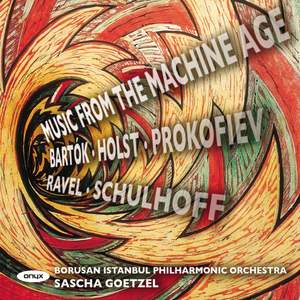
Borusan Istanbul Philharmonic Orchestra, Sascha Goetzel Another orchestral tour de force from Sascha Goetzel and this outstanding orchestra: after their acclaimed debut recording for ONYX of Respighi, Florent Schmitt and Hindemith, the Borusan Istanbul Philharmonic Orchestra and their charismatic Viennese music director have devised a fascinating programme of ballet music composed during the turbulent inter-war years of the 20th century. The music reflects the edgy, dangerous and turbulent political and social landscape of the period. This is music of great rhythmic vitality: Ravel’s refracted memories of a vanished Habsburg Vienna destroyed by the 1914–18 War, to the primitive barbarism of Prokofiev’s 'Scythian Suite' and the lurid violence of Bartok’s 'Miraculous Mandarin' with its themes of lust, criminality, prostitution and murder. Schulhoff’s ballet 'Ogelala' like Prokofiev’s score concerns pagan rituals and warring tribes, and a young couple who are meant to kill each other, but end up falling in love. Holst’s comic opera, 'The Perfect Fool', written in 1918–22, begins with a ballet which is danced by Spirits of Earth, Water and Fire. The score is brilliant – and though less concerned with human drama than the other works on this disc, the drive, energy and sheer brilliance of Holst’s score is very much of its time. “These five pieces ably summarise the ferment of creativity unleashed in the
aftermath of the First World War...Most fascinating of all is the Ogelala ballet suite by Erwin Schulhoff, a Czech composer who died in a Nazi concentration camp: it most clearly exhibits the liberating influence of Stravinsky's The Rite of Spring.” The Independent, 10th February 2012 **** “A brilliant idea: to assemble five ballets from the 1910s or 1920s that are all supposedly inspired by the mythological past, yet evoke the violence of the “machine age”...The Turkish all-stars give hard-edged performances under Sascha Goetzel.” The Times, 18th February 2012 “the boisterously confident Borusan Istanbul Philharmonic cuts another lively swathe through colourful 20th-century repertoire...[In the Bartok] The Turkish players and their Viennese conductor offer muscular strings, dirty slithering brass, but sagging momentum. Yet it's fascinating to hear the suite alongside other music similarly influenced by the period's big shocker, Stravinsky's Rite of Spring” BBC Music Magazine, May 2012 *** “There's something uniquely exciting about hearing a keen young orchestra devouring difficult but exciting music whole, which is precisely what the Borusan Istanbul Philharmonic does...Most of the orchestral playing delivers in spades and the sound quality is very good too, if occasionally wanting in inner detail. So, taken as a whole, this is an exciting CD (the orchestra's second for Onyx) that deserves the widest currency.” Gramophone Magazine, June 2012 | | | In stock - usually despatched within 1 working day. |
|
|
| |  | Holst: Symphony in F major 'The Cotswolds'
| | | In stock - usually despatched within 1 working day. |
|
|
| |  | British Ballet Music
Bliss: | Checkmate - Suite Royal Liverpool Philharmonic Orchestra, Vernon Handley | Elgar: | Enigma Variations, Op. 36 London Symphony Orchestra, Sir Adrian Boult | Holst: | The Perfect Fool, Op. 39/H 150: Ballet Music London Symphony Orchestra, André Previn | Sullivan, A: | Pineapple Poll Royal Philharmonic Orchestra, Sir Charles Mackerras | Tyrwhitt-Wilson: | A Wedding Bouquet: Tango & Waltz Orchestra & Chorus of the Royal Opera House, Robert Irving/ | Walton: | Façade Orchestral Suite No. 1 City of Birmingham Symphony Orchestra, Louis Frémaux Façade Orchestral Suite No. 2 City of Birmingham Symphony Orchestra, Louis Frémaux |
This collection of music from 20th-century ballets features such master conductors of British repertoire as Boult, Previn, Handley and Mackerras – who also, drawing on the works of Sir Arthur Sullivan, wrote Pineapple Poll for John Cranko. Dame Ninette de Valois choreographed the chessboard machinations of Bliss’s Checkmate, here complemented by Elgar’s much-loved Enigma Variations, Walton’s witty Façade, elemental dances from Holst’s opera The Perfect Fool, and colourful pieces by Berners, Lambert and Gordon. “Some sparkling playing here, especially Pineapple Poll under its arranger Charles Mackerras” BBC Music Magazine, September 2011 *** | | | In stock - usually despatched within 1 working day. |
|
|
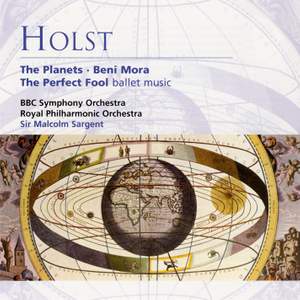
| |  | Holst: The Planets, Egdon Heath, The Perfect Fool & St. Paul’s Suite
Holst: | The Planets, Op. 32 London Philharmonic Orchestra, Bernard Herrmann The Perfect Fool, Op. 39/H 150: Ballet Music London Philharmonic Orchestra, Sir Adrian Boult Egdon Heath, a homage to Thomas Hardy, Op.47 London Philharmonic Orchestra, Sir Adrian Boult A Moorside Suite Grimethorpe Colliery Band, Elgar Howarth Suite No. 1 for Military Band in E flat major, Op. 28 No. 1, H105 Eastman Wind Ensemble, Frederick Fennell Suite No. 2 for Military Band in F major, Op. 28 No. 2, H106 Eastman Wind Ensemble, Frederick Fennell St Paul's Suite, Op. 29 No. 2 Saint Paul Chamber Orchestra, Christopher Hogwood A Fugal Concerto, H152 Op. 40 No. 2 Julia Bogorad (flute) & Kathryn Greenbank (oboe) Saint Paul Chamber Orchestra, Christopher Hogwood |
A collection of prized Decca recordings of the music of Holst, including a rare – and controversial! – recording by film score supremo Bernard Herrmann, released internationally for the first time on CD. Also included are two orchestral works (The Perfect Fool and Egdon Heath) conducted by Sir Adrian Boult, recorded in 1961 and much praised at his first appearance and its subsequence recurrences on CD. Much of Holst’s life was spent teaching and the St. Paul’s Suite was written for his pupils to play in their school orchestra. The finale – where Holst cleverly counterpoints ‘The Dargason’ with ‘Greensleeves’ is an arrangement of the parallel movement in his Second Suite for military band, composed two years earlier. The legendary recording by Frederick Fennell and the Eastman Wind Ensemble of the two Suites, made in 1955, here reappears, and is complemented with another suite for brass band, the Moorside Suite, commissioned by the BBC and the National Brass Band Festival Committee. Recording producers: Tony D’Amato, Gavin Barratt (The Planets); Ray Minshull (Egdon Heath, The Perfect Fool); Paul Myers (St. Paul’s Suite, Fugal Concerto); James Mallinson (Moorside Suite); Wilma Cozart Fine (Suites Nos. 1 & 2) Recording engineers: Arthur Lilley (The Planets); Kenneth Wilkinson (The Perfect Fool); Jonathan Stokes (St. Paul’s Suite, Fugal Concerto); Michael Mailes (Moorside Suite); C. Robert Fine (Suites) Recording locations: Eastman Theater, Rochester, New York, United States, May 1955 (Suites Nos. 1 & 2); Kingsway Hall, London, UK, March 1961 (Egdon Heath, The Perfect Fool), February 1970 (The Planets); Town Hall, Huddersfield, United Kingdom, June 1976 (Moorside Suite); Ordway Music Theater, Saint Paul, Minnesota, USA, May 1992 (St. Paul’s Suite, Fugal Concerto) “Egdon Heath is a masterpiece of evocation, the counterpart in sound of the sombre scene of Thomas Hardy's tale The Return of the Native … and I cannot imagine a better performance than this one with the London Philharmonic Orchestra” Gramophone Magazine “Outer portions of The Perfect Fool ballet music have superb sparkle and bite, while the poise of the central "Dance of Spirits of Water" is surely no less memorable.” Gramophone Magazine “an unqualified success” Gramophone Magazine (Suites 1 & 2) | | | In stock - usually despatched within 1 working day. |
|
|
| |  | Holst: The Planets
Holst: | A Somerset Rhapsody, Op.21 No. 2 Bournemouth Sinfonietta, Norman Del Mar Brook Green Suite Bournemouth Sinfonietta, Norman Del Mar The Perfect Fool, Op. 39/H 150: Ballet Music London Symphony Orchestra, André Previn The Planets, Op. 32 London Philharmonic Orchestra, Sir Adrian Boult Suite No. 2 for Military Band in F major, Op. 28 No. 2, H106 Central Band of the Royal Air Force, Wing Commander Eric Banks St Paul's Suite, Op. 29 No. 2 Royal Philharmonic Orchestra, Sir Malcolm Sargent Egdon Heath, a homage to Thomas Hardy, Op.47 London Symphony Orchestra, André Previn Choral Hymns from the Rig Veda, Op. 26: 2nd Group, H98 London Symphony Chorus, London Philharmonic Orchestra, Sir Charles Groves A Choral Fantasia, H177 Dame Janet Baker English Chamber Orchestra, Purcell Singers, Imogen Holst |
The Planets, one of the most popular and colourful orchestral scores of the twentieth century, here rubs shoulders with works showing Holst’s interest in English folksong; the mysticism of India; and his austerely beautiful take on Thomas Hardy’s “The Return of the Native” in Egdon Heath. Holst was born in Cheltenham in England in 1874 into a family with a long musical tradition. He began composing whilst still at school and then at Oxford. He was sent to London to study with Charles Villiers Stanford at the Royal College of Music, and it was here that he met and became a lifelong friend of Vaughan Williams. In 1905 he was appointed Director of Music at St. Paul's School in Hammersmith, London, a post he held until his death in 1934. Holst's most popular work and the piece that has kept him in the public eye since it was first performed in 1916 is The Planets, and the recording presented here is conducted by Sir Adrian Boult, the man who gave the work it's first performance. Great though The Planets is, it only shows one side of Holst's musical personality and the strength of this set is that it provides the opportunity to explore the other sides of this great master's musical personality. | | | In stock - usually despatched within 1 working day. |
|
|
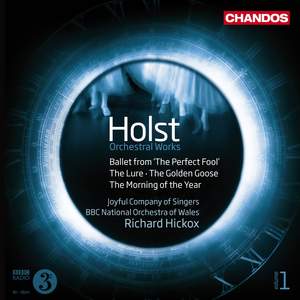
| |  | Holst: Orchestral Works Volume 1
The first disc of what was projected to be a cycle, cut tragically short by the recent death of Richard Hickox, one of the foremost exponents of British music. The Planets is at the heart of the English repertoire, yet much of Holst’s orchestral output is unjustly neglected. This series will demonstrate that Holst was a composer of great inventiveness. Volume 1 offers three rarely recorded works, the ballets The Lure (its first time to CD), The Golden Goose and The Morning of the Year, alongside the more familiar Ballet from the one-act opera The Perfect Fool, long recognised as one of Holst’s most successful small-scale works. The Golden Goose and The Morning of the Year are known as ‘choral ballets’. The Golden Goose was composed for Morley College, where Holst had been Director of Music since 1907, and was intended for amateurs. The ballet is based on the Grimms’ fairy tale of the Princess who had never been able to laugh. The Morning of the Year was the first work to be commissioned by the BBC Music Department, and so is an altogether more serious affair and dedicated to the English Folk Dance Society. This is one of Holst’s most impressive fusions of folk music with his own style, and has no need of the stage to make its full impact. The Lure shares some of the same origins with the Perfect Fool ballet. The music was written in 1918 as incidental music for a play called The Sneezing Charm by Clifford Bax but at the time it was performed neither as a ballet nor as an orchestral piece. Frustrated by the lack of performance, Holst eventually withdrew the work from his list of compositions. Based on a Northumbrian folk tune, it is lively and powerful, and typical of the composer. Holst had no desire to be predictable and if he has sometimes seemed to be eclipsed by his more gifted contemporaries he remains one of the most original and innovative musicians of the past century. This recorded survey is sure to shine new light on his neglected works and introduce a new audience to his orchestral music. “Holst's distinctive sound is carefully manicured in this recording; the rapid "mercurial" passages of string-and wind-writing of The Perfect Fool are delivered with exemplary crispness and vitality…” Gramophone Magazine, February 2009 “The only other recording of these ballets [The Golden Goose, The Morning of the Year] apart from ones of Imogen Holst's collations - is Hilary Davan Wetton's for Hyperion (1995), coupled with the much earlier and less inspiring choral ballard King Estmere. Hickos makes much the better case for them, with more spacious and lively conducting, fine playing and a more focused and animated chorus.” BBC Music Magazine, February 2009 **** “Though our modern age continues to extol ThePlanets as most archetypal of its composer, this recording of music written and completed during the 1920s serves only to reiterate that Holst's musical purview was much broader, and while he never enjoyed recognition for his ballet music (with the exception perhaps of The Perfect Fool as an orchestral suite), his originality rarely faltered. All the works featured here – a 'must' for all Holst fans – reveal how he built steadily on the experimental paradigms of The Planets with an orchestral technique second-to-none, 'naked' (as Vaughan Williams once described) in its exposed, gossamer textures. Holst's distinctive sound is carefully manicured in this recording; the rapid 'mercurial' passages of string- and wind-writing of The PerfectFool are delivered with exemplary crispness and vitality; the superimposed fourth harmonies of the unfamiliar The Lure, which develop mysterious bitonal 'saturnine' textures, look forward to the composer's unaccompanied choral masterpiece The Evening Watch as well as the desolate landscape of Egdon Heath, while the two choral ballets, The Golden Goose and The Morningof the Year (the former being weaker in quality) ebb and flow between Jovian elation and the more bizarre neo-classicism hinted at in 'Uranus' and the strange modernist textures of the later Choral Fantasia. Hickox certainly brings an electric appeal to these little-known, pointillistic scores as does the more finely tuned sense of ensemble between mystical voices and orchestra. Perhaps the most compelling item on this disc, however, is The Lure which gives us a 'reworking' of The Perfect Fool but with a different climactic outcome derived from the warmer timbres and harmonies of the Ode to Death.” Gramophone Classical Music Guide, 2010 | | | (also available to download from $10.50) | In stock - usually despatched within 1 working day. |
|
|
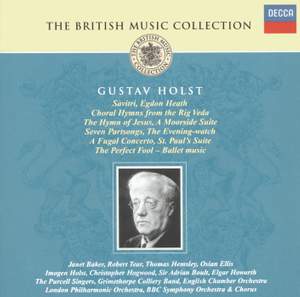
| |  | British Music Collection - Gustav Holst
Janet Baker (mezzo-soprano), Robert Tear (tenor), Thomas Hemsley (baritone), Osian Ellis (harp) Purcell Singers, English Chamber Orchestra, St Paul Chamber Orchestra, London Philharmonic Orchestra, BBC Symphony Orchestra, Grimethorpe Colliery Band, Imogen Holst, Christopher Hogwood, Adrian Boult, Elgar Howarth | | | In stock - usually despatched within 1 working day. |
|
|
| |  | Holst & Bax: Orchestral Works
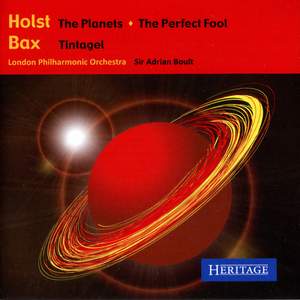
Heritage presents vintage Boult performances of Holst and Bax, transferred from vinyl with extraordinary results by former EMI engineer, Gary Moore. The 1954 recording of the planets comes from a Nixa LP (NPL 903) and The Perfect Fool and Tintagel were recorded a year later for Decca (LXT 5015). | | | Usually despatched in 8 - 10 working days. |
|
|
| |  | Holst: Symphony in F & A Hampshire Suite
| | | Usually despatched in 4 - 5 working days. |
|
|
| |  | On the Banks of the Green Willow
| | | Usually despatched in 2 - 3 working days. |
|
|
| |
|