All recordingsPrices shown exclude VAT. (UK tax is not payable for deliveries to United States.) See Terms & Conditions for p&p rates. | |  | Poulenc: Concerto pour deux pianos et orchestre, Concert Champêtre & Suite Française
After exploring the universe of Ravel, Anima Eterna continues its voyage of discovery through twentieth-century French music with Francis Poulenc. In Jos van Immerseel’s view, Poulenc is one of the most significant personalities of the twentieth century, coupling immense erudition with surprising spontaneity. Not to mention the fact that Poulenc was also a particularly brilliant pianist. The works presented in this recording are steeped in the French traditions of the sixteenth century (Suite Française for orchestra after Claude Gervaise) and the eighteenth (Concert champêtre for harpsichord (or piano) and orchestra). In the Concerto for two pianos, Poulenc breaks totally with the traditional concerto genre, liberating the form and the thematic development. Above all, the piece expresses the sheer pleasure of playing! “Of prime interest here are the instruments: Immerseel and his fellow pianist, Claire Chevallier, play on Erard concert grands dating from 1896 and 1902. Katerina Chrobokova eschews Wanda Landowska’s heavy-sounding 1912 Pleyel harpsichord in favour of a modern copy of a 1749 French instrument that sounds like a continuo rather than a soloistic voice...Poulenc’s wistful melodic nostalgia, sensual timbres and quirky wit guarantee illicit pleasure.” Sunday Times, 12th June 2011 *** “The dryest of kettle drums introduces a piquant "Concerto". The Mozartian accents are delivered with pithy wit, while Immerseel and Claire Chevalier play on flirty Erards. "Suite Française" sees the orchestra raid a stylistic dressing-up box, with shades of Berlioz and Bizet. "Concert Champêtre" has an urban tartness that belies its coy title.” The Independent on Sunday, 26th June 2011 “the Erard's mellow French polish does add a warm halo of colour to the central Larghetto, and by no means dampens the joie de vivre of the final. The orchestral playing is finely moulded to the pianos' spectrum of sonority so that after the initial shock of hearing something out of the ordinary, the performance yields up much in finesse, fluency and fun.” Gramophone Magazine, August 2011 “The Concerto for Two Pianos is part music hall romp, part Mozartian pastiche: Immerseel and Claire Chevallier play it for all its worth. The Suite Française for nine instruments is Poulenc’s touching tribute to 17th-century dance: a sensitive performance from Anima Eterna Brugge” Financial Times, 2nd July 2011 **** “Katerina Chrobokova's performance in the Concert Champetre is attractive in itself, assured and with a wide range of articulation.” International Record Review, July/August 2011 “Immerseel's enthusiasm for this music is evident from the explosion of tension and excitement in the opening of the Concert for Two Pianos...His chosen keyboard collaborators share his energetic quest to reveal the sharp contrasts between the old and the new in this music, especially in the delightful twists of the Concert champêtre.” Classic FM Magazine, September 2011 **** “Bruges's finest have made a stunning attempt to create the 1930s Parisian sound. As well as the orchestral poster-colours, they employ Erard pianos to give the Double Concerto an entrancing mix of overtones, adding an extra dimension to its gamelan effects...Everything is beautifully played; the only weakness in the performance is a stolidity about the wilder passages.” BBC Music Magazine, October 2011 **** “[The Concerto for Two Pianos] is brilliant, witty music. Slightly slower speeds don’t lead to heaviness, and Poulenc’s gamelan references are more pointed than usual. The slow movement’s Mozart pastiche is suavely elegant...The orchestral playing in the Concert champêtre is again brilliant...Wit and charm are present in spades.” The Arts Desk, 6th August 2011 | | | In stock - usually despatched within 1 working day. |
|
|
| |  | Debussy & Poulenc - Cello Sonatas
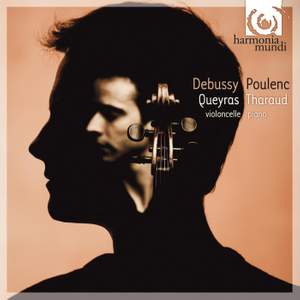
Debussy and Poulenc made a lasting impact on the musical identity of their country through both their references to the past and their innovations.This programme illustrates their vision of a certain esprit français: moving constantly between irony and emotion, extremely refined, yet at the same time offering an amplified echo of 'light' music - in short, the 'exquisite bad music' the creator of Les Mamelles de Tirésias prided himself on writing. Jean-Guihen Queyras and Alexandre Tharaud, upcoming interpreters of the young generation in France, have already made several recordings together and frequently programme these works in concert.Their recording of Schubert's Arpeggione Sonata was a Gramophone Editor's Choice. "I got to know the Poulenc sonata, thanks to Alexandre, who I believe (although I haven't yet managed to make him admit it) must have learnt to play this music before he started walking; it just seems to flow from his fingers as if it were second nature." J-G Queyras Long a soloist with the Ensemble Intercontemporain, Jean-Guihen Queyras was profoundly influenced by working with Pierre Boulez. His discography, distinguished by a musical eclecticism, includes works by Haydn (on period instruments) as well as Dvorák and 20th-century composers. He has premiered concertos by Ivan Fedele, Gilbert Amy, Bruno Mantovani and Philippe Schoeller (Wind's Eyes), some of which will be recorded for harmonia mundi in late 2008. Alexandre Tharaud devotes a large part of his activity to chamber music. His recording of Schubert's Arpeggione Sonata with Jean-Guihen received unanimous critical acclaim. An enthusiastic advocate of contemporary music, he premiered Thierry Pécou's cycle Outre-Mémoire, as well as his concerto L'Oiseau innumérable (HMC901974, July 2008). His recital programmes 'Hommages' intersperse harpsichord pieces by Rameau and Couperin played on the piano with tributes by living composers. “Vividly captured in a warm acoustic, Queyras and Tharaud's is an intimate approach which exactly suits the two short sonatas of Debussy and Poulenc, the former with its abrupt changes of direction and unpredictable mood swings, the latter brimful of Poulencian wit and, not surprisingly as it was sketched in 1940 (completed in 1948), replete with some self-plagiarising from Babar. These are fine accounts, the programme made even more attractive by the inclusion of the seven short movements of Poulenc's Suite française (1935) based on 16th-century dances by Claude Gervaise. It's a charmer. Apart from this, there are five other short works by the two composers making a truly delightful whole.” Gramophone Classical Music Guide, 2010 | | | In stock - usually despatched within 1 working day. |
|
|
| |  | Music for Organ, Brass & Percussion
“The music is so wonderful and Empire's performance is so good that you might forget that this arrangement eliminates the woodwind colors” American Record Guide | | | Usually despatched in 4 - 5 working days. |
|
|
| |  | ImagesMusical Pictures from Paris
Guitar Duo 'Fandango' - Claudia Hein and Kathrin Redlich | |
|
| |  | Poulenc: Organ Concerto & Concert champêtre
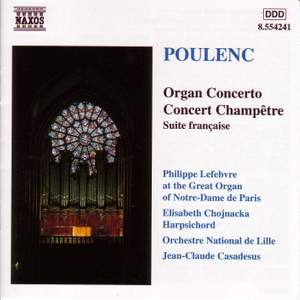
“Here is a worthy celebration of Poulenc's Centenery, a delightful feature of last years music-making. There is buoyant reading of the popular Organ Concerto in G minor which is played on the Great Organ of Notre-Dame in Paris. Here, registrations are spicy and rhythms springy. The Concert Champetre finds Poulenc in his cheeky vein, poking fun at the pastoral tradition. Good harpsichord playing here, and excellent orchestral work and conducting both in this piece and the Suite Francaise. Deft, witty music, excellently presented” Musical Opinion, January 2000 “Elisabeth Chojnacka gets off to a head start against most others who have recorded the Concertchampêtre by using the right kind of instrument: she understands that it's much sillier to play newish music on a period instrument than old music on a modern one. The effective proportions secured here between her deft playing and the orchestra also owe much to Jean-Claude Casadesus's nice sense of judgement and to the work of an excellent recording team. It was particularly perverse of Poulenc to ask a harpsichord to contend with large brass and percussion sections and then, a decade later, employ only strings and timpani in his concerto for the intrinsically far more powerful organ; and that perversity is underlined here by using the massive organ of Notre Dame, Paris – though once again the recording technicians have skilfully succeeded in producing a string sonority that doesn't suffer beside the organ's awesome thunders. You can't help wondering whether Poulenc really had such a giant sound in mind, but it's undeniably thrilling; and the quieter moments are captured with commendable clarity and calm. From the interpretative point of view, it's quite a performance. The wind and percussion of the Lille orchestra get a chance to demonstrate their quality in accomplished playing of the spry dances of the Suitefrançaise. This is an eminently recommendable disc.” Gramophone Classical Music Guide, 2010 | | | (also available to download from $6.00) | Usually despatched in 2 - 3 working days. (Available now to download.) |
|
|
| |  | Poulenc: Piano Music, Vol. 2
| | | (also available to download from $6.00) | Usually despatched in 2 - 3 working days. (Available now to download.) |
|
|
| |  | Shepherd's Hey
| | (Sorry, download not available in your country) | |
|
|
| |  | Poulenc - Works for Piano
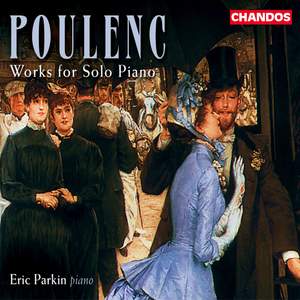
| | | (also available to download from $16.50) | Usually despatched in 2 - 3 working days. (Available now to download.) |
|
|
| |  | Poulenc: Un Siècle en France
| | | In stock - usually despatched within 1 working day. |
|
|
| |  | Poulenc - Concertos, Orchestral & Choral works
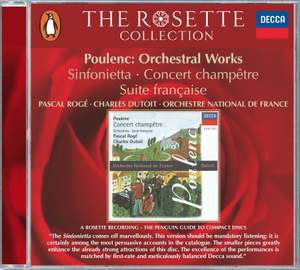
Françoise Pollet soprano (Gloria, Stabat Mater), François Le Roux baritone (Le Bal masqué, Le Bestiaire, Rapsodie nègre, Cocardes, Le Gendarme incompris, Quatre Poèmes de Max Jacob), Dominique Visse countertenor (Le Gendarme incompris), Lambert Wilson (Le Gendarme incompris), Chœur de Radio France (Gloria, Stabat Mater), François Polgár director, Maîtrise de Radio France (Litanies à la Vierge noire), Denis Dupays director, Pascal Rogé piano (Piano Concerto, Concerto for Two Pianos piano II, Aubade, Le Bal masqué, Rapsodie nègre); harpsichord (Concert champêtre), Sylviane Deferne piano (Concerto for Two Pianos piano I), Peter Hurford organ (Organ Concerto), , Pascal Saumon, Laurent Decker oboe, Philippe Hanon, Claude Fustin bassoon, Marc Bauer, Yves Coueffe trumpet, Sébastien Larrère, Jacques Fourquet, André Goudenhooft trombone, Bernard Balet percussion Philharmonia Orchestra & Orchestre National de France, Charles Dutoit | | | In stock - usually despatched within 1 working day. |
|
|
| |
|