All recordingsPrices shown exclude VAT. (UK tax is not payable for deliveries to United States.) See Terms & Conditions for p&p rates. | |  | Music For A While
| 
| | | In stock - usually despatched within 1 working day. |
|
|
| |  | Fauré & Duruflé: Requiems
Duruflé: | Requiem, Op. 9 Janet Baker (mezzo-soprano), Stephen Roberts (baritone), Timothy Hugh (cello) & John Butt (organ) Choir of King’s College, Cambridge, Sir Philip Ledger | Fauré: | Requiem, Op. 48 Robert Chilcott (treble), John Carol Case (baritone) & John Wells (organ) Choir of King’s College, Cambridge, Sir David Willcocks Pavane, Op. 50 Gareth Morris (flute) New Philharmonia Orchestra, Sir David Willcocks |
| | | In stock - usually despatched within 1 working day. |
|
|
| |  | The Very Best of Daniel Barenboim
Bartók: | Piano Concerto No. 1, BB 91, Sz. 83 | Beethoven: | Fantasia for Piano, Chorus and Orchestra in C minor, Op. 80 | Bizet: | Jeux d'enfants (Petite Suite), Op. 22 | Brahms: | Piano Concerto No. 2 in B flat major, Op. 83, 2nd movement | Bruckner: | Te Deum in C major, WAB 45 | Chopin: | Prelude Op. 28 No. 4 in E minor | Fauré: | Pavane, Op. 50 | Mozart: | Piano Concerto No. 23 in A major, K488 Piano Trio No. 6 in G major K564 Variations (10) in G major on Gluck's 'Unser dummer Pöbel meint', K455 Don Giovanni: excerpts Act 1 Scene 4 Symphony No. 41 in C major, K551 'Jupiter' - Finale |
Daniel Barenboim was born in Buenos Aires in 1942 and received his first piano lessons at age five from his mother. Later, he studied under his father, who would remain his only piano teacher. He gave his first public concert when he was seven and in 1952, he moved with his parents to Israel. At the age of ten, Barenboim gave his international debut performance as a solo pianist in Vienna and Rome, followed by Paris (1955), London (1956) and New York (1957). He began his recording career in 1954 as a pianist. He signed exclusively to EMI in 1966 and in the space of a few years he recorded the Beethoven Piano Sonatas, the Beethoven Piano Concertos (with Otto Klemperer), the Brahms Piano Concertos (with Sir John Barbirolli), and all the Mozart piano concertos with the English Chamber Orchestra, directing from the keyboard. Ever since his conducting debut in 1967 in London with the New Philharmonia Orchestra, Daniel Barenboim has been in great demand with leading orchestras around the world. He made his debut as an opera conductor at the Edinburgh Festival in 1973 with Mozart’s Don Giovanni and in 1981 he conducted for the first time in Bayreuth, where he would conduct every summer until 1999. His career continues to flourish with even-increasing success and he is now one of the most respected and admired musicians in the world. The first CD is devoted to Barenboim performing music by Mozart, beginning with the Piano Concerto No.23 in A (K488) with the English Chamber Orchestra directed from the keyboard by the young Barenboim soon after he began recording for EMI. Then we hear Barenboim in chamber music, in Mozart’s Piano Trio in G K564, recorded almost 40 years later, with the outstanding Danish violinist Nikolaj Znaider and the young Belarusian cellist Kyril Zlotnikov, whom Barenboim admires so much that he has loaned him the Peresson cello that had belonged to Barenboim’s wife, the late Jacqueline du Pré. Next comes Mozart’s set of Variations on ‘Les hommes pieusement’ by Gluck, and then Barenboim moves to the role of operatic conductor with the Mask Trio from Don Giovanni, recorded with the cast he conducted at the Edinburgh Festival in 1973. The CD concludes with the finale from Mozart’s famous ‘Jupiter’ Symphony in which Barenboim conducts the Orchestre de Paris, of which he was principal conductor from 1975 to 1989. CD 2 presents Barenboim in a wide range of contrasting repertoire, illustrating his extreme versatility as both pianist and conductor. The programme begins with Beethoven’s ‘Choral Fantasy’ which Barenboim conducts from the keyboard – no mean feat since the work involves a full symphony orchestra, a chorus and six vocal soloists, as well as the piano! The two movements from Bizet’s charming Jeux d’enfants are a further reminder of Barenboim’s time with the Orchestre de Paris, and then the opening movement from Bartók’s powerful First Piano Concerto gives Barenboim the opportunity to demonstrate his keyboard virtuosity in music of the 20th century. Chopin’s Prelude No.4 in E minor is a brief glimpse of Barenboim’s understanding of the music of this Polish genius before we move to the romantic third movement of Brahms’s monumental Second Piano Concerto with Barenboim as an inspired soloist. The last two pieces put Barenboim back in the role of conductor, firstly in Fauré’s hauntingly beautiful Pavane recorded in Paris and then in Bruckner’s magnificent Te Deum with the forces of the New Philharmonia Chorus and Orchestra and four distinguished vocal soloists. | | | In stock - usually despatched within 1 working day. |
|
|
| |  | Orff: Carmina Burana
Produced by EMI Classics in partnership with the prestigious National Gallery in London, The National Gallery Collection is a budget-price catalogue series bringing together the very best in fine art and classical music. The collection features a selection of classical masterworks in celebrated recordings from the EMI Classics catalogue, brought together with great artworks from The National Gallery’s permanent collection. | | | In stock - usually despatched within 1 working day. |
|
|
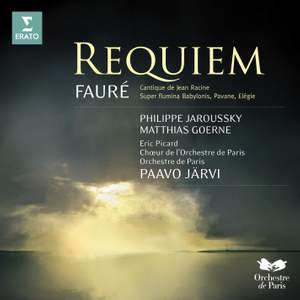
| |  | Fauré: Requiem & Cantique de Jean Racine
The second Virgin Classics CD from the Orchestre de Paris under its new Music Director, Paavo Järvi, is entirely devoted to Fauré, with his Requiem as the centrepiece. The soloists are baritone Matthias Goerne and, singing the Pie Jesu usually assigned to a soprano, countertenor Philippe Jaroussky. Paavo Järvi assumed his role as Music Director of the Orchestre de Paris at the beginning of the 2010-11 season and this, his second Virgin Classics recording with the orchestra, is based on concerts that took place in Paris in early 2011. Like its predecessor, a programme of Bizet released in Autumn 2010 (admired by the UK’s Observer for the “perfect athleticism and agility … provided in abundance by the Orchestre de Paris under its new conductor, Paavo Järvi), it is entirely devoted to music by one French composer -- here Gabriel Fauré. His serene, consoling Requiem is the main work on the CD, which also includes three other much-loved pieces and one little-known item. “For a conductor from outside France, working on French repertoire with a French orchestra is an exciting prospect, and l’Orchestre de Paris is consummate in this music,” comments Järvi. “I discovered French composers pretty early on, as I was getting to know the Romantic repertoire, with Fauré, Bizet and Dukas. Debussy and Ravel came later. They were a revelation for me.” (Ravel, of course, was a pupil of Fauré at Paris Conservatoire, where the older composer taught for many years.) The Requiem features two vocal soloists, usually a soprano and a baritone. Here, however, a countertenor – exclusive Virgin Classics artist Philippe Jaroussky – brings his ethereal timbre and sensitive phrasing to the poised Pie Jesu. His baritone colleague is the warm-toned German Matthias Goerne, acknowledged as on of today’s finest vocal recitalists. The Chœur de l’Orchestre de Paris also perform in three other works on the CD, the exquisite Pavane, with its flowing melody and mock-Rococo verses, and two early works to religious texts, the touching Cantique de Jean Racine and Super Flumina Babylonis (By the Rivers of Babylon). Completing the programme is a purely instrumental work, the reflective, but impassioned Elégie for cello and orchestra, in which the soloist is the Orchestre de Paris’ Principal Cellist, Eric Picard. “Jaroussky, breathtakingly angelic in what Saint-Saëns considered the only "Pie Jesu" worth performing. But it's Järvi's uncanny knack to somehow derive spiritual uplift from the gloomiest of subjects that most impresses here, a talent tailored to fit such needs.” The Independent, 9th September 2011 **** “On this showing, Jaroussky might more accurately be described as a countermezzo, since his fine high Fs (top line of the treble stave) are delivered with no sense of strain. Most of the time, he fits the historical bill in sounding more like a boy than a mezzo...Eric Picard plays the Elegie stylishly, supported by some lovely woodwind solos.” BBC Music Magazine, November 2011 *** “Järvi proves a surprisingly effective interpreter of the Requiem. His French orchestra and chorus lend the ‘Sanctus’ and ‘In Paradisum’ an appropriate air of mystic transcendence, and Matthias Goerne dignifies the ‘Libera me’. A countertenor may not be everyone’s choice for the ‘Pie Jesu’, but you can’t fault Philippe Jaroussky for purity.” Financial Times, 8th October 2011 **** “However admirable Paavo Järvi's performance of Fauré's Requiem may be, it's the motet Super Flumina Babylonis that provides the main focus on this disc... The choral singing is magnificent throughout...It's a nicely balanced recording, allowing us to appreciate the immense subtlety of Fauré's orchestration. The performance of the Cantique de Jean Racine is one of the most beautiful I know.” The Guardian, 13th October 2011 **** “Järvi's live recording packs a punch, the X-factor within its beautifully warm, full sound being a core strength that colours both timbre and interpretation and underpins even the light-textured, soprano-led In Paradisum. The vocal tones of both soloists slot into this sound world perfectly, with the casting of countertenor Philippe Jaroussky in the soprano role feeling surprisingly natural from the outset.” bbc.co.uk, 26th October 2011 “the real shock is just how well suited Jaroussky's countertenor turns out to be for the Pie Jesu. There is astonishing purity even in the very highest register and a level of restrained drama that transforms this into something of quite extraordinary impact...The real interest in this new disc is a rare outing for Faure's very first choral piece, Super flumina Babylonis...a remarkably serious and quite operatic utterance from an 18-year-old student” Gramophone Magazine, November 2011 “front-rank Faure. Emotional and cerebral intelligence are harnessed by Paavo Jarvi, a musician clearly dedicated to Faure's cause. Even the composer's familiar Pavane, done here with optional chorus and stripped of false sentiment, sounds fresh and new in its classical elegance.” Classic FM Magazine, December 2011 **** “The surprise in Paavo Järvi’s live recording of the full orchestral version is countertenor Philippe Jaroussky’s solo in the Pie Jesu, a gamble which comes off beautifully; Jaroussky’s otherworldly vocal perfect for this work...Järvi’s large choir make a pleasingly rich sound and the overall effect is more sincere and less cloying than it can be.” The Arts Desk, 5th November 2011 “[The] shorter pieces come off rather better than the Requiem, in which Järvi does not always sound very interested. This work does contain some very good things, however, particularly from the soloists, and certainly never falls below an acceptable level...Järvi injects a welcome touch of drama into the mid-section.” MusicWeb International, January 2012 | | | In stock - usually despatched within 1 working day. |
|
|
| |  | Albrecht Mayer: Bonjour Paris
Albrecht Mayer, principal oboe of the Berlin Philharmonic, celebrates a lifelong passion for France with this album of popular melodies, including favourites by Debussy, Fauré, and Ravel — plus the world-premiere recording of the impressionistic Été. “Mayer produces a velvety, ravishing sound of sensual purity. The authentic Gallic oboe tone is more nasal and plangent than Mayer's blemishless stream of eloquence, but when the results are so alluring I can't imagine anyone worrying unduly...Mayer sustains an astonishing level of musical poise, shaping every phrase to golden perfection.” Classic FM Magazine, June 2011 **** “Gotthard Odermatt's Été is a delightful modern piece in the style of Ravel at his most pastoral.” The Independent, 25th February 2011 *** | | | (Sorry, download not available in your country) | In stock - usually despatched within 1 working day. |
|
|
| |  | Fleur de Paris
The long-awaited new disc from the 12 Cellists of the Berliner Philharmoniker takes us on a journey of discovery through the musical landscape of France. In music spanning the best part of a century and covering several genres, the all-cello ensemble sings its way into our hearts, leaving us with “an inimitably French scent of nostalgia.” “We have long wanted to make a CD purely of French music,” the 12 Cellists write in an introductory note: “France produced many of the greatest cellists, including Pierre Fournier, Maurice Gendron and Paul Tortelier. In fact, the ensemble came into being some 35 years ago, when Jean Français wrote his Aubade especially for the 12 Cellists. When we were looking for music for our new CD, we found lots of pieces that - even if they hadn’t been originally written for our instrumental combination - were wonderfully suited to the sound of 12 cellos.” The central work on this recording is Poulenc’s most original choral score La figure humaine, composed in 1943 for two unaccompanied choirs of six voices each. Although rarely heard in the original setting, La figure humaine, based on eight poems by Paul Éluard, is perfectly suited to performance by The 12 Cellists. Over a span of nearly 20 minutes, it brings to mind, in turn, plainchant, organ textures, a Baroque dance, bits of popular melodies and resemblances to the work of Debussy and Ravel. The final poem is Liberté, which was dropped over German-occupied France during the War by the RAF and which has been described as a hymn to freedom from German-occupied France. Other album tracks include arrangements of Fauré’s Pavane, Ravel’s Pavane pour une infante défunte, Debussy’s Clair de lune and Satie’s Gymnopédies Nos. 1 & 2. From the sphere of popular song come Edit Piaf’s signature tune La vie en rose, two Michel Legrand numbers, The summer knows and Une femme est une femme and Fleur de Paris by Henri Bourtayre, made famous by Maurice Chevalier. Sous les ponts de Paris by the prolific Marseille composer Vincent Scotto evokes a stroll along the Seine while Hubert Giraud’s Sous le ciel de Paris is a familiar melody to many of us, even if we don’t know where we know it from. The 12 Cellists of the Berliner Philharmoniker, an orchestra within an orchestra, was formed in 1974 during the tenure of Herbert von Karajan. The ensemble counts as its godfathers Pablo Casals and Julius Klengel, a performance of whose Hymn for Twelve Cellos was their original raison d'être. In the intervening years, they have augmented their repertoire through commissions and arrangements in a wide variety of styles performed with guest artists on trumpet, clarinet, percussion, harp, double bass and more, drawn from different musical disciplines. Popular performers in concert halls around the world, the 12 Cellists of the Berliner Philharmoniker undertake regular tours both in tandem with the Orchestra and on their own. In the coming months, they will perform in Switzerland, Germany, Italy, and the Netherlands and on a tour of Asia. This is the 12 Cellists’ fifth recording for EMI Classics. Their previous releases were Angel Voices, music with sacred roots composed between the 16th and 21st centuries, As Time Goes By, mostly arrangements of film music, Round Midnight, a programme of classic Broadway songs, film themes, spirituals and jazz, and South American Getaway, featuring Villa-Lobos’s Bachianas Brasilieras Nos. 1 & 5 and tangos by Astor Piazzolla, among others. | | | In stock - usually despatched within 1 working day. |
|
|
| |  | Fauré - Music for Cello and Piano
Fauré: | Sicilienne, Op. 78 Cello Sonata No. 2 in G minor, Op. 117 Après un rêve, Op. 7 No. 1 (arr. Pablo Casals) Élégie in C minor, Op. 24 Romance in A major for cello & piano, Op. 69 Berceuse, Op. 16 (arr. for cello and piano) Papillon, Op. 77 Sérénade, Op. 98 Cello Sonata No. 1 in D minor, Op. 109 Pavane, Op. 50 (arr. H. Busser) |
Ina-Esther Joost Ben-Sasson (cello) & Allan Sternfield (piano) Fauré’s musical language bridged a gap between 19th-century Romanticism and the music that appeared with the new century, developing and evolving, but retaining its own fundamental characteristics. His gift for melody, subtle harmonic idiom, judicious and highly personal use of contemporary innovations make for enriching listening, whether in the popular Sicilienne, Pavane and other short pieces or in his two tuneful and impeccably crafted Cello Sonatas. Since receiving top prizes, including the Diploma of the Tchaikovsky Competition, Moscow, and First Prize of the International Cello Competition Belgrade, Ina-Esther Joost Ben-Sasson has been in high demand as a soloist all over the world. | | | (also available to download from $6.00) | In stock - usually despatched within 1 working day. |
|
|
| |  | Classic Brass
| | | In stock - usually despatched within 1 working day. |
|
|
| |  |
“Cherished memories for those who discovered the Fauré via this landmark recording, though it has not aged well. Ledger's Duruflé is much less leaden.” BBC Music Magazine, Proms 2007 **** “[The Fauré is] a recording as near as can be to absolute perfection from start to finish.” Gramophone Magazine | | | In stock - usually despatched within 1 working day. |
|
|
| |
|