Prices shown exclude VAT. (UK tax is not payable for deliveries to United States.) See Terms & Conditions for p&p rates. | |  | Tasmin Little plays Ravel, Poulenc, Debussy & Delius
Showcasing violinist Tasmin Little’s impressive versatility, these recordings highlight her sensitivity to both orchestral and chamber works. From the lyricism and blues-inspired melodies of Ravel’s Violin Sonata to the impassioned melodies of Delius’s Double Concerto, Little’s playing breathes life into every aspect of the music. | | | In stock - usually despatched within 1 working day. |
|
|
| |  |
| | | (also available to download from $6.00) | In stock - usually despatched within 1 working day. |
|
|
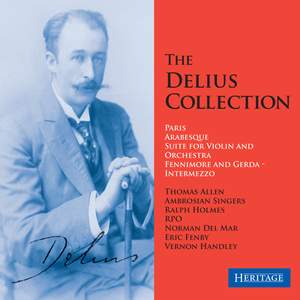
| |  | The Best of Delius
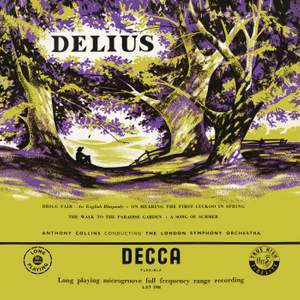
Five substantial pieces of 'classic' Delius are brought together on this remarkable and heartfelt tribute to the English composer (who spent very little of his actual career in England!), Frederick Delius. These mono recordings with the LSO and Anthony Collins are true Legends and for the Eloquence reissue have been remastered for optimum enjoyment. They represent Decca's earliest recordings of this composer's music - and arguably, the best. | | | In stock - usually despatched within 1 working day. |
|
|
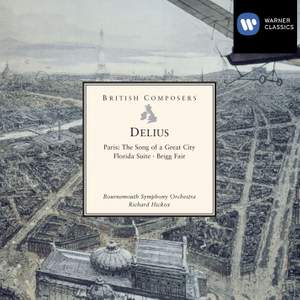
| |  | Delius: Orchestral Works
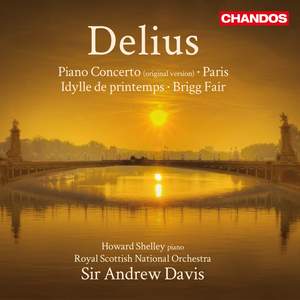
Of the works performed here by the Royal Scottish National Orchestra under the prominent Delius interpreter Sir Andrew Davis, the first three (Paris, the Piano Concerto, and Idylle de printemps) offer a fascinating insight into the early years of the development of Delius as a composer, when he was slowly and painstakingly honing his craft, and assuming the characteristic personal voice that is evident in more mature works such as Brigg Fair. Paris, sub-titled ‘The Song of a Great City’, is strongly inspired by the composer’s many years of living and working in Paris. With large-scale orchestral forces, Delius paints opulent pictures of a city that he obviously loved. The slow opening portrays the still darkness falling over Paris; then the music changes pace and takes us through the teeming and intoxicating nightlife of the city, with impressions of exuberant dance music coming from the many cafés and music-halls. The opening material returns, culminating in the sounds of the awakening streets. Until recently Delius’s Piano Concerto has been know exclusively in its final, one-movement form, which was first performed in London in 1907. The version recorded here, however, represents the composer’s earlier thoughts, from 1897. Performed by Howard Shelley, the work is brimming with full-bodied romanticism while showing the influences of Grieg and Liszt throughout. The airy mood of Idylle de printemps points to later depictions of nature in Delius’s music, as in Brigg Fair, which Delius categorised as ‘An English Rhapsody’. Cecil Gray, the Scottish music critic and composer, described the opening of Brigg Fair as ‘evoking the atmosphere of an early summer morning in the English countryside’. The work is based on a folk-tune which came to light in a competition instigated by Percy Grainger in 1905 to find ‘the best unpublished old Lincolnshire folk song or plough song’. Grainger was immediately taken with the folk-tune, and having arranged it himself for solo tenor and chorus, he approached Delius to write orchestral variations on it – urging him on as the only composer worthy of the task. Delius was soon persuaded, and Brigg Fair became one of his best-loved works. “Shelley and Sir Andrew Davis bring rather more in the way of epic ambition and romantic ardour to this likeable music [the Concerto] than do their Hyperion rivals, though at times greater rhythmic snap would not have gone amiss...As for the remainder, Davis makes a lovely job of the early Idylle de printemps.” Gramophone Magazine, November 2012 “Delius's piano writing isn't that of a natural virtuoso, but here Shelley transforms it with some really sensitive phrasing and an ability to make the patterns of the figuration sound idiomatic...Davis proves himself an instinctive Delian in the way he delineates the shifting moods and colours of Paris and Brigg Fair: these must be among the best current accounts of both works.” BBC Music Magazine, Christmas 2012 ***** “I believe that Andrew Davis is possibly the greatest conductor of this music since Beecham. Davis is so in touch with the unique qualities of Delius's genius as to cause one to stop and reconsider the music...I cannot image any of the works on this eminently desirable disc being better performed than they are here” International Record Review, December 2012 | | | (also available to download from $10.50) | Usually despatched in 2 - 3 working days. (Available now to download.) |
|
|
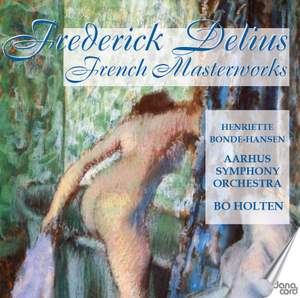
| |  | Delius: French Masterworks
With two of the previous releases in this Delius cycle receiving Gramophone Editor’s Choice status, this fourth title carries a rich pedigree and will not disappoint. Henrietta Bonde-Hansen is considered to be one of the leading Danish sopranos and has cemented her status through her career on the opera stage in France. As ever Bo Holten leads the Aarhaus Symphony Orchestra through the delights of this French inspired repertoire. “These works all receive sympathetic performances, with excellent playing by the Aarhus orchestra...And Henriette Bond-Hansel impresses in five settings of poems by Verlaine...this is a highly recommendable issue.” BBC Music Magazine, January 2013 **** | | | Usually despatched in 4 - 5 working days. |
|
|
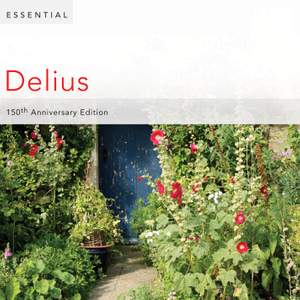
| |  | Essential Delius: 150th Anniversary
Delius: | Pieces (2) for Small Orchestra London Philharmonic Orchestra, Vernon Handley The Walk to the Paradise Garden London Symphony Orchestra, Sir John Barbirolli A Song before sunrise Royal Philharmonic Orchestra, Sir Malcolm Sargent Koanga: La Calinda Hallé Orchestra, Sir John Barbirolli Sleigh Ride Royal Philharmonic Orchestra, Sir Thomas Beecham Fennimore and Gerda: Intermezzo London Philharmonic Orchestra, Vernon Handley Irmelin Prelude London Symphony Orchestra, Sir John Barbirolli Summer Evening Northern Sinfonia of England, Richard Hickox Paris - Song of a Great City Royal Liverpool Philharmonic Orchestra, Sir Charles Mackerras In a Summer Garden Hallé Orchestra, Vernon Handley Hassan: Intermezzo Hallé Orchestra, Sir John Barbirolli A Song of Summer London Symphony Orchestra, Sir John Barbirolli To be sung of a summer night on the water, Nos. 1 & 2 Robert Tear (tenor) Choir of King’s College, Cambridge, Sir Philip Ledger Late Swallows London Symphony Orchestra, Sir John Barbirolli Dance Rhapsody No. 2 Royal Philharmonic Orchestra, Sir Thomas Beecham Cynara John Shirley-Quirk (baritone) Royal Liverpool Philharmonic Orchestra, Sir Charles Groves Brigg Fair Bournemouth Symphony Orchestra, Richard Hickox |
The best-loved and most popular works by Frederick Delius, performed by the world’s leading artists, in an accessible format at budget price as part of the ESSENTIAL CLASSICS series. | | | Usually despatched in 4 - 5 working days. |
|
|
| |  | Constantin Silvestri
Recorded: Winter Gardens, Bournemouth: 7 May 1965 / 1 December 1967 / 20 November 1967 / 6 December 1966 / 2 March 1967 / 5 January 1967 | |
|
| |  | Great Conductors - Beecham
| | | (also available to download from $8.75) | Usually despatched in 2 - 3 working days. (Available now to download.) |
|
|
| |  |
“This Brigg Fair is unique. What a lovely surprise to hear real London sparrows sharing the air space of St Augustine's Church with Delius's translated Lincolnshire larks (flute and clarinet) in the opening minutes of the work, albeit much more distantly. Very effective too are those almost still pools of string sound (early morning mists?), given the extended boundaries of this acoustic, and the familiar warmth and depth of tone Davis draws from the orchestra's strings. In the final magnificently broad climax (pealing bells, for once, very clear), you can't fail to be impressed by the depth, coherence and articulacy of the sound – hallmarks, indeed, of the entire disc. Davis's strings come into their own in the Walk to the Paradise Garden. For In a SummerGarden, Davis mutes his strings more often than Delius asks; but the reading's delicacy of texture and hazy, suffusing warmth are difficult to resist.” Gramophone Classical Music Guide, 2010 | | | Usually despatched in 4 - 5 working days. |
|
|
| |  | Sir Charles Mackerras: Master of Orchestral Texture
Although he was of Australian nationality Sir Charles Mackerras was actually born in Schenectady, New York in 1925. The family moved to Sydney when Mackerras was just three-years-old. In 1947 Sir Charles sailed for England with the intention of becoming a conductor and joined the Sadler's Wells orchestra as a wind player. He soon won a British Council scholarship to study conducting with Vaclav Talich in Prague and it was whilst there that he discovered and fell in love with the music of Janácek. Returning to London Sir Charles began his life-long association with Sadler's Wells Opera (now English National Opera), developing his reputation as a significant conductor of the works of Janácek, Handel, Gluck, Mozart, Britten, Sullivan and many others. As well as Sir Charles's first recording of Janácek's Sinfonietta, this 5-CD set also showcases him performing the music of other composers whose music he was particularly famed for the world over. Sir Charles died on 14 July 2010 at the age of 84. He remained active right up until his illness took over and, at the time of his death, he was scheduled to conduct at the 2010 Proms and the Edinburgh Festival. | | | In stock - usually despatched within 1 working day. |
|
|
| |
|