Prices shown exclude VAT. (UK tax is not payable for deliveries to United States.) See Terms & Conditions for p&p rates. | |  | Gennadi Rozhdestvensky conducts Mahler
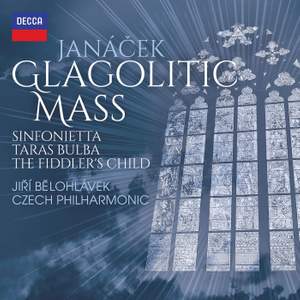
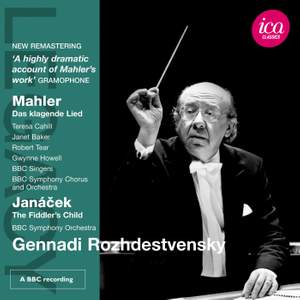
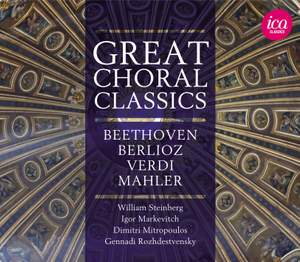
Only the most eminent and respected Russian musicians were allowed extensive foreign tours in the early 1960s, and Gennadi Rozhdestvensky was awarded this status. He appeared several times in Britain, mainly with the London Philharmonic Orchestra, and at Covent Garden. In 1971, he conducted the Leningrad Philharmonic Orchestra at the Proms. Rozhdestvensky became Artistic Director of the Stockholm Philharmonic Orchestra (1974–77 & 1991–95), and principal conductor of the BBC Symphony Orchestra (1978–81) and Vienna Symphony Orchestra (1980–82). He worked with the Berlin Philharmonic Orchestra, Royal Concertgebouw Orchestra, Chicago and Cleveland orchestras. He also is the honorary conductor of the Yomiuri Nippon Symphony Orchestra. Rozhdestvensky was the first Russian-born conductor to perform and record all Mahler’s symphonies in his country. Mahler’s Das klagende Lied is a rarity and here is performed live, complete in the original three-part edition The performance was reviewed by Gramophone magazine as follows: ‘Rozhdestvensky’s highly dramatic account of Mahler’s three-movement drama’. The recording was first issued in 1995 but deleted shortly afterwards with the demise of BBC Radio Classics. The ICA version has been completely remastered, restoring the wide dynamics of Rozhdestvensky’s magnificent performance. The distinguished soloists feature Dame Janet Baker, one of the greatest Mahler interpreters of the twentieth century. The CD also features another rarity – Janácˇek’s The Fiddler’s Child – from the 1979 Prague Festival. This live recording has never been issued before and is Rozdestvensky’s only taping of the work. Rozhdestvensky’s recordings of Tchaikovsky’s Symphony No.4 (ICAC5035) and Holst’s The Planets (ICAC5053) have received great critical acclaim. | | | (also available to download from $9.25) | In stock - usually despatched within 1 working day. |
|
|
| |  | Leos Janácek - Orchestral Works
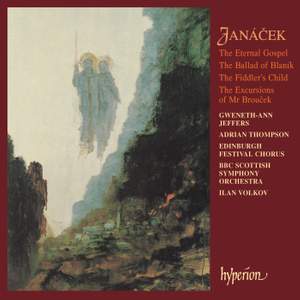
“Fans of the Glagolitic Mass should definitely make a beeline for Janácek's 1913 cantata The EternalGospel. Radiating a comparable spiritual and theatrical fervour, it's a setting of a text by Jaroslav Vrchlický inspired by the commentary on the Book of Revelation by the 12th-century mystic Joachim of Fiore, that serves up a seductive brew of rapt lyricism and tingling drama. Much of the solo vocal writing possesses a truly operatic scope and there are some memorably ardent choral interjections. The gifted young Israeli conductor Ilan Volkov masterminds a laudably disciplined and full-throated account of this bracing rarity, and the sound has commendable spread and amplitude (especially in its SACD format). The rest of the programme is no less enticing. The Fiddler's Child (1913) and The Ballad of Blaník (1919) are compact and often bewitchingly lovely tone-poems with patriotic leanings; and the disc concludes with an orchestral suite from the satirical two-part opera The Excursions of Mr Broucek (1908-17). A thoroughly diverting 21-minute sequence it makes, too: just try the fairground sway of the 'Moon Waltz' or the young lovers' ineffably tender tryst ('Before Dawn') that brings the curtain down on the first half. If it's festive spectacle you're after, the last two movements ('Song of the Hussites' and 'Procession of the Victors') have it by the spadeful. Performance-wise, there are no real grumbles. Although the music-making has not quite the irresistible tang you get from native interpreters in this repertoire, Volkov (not yet 30 and with talent to spare) directs with considerable flair and sensitivity. If their string section inevitably can't match up to, say, the Czech PO's for sheer heft or tonal lustre, the BBC Scottish SO play with admirable precision and infectious enthusiasm; leader Elizabeth Layton is a warm-hearted, songful presence in The Fiddler's Child. Hyperion's glowing natural sound-frame sets the seal on a first-rate anthology.” Gramophone Classical Music Guide, 2010 | | | In stock - usually despatched within 1 working day. |
|
|
| |  | Leos Janácek - Orchestral Works
“Janáček's 'legend' The Eternal Gospel is a seemingly odd undertaking for its agnostic composer… but its prophecy of a universal kingdom of love inspired him to music of surging lyricism. As Joachim, Adrian Thompson is suitably ardent and Slavic; as the Angel, Gweneth-Ann Jeffers with her slow vibrato is almost too Slavic. Soloists and chorus sing confidently in what's obviously carefully coached Czech. Elizabeth Layton contributes silvery violin solos, and under its young Chief Conductor Ilan Volkov the BBC Scottish Symphony Orchestra is idiomatic and incisive. The cantata is complemented by orchestral music from the same decade, the 1910s, when Janáček's extraordinary late-flowering genius was approaching its height... The performances are again excellent...” BBC Music Magazine, September 2005 **** “Fans of the Glagolitic Mass should definitely make a beeline for Janácek's 1913 cantata The Eternal Gospel. Radiating a comparable spiritual and theatrical fervour, it's a setting of a text by Jaroslav Vrchlický inspired by the commentary on the Book of Revelation by the 12th-century mystic Joachim of Fiore, that serves up a seductive brew of rapt lyricism and tingling drama. Much of the solo vocal writing possesses a truly operatic scope and there are some memorably ardent choral interjections. The gifted young Israeli conductor Ilan Volkov masterminds a laudably disciplined and full-throated account of this bracing rarity, and the sound has commendable spread and amplitude (especially in its SACD format). The rest of the programme is no less enticing. The Fiddler's Child (1913) and The Ballad of Blaník (1919) are compact and often bewitchingly lovely tone-poems with patriotic leanings; and the disc concludes with an orchestral suite from the satirical two-part opera The Excursions of Mr Broucek (1908-17). A thoroughly diverting 21-minute sequence it makes, too: just try the fairground sway of the 'Moon Waltz' or the young lovers' ineffably tender tryst ('Before Dawn') that brings the curtain down on the first half. If it's festive spectacle you're after, the last two movements ('Song of the Hussites' and 'Procession of the Victors') have it by the spadeful. Performance-wise, there are no real grumbles. Although the music-making has not quite the irresistible tang you get from native interpreters in this repertoire, Volkov (not yet 30 and with talent to spare) directs with considerable flair and sensitivity. If their string section inevitably can't match up to, say, the Czech PO's for sheer heft or tonal lustre, the BBC Scottish SO play with admirable precision and infectious enthusiasm; leader Elizabeth Layton is a warm-hearted, songful presence in The Fiddler's Child. Hyperion's glowing natural sound-frame sets the seal on a first-rate anthology.” Gramophone Classical Music Guide, 2010 | | | In stock - usually despatched within 1 working day. |
|
|
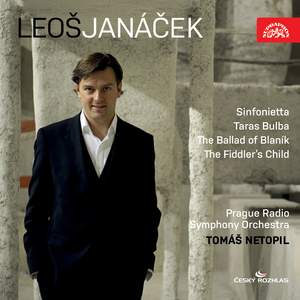
| |  | Janáček: Sinfonietta & Taras BulbaRecorded at the Rudolfinum, Prague, June 22-24 and 29, and September 30, 2012.
Prague Radio Symphony Orchestra, Tomáš Netopil The first new Czech recording of Janacek’s Sinfonietta and symphonic poems in many years. Janácek did not write a great quantity of symphonic works. Besides the Lachian Dances and an outline of the symphony Danube, they merely number the four compositions on this CD: three symphonic poems and the celebrated Sinfonietta. The symphonic poems, created within eight years between 1913 and 1920, reflect the turbulent political events and social tensions of the time, as well as Janácek’s keen interest in Czech and Russian literature. The Ballad of Blaník is based on a poem by Jaroslav Vrchlický, while The Fiddler’s Child was written to verses by Svatopluk Èech. When reading Gogol’s novella Taras Bulba, Janacek was impressed by its hero, a Cossack chieftain, and referred to the author as the “prophet of the Slavs”. Sinfonietta, indisputably the most significant Janacek orchestral piece, was premiered in June 1926 in Prague by Václav Talich with the Czech Philharmonic. Tomáš Netopil, the winner of the Sir Georg Solti International Conducting Competition and a regular guest of leading orchestras (Berliner Philharmoniker, London Philharmonic, etc.) and prestigious opera stages worldwide, has materialised his singular vision of Janacek’s music in the recording made with the splendid Czech Radio Symphony Orchestra. “[in The Ballad of Blaník & the Fiddler's Child] Netopil shows that he is a subtle and meticulous Janáček interpreter, while the Prague players prove they can produce playing of real delicacy and tonal refinement.” The Guardian, 23rd May 2013 *** | 
| | | Usually despatched in 4 - 5 working days. |
|
|
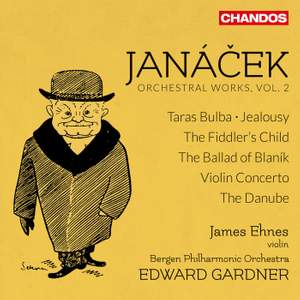
| |  | Janacek - Complete Orchestral Music Volume 2
| | | Usually despatched in 4 - 5 working days. |
|
|
| |  |
| | | (also available to download from $21.75) | Usually despatched in 2 - 3 working days. (Available now to download.) |
|
|
| |  |
| | | Usually despatched in 4 - 5 working days. |
|
|
| |
|