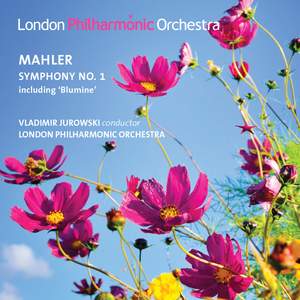
Prices shown exclude VAT. (UK tax is not payable for deliveries to United States.) See Terms & Conditions for p&p rates. | |  | Mahler: Symphony No. 1including original ‘Blumine’ movement
Recorded live at Southbank Centre’s Royal Festival Hall, London on 4 December 2010. Mahler’s First Symphony: the opening chapter of his spiritual autobiography. And the music itself seems to awaken – emerging from hushed strings and woodwind cuckoos into its stride, marching forth, stamping towards an eerie realisation of a nursery rhyme and arriving at a final, blazing affirmation of confidence. Vladimir Jurowski conducts the London Philharmonic Orchestra in this live 2010 concert performance including the Symphony’s original second movement, ‘Blumine’. “an undeniably fresh and often startling performance...Jurowski 'hears' everything but better yet the reasons for everything. His precipitous way with tempo contrasts creates moments of high drama in the outer movements...if ever there was a case for wanting the roar of applause, this is it.” Gramophone Magazine, June 2013 | 
| | | (also available to download from $10.50) | In stock - usually despatched within 1 working day. |
|
|
| |  | Mahler: Symphony No. 1
| | | In stock - usually despatched within 1 working day. |
|
|
| |  | Nicolai - Symphony in D major & Overtures
| | | In stock - usually despatched within 1 working day. |
|
|
| |  | Mahler - 4 Movements
Beside his nine completed symphonies and Das Lied von der Erde, Mahler wrote three ‘freestanding’ symphonic movements: i) Blumine (‘Flower Piece’) – originally the second movement of an orchestral work that became the Symphony No 1; ii) Totenfeier (‘Funeral rites’), the original first movement of the Symphony No 2, described by the composer as the burial of the (probably autobiographical) hero of the preceding symphony, and iii) the Adagio planned as the first movement of his Symphony No 10. Mahler died in 1911, leaving only this and the short third movement in something approaching a performable state; the symphony was finally completed in 1960 by Deryck Cooke. What The Wild Flowers Tell Me is Benjamin Britten’s arrangement, made in 1941, of the second movement of the Symphony No 3; his version preserves the essence of Mahler’s original, but in a practical version for reduced orchestra. At the time, Mahler’s symphonies were not a staple of the repertoire, and Britten – who felt a special affinity with the Austrian composer – was hoping to bring his work to a wider audience. Indeed, in 1967 Britten conducted the first modern performance of Blumine as an independent movement. The validity of the approach that Paavo Järvi and the Frankfurt Radio Symphony Orchestra take to Mahler was clearly proven at concerts in 2008: “The wide gamut of articulation favoured by the Principal Conductor of the Frankfurt Radio Symphony Orchestra found optimum opportunities for deployment. What The Wild Flowers Tell Me showed the musicians, on stunning form, seamlessly following Järvi’s direction, with its emphasis on subtlety, aristocratic refinement and bucolic modesty.” Frankfurter Rundschau “Gustav Mahler’s Totenfeier, which in its revised version became the first movement of his second symphony, is not a lament, but a ritual … Anyone who favours lush, Hollywood-style Mahler will not feel at home with Järvi and his orchestra; but anyone who wants to hear how this music works can expect a conclusive demonstration.” Frankfurter Rundschau Paavo Järvi has made recordings of music by Nordic and Estonian composers for Virgin Classics and he conducts his Frankfurt orchestra in a forthcoming release of Brahms’ Piano Concerto No 2 with Nicholas Angelich. “Järvi's meticulous separation of orchestral textures ensures maximum clarity, even in the nightmarish convulsions of "Totenfeier". The articulation is crisp, the sound clean.” The Independent on Sunday, 12th July 2009 “Järvi secures typically elegant and refined playing throughout and the sound is excellent.” Gramophone Magazine, Awards Issue 2009 | | | In stock - usually despatched within 1 working day. |
|
|
| |  | Mahler: Symphony No. 1
Uppsala Kammarorkester, Paul Mägi The Uppsala Chamber Orchestra is regarded by many as one of the finest chamber orchestras in Sweden. The orchestra is characterized by its flexibility in various styles, from early baroque to contemporary music, and its exquisite orchestral sound, both warm and lustrous. Paul Mägi took over from Howard Shelley in 2004 as the orchestra’s principle conductor. They perform on this new recording for Swedish Society, Mahler’s First Symphony. | | | (also available to download from $10.50) | Usually despatched in 2 - 3 working days. (Available now to download.) |
|
|
| |  |
The Netherlands Symphony Orchestra, alongside its illustrious Dutch counterpart The Concertgebouw Amsterdam, has a long tradition of Mahlerian performance. It is here led by its artistic director Willem de Vriend, in a recording of the 1893 “Hamburg” version of Mahler’s first symphony. This version bears the title Symphonic Poem in Two Parts, “Titan”, and includes the later discarded “Blumlein” movement. Jan Willem de Vriend is the artistic director of Combattimento Consort Amsterdam, the highly-rated early music group, and since 2006 the chief conductor and artistic director of the Dutch Symphony Orchestra. The DSO has taken a major role on the Netherlands’ musical scene, it has been involved in premieres of works by Offenbach, Say and Mahler, and by substituting historical instruments in the brass section, it has developed its own distinctive sound in the 18th and 19th century repertoire. Recently orchestra and conductor have embarked on a series of recordings of Beethoven’s complete symphonies. The first performance of the Symphonic Poem in Two Parts, later his First Symphony, was conducted by Mahler in Budapest on 20 November 1889, and received a cool if not hostile reception. This new recording is of the restored 1893 “Hamburg” version, and is made up of two parts and five movements. Part one, called “From the Days of Youth” contains the first three movements, with the later discarded “Blumlein” movement sandwiched between the first and the Scherzo, and Part two, “The Human Comedy”, consists of the Funeral March and the fifth movement, Finale: From Inferno to Paradise. “Known principally as an early music specialist, [de Vriend's] emphasis on clarity of articulation, hepled by excellent sound, allows the unusual aspects of the instrumentation to register more clearly...All fascinating stuff and unlikely to be trumped by a comparable issue...The music-making is winningly fresh and vigorous.” Gramophone Magazine, June 2010 | | | Usually despatched in 4 - 5 working days. |
|
|
| |  | Mahler: Symphony No. 1 in D major 'Titan' including "Blumine"
Sir Roger Norrington — arguably the most radical and influential pioneer of historically informed performance practice — was among the "first" to present the music of Schütz, Purcell, Handel, Mozart, Rossini, Beethoven, Brahms and Schumann on period instruments. Since the 2000 Season of the SWR Stuttgart, Sir Roger Norrington has begun a process of translating his period instrument experience to a modern symphony orchestra in the Romantic tradition. The result, has been what the maestro calls “Pure Tone” performance. Sir Roger writes of his “Pure Tone" approach to Mahler: “Although Mahler is a modern composer in so many ways, we try to play him as a 19thcentury composer instead of a 20th-century composer." Norrington’s interpretation succeeds in making Mahler's compositions the culmination of a Viennese tradition rather than a rebellion against it – telling his musicians to “Play it like Haydn!” This fabulous - and certain to be controversial - interpretation includes the lovely interlude for trumpet and strings (“Blumine”). Recorded following Sir Roger’s wildly successful tour of Japan with the SWR in 2004. The Tokyo audience not only gave this Norrington’s Mahler a ten-minute standing ovation but the concert was ranked as one of the Top Five Concert Events of the Year! This is Mahler as he has not been heard since he originally wrote the work, and is an essential listening experience today! | | | (also available to download from $10.50) | Usually despatched in 2 - 3 working days. (Available now to download.) |
|
|
| |  |
| | | Usually despatched in 4 - 5 working days. |
|
|
| |  | Mahler: Symphony No. 1 (including Blumine)
“Warm, rich full sound from Naxos with a wide an astonishing deep soundstage...its many virtues and budget price help it earn a recommendation.” Fanfare | | | (also available to download from $6.00) | This item is currently out of stock at the UK distributor. You may order it now but please be aware that it may be six weeks or more before it can be despatched. (Available now to download.) |
|
|
| |  | Mahler & Brahms: Lieder
Orchestra Orkest Golders, Yoav Talmi | | | Usually despatched in 2 - 3 working days. |
|
|
| |
|