All recordingsPrices shown exclude VAT. (UK tax is not payable for deliveries to United States.) See Terms & Conditions for p&p rates. | |  | Eugene Ormandy Conducts Tchaikovsky and MussorgskyRecorded live at the Academy of Music, Philadelphia, 1978 (Mussorgsky) / 1979 (Tchaikovsky)
Kirk Browning, Director Famous violinist Itzhak Perlman and Eugene Ormandy, long-standing conductor of the Philadelphia Orchestra recorded this fantastic Russian program live at the Academy of Music, Philadelphia, in 1978 and 1979 in extraordinary sound quality. Modest Mussogorsky’s most famous piano composition Pictures at an Exhibition which is deemed to be one of Ormandy’s specialties is orchestrated in the acclaimed Ravel version. Tchaikovsky’s Violin Concerto, which is considered as one of the best known and technically most challenging works for violin, is performed by Itzhak Perlman - undeniably the reigning virtuoso of the violin – who has also been called “one of the greatest musical talents to emerge since World War II” according to violin expert Tully Potter, New Grove. The concert is directed by the Peabody Award winner Kirk Browning, who is highly acclaimed for staging classical concerts due to his long-time experience as television director and producer. Picture format: NTSC, 4:3 Sound formats: PCM-STEREO, DD 5.1, DTS 5.1 Region code: 0 Booklet Notes: German, English, French Running Time: 89 mins | 
| | | In stock - usually despatched within 1 working day. |
|
|
| |  | Tchaikovsky: Mstislav Rostropovich & Benjamin Britten
Britten: | Gloriana (extracts) Bonus. Snape Maltings Concert Hall, Aldeburgh, 5 June 1970 Peter Pears (tenor) The Aldeburgh Fesitval Singers | Tchaikovsky: | Variations on a Rococo Theme, Op. 33 Snape Maltings Concert Hall, Aldeburgh, 16 June 1968 Mstislav Rostropovich (cello) Pezzo capriccioso, Op. 62 for cello & orchestra (or cello & piano) Snape Maltings Concert Hall, Aldeburgh, 16 June 1968 Mstislav Rostropovich (cello) Romeo & Juliet - Fantasy Overture Snape Maltings Concert Hall, Aldeburgh, 16 June 1968 |
“These recordings represent an overview of twenty of the most heady years of Mstislav Rostropovich’s career, during which he made his name in the West, was exiled from his homeland for his support of dissident artists, poets and musicians, and established himself as a major international force for (not just the musical) good.” (Chris de Souza) Introduced to Britten through Shostakovich, his teacher, Rostropovich formed a close partnership with the British composer – as evident here in their collaborative performances from the opening concert of the new Snape Maltings Concert Hall, which includes rare audiovisual footage of the Maltings before it was destroyed by fire in 1969 and rebuilt. Rostropovich’s Aldeburgh performance of Variations on a Rococo Theme displays him at the peak of his powers and is a wonderful example of his partnership with Britten, of whom this is rare conducting footage. The excerpts from Britten’s opera Gloriana (the contemporary poetic name for Elizabeth I), included as the bonus of this DVD, are a highly significant addition to the composer’s discography. While Britten conducted recordings of most of his operas on disc, Gloriana was not one of them, so this is the only hint we have of his approach to any of the score. The well-chosen sections, forming an unusual concert suite, include The Lute Song performed by Peter Pears. This is the first release of this material on DVD, and is available in time for the Britten centenary in 2013. Sound format: Enhanced Mono DVD format: NTSC Picture format: 4:3 Running time: 68’ Subtitles: n/a Menu languages: English Booklet languages: E/F/G Region code: 0 Territory Restrictions: None “it is a joy to see the two musicians in partnership. Britten sympathetically accompanying with the ECO...The 'bonus' is a real treat: Britten conducting excerpts from Gloriana...both chorus and orchestra are fully alert to Britten's every gesture - a truly electrifying performance” BBC Music Magazine, January 2013 **** | | | In stock - usually despatched within 1 working day. |
|
|
| |  | Tchaikovsky: Symphony No. 6 'Pathétique’, Op. 74
The Swedish Chamber Orchestra and Thomas Dausgaard here perform two works by Pyotr Tchaikovsky as part of their “Opening Doors” series. The series presents large-scale Romantic symphonic works with the clarity that a chamber orchestra can offer. Previous recordings include a full cycle of Schumann’s symphonies, Dvořák’s ‘New World Symphony’, and Symphony No. 2 by Bruckner. The works here come from either end of Tchaikovsky’s career and are linked by the tragedy apparent in their endings. “The virtues are self-evident: Dausgaard elicits some impressively accomplished and consistently bright-eyed playing, textures are sifted with watchful care...and his readings are abundantly musical, free of eccentricity and eschew any spurious expressive posturing...their innate good taste and sense of classical equilibrium never allowing the listener to forget for one moment Tchaikovsky's veneration of Mozart.” Gramophone Magazine, January 2013 “Tchaikovsky's textures are never problematically dense, but some of Dausgaard's tempi, especially his breakneck speed for the third-movement march, undermine the extra crispness the smaller-than-usual string section might have achieved.” The Guardian, 1st November 2012 *** | | | (also available to download from $10.50) | In stock - usually despatched within 1 working day. |
|
|
| |  | Celibidache conducts Tchaikovsky & Franck
Celibidache focused very much on concert performances rather than recordings. He aimed to make his concerts “transcendental experiences”. | | | (also available to download from $10.50) | In stock - usually despatched within 1 working day. |
|
|
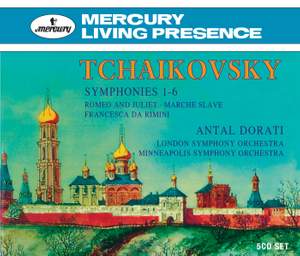
| |  | Tchaikovsky: Capriccio Italien. Francesca da Rimini, Romeo and Juliet & Nutcracker Suite
Four of Tchaikovsky’s most popular orchestral works make their appearances here in historic Decca and Philips recordings appearing internationally on CD for the first time. Most travellers to Italy content themselves with writing postcards. Tchaikovsky, on the other hand, wrote a popular symphonic work. His Capriccio italien was inspired by impressions made upon the composer during a three-month stay in Rome during the winter of 1879–80. This colourful and exciting work was first heard at the end of 1880, and right from the start, it was a popular success. Tchaikovsky prepared a suite of excerpts for concert performance even before The Nutcracker was completed. The Russian musicologist Boris Asafyev perceptively called this suite a ‘symphony about childhood’. Indeed, among Tchaikovsky’s major works, it is notable for its lack of fatalism and hysteria. These two joyous pieces encase two of Tchaikovsky’s greatest tone poems about star-crossed lovers. Its opening depicts the terrifying panorama of the second circle of Hell, Francesca da Rimini tells the story of Paolo and Francesca, condemned to damnation for a kiss. Shakespeare also found a home on Tchaikovsky’s proverbial bedside table. Many composers have found inspiration in the Bard’s famous ‘star-cross’d’ lovers. Tchaikovsky counted his contribution to this genre, the Romeo and Juliet Fantasy Overture, among his very best works. The Sussex-born conductor Anthony Collins left a treasured legacy for Decca, including the symphonies and selected tone poems by Sibelius. The Dutchman Eduard van Beinum was revered by orchestras for his generosity of spirit and for a time conducted both ‘his’ Concertgebouw in Amsterdam as well as the London Philharmonic simultaneously. “The LSO under Collins provides balletic grace and drama. Van Beinum conducts the smoother-sounding LPO and Concertgebouw in engaging accounts of Romeo and Nutcracker.” BBC Music Magazine, March 2012 *** “Decca's new Capriccio Italien opens with wonderfully resonant trumpet-calls (surely far more impressive than the Italian Royal Cuirassiers ever could have made them sound in their barracks for Tchaikovsky's benefit !) ; and indeed it continues throughout with recording of a very high standard […] Francesca da Rimini [is notable for the] warm quality of recording … seldom can a gong have sounded more menacing than at the beginning here … this Francesca quite certainly must have [an] unhesitating recommendation” Gramophone Magazine “Everything Eduard van Beinum recorded was distinctive … the electricity and finesse of the performances is never in doubt … The Nutcracker is beautifully played and … the ear is taken by the neat, scaled down effect of the Overture, the gentle delicacy of the Sugar-Plum Fairy and the elegance of the lovely Waltz of the flowers, with ripe horns and resonant cello playing.” Gramophone Magazine | | | In stock - usually despatched within 1 working day. |
|
|
| |  | From Russia with Music
| | | In stock - usually despatched within 1 working day. |
|
|
| |  |
Legendary cellist Pierre Fournier's stereo recording of the Dvorak Cello Concerto is well known, but his earlier recording from July 1954 for Decca is largely forgotten. It is revived in this Kubelik-led anthology, also bringing back to the catalogue the conductor's mono version of the Janacek Sinfonietta and his electrifying account of Tchaikovsky's love poem Romeo and Juliet, both recorded in March 1955. All recordings make their first international appearance on CD. | | | In stock - usually despatched within 1 working day. |
|
|
| |  | Tchaikovsky - Symphonies Nos. 5 & 6
| | | In stock - usually despatched within 1 working day. |
|
|
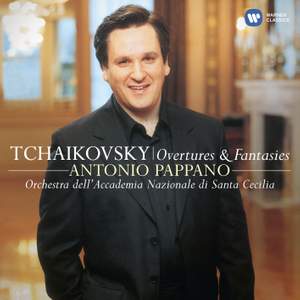
| |  | Tchaikovsky - Overtures & Fantasies
“A generous Tchaikovsky spectacular in masterly hands” BBC Music Magazine, October 2009 “With chorus added in the 1812 as well as the Waltz from Eugene Onegin, this is an exceptional Tchaikovsky collection, a fine start for Antonio Pappano's recordings with his Italian orchestra. What is very striking is how refreshing the 1812 is when played with such incisiveness and care for detail, with textures clearly defined. It starts with the chorus singing the opening hymn, expanding thrillingly from an extreme pianissimo to a full-throated fortissimo. A women's chorus then comes in very effectively, twice over, for one of the folk-themes, and at the end the full chorus sings the Tsar's Hymn amid the usual percussion and bells, though Pappano avoids extraneous effects, leaving everything in the hands of the orchestral instruments. It is equally refreshing to have the Waltz from Eugene Onegin in the full vocal version from the opera, again wonderfully pointed, as is the Polonaise which follows. What comes out in all the items is the way that Pappano, in his control of flexible rubato, is just as persuasive here as he is in Puccini, demonstrating what links there are between these two supreme melodists. So he builds the big melodies into richly emotional climaxes without any hint of vulgarity, strikingly so in both Francesca da Rimini and Romeo and Juliet. Pappano is impressive in bringing out the fantasy element in Francesca, and in Romeo the high dynamic contrasts add to the impact of the performance. There have been many Tchaikovsky collections like this, but with well balanced sound, outstandingly rich and ripe in the brass section, this is among the finest.” Gramophone Classical Music Guide, 2010 “Like the very best music directors, you can’t pigeon-hole Antonio Pappano. He may have made his name with Puccini but he’s got an instinctive feel for structure and for style that makes him good at most things. His Tchaikovsky doesn’t disappoint, full of vigour, of tunefulness” Gramophone Magazine | | | In stock - usually despatched within 1 working day. |
|
|
| |  | Tchaikovsky: Symphony No. 4
| | | In stock - usually despatched within 1 working day. |
|
|
| |
|