Prices shown exclude VAT. (UK tax is not payable for deliveries to United States.) See Terms & Conditions for p&p rates. | |  | Great Australasian Organs Vol 8: The Norman & Beard Organ of Wellington Town Hall, New Zealand
This fine Norman and Beard Organ stands untouched in Wellington Town Hall in New Zealand. Douglas Mews, the Town hall organist plays an exciting progamme of little recorded music to suit this fabulous instrument. Recorded January 25th and 26th 2010 | | | Usually despatched in 8 - 10 working days. |
|
|
| |  | Karajan Spectacular Volume 1Studio Recordings 1946-1958
Berlioz: | Le carnaval romain Overture, Op. 9 Studio Recording, 1958 Philharmonia Orchestra | Debussy: | La Mer Studio Recording, 1953 Philharmonia Orchestra | Liszt: | Les Préludes, symphonic poem No. 3, S97 Studio Recording, 1958 Philharmonia Orchestra | Strauss, J, II: | An der schönen, blauen Donau, Op. 314 Studio Recording, 1946 Wiener Philharmoniker | Tchaikovsky: | Romeo & Juliet - Fantasy Overture Studio Recording, 1946 Wiener Philharmoniker |
| |
|
| |  | The Philadelphia Orchestra play Tchaikovsky & Ewald
Ewald: | Brass Quintet No. 1, Op. 5 David Bilger (trumpet), Jeffrey Curnow (trumpet), Jennifer Montone (French horn), Nitzan Haroz (trombone) & Carol Jantsch (tuba) Brass Quintet No. 3, Op. 7 David Bilger (trumpet), Jeffrey Curnow (trumpet), Jennifer Montone (French horn), Nitzan Haroz (trombone) & Carol Jantsch (tuba) | Tchaikovsky: | Romeo & Juliet - Fantasy Overture The Philadelphia Orchestra, Christoph Eschenbach Serenade for strings in C major, Op. 48 The Philadelphia Orchestra, Christoph Eschenbach Francesca da Rimini, Op. 32 The Philadelphia Orchestra, Christoph Eschenbach |
This new recording by The Philadelphia Orchestra and Christoph Eschenbach features a unique coupling of Tchaikovsky’s most popular orchestral pieces with two rarely recorded brass quintets by Victor Ewald, performed by the Orchestra’s outstanding brass principals. Both Peter Tchaikovsky and Victor Ewald were active composers in St. Petersburg's musical life during the same time and familiar with each other’s work. Esteemed by all lovers of brass music, Ewald’s Quintets are imbued with romantic Russian national feeling. This is the concluding ninth CD to be released under the “formidable Ondine-Eschenbach-Philadelphia partnership” (Gramophone), which since 2005 has produced discs that have been honored with accolades including BBC Music Magazine’s Disc of the Month, Gramophone’s “Editor’s Choice,” The New York Times’ “Top Ten Recordings of the Year,” and the German Record Critics’ Award, among others. “In Francesca da Rimini Eschenbach and his meticulously prepared band ride the Allegro vivo whirlwind with prodigious skill...[the Ewald quintets] are delectably tuneful and idiomatically crafted morsels, delivered with wonderful poise and very real affection by the Philadelphia's top-flight principals.” Gramophone Magazine, September 2010 “Christoph Eschenbach's approach to the Serenade is big and sumptuous...he [hits] the heights of the love theme [in Romeo & Juliet] with aristocractic aplomb and he always reminds you what a fabulously organised symphonic movement this is.” BBC Music Magazine, October 2010 ***** | | | (also available to download from $21.00) | Usually despatched in 2 - 3 working days. (Available now to download.) |
|
|
| |  | ItalyVerona and Romeo and Juliet - Florence - Naples
The Places Our tour of Italy stars in Verona, with its reminiscences of Romeo and Juliet. Then to Florence, for some 300 years, from 1434, the seat of the powerful Medici family, whose artistic patronage has left an impressive cultural legacy. The tour ends in the south, with Naples, originally a Greek colony and later a Roman port, and then capital of a kingdom, ruled by Normans and later from Spain. Briefly a Habsburg possession, from 1734 it belonged to the Bourbons, before the unification of Italy in 1860. The Music Tchaikovsky stayed in Florence on two occasions in 1878, after the disaster of his marriage, hastily contracted, had led him to seek respite abroad. A visit to Rome in 1880 led to the composition of the Italian Capriccio and his opera The Queen of Spades was written in 1890 in Florence, recalled in the same year in his Souvenir de Florence. The other music heard here is the Fantasy Overture, Romeo and Juliet, written in 1869 and based on Shakespeare's play, set in Verona. | | | Usually despatched in 2 - 3 working days. |
|
|
| |  | Pavel Kogan conducts Tchaikovsky
Moscow State Symphony Orchestra, Pavel Kogan | | | Usually despatched in 8 - 10 working days. |
|
|
| |  | Bruno Walter conducts Tchaikovsky & Mahler
The New York Philharmonic and Vladimir Horowitz play Tchaikovsky’s Piano Concerto No. 1 in a performance recorded live at the Carnegie Hall April 1948 – a legendary performance! Also the Romeo and Juliet Overture with the Los Angeles Philharmonic Orchestra from June 1942. | | | Usually despatched in 2 - 3 working days. |
|
|
| |  | Tchaikovsky - Symphony No. 4 & Romeo and Juliet
A wonderful programme featuring two of Tchaikovsky’s most enduring and popular pieces. Once again Hans Vonk conducts the St Louis Symphony Orchestra in live performances recorded at the Powell Symphony Hall in 1997 and 1999. | | | Usually despatched in 2 - 3 working days. |
|
|
| |  | Tchaikovsky - Romeo and Juliet & Hamlet
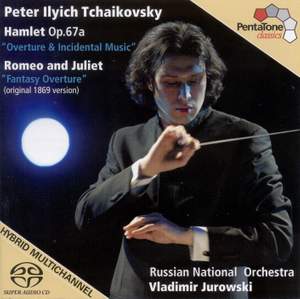
Any recording on PentaTone with Vladimir Jurowski must be regarded as an event and this release certainly lives up to its promise. Russian conductor and Russian orchestra play this astounding music with full romantic panache! “The best music, in the Entr'actes, comes from elsewhere - namely a much more distinguished stage project, The Snow Maiden, the alla tedesca of the Third Symphony and the rather lovely Elegy in Honour of Ivan Samarin. Jurowski seems to care here especially for the latter. The rest is played with spirit by a Russian National Orchestral sounding in increasingly better shape - it still has some way to go - and Ophelia's music is affectingly sung by the lovely lyric soprano Tatiani Monogarova.” BBC Music Magazine, February 2009 **** “Vladimir Jurowski’s highly focused conducting makes Tchaikovsky’s overture and incidental music for ‘Hamlet’ leap off the page. A galvanised Russian orchestra displays blistering strings, pleasingly
punchy woodwind…a must-buy disc.” The Independent on Sunday, 14th December 2008 “Think you know your Tchaikovsky? Think again…..Hamlet gives us a glimpse into a composer with a theatre director’s sensibility – he knows when to lend urgency to the players without overwhelming
them, the music heightening but never upstaging….Jurowski and his forces offer playing of drive and passion.” Gramophone Magazine, March 2009 CD of the Month “At first glance this might look like the traditional pairing of Tchaikovsky's two fantasy overtures – but you might have known that Vladimir Jurowski was likely to be more inquisitive than that. In 1891 a complete stage performance of Shakespeare's Hamlet took place in St Peters- burg with music by Tchaikovsky. His fantasy overture, written for a charity event three years earlier, was heard again, this time filleted to roughly half its original length and reduced in scoring to the requirements of a theatre orchestra. The results are fascinating, not least for the ingenuity of Tchaikovsky's cut-and-paste job, jump-cutting now with renewed urgency. Of course, one misses the symphonic weight of the original. The effect is more muted here, the scale diminished so as not to pre-empt that moment in the actual drama. But Ophelia is more than ever at the heart of the piece, her plaintive oboe melody very much dominating this version and exquisitely played – as is everything – by the Russian National Orchestra, whose refinement has opened a new chapter in Russian orchestral playing. Ophelia's first entrance, incidentally, is none other than the graceful 'Alla tedesca' second movement of Tchaikovsky's Third Symphony, the Polish. How's that for recycling? And there's more with the Prelude to Act 4 scene 1, a poignant string elegy turned on wistful arabesques. That is one of the more substantial of the 16 clips and touchingly foreshadows Ophelia's tragedy. She – the lovely Tatiana Monogarova – has a twopart Mad Scene or 'melodrama' where the spoken lines lend a stark reality to her delusions. Those who know the original 1869 version of the Romeo and Juliet Fantasy Overture will be aware that it's another example of how much more interesting, though not necessarily better, a composer's first thoughts can be. Fascinating is the earlier premonition of the great love theme and the way Tchaikovsky quite literally tosses it about in the more radical and certainly more violent development of the fight music: all gone in the revision! Jurowski savours the differences and makes capital of the anomalies. Very exciting.” Gramophone Classical Music Guide, 2010 | | | (also available to download from $10.50) | Usually despatched in 2 - 3 working days. (Available now to download.) |
|
|
| |  | Tchaikovsky - Symphonies Nos. 4 & 5
| | | Usually despatched in 4 - 5 working days. |
|
|
| |  | Tchaikovsky - Symphony No. 6
| | | Usually despatched in 2 - 3 working days. |
|
|
| |
|