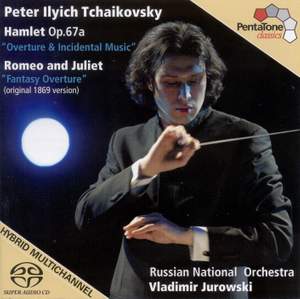
All recordingsPrices shown exclude VAT. (UK tax is not payable for deliveries to United States.) See Terms & Conditions for p&p rates. | |  | Tchaikovsky - Romeo and Juliet & Hamlet
Any recording on PentaTone with Vladimir Jurowski must be regarded as an event and this release certainly lives up to its promise. Russian conductor and Russian orchestra play this astounding music with full romantic panache! “The best music, in the Entr'actes, comes from elsewhere - namely a much more distinguished stage project, The Snow Maiden, the alla tedesca of the Third Symphony and the rather lovely Elegy in Honour of Ivan Samarin. Jurowski seems to care here especially for the latter. The rest is played with spirit by a Russian National Orchestral sounding in increasingly better shape - it still has some way to go - and Ophelia's music is affectingly sung by the lovely lyric soprano Tatiani Monogarova.” BBC Music Magazine, February 2009 **** “Vladimir Jurowski’s highly focused conducting makes Tchaikovsky’s overture and incidental music for ‘Hamlet’ leap off the page. A galvanised Russian orchestra displays blistering strings, pleasingly
punchy woodwind…a must-buy disc.” The Independent on Sunday, 14th December 2008 “Think you know your Tchaikovsky? Think again…..Hamlet gives us a glimpse into a composer with a theatre director’s sensibility – he knows when to lend urgency to the players without overwhelming
them, the music heightening but never upstaging….Jurowski and his forces offer playing of drive and passion.” Gramophone Magazine, March 2009 CD of the Month “At first glance this might look like the traditional pairing of Tchaikovsky's two fantasy overtures – but you might have known that Vladimir Jurowski was likely to be more inquisitive than that. In 1891 a complete stage performance of Shakespeare's Hamlet took place in St Peters- burg with music by Tchaikovsky. His fantasy overture, written for a charity event three years earlier, was heard again, this time filleted to roughly half its original length and reduced in scoring to the requirements of a theatre orchestra. The results are fascinating, not least for the ingenuity of Tchaikovsky's cut-and-paste job, jump-cutting now with renewed urgency. Of course, one misses the symphonic weight of the original. The effect is more muted here, the scale diminished so as not to pre-empt that moment in the actual drama. But Ophelia is more than ever at the heart of the piece, her plaintive oboe melody very much dominating this version and exquisitely played – as is everything – by the Russian National Orchestra, whose refinement has opened a new chapter in Russian orchestral playing. Ophelia's first entrance, incidentally, is none other than the graceful 'Alla tedesca' second movement of Tchaikovsky's Third Symphony, the Polish. How's that for recycling? And there's more with the Prelude to Act 4 scene 1, a poignant string elegy turned on wistful arabesques. That is one of the more substantial of the 16 clips and touchingly foreshadows Ophelia's tragedy. She – the lovely Tatiana Monogarova – has a twopart Mad Scene or 'melodrama' where the spoken lines lend a stark reality to her delusions. Those who know the original 1869 version of the Romeo and Juliet Fantasy Overture will be aware that it's another example of how much more interesting, though not necessarily better, a composer's first thoughts can be. Fascinating is the earlier premonition of the great love theme and the way Tchaikovsky quite literally tosses it about in the more radical and certainly more violent development of the fight music: all gone in the revision! Jurowski savours the differences and makes capital of the anomalies. Very exciting.” Gramophone Classical Music Guide, 2010 | | | (also available to download from $10.50) | Usually despatched in 2 - 3 working days. (Available now to download.) |
|
|
| |  |
| | | (also available to download from $10.50) | Usually despatched in 2 - 3 working days. (Available now to download.) |
|
|
| |  | Alexander Gauk Edition Volume 1
Arensky: | March, in memory of Suvorov Characteristic Pieces (24), Op. 36: In the Fields Waltz in F major, from: 6 Children’s Pieces Op. 34 | Beethoven: | Coriolan Overture, Op. 62 | Bizet: | Patrie Overture, Op. 19 | Casella: | Italia, Op. 11 | Dukas: | The Sorcerer's Apprentice | Enescu: | Romanian Rhapsody in A major, Op. 11 No. 1 | Glazunov: | Spring, Op. 34 Waltz in D major Op. 42 No. 3 | Glinka: | Premiere Polka in B Flat Major Kamarinskaya Memory of Friendship Patriotic Song | Ivanov-Radkevich: | Russian Overture | Khachaturian: | Spartacus Suite Symphony No.1 in E minor | Liszt: | A Faust Symphony, S108 | Mendelssohn: | Ruy Blas Overture, Op. 95 | Miaskovsky: | Symphony No. 17 in G sharp minor, Op. 41 | Milhaud: | Suite Provençale | Prokofiev: | Flourish, Mighty Land Op. 114 Russian Overture, Op. 72 | Rachmaninov: | Three Russian Songs, Op. 41 Evegeny Kibkalo (baritone) | Rimsky Korsakov: | The Song of Oleg, The Wise Dmitri Tarkhov (tenor), Konstantin Polyaev (bass) | Shostakovich: | Symphony No. 5 in D minor, Op. 47 Symphony No. 11 in G minor, Op. 103 'The year 1905' | Tchaikovsky: | The Seasons, Op. 37b (omitting May & August) Hamlet: Overture & Incidental Music |
USSR State Radio & TV Symphony Orchestra & Chorus, Alexander Gauk This set presents a great opportunity to become more familiar with the charismatic Russian conductor, Alexander Gauk. He was also a composer but is probably better known for his orchestral arrangements, notably of Tchaikovsky’s ‘The Seasons’, included in this set. Gauk also reconstructed the score of Rachmaninoff’s first piano concerto from the parts in 1945, thus enabling further performances after its disastrous première in 1897. He had a preference for Russian music which is shown here, eight out of the ten CDs being devoted exclusively to Russian composers. Many of the most prominent Russian conductors of the twentieth century were once pupils of Alexander Gauk, for example, Evgeny Mravinsky and Evgeny Sveltanov. Gauk, who died in 1963, was one of those talented Russian musicians who rarely had the opportunity to experience the western lifestyle yet his fame did reach beyond his mother country. Apart from featuring some of today’s better known symphonies by Shostakovich (Nos. 5 and 11) and the aforementioned ‘The Seasons’, the Gauk Edition comprises seldom performed works by Arensky, Balakirev (Islamey), Myaskovsky (Symphony No. 17) and Glinka and Rimsky-Korsakov. | | | In stock - usually despatched within 1 working day. |
|
|
| |
|