All recordingsPrices shown exclude VAT. (UK tax is not payable for deliveries to United States.) See Terms & Conditions for p&p rates. | |  | Debussy: Orchestral Works
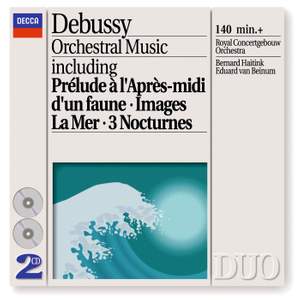
This generous disc brings together all of Pierre Monteux’s Debussy recordings for Decca and Philips. Encompassing some of Debussy’s major orchestral works, these performances have a fluidity and atmosphere about them in recordings that have worn their years lightly. Monteux omits ‘Sirènes’ in his recording of the Nocturnes – a practice not atypical of recordings of the work in the 1950s and 1960s. “The orchestra play beautifully but the music often hangs fire’ [Images] … ‘As well as the expected orchestral refinement there is an overall sweep - the clouds passing steadily overhead and the Fêtes celebrated with tingling vitality’ [Nocturnes] … ‘Monteux’s reading evokes the cool, classical world of the faun” MusicWeb International (Prélude) “Monteux's Debussy was without peer, comparable to that other great Decca artist, Ernest Ansermet but the recording of the 'San Sebastien' fragments was made for Philips and it has been accorded star status ever since its issue in 1963” Classical Net “Monteux’s sensitive, colourful performances reveal his deep immersion in the Debussyian idiom. He [offers a] relaxed interpretation that revels in Ibéria’s Spanish coloring, while Prelude to the Afternoon of a Faun passes by like a serene interlude. ‘Nuages’ also flows effortlessly and unrushed, allowing for Debussy’s tangy harmonies to fully emerge, and ‘Fêtes’ sparkles with vibrant energy … The London Symphony … plays beautifully, with impressive tonal and rhythmic precision.” Classics Today | | | (Sorry, download not available in your country) | In stock - usually despatched within 1 working day. |
|
|
| |  | Debussy: La Mer, Images & Prélude à l’après-midi d’un faune
After discs devoted to Ravel and Poulenc (ZZT060901 & ZZT110403 - critical and popular successes, the latter measured in sales), Jos van Immerseel returns to French music, tackling Debussy and his most famous orchestral works. This he does brilliantly well, of course, relying on historic instruments with the aim of blending a singular vision of these scores with a highly rigorous approach. “[Immerseel] sees beyond the mere timbre itself and looks to the bristling impact that the music must have made when it was new...the freshness of Debussy's imagination is underlined by performances that have a strong dramatic impulse inflected with all manner of expressive subtleties that bring the music to life...Anima Eterna's disc approaches it with a compellingly rejuvenated outlook.” Gramophone Magazine, February 2013 “Van Immerseel's approach can seem a bit too deliberate; there's something ponderous about Prélude à l'Après-Midi...it's the orchestral Images that gains most from the brighter, rawer colours of this performance, with the myriad subtleties of Debussy's scoring more beguiling than ever.” The Guardian, 1st November 2012 **** “Woodwind, brass and strings are highly individuated: the solo flute is blanched in tone, the trombones broad and warm. For sound alone, it is a fascinating experiment, though van Immerseel’s tempi are somewhat indulgent.” The Independent on Sunday, 25th November 2012 **** | | | In stock - usually despatched within 1 working day. |
|
|
| |  | Debussy: Orchestral Works
Before Sir Simon Rattle took over the helm of the Berlin Philharmonic Orchestra, he poured all his resources as the conjurer of Early Modern music into his work with the City of Birmingham Symphony Orchestra. One of the best documents of this cooperation is his set of recordings of the Impressionist orchestral scores of Claude Debussy. | | | In stock - usually despatched within 1 working day. |
|
|
| | .jpg) | Debussy: Orchestral Works
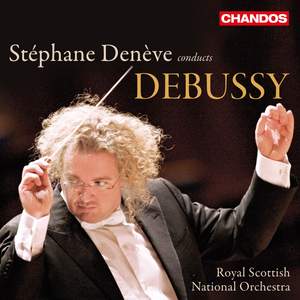
Recognised internationally as a conductor of the highest calibre, Stéphane Denève took up the post of Music Director of the Royal Scottish National Orchestra in 2005, and has since attracted attention from audiences and critics alike. This May, the conductor bids a fond farewell to Scotland and the RSNO with a series of ‘Au Revoir’ concerts, and of course, this disc of orchestral works by Debussy. After the impact made by the production of Pelléas et Mélisande in 1902, the next orchestral work by Debussy was awaited with intense interest. La Mer did not disappoint, and is today widely considered to have been crucial in its influence on twentieth-century music. After completing this work, Debussy spent no fewer than seven years wrestling with what were to become Images for orchestra. Some critics were puzzled by the work and suggested that Debussy’s talent might have dried out. They were promptly put right in an article by Ravel, who accused them of ‘slowly closing their eyelids before the rising sun amid loud protestations that night is falling’. With a sultry flute solo, Prélude à l’après-midi d’un faune opened an astonishing new world for western music. Debussy based this composition on a poem by Mallarmé, who wrote to the composer: ‘I have come from the concert, deeply moved: A miracle! that your illustration of L’Après-midi d’un faune should present no dissonance with my text, other than to venture further, truly, into nostalgia and light…’ The three Nocturnes feature some of Debussy’s most imaginative orchestral writing. In the words of the composer, ‘the title Nocturnes is… not meant to designate the usual form of a nocturne, but rather all the various impressions and the special effects of light that the word would suggest’. Debussy provided descriptions of the three movements. ‘Nuages’, for example, depicts ‘the slow, melancholy procession of the clouds, ending in a grey agony tinged with white’, and also the experience of standing ‘on the Pont de Solférino very late at night. Total silence. The Seine without a ripple, like a tarnished mirror’. “his Debussy is his own, muscular yet transparent, colouristic yet atmospheric and mysterious...Even that symphonic warhorse La Mer sounds freshly reimagined by the young Frenchman, whose sense of the music’s ebb and flow, with surging climaxes, is unerring...an ideal way to acquire Debussy’s orchestral masterpieces” Sunday Times, 3rd June 2012 “Denève still summons a sensuous bloom in the Prélude, and thanks to his influence, the RSNO proves better than the French at their own game: these are among the most seductive Debussy performances I have heard in years.” Financial Times, 9th June 2012 **** “Denève has clear ideas about the lucidity of Debussy’s scoring and he conducts the orchestra in a way that brings the poetic or visual pictures that inspired the music vividly and freshly to life...All are performed with finesse and with a combination of energy, discretion and colour that give them a luminous quality.” The Telegraph, 22nd June 2012 *** “Denève shows how precise were [Debussy's] choices of instrumental colour and how well-defined and animated the images he was expressing through his music...There is nothing vague about these performances; rather they convey both the dynamism and the delicacy of the music with understanding and stimulating freshness.” Gramophone Magazine, August 2012 “his meticulous attention to detail is impressive, but what should be a complex, living seascape remains stubbornly one-dimensional...Outwardly brilliant, inwardly dull. Perplexing.” MusicWeb International, August 2012 | | | (also available to download from $21.50) | In stock - usually despatched within 1 working day. |
|
|
| |  | Fauré: Requiem
| | | In stock - usually despatched within 1 working day. |
|
|
| |  | Debussy: La Mer, Images, Nocturnes & Jeux
When Claude Debussy (1862-1918) composed his Prélude à l'après-midi d'un faune in 1894, nothing quite like it had been heard before. At the time it totally revolutionised music and set a new path for music in the century to come. It was during 1905 that Debussy spent some months residing in Eastbourne in England where he completed one of his greatest works – La Mer (The Sea). He had taken refuge in England with his pregnant mistress, Emma Bardac, to escape the scandal caused by the attempted suicide of his then wife. Shortly after returning to Paris, Bardac gave birth to Debussy's only child, Claude-Emma, to whom he dedicated the piano original of his Children's Corner. The Ballet score Jeux was Debussy's last orchestral work, being written in 1912 for Diaghilev's Ballet Russes with choreography by Nijinsky. It is a complex piece, made up of many small musical cells and changes of tempo. | | | In stock - usually despatched within 1 working day. |
|
|
| |  | Debussy: Orchestral Works Volume 3
The music of three nations – Britain, Spain and France – inspired Debussy’s Images for orchestra, which occupied him from 1905 to 1912. Originally conceived for two pianos (Images I and II for solo piano are on 8.550253), this third set draws on several folk songs in its outer movements, the tripartite middle movement evoking in musical terms Spanish sights, sounds and fragrances. Vivid orchestrations by both Debussy and Ravel of short piano pieces likewise embrace contrasting moods and national characters. Volumes 1 (8570759) and 2 (8570993) in this series have been highly praised. “Jun Märkl persuades his orchestra to extremes of vulgarity and tenderness, which is as it should be in the extraordinary Images. They also catch the ambivalence of mood that marks these pieces...there is much here to enjoy.” BBC Music Magazine, June 2010 **** “In Jun Märkl’s expert hands one can immediately sense Debussy…[Märkl] magically evokes iridescent textures from which points of sound emerge like piquant sources of light on a canvas. A captivating performance enhanced by four bonus orchestrations.” Classic FM Magazine | | | (also available to download from $6.00) | In stock - usually despatched within 1 working day. |
|
|
| |  | Debussy - Orchestral Works
This volume of Debussy’s orchestral works under Ernest Ansermet brings together all of the composer’s acknowledged masterpieces together with some of the shorter pieces. The rare 1951 recording of Prélude à l’après-midi d’un faune and the 1949 recording of the Images make their first appearance on CD. Ansermet’s second recording of La Mer – he also recorded the piece for Decca in 1947, 1957 and 1964 – his first of the Nocturnes, and the early stereo version of Jeux are, likewise, all rarities. The anthology is completed with an authentically French-sounding Rapsodie pour clarinette as well as a lush Clair de lune and a delectable Petite suite. | | | In stock - usually despatched within 1 working day. |
|
|
| |  | Debussy: Images & Printemps
| | | In stock - usually despatched within 1 working day. |
|
|
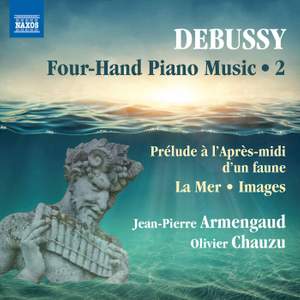
| |  | Debussy TranscriptionsTranscriptions of Debussy for 2 pianos and transcriptions by Debussy for piano 4 hands or for 2 pianos
Jean-François Heisser & Georges Pludermacher (pianos) | | | In stock - usually despatched within 1 working day. |
|
|
| |
|