Prices shown exclude VAT. (UK tax is not payable for deliveries to United States.) See Terms & Conditions for p&p rates. | |  | Music for string trio
| | | In stock - usually despatched within 1 working day. |
|
|
| |  |
Sonia Bergamasco, Pietro De Maria Contempoartensemble, Trio Artes, Mauro Ceccanti In Attractive Collectors Edition Metal Packaging | | | In stock - usually despatched within 1 working day. |
|
|
| |  | Schoenberg: Concerto for String Quartet and Orchestra
| | | Usually despatched in 4 - 5 working days. |
|
|
| |  | Schoenberg, Webern & Schnittke: String Trios
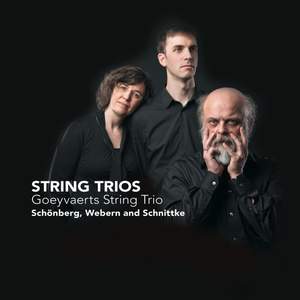
The Goeyvaerts String Trio, which was founded in 1997 and focuses exclusively on 20th and 21st century repertoire, perform works of the Second Viennese School by Schoenberg and Webern as well as the powerful and emotional String Trio of 1985 by Russian composer Alfred Schnittke. Arnold Schoenberg’s pupil Leonard Stein recalls that the composer apparently meant the many strange, seemingly incoherent events in the String Trio op. 45 as a musical depiction of the delirium that he experienced after his recent heart attack. Although dating from two decades earlier, Anton Webern’s String Trio op. 20 (1927) is, like Schoenberg’s, a work written according to serial principles. The development of Alfred Schnittke’s String Trio (1985) seems to have been a very intense emotional experience for the composer. It is fairly well known just how much Schnittke, as a Soviet composer, suffered under the cultural isolation imposed on him by the Soviet authorities. The Goeyvaerts String Trio owes its name to the late Flemish composer Karel Goeyvaerts (1923-1993) who played a key role in the fundamental changes in European new music. They have collaborated with several major contemporary composers including Giya Kancheli and Peter Swinnen, as well as performers such as Alexander Ivashkin (cellist and biographer of Alfred Schnittke), and Henk Guittart of the Schoenberg Quartet. “...this disc juxtaposes what are probably the most characterful string trios from the entire 20th century...Webern comes off best in these hyper-intense, rather over-resonant recordings, with the balance between lyricism and drama, and between dance-like and more fragmented rhythmic patterns, generally well realised.” Gramophone Magazine, Awards Issue 2010 | | | Usually despatched in 4 - 5 working days. |
|
|
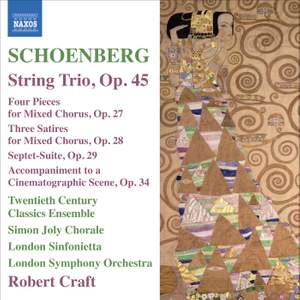
| |  | Schoenberg - String Trio, Op. 45
Schoenberg: | String Trio, Op. 45 Rolf Schulte (violin), Richard O’Neill (viola) & Fred Sherry (cello) Four Pieces for Mixed Chorus, Op. 27 Simon Joly Chorale & Members of the London Sinfonietta Three Satires for Mixed Chorus, Op. 28 Simon Joly Chorale & Members of the London Sinfonietta Septet (Suite) in E flat major, Op. 29 Rolf Schulte (violin), Fred Sherry (cello), Christopher Oldfather (piano), Charles Neidich and Alan R. Kay (clarinets), Michael Lowenstern (bass clarinet) & Toby Appel (viola) Accompaniment to a Cinematographic Scene, Op. 34 London Symphony Orchestra |
Craft has twice won the Grand Prix du Disque, as well as the Edison Prize for his landmark recordings of Schoenberg, Webern and Varèse, and countless other awards. Craft’s consummate artistry and unique insight continue to bear fruit with this volume featuring diverse works spanning more than twenty years of Schoenberg’s controversial and highly influential career. “Robert Craft was put on this earth to produce clear blueprints of Schoenberg and Stravinsky scores.” Gramophone “An intriguing assortment...Insightful performances” BBC Music Magazine, May 2010 **** “The performance has the right idea in not attempting to gloss over the discontinuities [of the String Trio]...[these players] give a good sense of the way angry expression dissolves into wistful lyricism at the end...Schoenberg's voice...is heard to powerful effect.” Gramophone Magazine, June 2010 “The latest in Craft’s Schoenberg series for Naxos is a bizarre but bracing sequence. First comes the late, great String Trio, a profoundly concentrated but expressively liberated single span...and afterwards the Septet-Suite, one of his most dazzling essays, played with fierce gusto.” Sunday Times, 11th April 2010 *** “the late, febrile String Trio of 1947 [is] played with wiry intensity by Rolf Schulte, Richard O'Neill and Fred Sherry” The Guardian, 18th March 2010 *** | | | (also available to download from $6.00) | Usually despatched in 2 - 3 working days. (Available now to download.) |
|
|
| |  | Mozart & Schoenberg: Piano Trios
| | | (also available to download from $10.75) | Usually despatched in 2 - 3 working days. (Available now to download.) |
|
|
| |  | Schoenberg: Verklärte Nacht & String Trio Op. 45
| | (Sorry, download not available in your country) | |
|
|
| |  |
| | | This item is currently out of stock at the UK distributor. You may order it now but please be aware that it may be six weeks or more before it can be despatched. |
|
|
| |  |
Sonia Bergamasco, Pietro De Maria Contempoartensemble, Trio Artes, Mauro Ceccanti | | | Usually despatched in 4 - 5 working days. |
|
|
| |  | The RIAS Second Viennese School ProjectBerlin 1949-1965
Berg: | Lyric Suite - for string quartet (1926) Four Pieces for Clarinet and Piano, Op. 5 Sieben frühe Lieder Schliesse mir die Augen beide (1907 version) Schliesse mir die Augen beide (1925 version) | Schoenberg: | Pierrot lunaire, Op. 21 Chamber Symphony No. 1 in E major, Op. 9 Piano Concerto, Op. 42 Phantasy for Violin with Piano Accompaniment, Op. 47 Das Buch der Hängenden Gärten, Op. 15 De Profundis (Psalm 130), Op. 50b for mixed choir a cappella Klavierstücke (3), Op. 11 Kleine Klavierstücke (6), Op. 19 Klavierstücke (5), Op. 23 Klavierstück, Op. 33a Klavierstück, Op. 33b String Trio, Op. 45 Suite in G for String Orchestra Phantasy for Violin with Piano Accompaniment, Op. 47 | Strauss, J, II: | Rosen aus dem Süden, Op. 388 arr. Schoenberg Schatz-Walzer, Op. 418 arr. Webern | Webern: | Passacaglia for Orchestra, Op. 1 Five Pieces for Orchestra Op. 10 Four pieces for violin & piano, Op. 7 (1910) |
This 4-CD boxed set presents historic recordings of works by Arnold Schoenberg, the founding father of 20th-century modern music, and his most prominent pupils, Alban Berg and Anton Webern. These recordings, made between 1949 and 1965, comprise works which were written between 1906 and 1950, thus portraying practically the entire era of the Viennese School. Not only do they trace the multi-layered compositional developments of the Viennese School, but they are also significant musical and historic documents of multi-faceted interpretational approaches towards this music. The Viennese School was formed before the First World War as a movement in music attempting to unite radical expressive techniques and traditional form concepts, demanding specially trained interpreters for this undertaking. In these RIAS recordings, first-rate artists from the circle of the three Viennese composers can be heard: Rudolf Kolisch, Eduard Steuermann, Winfried Zillig and Else C. Kraus were immediately shaped by their teacher, Schoenberg, whereas others, such as Peter Stadlen and Tibor Varga were in contact with the composer, or with Webern or Berg. Ferenc Fricsay or Suzanne Danco, on the other hand, did not belong to the circle of the Viennese School and its performance teachings. Their interpretations are of particular interest as they brought these works to life, unprejudiced by performance traditions of this music which, at that time, was hardly performed. The comparison of the two recordings of Schoenberg’s 'Fantasy for Violin and Piano', Op. 47, with Kolisch and Varga respectively, and the sensational interpretation of Schoenberg’s 'Pierrot Lunaire' by the Munich singer Irmen Burmester alongside an outstanding instrumental ensemble under the direction of Josef Rufer (1949) are particular highlights of this anthology. These radio recordings were made possible thanks to the indefatigable initiative of the music writer Hans Heinz Stuckenschmidt in his role as Editor of New Music at the RIAS. He and his colleague Josef Rufer, who can be heard as conductor, ensured that those musicians who had returned from exile would be engaged to contribute to these radio documents. By doing so, Stuckenschmidt and Rufer intended, on the one hand, to continue the tradition of Schoenberg’s stay in Berlin from 1925 until 1933, and, on the other hand, to provide the music of the Viennese School with greater resonance within public awareness. This edition is complemented by the publication of a text by Prof Dr Rudolf Stephan, the doyen of research into the Viennese School in Germany after the Second World War and editor of the complete works of Arnold Schoenberg and Alban Berg. He reflects on his comprehensive experiences with the music of the Viennese School, stretching back to the years immediately following the end of the war. “Hard to exaggerate the richness of these four CDs...Irmen Burmester insightfully takes the Sprechstimme in a vivid Pierrot lunaire...[Stadlen] is a commanding soloist in Schoenberg’s Piano Concerto” Sunday Times | | | (also available to download from $36.25) | In stock - usually despatched within 1 working day. |
|
|
| |
|