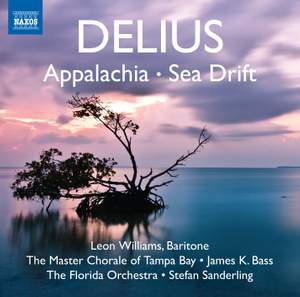
All recordingsPrices shown exclude VAT. (UK tax is not payable for deliveries to United States.) See Terms & Conditions for p&p rates. | |  | Delius: Appalachia & Sea Drift
Leon Williams (baritone) The Master Chorale of Tampa Bay & The Florida Orchestra, Stefan Sanderling Appalachia (a native American word for North America) is a set of variations based on a slave song about the tragedy of the cotton planters ‘being sold down the river’. Delius heard the song when teaching the violin in Virginia, but the primary inspiration was his formative experience of the semi-tropical beauty of Florida’s Solano Grove where he had managed an orange plantation. In Sea Drift Delius absorbed a further American influence in the nature mysticism of Walt Whitman. The symphonic poem, one of his greatest works, is a song of love and death in which the baritone soloist is both a participant in the drama and offers a commentary upon it. “This fine orchestra has a superb violinist leader (crucial in Sea Drift) plus serious class in every department, the brass in particular. The choral singing, too, is exemplary in its firm-toned accuracy...Sanderling's approach to both works is at once more tight-reined and more sweeping than the familiar Beecham/Groves/Hickox way.” BBC Music Magazine, Christmas 2012 **** “Sanderling's interpretation of this imaginative score is sympathetic, especially in the protracted evocation of the dawn. The tempi are well chosen and the handling of Delius's poetic orchestration, not least in its richer Straussian garb, is nicely poised. The chorus also evinces a sense of quasi-informality in its 'free' sound and delivery.” Gramophone Magazine, December 2012 | | | (also available to download from $6.00) | In stock - usually despatched within 1 working day. |
|
|
| |  | Elgar: The Dream of Gerontius
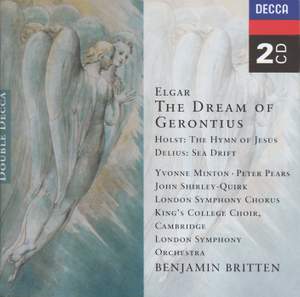
Delius: | Sea Drift John Shirley-Quirk London Symphony Chorus, Royal Philharmonic Orchestra, Richard Hickox | Elgar: | The Dream of Gerontius, Op. 38 Peter Pears, John Shirley-Quirk, Yvonne Minton The Choir of King's College, Cambridge, London Symphony Chorus, London Symphony Orchestra, Benjamin Britten | Holst: | The Hymn of Jesus, H140 BBC Chorus, BBC Symphony Orchestra, Adrian Boult |
| | | (Sorry, download not available in your country) | In stock - usually despatched within 1 working day. |
|
|
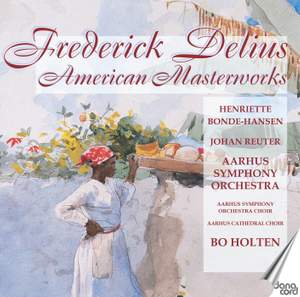
| |  | Delius: American Masterworks
Henriette Bonde-Hansen (soprano), Johan Reuter (baritone), Simon Duus (baritone) Aarhus Symphony Orchestra Choir, Aarhus Cathedral Choir, Aarhus
Symphony Orchestra, Bo Holten The final volume in this ground breaking Delius cycle, truly a magnificent achievement by the Danish label Danacord. All volumes have been produced by the Deutsche Grammophon team of Lennart Dehn and Stephan Flock. This series of Delius recordings marks a defining point in the available works of this composer and should be the corner stone of any music collection. “Following albums devoted to Delius’s Scandinavian, English and French music, Holten and his Danish orchestra now turn to the composer’s American years – with the same rapturous results....[Sea Drift] showcas[es] Holten’s ear for Delian harmony, Reuter’s virile singing and the Aarhus chorus’s clean, clear contributions.” Financial Times, 15th February 2013 **** “This is the fifth and last of Danacord's fine series of 'Delius Masterworks'...this is in many ways the most attractive of the whole series...Johan Reuter is the excellent baritone soloist in Sea Drift, sustaining the narration well...the most memorable performance here is of Appalachia...[the conclusion] is a passage which I find sticks in the mind for days after you have heard it, a tribute to this dedicated performance.” Gramophone Magazine, April 2013 “Holten gives a beautifully-shaped and sensitive reading of Appalachia commencing with a wondrous scene-setting...Holten’s portrait of the seas off Long Island [in Sea Drift] shines and shimmers in sympathy with the tragedy unfolding on the beach....[Reuter] lacks just enough expressiveness to really convince” MusicWeb International, 17th April 2013 “The enchanting Henriette Bonde-Hansen (Palmyra) and powerful Johan Reuter (Koanga/Sea Drift) sing excellent English, and Holten proves this most cosmopolitan of composers is not the exclusive preserve of Brits.” Sunday Times, 6th January 2013 | 
| | | Usually despatched in 4 - 5 working days. |
|
|
| |  | Saab, Delius and Stephan: Works for Orchestra
| |
|
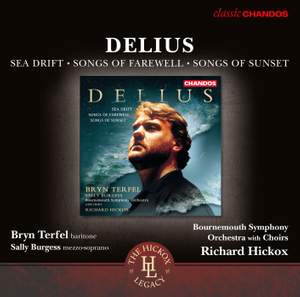
| |  | Delius - Songs
Gramophone Award winner “ Sea Drift is a sublime conjunction of Whitman's poetry and Delius's music describing love, loss and unhappy resignation, with the sea (as Christopher Palmer put it) as 'symbol and agent of parting'. Written in 1903-4 (the same years as Debussy's La mer), it's surely Delius's masterpiece; right from the swaying opening bars its spell is enduring and hypnotic. Hickox in his second recording of the work now gives us the finest recorded post-Beecham Sea Drift. The shaping of the opening falling woodwind figures at a slow tempo more than usually (and very beautifully) portends the sad turn of events; and the climax is broad and superbly co-ordinated. Terfel's bar-by-bar characterisation (and glorious voice), conveys the full expressive range of the role from impassioned appeal to gentle call without artifice; and the choral singing is superb. The whole is recorded with warmth, spaciousness, depth and clarity.” Gramophone Classical Music Guide, 2010 | | | (also available to download from $10.50) | Usually despatched in 2 - 3 working days. (Available now to download.) |
|
|
| |  | Great Conductors - Beecham
| | | (also available to download from $8.75) | Usually despatched in 2 - 3 working days. (Available now to download.) |
|
|
| |  | The Beecham Collection
| | | Usually despatched in 2 - 3 working days. |
|
|
| |  | Very Best of English Song
anon.: | Willow song Alfred Deller (countertenor), Desmond Dupré (lute) | Balfe: | Come into the garden, Maud Robert Tear (tenor), André Previn (piano) | Bishop, H R: | Home, Sweet Home Robert Tear (tenor), André Previn (piano) | Brahe: | Bless this house Dame Janet Baker (mezzo), Sir Philip Ledger (piano) | Britten: | The foggy, foggy dew Robert Tear (tenor), André Previn (piano) The Plough Boy Robert Tear (tenor), André Previn (piano) Serenade for Tenor, Horn & Strings, Op. 31 Robert Tear (tenor), Alan Civil (horn) Northern Sinfonia, Sir Neville Marriner Les illuminations, Op. 18 John Mark Ainsley (tenor), Pauline Lowbury (violin) Britten Sinfonia, Nicholas Cleobury | Butterworth, G: | Loveliest of Trees Anthony Rolfe Johnson (tenor), David Willison (piano) Love Blows As The Wind Blows Robert Tear (tenor) Vernon Handley | Byrd: | Lullaby, my sweet little baby Michael Chance (countertenor) Fretwork Elegy on the death of Thomas Tallis Michael Chance (countertenor), Christopher Wilson (lute) | Carter, S: | Down Below Ian Wallace (bass-baritone), Donald Swann (piano) | Delius: | Sea Drift John Noble (baritone) Liverpool Philharmonic Choir, Royal Liverpool Philharmonic Orchestra, Sir Charles Groves | Dibdin: | Tom Bowling Robert Tear (tenor), André Previn (piano) | Dowland: | Sorrow, stay Dame Emma Kirkby (soprano), Anthony Rooley (lute) Can she excuse my wrongs? (First Booke of Songes, 1597) Dame Emma Kirkby (soprano), Anthony Rooley (lute) Awake, sweet love Dame Emma Kirkby (soprano), Anthony Rooley (lute) Woeful heart Dame Emma Kirkby (soprano), Anthony Rooley (lute) Shall I sue? Charles Daniels (tenor), David Miller (lute) Me, me, and none but me Charles Daniels (tenor), David Miller (lute) Flow my teares (Lacrimæ) Charles Daniels (tenor), David Miller (lute) | Elgar: | Sea Pictures, Op. 37 Dame Janet Baker (mezzo) London Symphony Orchestra, Sir John Barbirolli Two Songs Op. 60 (The Torch; The River) Robert Tear (tenor) City of Birmingham Symphony Orchestra, Vernon Handley | Finzi: | Since we loved Ian Bostridge (tenor), Julius Drake (piano) Rollicum-rorum Jonathan Lemalu (bass-baritone), Roger Vignoles (piano) Dies natalis, Op. 8 Wilfred Brown (tenor) English Chamber Orchestra, Christopher Finzi | Gurney: | Down by the Salley Gardens Anthony Rolfe Johnson (tenor), David Willison (piano) Black Stitchel Anthony Rolfe Johnson (tenor), David Willison (piano) | Ireland: | The Salley Gardens Dame Janet Baker (mezzo), Gerald Moore (piano) Sea Fever Jonathan Lemalu (bass-baritone), Roger Vignoles (piano) | Johnson, R: | Where the bee sucks Alfred Deller (countertenor), Desmond Dupré (lute) Full fathom five Alfred Deller (countertenor), Desmond Dupré (lute) | Keel: | Trade Winds (No. 2 from Three Salt-Water Ballads) Jonathan Lemalu (bass-baritone), Roger Vignoles (piano) | Morley: | It was a lover and his lass Alfred Deller (countertenor), Desmond Dupré (lute) O mistress mine Alfred Deller (countertenor), Desmond Dupré (lute) | Mortimer: | The Smuggler's Song Owen Brannigan (bass), Gerald Moore (piano) | Parry: | O Mistress Mine Dame Janet Baker (mezzo), Gerald Moore (piano) | Peel: | Bredon Hill Sir Thomas Allen (baritone), Geoffrey Parsons (piano) In Summertime on Bredon orchestral version Frederick Harvey (baritone) George Weldon | Purcell: | Fairest Isle (from King Arthur) Nancy Argenta (soprano), Nigel North (lute) Music for a while, Z583 Nancy Argenta (soprano), John Toll (harpsichord) I attempt from love's sickness to fly in vain (from The Indian Queen) Nancy Argenta (soprano), Paul Nicholson (harpsichord) If music be the food of love, Z379 Nancy Argenta (soprano), Richard Boothby (lute), John Toll (harpsichord) An Evening Hymn 'Now that the sun hath veiled his light', Z193 Nancy Argenta (soprano), Paul Nicholson (harpsichord) | Quilter: | Love's Philosophy, Op. 3 No. 1 (Shelley) Dame Janet Baker (mezzo), Gerald Moore (piano) Now sleeps the crimson petal, Op. 3 No. 2 (Tennyson) Sir Thomas Allen (baritone), Geoffrey Parsons (piano) Come away, death Ian Bostridge (tenor), Julius Drake (piano) | Sanderson, W: | Devonshire Cream and Cider orchestral version Frederick Harvey (baritone) Philharmonia Orchestra, George Weldon | Stanford: | Drake's Drum Robert Lloyd (bass), Nina Walker (piano) The Old Superb Robert Lloyd (bass), Nina Walker (piano) Songs of the Sea, Op. 91 Benjamin Luxon (bass-baritone) Bournemouth Symphony Orchestra, Norman Del Mar | Swann, D: | A Transport of Delight (The Omnibus) Ian Wallace (bass-baritone), Donald Swann (piano) The Wart Hog Ian Wallace (bass-baritone), Donald Swann (piano) The Hippopotamus Song (Mud, mud, glorious mud) Michael Flanders & Donald Swann | trad.: | Greensleeves Alfred Deller (countertenor), Desmond Dupré (lute) | Vaughan Williams: | Linden Lea Dame Janet Baker (mezzo), Gerald Moore (piano) The Lamb Ian Partridge (tenor), Janet Craxton (piano) The Shepherd Ian Partridge (tenor) Silent Noon Ian Bostridge (tenor), Julius Drake (piano) Songs of Travel Sir Thomas Allen (baritone) Sir Simon Rattle Five Mystical Songs John Shirley-Quirk (bass-baritone) Choir of King's College Cambridge, English Chamber Orchestra, Sir David Willcocks On Wenlock Edge orchestral version Ian Bostridge (tenor) London Philharmonic Orchestra, Bernard Haitink | Walton: | Popular Song from 'Façade' Fenella Fielding, Michael Flanders Academy of St Martin-in-the-Fields, Sir Neville Marriner | Warlock: | My Own Country Anthony Rolfe Johnson (tenor), David Willison (piano) Passing By Anthony Rolfe Johnson (tenor), David Willison (piano) Pretty Ring Time Anthony Rolfe Johnson (tenor), David Willison (piano) Balulalow Dame Janet Baker (mezzo), Sir Philip Ledger (piano) Yarmouth Fair Owen Brannigan (bass), Ernest Lush (piano) | Woodforde-Finden: | Kashmiri Song Frederick Harvey (baritone), Jack Byfield (piano) |
Ranging from Shakespeare’s contemporaries to the Victorian school and beyond, this fine box set calls on some of the greatest artists—including a wealth of British talent—to celebrate the diversity and longevity of English song. From simple melodic expression to the textural sophistication of orchestral settings, with the sea and landscape assuming a prominent role throughout, the songs included here comprise a fitting tribute, simultaneously revealing the rich cultural legacy of English poetry. | | | In stock - usually despatched within 1 working day. |
|
|
| |  | Sir Thomas Beecham conducts English Music
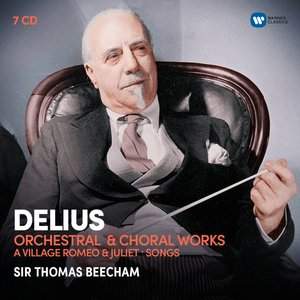
There can be few, if any, musicians who have singlehandedly done so much in the establishment of resources for musical performance than Sir Thomas Beecham. During WWI he conducted and supported financially both the Hallé and London Symphony Orchestras and the Royal Philharmonic Society. In 1915 he formed the Beecham Opera Company which trained many young British singers in this field. Eight years later this became the British National Opera Company and was absorbed into Covent Garden in 1932 when Beecham returned to be its Musical Director. To quote David Cairns “We are nationally and individually a more musically aware people because of him and what he gave us”. A forceful statement, true, but whose life could ever challenge it? Dissatisfied by conditions and practices, notably the supply of deputies for rehearsals, prevalent in British orchestras, he formed the London Philharmonic Orchestra that same year. Beecham was now able to be at the fulcrum of all developments in music in Britain. WWII put an end to this halcyon period. With Covent Garden shut he travelled, primarily in America, and did not return to Britain until 1944. The London Philharmonic had now become a self-governing body so Beecham, then aged 67, launched the Royal Philharmonic Orchestra. This was the orchestra with which he committed to disc so many classic recordings with which EMI Classics marks the 50th anniversary of his passing. It is true that Beecham had particular favourites in composers – Haydn, Mozart, Schubert, Berlioz, Bizet and Puccini spring immediately to mind; also his love for Handel – even though his performances were always BIG-scale! He was an early champion of Richard Strauss and became a most effective exponent of Sibelius. His name will always be inextricably linked with that of Delius whose music Beecham seemed to know better even than the composer and it is appropriate that they are buried not far apart in the graveyard at St. Peter’s Parish Church, Limpsfield, Surrey. He was knighted in 1916, the year he succeeded to his father’s baronetcy, and made a Companion of Honour in 1957.This affable, brilliant, usually charming, ever-communicative, quick-witted – even, at times, to the point of cruelty, dedicated conductor was also the most gifted executive musician England has ever produced. He was fortunate that his grandfather, a chemist, had created the highly successful pharmaceutical manufacturing business which bore his name. His father, who had started in the company whilst still a teenager, was also fond of music so he was prepared to fund his son’s enthusiastic appetite to attend operas and concerts both here and abroad. Born on 29th April 1879 in St. Helens, he attended public school at Rossall where his talent at the piano became a legend (the only boy ever to have been allowed a grand piano in his study!). From there he briefly attended Oxford (Wadham) but the composition classes, with Charles Wood in London and Moszkowski in Paris, were funded privately. As a conductor he was purely self-taught. He formed an orchestra in his home town and deputised for Richter at a Hallé concert when his father was mayor. His career path was clear: he would use his financial resources to support the art which he enjoyed with the aim of bringing it to as many as possible. At the age of 30 he launched the Beecham Symphony Orchestra, all young and carefully chosen. They would tour, play for opera and ballet and give concerts of adventurous music. London duly welcomed him for a season of intensive opera performances and over the next three years introduced many new ones to British audiences, including by Strauss, Delius and the Russians. He also brought Diaghilev’s Ballets Russes starring Nijinsky and Karsavina to the British stage. “The finesse of the detail, the fierce attack, individual flair, corporate precision, blazing warmth: the sum total is playing of tangible personality and, often, ineffable beauty...Beecham might even make you love Delius.” The Times, 18th February 2011 ***** “Beecham's English Collection is unmissable...[Song of the High Hills is] one of the first recordings made by Beecham's new postwar orchestra, and they already play as though they adore him” BBC Music Magazine, July 2011 ***** | | | In stock - usually despatched within 1 working day. |
|
|
| |  | Delius Edition
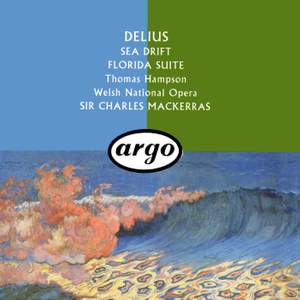
Marking the 150th Anniversary of Delius’ birth date in 1862, Decca Classics releases the ‘Delius Edition’ - the most comprehensive Collection of Delius’ music ever put together on 8CD and featuring noted Delius conductor Sir Charles Mackerras. Containing all of Delius’s major work, this cap-box set combines the major orchestra & choral works of Brigg Fair, Sea Drift, In a Summer Garden, Florida Suite, The Walk to the Paradise Garden, Piano Concerto, Violin Concerto & Paris: Song of a Great City along with the major chamber music, such as the Cello Sonata, String Quartet and 4 Part Songs. The set culminates in Delius’s masterpiece, his opera, A Village Romeo and Juliet. Featuring a cast of great artists and performers, including Thomas Hampson, Julian Lloyd Webber, the Fitzwilliam Quartet, the London Symphony Orchestra, the Academy of St Martin in the Fields, Sir Neville Marriner & Sir Charles Mackerras. | | | (Sorry, download not available in your country) | In stock - usually despatched within 1 working day. |
|
|
| |
|