Sibelius: Six Songs, Op. 50

This page lists all recordings of Six Songs, Op. 50, by Jean Sibelius (1865-1957) on CD & download (MP3 & FLAC).

Recommendations

4 star

All recordings

Prices shown exclude VAT. (UK tax is not payable for deliveries to United States.)
See Terms & Conditions for p&p rates.

Sibelius - Songs

Sibelius - Songs


Sibelius:

Illalle, Op. 17 No. 6 (Forsman-Koskimies)

Den judiska flickans sång (from Belshazzar's Feast, Op. 51)

Six Songs, Op. 36

Jag är ett träd (I am a tree) Op. 57 No. 5 (Josephson)

Necken (The Watersprite, or The Elf-King) Op. 57 No. 8 (Josephson)

Five Songs, Op. 37

Vem styrde hit din väg? (Who has brought you here?) Op. 90 No. 6 (Runeberg)

Norden, Op. 90 No. 1 (Runeberg)

Six Songs, Op. 50

Våren flyktar hastigt, Op. 13 No. 4 (Text: Runeberg)

Under strandens granar (Under the fir-trees) Op. 13 No. 1 (Runeberg)


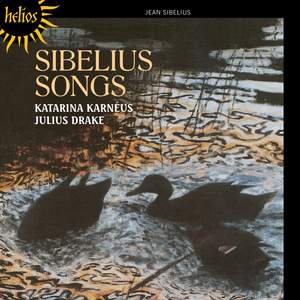
Katarina Karnéus (soprano) & Julius Drake (piano)

‘Inspired performances … It is a magic partnership, giving fresh insights in every song’ (The Guardian)

“Sibelius's songs have taken a long time to come in from the cold. After all, the few that are relatively well-known (Black roses and Op 37 No 5, 'The Tryst') are passionate enough to have come from Italian opera, and others which over the years have found a place in the repertoire have a span of phrase and a melodic surge that encourage the voice to rise thrillingly, as in 'The Tryst's' predecessor, 'Was it a dream?'. The tingle of a Nordic chill in among this is in fact a further excitement of the blood. Given a voice that can combine the sparkle of sunlight on snow with the dark splendour which lies at the heart of those black roses, an entire programme of Sibelius's songs offers not an austere pleasure but almost a rich indulgence.
But from both singer and pianist there must also be a ready supply of imagination. Katarina Karnéus and Julius Drake answer these calls magnificently. The voice is firm and resonant, purest in quality in the upper D-to-F region and of ample range. In Julius Drake she has a pianist who extends the normal field of vision, and the two work together to great effect.
In the opening song, To evening ('Illalle'), Karnéus and Drake 'build' the verses with such effective graduations of power and intensity that everything is enhanced – the vocal line, the piano's tremolandos, words, mood, the poem-aspainting, the song as miniature epic. In some others – 'Little Lasse' in Op 37 and the remarkable 'Tennis in Trianon' of Op 36 are examples – von Otter and Bengt Forsberg bring a further sophistication, more rightfully placed in the second example than the first. But if you want a single disc of 25 to to represent Sibelius's output of roughly 100 songs then this disc must take first choice.”
Gramophone Classical Music Guide, 2010

Hyperion - CDA67318

(CD)

$16.75

In stock - usually despatched within 1 working day.

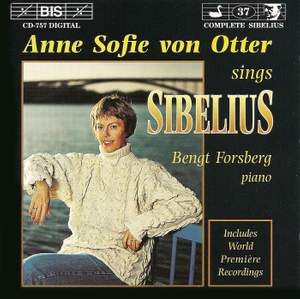
Anne Sofie von Otter sings Sibelius

Anne Sofie von Otter sings Sibelius


Sibelius:

Den judiska flickans sång (from Belshazzar's Feast, Op. 51)

Likhet

Six Songs, Op. 50

Six Songs, Op. 90

The Wood-Nymph (Skogsrået), Op. 15

En visa

Serenade

Tanken (duet)

with Monica Groop (mezzo-soprano)

Seven Runeberg Songs, Op. 13


Anne Sofie von Otter (mezzo-soprano), Bengt Forsberg (piano)

“The vast majority of Sibelius's songs are in Swedish, the language with which he grew up as a child, and here they're given by a distinguished native Swedish partnership. The Seven Songs, Op 13, are all Runeberg settings and come from the composer's early years (1891-2). Best known, perhaps, are 'Spring is flying' and 'The dream', but there are others, such as 'The young hunter', that are no less delightful and characterful.
The other Runeberg settings here, the Six Songs, Op 90, come towards the end of Sibelius's career as a song composer (1917-18). 'The north', as in all the nature poetry of Runeberg, touches a very special vein of inspiration. Along with 'Die stille Nacht', Op 50 No 5, which is equally affectingly given by these two artists – it's among his finest songs. Interest naturally focuses on the rarities.
The Wood Nymph, not to be confused with the melodrama or the tone-poem, is recorded here for the first time. As well as A Song, there are two other early Runeberg settings, the 1888 Serenade and Resemblance, both of them also premiere recordings. 'The Jewish Girl's Song' will be familiar from the incidental music to Belshazzar'sFeast, and is affecting in this form – particularly sung as it is here. Given the artistry and insight of this splendid partnership, and the interest and beauty of the repertoire, this is a self-recommending issue.”
Gramophone Classical Music Guide, 2010

BIS - Sibelius Edition - BISCD757

(CD)

$16.75

(also available to download from $10.50)

Usually despatched in 2 - 3 working days. (Available now to download.)

The Sibelius Edition Volume 7 - Complete Songs

The Sibelius Edition Volume 7 - Complete Songs

The Complete Solo Songs, including preliminary and alternative versions


includes:

Sibelius:

Laulu ristilukista Op. 27 No. 4

Segelfahrt

Souda, souda, sinisorsa (Swim, duck, swim) (A.V. Forsman-Koskimies)

Andantino in E flat minor [Säv, säv, susa / Sigh, Sigh, Sedges], JS42

Five Songs, Op. 37

Six Songs, Op. 36

Jag ville, jag vore i Indialand (I wish I were in India)

Five Songs, Op. 38

Les Trois Soeurs aveugles (The Three Blind Sisters), Op. 46 No. 4 (M. Maeterlinck)

Six Songs, Op. 50

Erloschen

2 Songs, Op. 35

Vänskapens blomma

Eight Songs, Op. 57 (Text: Ernst Josephson)

2 Songs from Shakespeare's 'Twelfth Night', Op. 60

8 Laulut, Op. 61

Arioso, Op. 3 (Text: J.L. Runeberg)

Five Christmas Songs, Op. 1

Luonnotar, Op. 70 (Text: Kalevala)

Six Songs, Op. 72 (Songs Nos. I & II are lost)

Tanken

Six Songs, Op. 86

Six Songs, Op. 88 'Flower Songs'

Six Songs, Op. 90

Kullervon valitus from Op. 7

Mummon syntymäpäivänä

Autrefois (Scène pastorale pour orchestre), Op. 96b

Små flickorna (Text: Hjalmar Procopé)

Narciss (Narcissus) (B. Gripenberg)

Siltavahti [The Guardian of the Bridge], JS170b

Den judiska flickans sång (from Belshazzar's Feast, Op. 51)

Hymn to Thaïs (Text: Arthur H. Borgström)

plus:

CD1

1. Serenad, JS167 2'48

2. Medan nordanvinden gnyr [While the North Wind Roars] 1'11

3. Näcken, JS138 3'19

4. Då världar ännu skapade ej voro [When Worlds Still Uncreated Were], JS56 2'23

5. En visa [A Song], JS71 1'25

6. Solen slog himlen röd… [The Sun Reddened the Sky…], 1888, fragment 1'34

7. Orgier [Orgies], JS143 2'17

8. Skogsrået [The Wood-Nymph], JS171 6'40

9. Höstkväll [Autumn Evening], 1888–89, fragment 2'22

10. Flickan gick en vintermorgon [The Maiden Went One Winter Morning], 1890–92, fragment 0'45

11. Jag kysser dig [och ledsnar] ej [I Kiss You and Weary Not], 1889–91 0'54

12. Löjet var utan hem [Wit Was Without a Home], 1890–91 2'25

13. Likhet [Alikeness], JS120 1'40

14. Den första kyssen [The First Kiss], JS57 2'08

15. Tule, tule kultani [Come, Come, My Sweetheart] (folk-song arrangement), JS211 1'14

Seven Runeberg Songs, Op.13

16. 1. Under strandens granar [Under the Fir-Trees] 5'24

17. 2. Kyssens hopp [The Kiss’s Hope] 2'10

18. 3. Hjärtats morgon [The Heart’s Morning] 2'27

19. 4. Våren flyktar hastigt [Spring Flies Speedily] 1'33

20. 5. Drömmen [The Dream] 1'43

21. 6. Till Frigga [To Frigga] 3'59

22. 7. Jägargossen [The Young Huntsman] 2'44

Seven Songs, Op.17

23. 1. Se’n har jag ej frågat mera [Since Then I Have Questioned No Further] 2'14

24. 2. Sov in! [Go to Sleep!] 1'41

25. 3. Fågellek [Play of the Birds] 1'32

26. 4. Vilse [Astray] 0'52

27. 5. En slända [A Dragonfly] 4'22

28. 6. Illalle [To Evening] 1'15

29. 7. Lastu lainehilla [Driftwood] 1'06

30. Koskenlaskijan morsiamet [The Rapids-Rider’s Brides], Op.33

CD5

1. Serenad, JS167 (preliminary version, 1887) 2'53

Seven Runeberg Songs, Op.13 (preliminary versions)

2. 2. Kyssens hopp [The Kiss’s Hope], 1892 2'21

3. 3. Hjärtats morgon [The Heart’s Morning], 1890 2'25

4. 5. Drömmen [The Dream], 1891 2'02

5. Kullervos Wehruf [Kullervo’s Lament], from Op.7 (first version 1892, rev. 1892–93) 2'12

Seven Songs, Op.17 (early draft copies)

6. 1. Se’n har jag ej frågat mera [Since Then I Have Questioned No Further], 1890–92 2'37

7. 6. Illalle [To Evening], 1898 1'50

8. Soluppgång [Sunrise], JS87 (preliminary version 1902) 2'14

9. Judeflickans sång [The Jewish Girl’s Song], JS48 No.2b [Op.51 No.2] (first version 1906, rev. c.1907) 2'51

10. Hundra vägar [A Hundred Ways], Op.72 No.6 (preliminary version 1907) 2'13

11. Teodora, Op.35 No.2 (preliminary version 1908) 4'39

12. Hymn to Thaïs, the Unforgettable, JS97 (first version 1909) 2'06

Two Songs from ‘Twelfth Night’, Op.60 (Original versions for voice and guitar)

13. 1. Kom nu hit, död! [Come Away, Death!] 3'12

14. 2. Hållilå, uti storm och i regn [Hey, ho, the Wind and the Rain] 2'07

15. Dolce far niente, Op.61 No.6 (preliminary version 1910) 1'43

16. On hanget korkeat, nietokset [High are the Snowdrifts], Op.1 No.5 (1901, rev. 1903–05) 2'07

17. Pastorale, extract from ‘Autrefois’, Op.96b, 1919–20 2'45


Artists include Helena Juntunen (soprano), Anne Sofie von Otter and Monica Groop (mezzo-soprano), Dan Karlström (tenor), Gabriel Suovanen and Jorma Hynninen (baritone), Folke Gräsbeck, Bengt Forsberg and Love Derwinger (piano), Jaakko Kuusisto (violin) & Marko Ylönen and Joel Laakso (cello)

This box contains a large number of previously unreleased recordings, as well as many world premières on disc. The 236 page booklet contains all song texts in the original language, with English translations.

Sibelius’s earliest music was instrumental and it wasn’t until he was in his twenties that he turned to the solo song genre. From that time on, however, he wrote songs at regular intervals – more than a hundred in total. They form a substantial part of his output and are treasured highly by admirers of the composer, although only a handful have gained a regular place in the international repertoire.

As Andrew Barnett remarks in his informative liner notes, ‘listening to them in their entirety reveals considerable lightness of touch and many a flash of genuine humour. The finest of them certainly reveal his gift for melody and his acute response to nature imagery, especially when setting poems featuring pantheistic imagery.’

Many of the songs were written for or premièred by leading Finnish singers. It is a fine cast of Finnish singers who perform their compatriot’s music on this collection, which also includes the highly acclaimed recordings by the Swedish mezzo Anne Sofie von Otter of some of the best-known songs, including Black Roses, The Diamond on the March Snow and But My Bird is Long in Homing. As for the accompaniments, the lion’s share is in the hands of Folke Gräsbeck, an undisputed authority on Sibelius’s piano scores and a key contributor to this edition.

BIS - New Sibelius Complete Edition - BISCD1918/20

(CD - 5 discs)

$53.75

(also available to download from $38.25)

This item is currently out of stock at the UK distributor. You may order it now but please be aware that it may be six weeks or more before it can be despatched. (Available now to download.)

Copyright © 2002-13 Presto Classical Limited, all rights reserved.