All recordingsPrices shown exclude VAT. (UK tax is not payable for deliveries to United States.) See Terms & Conditions for p&p rates. | |  | Boris Berman - Chopin: Scherzo No. 1
Chopin: | Scherzo No. 1 in B minor, Op. 20 Piano Masterclass at The Royal Northern College of Music |
Internationally regarded as one of the great keyboard teachers of our time, Boris Berman is well known to the audiences of nearly fifty countries. Since 1979 he has lived in the U.S. and has taught at Boston University, Brandeis University,Indiana University, and is currently head of the piano department at the Yale School of Music. Among other acclaimed CDs he has recorded the complete piano works of Sergei Prokofiev for the Chandos label. In this masterclass he works on Chopin's first Scherzo | | | In stock - usually despatched within 1 working day. |
|
|
| |  | Jorge Bolet: His earliest recordings
From the mid 1970’s until his death, Cuban born Jorge Bolet emerged as one of the world’s truly great pianists and one of the last representatives, along with the likes of Cherkassky, Horowitz and Earl Wild, of the great Romantic tradition of pianism. His pedigree was marvellous - a student of Godowsky-disciple David Saperton at the Curtis Institute, there he was also able to play for Godowsky himself and Josef Hofmann. He won the Naumburg competition in 1937 and looked set for a great career, but the war interrupted the flow of things and he struggled through the 1950s & 60s, mainly playing in the USA and not quite making the international ‘big-time’. His big break came with an RCA contract and the release on LP of a stunning live Carnegie Hall concert in 1974. Shortly after, he was signed to Decca and went on to make many award winning discs. But what of the early years? There’s not much, but here, for the first time on CD, we have the four LPs he made in the 1950s. His very first disc was of Latin-American repertoire that he was never to record again. Here also is the first ever recording of Prokofiev’s Second Piano Concerto in a performance that is still up there with the best. These almost unknown discs are sure to fascinate, and fill an important gap in the mystery of Bolet’s early career. “This invaluable reissue of discs dating from 1952-53 is a reminder of Jorge Bolet's early stature. The first-ever recording of Prokofiev's malignant, ferociously demanding Second Concerto is of so much more than documentary interest...nothing can dim one's sense of Bolet's massive and unswerving authority, a quality at once lyrical and magisterial...A true aristocrat of the keyboard, his warmth and humanity strike you at every turn.” Gramophone Magazine, December 2011 | | | In stock - usually despatched within 1 working day. |
|
|
| |  | Chopin: 4 Scherzi & 13 Preludesrecorded in Tokyo 1977-9
“Immense, yet light-fingered keyboard power from Richter, whose mastery opens out great vistas of space around the music.” BBC Music Magazine, May 2012 ***** | | | In stock - usually despatched within 1 working day. |
|
|
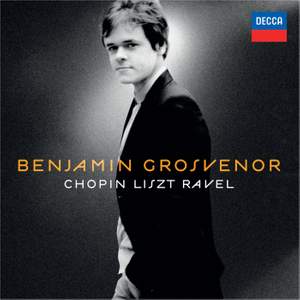
| |  | Benjamin Grosvenor: Chopin Liszt Ravel
Chopin Liszt Ravel is the debut album from the incredible Benjamin Grosvenor. Decca Classics’ new signing made his name as an 11 year old prodigy when he performed at the BBC Young Musician Final, (narrowly missing out to winner, violinist Nicola Benedetti). Still only aged 18, Benjamin has burst onto the performance scene. His debut album, Chopin Liszt, Ravel is out this July. Benjamin is due to receive nationwide media attention when he performs at the First Night of the Proms, which will be followed by a BBC Breakfast News appearance. He will also tour this season with the National Youth Orchestra (and play at their BBC Prom) showing his relevance and support to young classical musicians today. “one of the most individual things about this stunning debut by Benjamin Grosvenor is his pervasive sense of balance and his unerring blend of Classical restraint and Romantic ardour...He is a virtuoso who declines the mantle of virtuoso, every gestures being put exclusively and exhilaratingly at the service of the music. Grosvenor's playing exudes joy and spontaneity, seeming to release rather than interpret the music.” BBC Music Magazine, October 2011 ***** “In Gaspard he magically combines the micro-refinement of a Pogorelich with the poetic wisdom and golden touch of a Perlemuter, and in Chopin's Scherzos integrates the music's hurtling mood-swings with mesmerising intensity.” Classic FM Magazine, September 2011 ***** “evidence of an awesome talent, a pianist with fantastic natural reflexes in the Cziffra class and, more excitingly, a musician with purpose and imagination, whose playing transcends the sterile confines of the studio...Crowning all is a masterly Gaspard in which an astonishing array of touch and tonal colouring are brought to bear in Grosvenor's vivid, distinctly defined characterisation of all three movements.” Gramophone Magazine, October 2011 “This release is quite superlative in every way...Grosvenor's fleet-fingered virtuosity is a match for the finest...Despite this, there's a modesty and humility to these readings which is wonderful to behold...Grosvenor is seemingly incapable of producing an ugly tone and the richness of colour and nuance has been perfectly captured by the Decca engineers. This is essential listening.” International Record Review, September 2011 “Both the main works here...demonstrate the brilliance of Grosvenor's technique as he takes the challenges of Chopin's pieces in his stride, and vividly conjures up the colours of Ravel's piano writing, if rather underplaying the pieces' nightmarish qualities” The Guardian, 18th August 2011 *** “It's an immensely confident set, comparable to Evgeny Kissin's early performances – the most impressive aspect being not his obvious command of technique, but an intellectual and emotional understanding of the music way beyond his tender years.” The Independent, 8th July 2011 **** “This recital disc shows his ability to twin youthful exuberance with impeccable technique and magisterial musical intelligence...Grosvenor's balance of oratory and ornament, gesture and poetry – evident, too, in Ravel's Gaspard de la nuit – are moving as well as impressive. He's a phenomenon: modest, poised and natural, as well as brimming with talent.” The Observer, 17th July 2011 “The first thing you notice is the limpid surface of Grosvenor’s playing, the warm tonal gleam that he conjures up from the keys. It is a beautiful sound, and beneath it there are seams of passion, discretion and emotional affinity with the music...there is little to quibble with in this recital, which shows intelligence coupled with a command of keyboard colour and musical characterisation that are remarkable.” The Telegraph, 14th July 2011 **** “Have you ever heard a more aqueous evocation of Ravel’s water nymph? Grosvenor’s Steinway instrument seems permanently underwater, swimming through the softest of rippling textures...Grosvenor, you can tell, is a Romantic pianist, almost from another age. He doesn’t deconstruct, or stand at a distance. He jumps inside the music’s soul.” The Times, 8th July 2011 **** BBC Music Magazine
Instrumental Choice - October 2011 |
| | | In stock - usually despatched within 1 working day. |
|
|
| |  | Garrick Ohlsson plays Chopin, Brahms & Liszt
Ohlsson won the 1970 Chopin International Piano Competition, just four years before the recital performance of Chopin and Liszt featured on this DVD. Ohlsson has also recorded the complete works of Chopin to global acclaim and is widely regarded as one of the world’s leading exponents of his works. Jeremy Siepmann describes Ohlsson as demonstrating subtlety, brilliance and generosity of performance in the Brahms Concerto. Ohlsson has recorded on the Arabesque, RCA Victor Red Seal, Angel/EMI, Bridge, BMG, Delos, Hänssler, Nonesuch, Telarc, and Virgin Classics labels and has been awarded a Grammy Award for his disc of Beethoven Sonatas. He also features in a Chopin documentary, ‘The Art of Chopin’, which was released on the EuroArts label in 2010. 1DVD Sound format: LCPM mono Picture format: 4:3 Running time: 78’ Subtitles: n/a Menu languages: English Booklet languages: E/F/G Region code: 0 Territory Restrictions: None | | | In stock - usually despatched within 1 working day. |
|
|
| |  | Chopin: Mazurkas
Chopin: | Mazurka No. 3 in E major, Op. 6 No. 3 Mazurka No. 5 in B flat major, Op. 7 No. 1 Mazurka No. 11 in E minor, Op. 17 No. 2 Mazurka No. 13 in A minor, Op. 17 No. 4 Mazurka No. 15 in C major, Op. 24 No. 2 Mazurka No. 17 in B flat minor, Op. 24 No. 4 Mazurka No. 33 in B major, Op. 56 No. 1 Mazurka No. 41 in C sharp minor, Op. 63 No. 3 Mazurka No. 47 in A minor, Op. 68 No. 2 Mazurka No. 49 in F minor, Op. 68 No. 4 Scherzo No. 1 in B minor, Op. 20 Nocturne No. 13 in C minor, Op. 48 No. 1 Polonaise No. 7 in A flat major, Op. 61 'Polonaise-fantaisie' |
Cédric Tiberghien offers us a panorama of Chopin’s output, with three of the composer’s key works framed by a selection of mazurkas. “I devised a recital programme for the 150th anniversary of Chopin’s death in 1999. The idea was to offer a panoramic survey of his output featuring several representative ‘large’ pieces, with the mazurkas providing a sort of chronological thread between them. So ten years later it was a natural process to narrow the focus down to three key pieces from different periods of Chopin’s life, surrounded by a generous selection of mazurkas… One of the very first Chopin pieces I discovered was on a record telling the story of the composer’s life: the Mazurka op.68 no.2, which illustrates the nostalgia for his homeland, the melancholy so often present in his music. I think the mazurkas show the most intimate side of Chopin’s personality, with their mixture of improvisation, evocation, and the ephemeral. These short pieces were a way for him to stay in touch with the roots of his country; he has nothing to prove, he submits to no rule except that of his inner music. I find it fascinating to see how varied Chopin’s inspiration is despite the common basis of all the mazurkas. As I explored the fifty-one pieces in the collection, I rediscovered masterpieces I thought I knew already, while others that were new to me have now become essential parts of my life. Chopin wrote mazurkas throughout his adult career, from 1830 to 1849. The first ones (opp.6 and 7) emphasise the popular element, while the later examples (op.59, op.68 no.4) show an unprecedented harmonic refinement that betrays his contact with French culture. The Scherzo has always struck me with its violence, which grips you right from the first chord and never lets up until the magnificent ‘Christmas carol’ which is transcendent in its simplicity. The Nocturne illustrates how important melody was for Chopin. He insisted that all his pupils should practise singing so that they would sense the phrasing, the direction of the lines, the moments of tension and relaxation. The Polonaise-Fantaisie is a very special work. It’s at the very opposite pole from the mazurkas, if only in its dimensions; and it achieves a mysterious balance between its improvisatory aspect and the strength of its architecture, between extreme complexity and a feeling of intimacy. The opening chords warn the listener: ‘Prepare for an extraordinary journey.’ If I were allowed to keep only one work by Chopin, it would be this Polonaise-Fantaisie in A flat – a key which was very dear to him, incidentally. For me it’s the perfect expression of his personality.” Cédric Tiberghien “When Tiberghien next plays in London, be there.” Geoff Brown, The Times Concert reviews: Chopin Mazurkas “The case for the innovatory nature of Chopin's mazurkas, penetrating the deepest of emotions often with the sparsest of musical gestures, was formidably made.” Tim Ashley, The Guardian, 26 January 2010 “This is very close to what we know about Chopin's own playing...How well Tiberghien caught the gentle, musing melancholy of the opening, and how the silence before the ensuing storm seemed to press on our eardrums!” The Daily Telegraph “Tiberghien says that if he was allowed to keep only one Chopin work, it would be the Polonaise-Fantasie, and he plays this once-neglected piece as if he treasures it: there's a sense of mystery in the way the dances are hinted at impressionistically.” BBC Music Magazine, December 2010 **** “Perhaps the C minor Nocturne, Op. 48 No. 1, adds up to this recital's best-realised interpretation, with its measured and sustained opening section and assiduous build into a shattering climax. Harmonia Mundi provides Tiberghien with attractively robust engineering.” Gramophone Magazine, November 2010 “Tiberghien seems to have the poise and poetry of Chopin in his blood. He makes the piano sing...This is an imaginative disc of shifting moods that are readily within Tiberghien’s expressive orbit and which he interprets with sublime inspiration.” The Telegraph, 8th October 2010 ***** | | | In stock - usually despatched within 1 working day. |
|
|
| |  | Chopin: Scherzos, Nocturnes & Mazurkas
Chopin: | Scherzo No. 1 in B minor, Op. 20 Scherzo No. 4 in E major, Op. 54 Polonaise No. 2 in E flat minor, Op. 26 No. 2 Mazurka No. 42 in G major, Op. 67 No. 1 Mazurka No. 5 in B flat major, Op. 7 No. 1 Mazurka No. 45 in A minor, Op. 67 No. 4 Mazurka No. 43 in G minor, Op. 67 No. 2 Nocturne No. 4 in F major, Op. 15 No. 1 Nocturne No. 6 in G minor, Op. 15 No. 3 Nocturne No. 5 in F sharp major, Op. 15 No. 2 Nocturne No. 18 in E major, Op. 62 No. 2 |
The Latvian pianist Dina Yoffe is a professor at the Anton Rubinstein International Academy in Germany and has worked with many celebrated orchestras and conductors. She has made numerous recordings for radio, television and phonographic companies including Chopin’s 24 Preludes, Fantasy in F minor and 19 Waltzes. She performs here on a 1848 Pleyel fortepiano. | | | In stock - usually despatched within 1 working day. |
|
|
| |  | Richard Farrell - The Complete Recordings, Volume 2
Brahms: | Variations and Fugue on a Theme by Handel, Op. 24 Klavierstücke (4), Op. 119 Rhapsody in G minor, Op. 79 No. 2 | Chopin: | Scherzo No. 1 in B minor, Op. 20 Mazurka No. 10 in B flat major, Op. 17 No. 1 Mazurka No. 41 in C sharp minor, Op. 63 No. 3 Étude Op. 10 No. 3 in E major 'Tristesse' Previously unreleased Étude Op. 10 No. 4 in C sharp minor Previously unreleased Étude Op. 10 No. 5 in G flat major 'Black Key' Étude Op. 10 No. 10 in A flat major Previously unreleased Étude Op. 25 No. 11 in A minor 'Winter Wind' Previously unreleased Nocturne No. 4 in F major, Op. 15 No. 1 Waltz No. 14 in E minor, Op. post., KKIVa:15, B 56 Polonaise No. 6 in A flat major, Op. 53 'Héroïque' Previously unreleased | Debussy: | Clair de Lune (from Suite Bergamasque) | Granados: | Goyescas: Quejas ó La Maja y el Ruiseñor | Liszt: | Concert Paraphrase on Rigoletto, S.434 after Verdi's opera Widmung S566 after Schumann (Liebeslied) Hulanka (Drinking Song, after Chopin) | Mendelssohn: | Song without Words, Op. 38 No. 6 in A flat major 'Duetto' | Rachmaninov: | Variations on a theme of Corelli, Op. 42 First ever stereo release Prelude Op. 3 No. 2 in C sharp minor First ever stereo release Prelude Op. 23 No. 4 in D major First ever stereo release Prelude Op. 23 No. 5 in G minor First ever stereo release Prelude Op. 23 No. 6 in E flat major First ever stereo release Prelude Op. 32 No. 5 in G major First ever stereo release Prelude Op. 32 No. 12 in G sharp minor First ever stereo release | Schumann: | Arabeske in C major, Op. 18 |
| | | In stock - usually despatched within 1 working day. |
|
|
| |  | Chopin - Piano Works
Young Danish/Portugese pianist Bruno d’Espiney is making a name for himself on concert platforms throughout Europe. These heart felt performances of these very well known compositions demonstrate why d’Espiney is a true rising star. | | | In stock - usually despatched within 1 working day. |
|
|
| |  |
“A generous selection of Rubinstein's early Chopin recordings shows a seemingly effortless, intuitively musical response to each piece. Sound quality is not an issue when faced with such great performances.” BBC Music Magazine, May 2008 ***** “A distinguished series of beautifully presented reissues” Gramophone Magazine “The current remastering by Andrew Walter has removed almost all the background noise, and the mono piano recording is miraculously real and vivid.” Penguin Guide, 2011 edition | | | In stock - usually despatched within 1 working day. |
|
|
| |
|