All recordingsPrices shown exclude VAT. (UK tax is not payable for deliveries to United States.) See Terms & Conditions for p&p rates. | |  | Grieg & Sibelius Favourites ‘From Fjord & Forest’
Grieg: | Lyric Pieces Op. 65: No. 6 - Wedding Day at Troldhaugen Two Elegiac Melodies, Op. 34 Nordic Melodies Op. 63: Cow-Call, Dance Holberg Suite, Op. 40: excerpts 1st movement Peer Gynt: Morning Peer Gynt: Anitra's Dance In the Hall of the Mountain King (from Peer Gynt) | Sibelius: | Karelia Suite Op. 11: Intermezzo Lemminkäinen Suite, Op. 22: The Swan of Tuonela (No. 2) Finlandia, Op. 26 Pelléas and Mélisande Suite, Op. 46 (excerpts) King Kristian II, incidental music, Op. 27: Musette King Kristian II, incidental music, Op. 27: Elegie Valse Triste, Op. 44 No. 1 |
| | | In stock - usually despatched within 1 working day. |
|
|
| |  | Journey Around the World (Classical Clubhouse)
Albéniz: | Sevilla (from Suite Española, Op. 47) | anon.: | La Cucaracha | Benjamin, A: | Jamaican Rumba | Berlioz: | La Damnation de Faust, Op. 24: Rákóczi March | Borodin: | In the Steppes of Central Asia | Copland: | Rodeo: Hoe down | Debussy: | Clair de Lune (from Suite Bergamasque) | Grainger: | Country Gardens | Rachmaninov: | Oriental Dance, Op. 2 No. 2 | Respighi: | Ancient Airs and Dances, Suite No. 3, P. 172: III. Siciliana | Sibelius: | Finlandia, Op. 26 | Smetana: | Má Vlast: Vltava | Strauss, J, II: | An der schönen, blauen Donau, Op. 314 |
Classical Music doesn’t get much more exciting than this! With the help of wonderful music (some familiar, some new) this collection encourages children to experience the fantastic array of world music styles and colourful portrayals of foreign lands in Classical Music. Featuring music from Debussy, Johann Strauss II, Copland and many others this selection will have kids thrilled with recreations of the American Wild West, learning the Jamaican Rumba, waltzing in Vienna and exploring the Steppes of Central Asia! A fully illustrated 44 page booklet presents an adventure-filled journey around the world challenging the reader to listen, see and recreate the wonders of the countries they visit. The text is designed to be read either by an older child of 5 or 6 or with an adult for the younger children. The writer is Sarah Breeden noted for the fun and informative programmes she has written for the BBC Children’s Proms. | | | In stock - usually despatched within 1 working day. |
|
|
| |  | Sir Alexander Gibson conducts Sibelius
“Gibson was a much under-recorded conductor, so this reissue of his tight-reined, yet sweepingly intense way with early Sibelius is especially welcome. The RPO responds to him in classy style.” BBC Music Magazine, May 2011 **** | | | In stock - usually despatched within 1 working day. |
|
|
| |  | Sibelius - Symphonies 1, 2, 3 & 5
Jean Sibelius was born in 1865 as Julius Christian but adopted the French equivalent and is now always known as such. He soon established himself as Finland’s greatest composer and the most powerful symphonist to have come from Scandinavia and the countries surrounding the Baltic Sea. The first work to be composed in this collection recorded by Mariss Jansons and the Oslo Philharmonic Orchestra is arguably his most famous: Finlandia, written in 1899, which shows his strong belief in national self-determination for his homeland and against Russian rule. Works flowed quickly as by 1902 he had already completed his Second Symphony (both this and his First are in this set). His Valse Triste became very popular and throughout the world and tended temporarily to mask his other achievements, The Third Symphony tended to be overlooked as it was less romantic, more classical in form and was also distinct from the more brooding later symphonies; now it is becoming more performed and appreciated as part of the great canon. Of the later Symphonies the Fifth is certainly the most popular, the dark gloom of the Fourth (no doubt due to the suspected throat cancer) had been replaced by brightness with melodies that truly sing. The gradual accelerando in the third movement is breathtaking in its excitement ending in a titanic coda where themes from the first and third movements are recalled, the final bars of loud staccato chords are both spell-binding in their originality and brilliant in their effect. The last work from the set to be composed, Andante Festivo, was written in 1922 for string quartet just before the Sixth Symphony, he later expanded it for string orchestra. | | | In stock - usually despatched within 1 working day. |
|
|
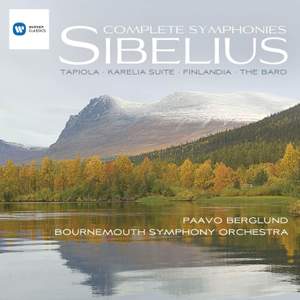
| |  | Sibelius - Tone Poems
Jean Sibelius (1865-1957) was Finland’s greatest composer and the most powerful symphonist to have come from Scandinavia. Eight years before his first of the seven numbered symphonies was written he composed the five movement work entitled Kullervo based on the Finnish national literary epic, from which he took so much inspiration, the Kalevala. Scored for two soloists, male chorus and orchestra it established him overnight as a leading musical figure. Paavo Berglund made a detailed study of the score and his recording in November 1970 made with Finnish singers but with the Bournemouth Symphony Orchestra, of which he was musical director, was revelatory inspiring many other conductors to perform and record this major work. The set is completed by three tone poems – the ever popular Finlandia, The Oceanides and his final completed work, Tapiola – the first suite of Scènes historiques, two movements from the Karelia Suite and the two Serenades for Violin and Orchestra in which Ida Haendel is the soloist. | | | In stock - usually despatched within 1 working day. |
|
|
| |  | Herbert von Karajan: 100th Anniversary Edition
| | | In stock - usually despatched within 1 working day. |
|
|
| |  | Sibelius - Tone Poems
“Massive, craggy performances which testify to Karajan's exceptional rapport with Sibelius. Many may prefer the less ponderous, airier tempos of Vänska, Beecham or Gibson, and En Saga's build-up is rather calculated, but Tapiola's storm gathers with unequalled power.” BBC Music Magazine, January 2006 ***** “Superlative performances and the excellence of the recording, extraordinarily vivid and realistic, cannot be too strongly emphasised.” Gramophone Magazine | | | In stock - usually despatched within 1 working day. |
|
|
| |  |
“Of all the cycles of Sibelius's symphonies recorded in recent years this is one of the most consistently successful. Ashkenazy so well understands the thought processes that lie behind Sibelius's symphonic composition just as he's aware, and makes us aware, of the development between the Second and Third Symphonies. His attention to tempo is particularly acute and invariably he strikes just the right balance between romantic languor and urgency. The Philharmonia plays for all it's worth and possesses a fine body of sound. The recordings are remarkably consistent in quality and effectively complement the composer's original sound world.” Gramophone Classical Music Guide, 2010 | | | (Sorry, download not available in your country) | In stock - usually despatched within 1 working day. |
|
|
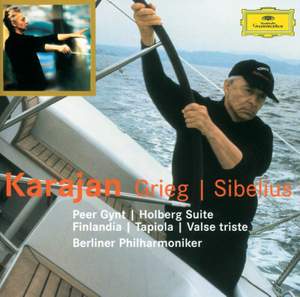
| |  | Greig: Peer Gynt and Holberg Suitesand works by Sibelius
“Very impressive indeed. Somehow one feels that one could stretch out and touch the players, so vivid is the sound here. In the Peer Gynt movements, there's much greater range and separation. Peer Gynt is most beautifully done. At times you might think the wind could have been a shade more distant, particularly in the 'By the seashore' movement but there's no want of atmosphere here – quite the contrary! Not to put too fine a point on it, this is a marvellous recording. In the Holberg Suite, the sound has marvellous clarity and definition as well as exemplary range. For some tastes it may be a little too sophisticated but one's admiration for it remains undimmed. The playing throughout is beautifully cultured and there's wonderful lightness and delicacy. The present issue is Karajan's third account of 'The Swan of Tuonela' and it's regrettable that he never committed to disc the four Legends in their entirety. It's as powerful and atmospheric an account as ever recorded, and the remaining two pieces, 'Valse triste' and Finlandia, reinforce the feeling that this partnership has never been equalled. The stirring account of Finlandia is incredibly wide-ranging – the orchestral playing is really in a class of its own.” Gramophone Classical Music Guide, 2010 | | | In stock - usually despatched within 1 working day. |
|
|
| |  |
“Ashkenazy makes a superb job of Finlandia, which boasts some of the most vibrant, powerful brass sounds on disc. More than 30 years separate En Saga and Tapiola, yet both works are quintessential Sibelius. The latter is often praised for the way Sibelius avoided 'exotic' instruments, preferring instead to draw new and inhuman sounds from the more standard ones; and the former is, in many ways, just as striking in the way the orchestration evokes wind, strange lights, vast expanses and solitude. Both works suggest a dream-like journey: En Saga non-specific, though derived from Nordic legend; Tapiola more of an airborne nightmare in, above and around the mighty giants of the Northern forests inhabited by the Green Man of the Kalevala, the forest god Tapio (the final amen of slow, bright major chords brings a blessed release!). Ashkenazy's judgement of long-term pacing is very acute; the silences and shadows are as potent here as the wildest hurricane. And Decca's sound allows you to visualise both the wood and the trees; every detail of Sibelius's sound world is caught with uncanny presence, yet the overall orchestral image is coherent and natural.” Gramophone Classical Music Guide, 2010 | | | In stock - usually despatched within 1 working day. |
|
|
| |
|