All recordingsPrices shown exclude VAT. (UK tax is not payable for deliveries to United States.) See Terms & Conditions for p&p rates. | |  | The Voice of Peter Pears
Berkeley, L: | How Love Came In Benjamin Britten (piano) | Bridge: | Love went a-riding Benjamin Britten (piano) | Britten: | The Holy Sonnets of John Donne, Op. 35 Benjamin Britten (piano) The Plough Boy Benjamin Britten (piano) | Campion: | Shall I come, sweet love, to thee? Julian Bream (guitar) | Copland: | Long Time Ago Benjamin Britten (piano) Simple Gifts (from Old American Songs, Set I) Benjamin Britten (piano) I Bought me a Cat Benjamin Britten (piano) | Dowland: | I saw my Lady weepe Julian Bream (guitar) What if I never speed? Julian Bream (guitar) | Ford, T: | Faire, sweet, cruell Julian Bream (guitar) | Grainger: | Six Dukes Went a-Fishin' Benjamin Britten (piano) | Ireland: | I Have Twelve Oxen Benjamin Britten (piano) | Moeran: | In youth is pleasure Benjamin Britten (piano) | Morley: | It was a lover and his lass Julian Bream (guitar) | Rosseter: | What then is love but mourning? Julian Bream (guitar) | Schubert: | Im Frühling, D882 Benjamin Britten (piano) Auf der Bruck, D853 Benjamin Britten (piano) An die Laute D905 Benjamin Britten (piano) Die Taubenpost, D965A (D957 No. 14) Benjamin Britten (piano) | Warlock: | Yarmouth Fair Benjamin Britten (piano) |
| | | In stock - usually despatched within 1 working day. |
|
|
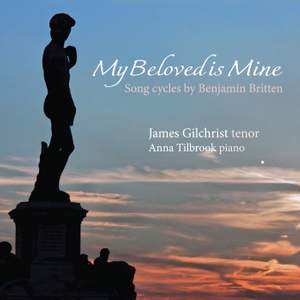
| |  | Britten: My Beloved is MineSong cycles by Benjamin Britten
The greatly sought-after tenor, James Gilchrist, continues his highly acclaimed exploration of British song with his new recording of Benjamin Britten works. His 2010 recording of Leighton Earth, Sweet Earth…(laudes terrae) and Britten Winter Words was called ‘outstandingly accomplished’ by Gramophone. ‘On This Island’ is strikingly fresh and Gilchrist sings these beautiful poems with a graceful insight. Contrasting this opening set, Gilchrist gives a moving and heartfelt performance of Britten’s dark and profound song cycle ‘The Holy Sonnets of John Donne’. My Beloved is Mine ends with what Peter Pears called ‘Britten’s finest piece of vocal music to date’; a psalm-like poem with energetically evolving rhythms and beautiful harmonies. James Gilchrist has appeared with many of the world’s prestigious ensembles and under several leading conductors; he recently performed with Retrospect Ensemble for their recording with Linn Records, J. S. Bach Easter & Ascension Oratorios. James is sought after for operatic roles, ensemble performances and as a respected recitalist. Anna Tilbrook is one of Britain's most exciting pianists, with a considerable reputation in song recitals and chamber music. She made her debut at Wigmore Hall in 1999 and has since become a regular performer at Europe’s major concert halls and festivals. “His immaculate diction – in Italian as well as English – is more than ample compensation for a slight feeling that sometimes the vocal lines are treated with just a little too much respect...But Gilchrist's restraint also proves to be the perfect counterpart to Tilbrook's piano playing, which relishes every bit of the athleticism that Britten built into accompaniments that he wrote to play himself.” The Guardian, 2nd August 2012 **** “Gilchrist is a greatly sensitive interpreter, his tone liquid yet urgent, his diction immaculate and august, his choices admirable.” Sunday Times, 5th August 2012 “Gilchrist, well matched by by Anna Tilbrook's clean-cut playing, offers gentle sensitivity and words that are crystal clear...Well recorded, with a duo that is perfectly matched, this recital has its virtues. Even so, my preference is for a singer with richer vocal resources.” Gramophone Magazine, Awards Issue 2012 “Gilchrist is as agile as his pianist and evidently attuned to the importance of her role...the mystic union of ground-bass piano with confident vocal line in the concluding 'Death, be not proud' set this interpretation of The Holy Sonnets on a footing with that of tenor Peter Pears and Britten...It's in the most introspective moments...the simple-seeming 'Nocturne' in On This Island, for instance...that Gilchrist's unique artistry is heard to best advantage.” BBC Music Magazine, November 2012 ***** “everything about it emanates thoughtfulness, intelligence and good design...His enunciation is superb throughout...[The Holy Sonnets] are given robust performances. These are full of passion and commitment, and are superbly communicated.” MusicWeb International, January 2013 | | | (also available to download from $10.50) | In stock - usually despatched within 1 working day. |
|
|
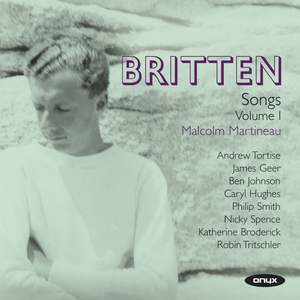
| |  | Britten: Complete Songs Volume 1
28 pp booklet, essay and sung texts Britten was a prolific composer of songs throughout his creative life, producing over 100 settings for voice and piano, in addition to the works for voice and orchestra. His songs for voice and piano – of which this is the first in a two-volume 4CD cycle, contain settings by poets as diverse as Michelangelo, Hölderlin, Hardy, Pushkin, Auden and Soutar. The earliest songs date from 1922, when Britten was just nine years old – ‘Beware!’ and two other songs were from this period were reassessed by the composer in 1968, but not published until 1985. These rarities display little of the mature composer’s style, but they are confident and charming settings. The touching ‘Lilian’ and ‘The Joy of Grief’ are also early songs and receive their premiere recordings here. Mature Britten is represented by the Holy Sonnets of John Donne, Winter Words and the 1965 cycle The Poet’s Echo. This survey of all Britten’s songs for voice and piano is a major project, and Malcolm Martineau has assembled some of the finest young singers of our time for this fascinating journey through repertoire that spans the period 1922–1971. “Martineau paces his survey of Britten’s songbook with the same lightly worn expertise he brings to his accompaniments, alternating lighter and darker material, innocent and knowing, in a way that maintains the listener’s interest.” Financial Times, 28th May 2011 *** “Martineau has gathered a gratifyingly formidable array of young British singing talent. Ben Johnson is commanding in an urgent, passionate reading of The Holy Sonnets of John Donne. Andrew Tortise conveys rapturously intense emotions in Canticle I...Perhaps the best is left until last, when Robin Tritschler gives a fresh-sounding Winter Words.” Sunday Times, 29th May 2011 **** “The John Donne sonnets (Ben Johnson) and The Poet's Echo (Katherine Broderick) are very fine, but the most compelling track is "Canticle 1", a masterpiece powerfully delivered by Andrew Tortise.” The Observer, 12th June 2011 “James Geer, a tenor with an instinct for the inflection of poetry that matches the composer's own, offers 'A Dirge'...Katherine Broderick brings by turns a forlorn beauty and a fiery plangency to the Pushkin settings of The Poet's Echo...We have a tiny and tantalising glimpse of tenor Nicky Spence...O that I had ne'er been married...a touching and memorable gem within this auspicious first volume.” BBC Music Magazine, August 2011 **** “Among so many potential successors to Peter Pears...two tenors stand out: Robin Tritschler, who gives a performance of exceptional tenderness in the ever-popular Winter Words, and Ben Johnson, whose string and intense singing of the Holy Sonnets of John Donne nails his colours to the Britten mast with impressive authority...As always, Malcolm Martineau's accompaniments are a constant source of inspiration on the journey.” Gramophone Magazine, September 2011 | | Onyx - ONYX4071 (CD - 2 discs) Normally: $25.00 Special: $12.50 |
| | In stock - usually despatched within 1 working day. |
|
|
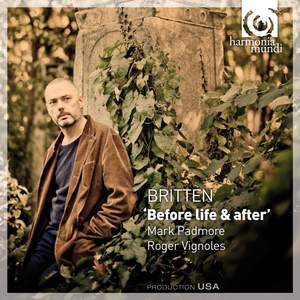
| |  | Britten - Before Life and After
It was on returning from a tour of the German concentration camps with Yehudi Menuhin, in 1945, that Britten finally realised his long-cherished project of setting to music the spiritual sonnets of John Donne (1572-1631). He succeeded admirably in conveying their skilful blend of passion and intellectual rigour. Mark Padmore was born in London and grew up in Canterbury. After beginning his musical studies on the clarinet he gained a choral scholarship to King's College, Cambridge and graduated with an honours degree in music. He has established a flourishing career in opera, concert and recital. His performances in Bach's Passions have gained particular notice throughout the world. His disc of Handel arias As Steals the Morn with The English Concert and Andrew Manze won the BBC Music Magazine Vocal Award in April 2008. Future releases for harmonia mundi include Die Winterreise with Paul Lewis. “Padmore's sound is more beautiful and easily expressive than Pears's ever was, but he never imposes his own personality too forcefully, content to let the natural inflections of the bespoke vocal lines in the Donne cycle follow their own course.” The Guardian, 26th June 2009 **** “Before life and after is the more consoling conclusion to the Hardy cycle, and Padmore lavishes a palette of tone colour to match or even outshine Pears here. His English diction has an unfussy naturalness, and Vignoles captures the descriptive imagery of the piano parts with their descriptions of the train whistle and the boy’s violin. Padmore’s voice now sounds dark for Purcell, but the three Britten realisations suit it well, and the disc is rounded off by five of Britten’s most attractive folk-song arrangements.” Sunday Times, 5th July 2009 ***** “Padmore is on happier ground with the idiosyncratic Purcell realisations, especially in a gem of an 'Evening Hymn', while the Hardy vignettes of Winter Words bring an ideally subtle sense of atmosphere from both singer and pianist.” BBC Music Magazine, August 2009 **** “The Holy Sonnets of John Donne were composed in 1945, soon after Britten's visit to German concentration camps, and the stark immediacy of that experience can be heard in the composer's own recordings. Padmore and Roger Vignoles, his warm-toned accompanist, take a more reflective line. ...the core of the cycle is some heartfelt singing in the sixth and most beautiful setting, "Since she whom I loved". The vivid picture-painting of Winter Words helps make it probably Britten's most popular song-cycle with piano. Several of the Thomas Hardy poems evoke a time of innocence now lost, a familiar Britten theme, and the evocative performance by Padmore and Vignoles captures that sense of longing particularly well.” Gramophone Magazine, September 2009 “This declamatory, religious-themed repertoire fits Padmore like a glove, marrying as it does his enduring success as a performer of early sacred music with his newer success as a chamber recitalist...A satisfying recital on every level.” Charlotte Gardner, bbc.co.uk, 21st December 2009 | | | In stock - usually despatched within 1 working day. |
|
|
| |  | Britten - Songs
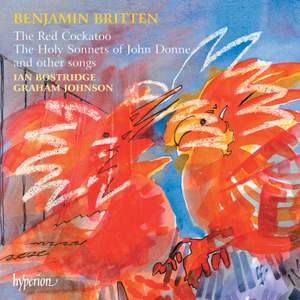
“Bostridge is in the royal line of Britten's tenor interpreters. Indeed his imaginative response to words and music may come closer than any to Pears himself. He's heard here in a veritable cornucopia of mostly unfamiliar and unknown songs (the Donne cycle apart), mainly from the earliest period of Britten's song-writing career when his inspiration was perhaps at its most free and spontaneous. The three settings from Ronald Duncan's This way to the Tomb nicely match that poet's florid, vocabulary-rich style as Britten was to do again two years later in Lucretia, with 'Night', based on a B-minor ground bass, a particularly arresting piece. The Auden settings, roughly contemporaneous with On this Island, all reflect Britten's empathy with the poet at that time. The third, To lie flat on the back, evinces Britten's gift for writing in racy mode, as does When you're feeling like expressing your affection, very much in the style of Cabaret Songs. Much deeper emotions are stirred by the two superb Beddoes settings (Wild with passion and If thouwilt ease thine heart), written when the composer and Pears were on a ship returning home in 1942. The red cockatoo itself is an early setting of Waley to whom Britten returned in Songs fromthe Chinese. All these revelatory songs are performed with full understanding and innate beauty by Bostridge and Johnson, who obviously have a close artistic rapport. The Donne Sonnets are as demanding on singer and pianist as anything Britten wrote, hence their previously small representation in the catalogue. Both artists pierce to the core of these electrifying songs, written after, and affected by, Britten's visit to Belsen with Menuhin in 1945. The recording catches the immediacy of these riveting performances. A richly satisfying issue.” Gramophone Classical Music Guide, 2010 | | | In stock - usually despatched within 1 working day. |
|
|
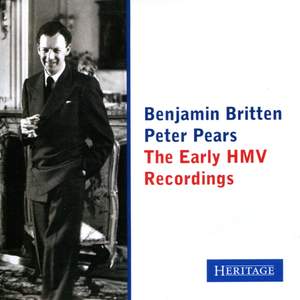
| |  | Benjamin Britten and Peter Pears: The Early HMV Recordings
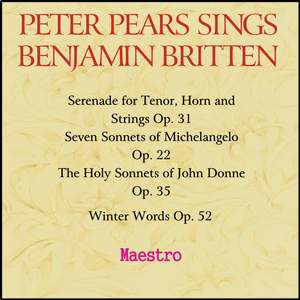
Britten and Pears early collaborations for HMV display an infectious vigour. Britten’s own works, the Seven Sonnets of Michelangelo, Op.22 and the Holy Sonnets of John Donne, Op. 35. are given definitive readings. Also included are folk song settings by Britten, Grainger and Copland and the programme concludes with two of Schubert’s most famous songs ‘Im Fruhling’ and ‘Auf der Bruck’. Essential listening for fans of Benjamin Britten and Peter Pears. | | | Usually despatched in 8 - 10 working days. |
|
|
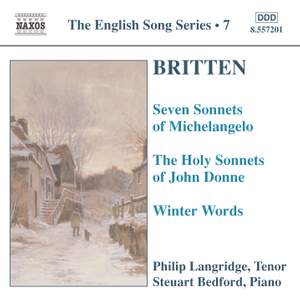
| |  | The English Song Series Volume 7 - Benjamin Britten 1
| | | (also available to download from $5.75) | Usually despatched in 2 - 3 working days. (Available now to download.) |
|
|
| |  | Emotional TurbulenceSong recital
Daphna Cohen-Licht (soprano), Tamir Chasson (piano) | | | Usually despatched in 8 - 10 working days. |
|
|
| |  | Britten - Billy Budd
Britten: | The Holy Sonnets of John Donne, Op. 35 Peter Pears (tenor), Benjamin Britten (piano) Songs and Proverbs of William Blake, Op. 74 Dietrich Fischer-Dieskau (baritone), Benjamin Britten (piano) Billy Budd Peter Glossop (Billy Budd), Peter Pears (Captain Vere), Michael Langdon (Claggart), John Shirley-Quirk (Mr Redburn), Bryan Drake (Mr Flint), David Kelly (Mr Ratcliffe), Kenneth MacDonald (Red Whiskers), David Bowman (Donald), Dennis Wicks (Dansker), Robert Tear (Novice), Robert Bowman (Squeak), Benjamin Luxon (Novice's Friend) Ambrosian Opera Chorus, London Symphony Orchestra, Benjamin Britten |
“a definitive performance, superbly captured by producer John Culshaw. Peter Pears's Captain Vere oversees matters masterfully, but it's Peter Glossop and Michael Langdon as the pitiable Budd and odious Claggart who really drive the action.” BBC Music Magazine, January 2012 “Billy Budd is remarkable in having been composed for male voices, yet not once is there any lack of colour or variety. Britten marvellously supports the tenor, baritone and bass voices with extraordinary flair in the use of brass and woodwind. This was the last operatic recording John Culshaw produced for Decca and he again showed himself unsurpassed at creating a theatrical atmosphere in the studio. Although there have been several striking and brilliant stage productions of this opera in recent years, not to mention Nagano's recording, it must also be said that both technically and interpretatively this Britten/Culshaw collaboration represents the touchstone for any that follows it, particularly in the matter of Britten's conducting. Where Britten is superb is in the dramatic tautness with which he unfolds the score and his unobtrusive highlighting of such poignant detail as the use of the saxophone after the flogging. But most of all, he focuses with total clarity on the intimate human drama against the background of life aboard the ship. And what a cast he had, headed by Peter Pears as Vere, conveying a natural authoritarianism which makes his unwilling but dutiful role as 'the messenger of death' more understandable, if no more agreeable. Peter Glossop's Billy Budd is a virile performance, with nothing of the 'goody-goody' about him. Nor is there any particular homo-eroticism about his relationship with Michael Langdon's black-voiced Claggart: it's a straight conflict between good and evil, and all the more horrifying for its stark simplicity. Add to these principals John Shirley-Quirk, Bryan Drake and David Kelly as the officers, Owen Brannigan as Dansker and Robert Tear and Benjamin Luxon in the small roles of the novice and his friend, and the adjective 'classic' can be applied to this recording with a clear conscience. Also on the discs are two of Britten's most sombre song cycles, the Donne Sonnets and the Blake Songs and Proverbs, the former with Pears, the latter with Fischer-Dieskau, and both incomparably accompanied by Britten. They make ideal complements to Billy Budd. This is without doubt a vintage set.” Gramophone Classical Music Guide, 2010 “Britten himself has an outstanding cast, with Glossop a bluff, heroic Billy and Langdon a sharply dark-toned Claggart, making these symbol-figures believable. Magnificent sound, and the many richly imaginative strokes - atmospheric as well as dramatic - are superbly managed.” Penguin Guide *** | | | (Sorry, download not available in your country) | In stock - usually despatched within 1 working day. |
|
|
| |  | Britten, Berkeley & Rubbra
Berkeley, L: | Horn Trio Op. 44 Six Preludes for Piano, Op. 23 Four poems of St. Teresa of Avila, Op. 27 Three Greek Songs Op. 38 Five Poems of W.H. Auden, Op. 53 (1958) Polka, Op. 5 The Lord is my Shepherd, Op. 91 No. 1 I sing of a maiden | Britten: | Peter Grimes (extracts) Seven Sonnets of Michelangelo, Op. 22 The Holy Sonnets of John Donne, Op. 35 | Rubbra: | Piano Concerto in G, Op. 55 Symphony No. 5, Op. 63 Improvisations on Virginal Pieces by Giles Farnaby, Op. 50 |
The opening of Peter Grimes in 1945 changed British music and international opera forever. Amongst a host of première recordings, this set collects for the first time the 1948 scenes from Grimes (with original cast and conductor), the 1947 Glyndebourne Lucretia (also under Goodall), and the early HMV recordings of the two sonnet cycles, Britten’s partner Pears capturing the creative moment in virile voice. Alongside those works and Britten’s two concertos are fascinatingly set contemporaneous recordings of Rubbra and Berkeley. | | | In stock - usually despatched within 1 working day. |
|
|
| |
|