All recordingsPrices shown exclude VAT. (UK tax is not payable for deliveries to United States.) See Terms & Conditions for p&p rates. | |  | Debussy: Clair de luneand other piano works
| 
| | | (Sorry, download not available in your country) | In stock - usually despatched within 1 working day. |
|
|
| |  | Debussy & Mahler: Mélodies de jeunesse
Julie Fuchs (soprano) & Alphonse Cemin (piano) Julie Fuchs, the 26-year-old soprano from Avignon, has just won a Victoire de la Musique Classique in the 'Lyrical Revelation of the Year' category, after being hailed a Classical Revelation by the perfomers’ rights society, ADAMI and carrying off the Gabriel Dessurget prize at the 2011 Aix-en-Provence Festival. Today, roles such as Susanna in 'Figaro' or Urgande in 'Amadis de Gaule' correspond perfectly to the quality of her voice, as did the title role in 'Acis et Galatée' which she took in July 2011 for the Aix-en-Provence Festival. Over the coming decade, that voice and that stage presence will see her moving towards weightier roles, with the title role of La Traviata beckoning. She’s at the start of a big career: one to watch. “Fuchs’ bright soprano radiates character and sensitivity. An enchanting disc.” Financial Times, 16th March 2013 **** | 
| | | In stock - usually despatched within 1 working day. |
|
|
| |  | Satie & Compagnie
From the poetry of Debussy to the nostalgia of Ravel, from the humour of Satie to the insouciance of Poulenc, the French music of the early decades of the twentieth century was created by fine minds capable of grasping delicate nuances, infinite variations of light on the natural world and the human soul. From the gentlest im pressionism to the most outrageous surrealism, the pathways of French music are many and varied - and immensely colourful. Dedicated to the memory of Brigitte Engerer. “Queffelec has a knack for stimulating programmes and this is no exception...Queffelec's personality is stamped on every note of this generously filled and enjoyable disc.” BBC Music Magazine, May 2013 **** “Queffelec has crafted an inpired 80-minute sequence anchored around some of Satie’s best-known works … Just wonderful!’” Classical Music, February 2013 “This musical jardin a la francaise is dedicated to the memory of Brigitte Engerer, whose death in June last year Anne Queffelec heard of on the very morning she began recording this disc...That is not to say that it's all doom and gloom. Far from it. There are plenty of Gallic high spirits...Altogether an enchanting disc with which to mark your 65th birthday.” Gramophone Magazine, April 2013 | 
| | | In stock - usually despatched within 1 working day. |
|
|
| |  | Debussy: String Quartet & Piano Trio
The Brodsky Quartet celebrates its fortieth anniversary this year. Formed in 1972, the Quartet quickly emerged at the forefront of the international chamber music scene. It has performed more than 2000 concerts and made more than fifty highly acclaimed recordings. Now exclusive Chandos artists, the Brodsky players are releasing their second disc on Chandos with guest soloists Jean-Efflam Bavouzet and the harpist Sioned Williams. The Trio for piano, violin, and cello is an early work, written before Debussy established his own very distinctive musical language heard in pieces such as La Mer. Another early piece, Rêverie, for piano, was written by the young, struggling composer at a time when he was trying to make a living in Paris. The easiest market to break into for a composer was the salon, where songs and not-too-taxing piano music were in demand. Rêverie was one of several charming and tuneful works that Debussy wrote for this scene. In a somewhat different league, the String Quartet is considered a defining work in the history of chamber music. Sensual and impressionistic, it employs a cyclic structure that constituted a split from the rules of classical form and pointed the way forward. In the words of Pierre Boulez, Debussy freed chamber music from ‘rigid structure, frozen rhetoric, and rigid aesthetics’. The Deux Danses, made up of the ‘Danse sacrée’ and ‘Danse profane’, complete the disc. At the end of the nineteenth century, the Parisian instrument makers Pleyel invented a ‘chromatic harp’ which dispensed with pedals and achieved the full chromatic compass from two rows of strings that slanted across one another. Debussy was approached to write two pieces intended for a final examination of the Pleyel model. ‘Danse sacrée’ makes use of Church modes, while ‘Danse profane’ is a kind of sarabande. The ‘competition’ aspect of the pieces is highlighted by the fact that, after the opening introduction, the harpist has no more than six bars’ rest. As it happened, the Pleyel model never caught on, and the works are now always performed on a pedal harp. “For those of us who recall the Brodskys as “Cool Britannia” clotheshorses, their 40th anniversary this year — well, for two of the line-up — comes as a shock. Less surprising is their compelling account, forthright and dramatic, rather than hazily impressionistic, of the [Debussy]” Sunday Times, 1st April 2012 “The Quartet tops the running order in a confident, vital, lyrical reading. Beautifully nuanced, there's acerbic edge, gentle Gallic playfulness, aching romance and every emotional and tonal shade in-between...Cassidy's scoring [of Reverie] is so similar to that of the quartet that the work has taken on a new identity...its new gravitas makes it a fitting bookend to the programme, a partner to the Quartet, and an unexpected delight.” Charlotte Gardner, bbc.co.uk, 18th April 2012 “In the Piano Trio Bavouzet enjoys the spotlight with some memorable pearliness of tone, and here violinist Daniel Rowland is joined by cellist Jacqueline Thomas in a performance notable for its warmth and luminosity...the natural-sounding acoustic does much to enhance the listener's experience.” International Record Review, May 2012 “Altogether a satisfying and unique Debussy coupling, superbly played...What is so striking about the playing of the Brodsky Quartet throughout is their brimming love for the music, with some ravishing shading down to the most hushed pianissimos. All this is caught in wonderfully rich and transparent sound, a credit to the Chandos engineers.” Gramophone Magazine, June 2012 “This is a marvellously inventive collection...There has been a tendency towards more red-blooded performances of Debussy's String Quartet in recent years...The Brodsky Quartet partially fit that mould...Their playing is tempered, both in the Quartet and the Reverie, by a quivering texture in more hushed moments” BBC Music Magazine, June 2012 **** “The Brodsky Quartet makes its intentions clear from the first bars of Debussy’s Opus 10 String Quartet: this is by no means going to be an atmospheric echo of impressionism, but an interpretation in which every single stress and emotive extreme is going to be exploited and laid bare. The Brodsky players do plenty in terms of colour” MusicWeb International, June 2012 | | | (also available to download from $10.50) | In stock - usually despatched within 1 working day. |
|
|
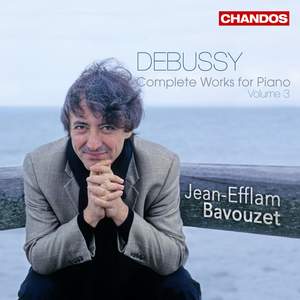
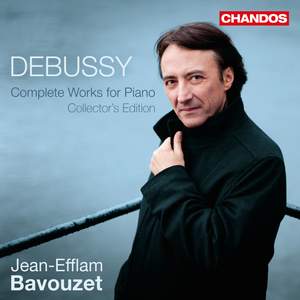
| |  | Debussy - Complete Works for Solo Piano Volume 3
Jean-Efflam Bavouzet here offers the third volume in his series devoted to the complete works for piano by Debussy. The music now moves to a more playful strand in Debussy’s compositional career, with generally shorter pieces of the salon genre, including the two famous collections Children’s Corner and Suite bergamasque. In addition to these well-known works are several that are more rarely heard. Two such are La plus que lente, which seems to look ahead to the Études of 1915, and Élégie. Roger Nichols describes the former as ‘one of his most delightful pieces… the harmonic turns are particularly sophisticated and enchanting’. The Élégie was written in 1915 following the composer’s move to the coast. The outbreak of the First World War had initially depressed Debussy into a state of creative sterility but the move was to prove most productive. The Élégie was written for a charity and, dedicated to Queen Alexandra, honours the role of women in wartime. It is now rarely performed but Roger Nichols writes, ‘it is one of the composer’s most extraordinary works… and we are left wondering what on earth Debussy would have written in the 1920s and beyond’. Bavouzet’s previous two volumes have been very well received both critically and commercially. In a recent review of volume two the LA Times wrote, ‘In what may turn out to be the greatest complete recorded survey of the composer’s piano music yet, Jean-Efflam Bavouzet… plays with such bracing clarity that hearing the early Romantic pieces, one feels like jumping into an icy pond after an hour in the sauna’. Of the same volume International Record Review has noted, ‘I had the highest praise for Jean-Efflam Bavouzet’s first volume of Debussy, and the present disc is fully the equal of that one in terms of colour, refinement of touch, spontaneity and technical finish… Bavouzet has written that his Debussy playing has been influenced by that of Gieseking, Michelangeli and Richter. You may hear something of each of these pianists in his playing but more than that you will hear his own distinctive and special voice’. This series is a deeply personal project for Bavouzet who has been involved in all aspects of the recording process. “This third volume confirms Jean-Efflam Bavouzet's winning affinity for Debussy's music. Such familiar pieces as the Suite bergamasque, Deux Arabesques or Children's Corner come across with their colours luminous, their ideas voiced fluently and the moods atmospherically fixed.” The Telegraph, 31st May 2008 “Fiercely energised yet superfine, his performances are not for those with comfortable drawing-room notions of Debussy.” Gramophone Magazine, July 2008 “…this delightful disc places Debussy's two most modest cycles (Children's Corner and Suite bergamasque) within a broadly chronological sequence of pieces spanning the composer's career.” BBC Music Magazine, June 2008 ***** “Volume 3 of Jean-Efflam Bavouzet's superb Debussy cycle links mostly early miniatures with the Suite bergamasque and Children's Corner. Once more he turns conventional notions of 'impressionism' topsy-turvy, cleansing Debussy of years of dust and accretion and recreating him in every bar in a sparkling and pristine light. Fiercely energised yet superfine, his performances are not for those with comfortable drawing- room notions of Debussy, and rarely in my experience has a pianist so faultlessly or precisely achieved his aims. All sentimentality is erased from the Nocturne's enchanting evanescence and just when he momentarily has you wishing that his formidable directness would melt into something more heart-easing, he makes you gasp at his flawless balance of sense and sensibility. He makes something audaciously epic out of Hommage à Haydn and the startling hesitancy in the opening of 'The Snow is Dancing' is convincing rather than idiosyncratic. His recital ends on a desolating note with the Berceuse héroïque's phantom battle-cries and bugle-calls memorably evoked. The superbly recorded disc includes his own remarkable essay. This could well be the finest and most challenging of all Debussy piano cycles. A greater study in contrast in 'composer and interpreter' would be hard to imagine then between Bavouzet and Pascal Rogéacute;. Where Bavouzet breaks out into blazing Mediterranean sunlight, Rogéacute; (radically enriching his earlier Decca Debussy discs) is happy to withdraw into shadow-land. Time and again his playing suggests emotion recollected in tranquillity rather than turmoil; and in, say, 'Hommage à Rameau' or the Sarabande from Pour le piano he discovers the mysterious, still centre of Debussy's art. 'Poissons d'or' is a marvellous distillation of indolence and flashing disruption, and 'Mouvement' is a perky and vivacious rejoinder to all former introspection. And so too is the Toccata, played with unerring ease and grace, and with many ear-catching details. To summarise, the ever-elusive truth lies somewhere between Rogéacute; the dreamer, Bavouzet the sinewy but always musical athlete, Thibaudet, the teasing wit and sophisticate and, of course, the legendary Gieseking. You pays your money and you takes your choice…” Gramophone Classical Music Guide, 2010 “Debussy playing does not come any better than this” Penguin Guide, 2011 edition | | | (also available to download from $10.50) | In stock - usually despatched within 1 working day. |
|
|
| |  | Debussy - Complete Piano Works Volume 3
“Where Bavouzet breaks out into blazing Mediterranean sunlight, Rogé is happy to withdraw into shadow-land. Time and again his playing suggests emotion recollected in tranquillity rather than turmoil;… "Poissons d'or" is a marvellous distillation of indolence and flashing disruption.” Gramophone Magazine, July 2008 | | | In stock - usually despatched within 1 working day. |
|
|
| |  | Debussy: Complete Solo Piano Music, Vol.1
| | | (Sorry, download not available in your country) | In stock - usually despatched within 1 working day. |
|
|
| |  |
Also available as part of the Debussy - The Piano Works box set, ALC4002. | | | In stock - usually despatched within 1 working day. |
|
|
| |  | Debussy: Works for Piano
| | | In stock - usually despatched within 1 working day. |
|
|
| |  | Reverie
Anthony Ferner (flute), Helen Webby (harp) Leading New Zealand musicians Anthony Ferner (flute) and Helen Webby (harp) – both from Christchurch – perform a selection of reflective works for flute and harp, including Dorothea Franchi’s ‘Suite for Flute and Harp’. | | | In stock - usually despatched within 1 working day. |
|
|
| |
|