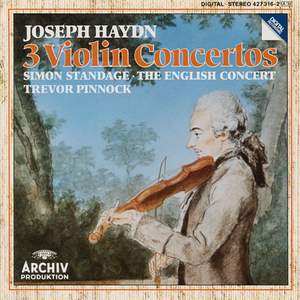
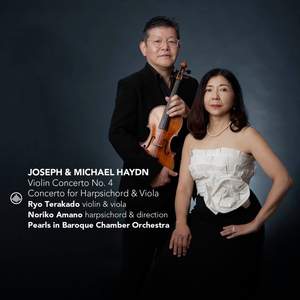
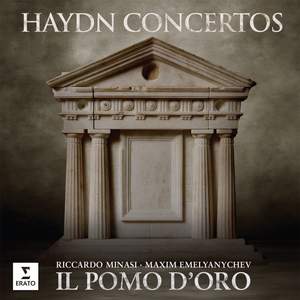
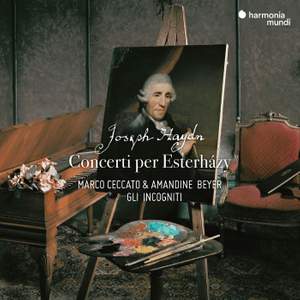
Prices shown exclude VAT. (UK tax is not payable for deliveries to United States.) See Terms & Conditions for p&p rates. | |  | Haydn - Concertos for Harpsichord & Violin
Milan’s acclaimed period performance specialists Accademia Bizantina conclude the Haydn anniversary celebrations with an invigorating rethinking of his concertos for harpsichord and violin. Accademia Bizantina, esteemed by critics and music lovers as one of today’s foremost period performance ensembles, is especially renowned for its respectful mastery of 17th- and 18th-century Italian repertoire The disc contains a concerto each for violin and harpsichord, as well as one for both instruments. Multi-talented Ottavio Dantone conducts the ensemble and is harpsichord soloist. The group’s leader Stefano Montanari plays the solo part in the Violin Concerto The Independent lauded the recording of Bach’s Harpsichord Concertos: “For intimacy and brio, there’s Ottavio Dantone and Accademia Bizantina . . . the ensemble is faultless.” “Past Haydn’s anniversary year, the world still needs his intelligence and wit — much in evidence in these bubbly performances from Dantone’s Accademia Bizantina. Stefano Montanari’s agile and subtle playing steals the show in the G major Violin Concerto...A CD that makes you feel good to be alive.” The Times, 15th May 2010 **** “[Montanari's] tone is rich, warm and seductive but with impeccable Classical poise...Throughout the programme, both Montanari and Dantone also add some really delightful touches of ornamentation. The recording was made in the Sala Dantesca in Ravenna and it's astonishingly vivid.” International Record Review, July/August 2010 | | | In stock - usually despatched within 1 working day. |
|
|
| |  | Gil Shaham plays Haydn & Mendelssohn
Gil Shaham and Sejong Soloists’ association extends back over a decade, the Haydn concerti and Mendelssohn Octet on this release benefiting from a US tour in April 2009 just prior to the recording sessions. Haydn and Mendelssohn may not be obvious bedfellows but there is considerable synergy in the composers and this repertoire. Both Haydn’s C major and G major concerti date from the 1760s, still very much in his self proclaimed, “extended youthful period”, together with the fresh and adventurous nature of the Octet, composed when Mendelssohn was still just a teenager. Haydn and Mendelssohn also shared a certain financial freedom that seemed to propel both to new heights of inspiration. Shaham and Sejong give this repertoire a sense of real intimacy, creating a magical intensity and engagement. The Haydn concerti display Shaham’s flawless technique and lyrical tone - communicating like few others can - and Sejong embrace his direction and Haydn’s intricacies magnificently. Mendelssohn’s Octet in E-flat Major is arguably THE crown jewel of chamber music. In this recording, Gil Shaham combines aspects from Mendelssohn’s original manuscript version of the Octet, which saw him achieve instant fame, and the final published edition, the 2 versions being separated by 7 years and several revisions in between. Here, for the first time, the modern music world is introduced to the youthful spirit with which Mendelssohn first brought this work to the world. Of particular significance is the considerably more lively tempi adopted from the original manuscript. Shaham and Sejong embrace and execute this with amazing clarity, the sound being lush and sumptuous yet with an amazing sense of intimacy. This recording is one of those rare occasions where the ensemble and repertoire come together, the ultimate triumph being the blend and balance achieved by Shaham and Sejong to completely immerse the listener in the moment. The insightful CD booklet annotations have been authored by Stephen Somary, Artistic Director of the Mendelssohn Project. ‘Shaham manages to combine extraordinary virtuosity with uncommon restraint ... The majestic sweep of the augmented quartet form was given full rein ... two powerful forces in the service of a higher cause.’ Santa Barbara Independent, Mendelssohn/Haydn Concert Review April 2009 “The Sejong Soloists muster a propulsive verve in the first movement...Both Scherzo and Finale work best, the former because the half-lit filigree is beautifully realised, the latter thanks to the guiding hand of some exhilarating counterpoint.” BBC Music Magazine, June 2010 *** “Gil Shaham and the Sejong Soloists - a handpicked ensemble of young musicians - present a driving performance, bustling and forward-moving in the opening Allegro...building cumulatively to a chattering contrapuntal finale that demonstrates these players' admirable abilities individually and in ensemble.” Gramophone Magazine, June 2010 | | | In stock - usually despatched within 1 working day. |
|
|
| |  | Rachel Podger - Mozart & Haydn Concertos
Rachel Podger’s first recording with orchestra since the landmark Gramophone Award winning disc of Vivaldi’s La Stravaganza. Follows eight volumes of the Award Winning Mozart Violin Sonatas edition. Rachel Podger challenges Pavlo Beznosiuk. Soloists play on real ‘Strads’. “…Rachel Podger…silvery-toned, subtly nuanced 1739 Pesarinius violin and intent direction of the strings of the Orchestra of the Age of Enlightenment find a genuine eloquence in the Adagio of the otherwise unremarkable G major Concerto. Mozart's Sinfonia Concertante is... a masterpiece unique even in his output for the almost operatic interplay between its solo violin and viola protagonists... Podger's almost 'speaking' line contrasts with the more 'masculine' tones of Pavlo Beznosiuk. Others have wrung even more pathos from the somber Andante, but this scarcely alloys the warmth and life of the reading.” BBC Music Magazine, Christmas 2009 **** “Podger makes a strong case for Haydn's concertos… the sound has a warm glow that enhances her standpoint that these works are not lightweight nonentities. Slow movements are particularly profound…” Gramophone Magazine, December 2009 “...the OAE accompanies with poise and discretion, allowing Podger's consummate talent to shine through.” The Observer, 29th November 2009 | | | In stock - usually despatched within 1 working day. |
|
|
| |  | Le Cercle de l'Harmonie play Haydn & Hofmann
Most of Haydn's concertos are early works, written in the years immediately before or after his engagement at the Esterhazy court in 1761. During that time, he composed four violin concertos, of which three-all except Hob.VIIa, No.2 in D major - survive, none of them in autograph form. Hob.VIIa No.3, in A major turned up only in 1949. Leopold Hofmann (1738-1793) was regarded by his contemporaries as one of the most gifted and influential composers of his generation. Although a church musician by profession, Hofmann was also an important and prolific composer of instrumental music. His symphonies, concertos and chamber works were played all over Europe and the avidity with which they were collected is attested to by the large number of surviving manuscript copies. Hofmann was famed for his violin playing and several of his concertos were probably written for his own use. He held a number of important church music positions in Vienna, foremost among them, that of Kapellmeister at St Stephan's Cathedral (1772-1793) and also served for some years as Hofklaviermeister. “Three elegant concertos from a bright young period-instrument orchestra” Gramophone Magazine, November 2009 | | | In stock - usually despatched within 1 working day. |
|
|
| |  |
| | | In stock - usually despatched within 1 working day. |
|
|
| |  | Haydn: Symphonies Nos. 26, 52 and 53
“These are fresh, vital, cleanly articulated performances which wear their authenticity lightly” Penguin Guide | | | In stock - usually despatched within 1 working day. |
|
|
| |  |
| | | In stock - usually despatched within 1 working day. |
|
|
| |  | Haydn: Cello Concertos Nos. 1 & 2
| | | Usually despatched in 2 - 3 working days. |
|
|
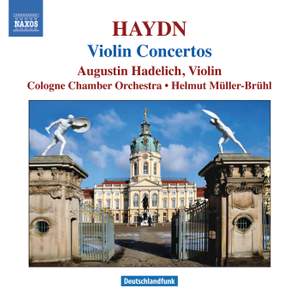
| |  | Haydn: Violin Concertos
Following his critically acclaimed recording of all the Mozart concertos, Giuliano Carmignola fulfills his long-held wish to record the unjustly neglected violin concertos of Joseph Haydn. Carmignola’s technical precision, disciplined musicality and gorgeous tone bring every one of the composer’s intentions to vivid life. His musical collaborators here, the remarkable Orchestre des Champs-Élysées − known for performing repertoire from Haydn to Mahler on period instruments − makes an ideal partner. “Haydn’s three surviving violin concertos date from the 1760s, although they haven’t been much played since (they weren’t even published till the 20th century). Carmignola’s pristine performances with the Orchestre des Champs-Elysées should persuade us to listen again.” The Times, 14th January 2012 *** “[Carmignola's] ability to generate intense emotions by the sparest means leads to unforgettable things in the First's adagio. The Orchestre des Champs-Elysées under its leader Alessandro Moccia are classy: their acerbic sound keeps the drama uppermost and prevents everything from becoming cloying.” The Guardian, 9th February 2012 **** “Carmignola combines historical performance practice with spontaneous touches of colour to make the most of Haydn's phrases. The Orchestre des Champs-Elysees match him in crispness and bounce.” BBC Music Magazine, April 2012 *** “Carmignola plays as if this music had been composed specifically for him, with all the tonal richness and agility required of him and with a pinpoint accuracy of intonation...There's no denying that these works aren't the last word in violin concerto composition but, performed as scintillatingly as this, they're worth an hour of anyone's time.” Gramophone Magazine, May 2012 “the outer movements bubble along here full of life and fresh-faced charm...Carmignola injects a level of colour and variety into this music which more than compensates for a gnawing that when he wrote it Haydn was not entirely brimming over with new ideas.” International Record Review, May 2012 | | | Usually despatched in 2 - 3 working days. |
|
|
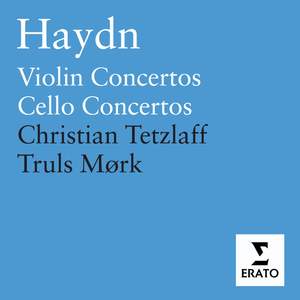
| |  | Haydn: Violin & Cello Concertos
After Haydn became vice-Kapellmeister to the Esterházy family in 1761, he soon realised that he had at his disposal some remarkable musicians in the orchestra at the court. In his Symphonies 6, 7 and 8 he had given the principal musicians significant solo parts. Although he didn’t repeat this in later symphonies, he produced a series of concertos for violinist Luigi Tomasini, cellist Joseph Weigl and others. These works lay unknown throughout the 19th century, and only came to light in the first part of the 20th – in fact the famous D major Cello Concerto (now one of the most popular of Haydn’s works and one of the ‘great’ cello concertos) wasn’t discovered until the early 1950s. New booklet notes by Haydn authority David Threasher. ‘The recorded quality is lifelike, surfaces are completely silent – save for the impeccable playing of these splendid artists.’ Gramophone, October 1981 (violin concertos) | | | Usually despatched in 2 - 3 working days. |
|
|
| |
|