Prices shown exclude VAT. (UK tax is not payable for deliveries to United States.) See Terms & Conditions for p&p rates. | |  | American Music: Quatuor Diotima
Quatuor Diotima: Yun-Peng Zhao, Naaman Sluchin (violin), Franck Chevalier (viola) & Pierre Morlet (cello) Following two highly praised recordings for Naïve of music by Georges Onslow and the Second Viennese School, the Quatuor Diotima’s new recording presents three major compositions of 20th century American chamber music. They are Different Trains by Steve Reich (with a tape recorded by Diotima themselves), Samuel Barber’s Quartet op.11, which includes the original version of his famous ‘Adagio’, and George Crumb’s Black Angels. Founded by graduates of the Paris and Lyon conservatoires, the Diotima Quartet is a favoured partner of many contemporary composers including Helmut Lachenmann, Brian Ferneyhough, and Toshio Hosokawa. It regularly commissions new pieces from such composers as Emmanuel Nunes and James Dillon, but by no means neglects the classic string quartet repertoire, paying particular attention to the late quartets of Beethoven, French music, and the music of the early twentieth century. The quartet’s first recording of music by Lachenmann and Nono was awarded a Diapason d’Or in 2004 in the ‘Discovery’ category. Its discography includes the two Janacek quartets and Schoenberg’s Concerto for Quartet and Orchestra for the label Kairos, and an album with Thomas Larcher on ECM. The Quatuor Diotima’s recordings in recent years of quartets by Georges Onslow (V5200) and music of the Second Viennese School (V5240) for Naive have both been highly praised by reviewers. “the conjunction of these three contrasting string pieces written across the 20th century proves useful, and stimulates thought. Furthermore, Hughes Deschaux's recording is terrific. It's vivid and warm with a generous sense of space...and you can't fault Pierre Morlet's cello, always singing and sorrowful.” BBC Music Magazine, March 2012 **** “This is an eccentric collection of strange bedfellows...the Diotima's performance is a strong one.” Gramophone Magazine, March 2012 “Eloquent and tonal, it exudes a suavely Gallic influence. The Quatuor Diotima avoid supersweet sentimentalism and concentrate instead on clarity.” Sunday Times, 13th November 2011 “Deeply peculiar in a highly satisfying way, this music provokes shocks and giggles in equal measure.” The Arts Desk, 10th March 2012 “the shrill, astringent tone of the violins...works to their advantage in realising George Crumb's "Black Angels for Electric Quartet", a dramatic, sometimes antagonistically cacophonous assemblage of 13 brief "images from the dark land", in places seemingly influenced by Bernard Herrmann's piercing score for Psycho.” The Independent, 4th November 2011 ** | | | (also available to download from $10.50) | In stock - usually despatched within 1 working day. |
|
|
| |  | Barber - String Quartet, Serenade, Dover Beach & Songs
Barber, S: | Dover Beach, Op. 3 Serenade for String Orchestra, Op. 1 Three Songs, Op. 2 Three Songs, Op. 10 Four Songs, Op. 13, No. 4 (Nocturne) Sure on this shining night, Op. 13 No. 3 Three Songs, Op. 45 Despite and Still, Op. 41 with Eric Cutler, Bradley Moore String Quartet, Op. 11 |
Although he wrote two large scale operas, two symphonies and a concerto each for violin, cello and piano, the majority of Barber's compositions were on a much smaller scale. This collection of songs and chamber pieces contains some of his earliest work, dating from 1928 to 1940, with two groups of songs from 1968 and 1972 respectively. The Adagio movement of the String Quartet from 1936 has, in its version for string orchestra, become one of the most popular works by an American composer. Here is an opportunity to hear it as Barber originally intended, and the intimacy brought to it by a smaller ensemble lends it a greater intensity. Barber was a fine composer for the voice and his output of songs was prolific. Dover Beach, to words by Matthew Arnold, is one of Barber's finest compositions and it is beautifully sung here by Thomas Allen. “Mostly a wide-ranging choice of Barber's songs, intense and rather Brittenish in idiom, but polished and often warm-hearted, plus his String Quartet, source of the famous Adagio.” BBC Music Magazine, November 2009 **** | | | In stock - usually despatched within 1 working day. |
|
|
| |  | American Anthem: The Music of Samuel Barber & Howard Hanson
Contains standard CD and Blu-ray surround-sound audio disc | 
| | | (also available to download from $10.50) | Usually despatched in 2 - 3 working days. (Available now to download.) |
|
|
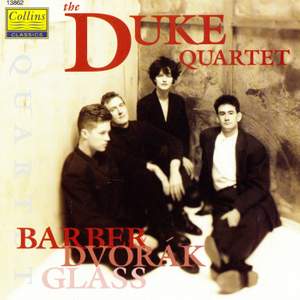
| |  | Barber, Dvorak & Glass: String Quartets
| |
|
| |  | Barber: String Quartet & Cello Sonata
| |
|
| | | |  |
| | (Sorry, download not available in your country) | |
|
|
| |  | Samuel Barber: Historical Recordings 1935-1960
Barber, S: | Adagio for Strings, Op. 11 Recorded live on 5th November 1938 NBC Symphony Orchestra, Arturo Toscanini Capricorn Concerto Recorded live on 2nd May 1945 CBS Orchestra, Samuel Barber Violin Concerto, Op. 14 Recorded 7th February 1941 Albert Spalding (violin) Philadelphia Orchestra, Eugene Ormandy Cello Concerto, Op. 22 Recorded 11th December 1950 Zara Nelsova (cello) New Symphony Orchestra, Samuel Barber Die Natali, Op. 37 Recorded live on 23rd December 1960 Boston Symphony Orchestra, Charles Munch Dover Beach, Op. 3 Recorded 13th May 1935 Samuel Barber (baritone) Curtis String Quartet First Essay for Orchestra Op. 12 Recorded live on 5th November 1938 NBC Symphony Orchestra, Arturo Toscanini Second Essay for Orchestra, Op. 17 Recorded live on 16th April 1942 New Symphony Orchestra, Bruno Walter Excursions Op. 20 Recorded 17th November 1950 Rudolf Firkušný (piano) Knoxville: Summer of 1915, Op. 24 Recorded live 19th June 1949 Eileen Farrell (soprano) CBS Symphony Orchestra, Bernard Herrmann Medea Orchestral Suite, Op. 23 Recorded 12th December 1950 New Symphony Orchestra, Samuel Barber Overture to The School for Scandal, Op. 5 Recorded 11th March 1942 Janssen Symphony, Janssen Victor Prayers of Kierkegaard, Op. 30 Recorded live on 3rd December 1954 Boston Symphony Orchestra, Charles Munch Cello Sonata in C minor, Op. 6 Recorded live on 28th January 1973 Orlando Cole (cello), Vladimir 'Billy' Sokoloff (piano) String Quartet, Op. 11 Recorded live on 14th March 1938 Curtis Quartet Symphony No. 1, Op. 9 Original version; recorded live 2nd April 1938 NBC Symphony Orchestra, Artur Rodzinski Symphony No. 2, Op. 19 Original version; recorded live on 4th March 1944 Boston Symphony Orchestra, Serge Koussevitzky Vanessa Recorded live on 1st February 1958 Eleanor Steber (Vanessa), Rosalind Elias (Erika), Nicolai Gedda (Anatol), Giorgio Tozzi (The Doctor), Regina Resnik (The Old Baroness), George Cehanovsky (Nicholas), Robert Nagy (Footman) Orchestra and Chorus of the Metropolitan Opera House, Dimitri Mitropoulos Violin Concerto, Op. 14 Revised version; recorded 7th January 1949 Ruth Posselt (violin) Boston Symphony Orchestra, Serge Koussevitzky Knoxville: Summer of 1915, Op. 24 Revised version; recorded live in October 1958 Eleanor Steber (soprano) Edwin Biltcliffe Knoxville: Summer of 1915, Op. 24 Revised version; recorded live on 15th November 1959 Leontyne Price (soprano) New York Philharmonic Orchestra, Thomas Schippers Symphony No. 1, Op. 9 Revised version; recorded 12th March 1944 New York Philharmonic Orchestra, Bruno Walter Symphony No. 2, Op. 19 Revised version; recorded 13th December 1950 New Symphony Orchestra, Samuel Barber Medea's Meditation and Dance of Vengeance, Op. 23a Recorded live on 16th March 1958 New York Philharmonic Orchestra, Dmitri Mitropoulos Sure on this shining night, Op. 13 No. 3 Four Songs, Op. 13, No. 4 (Nocturne) I hear an army Recorded live on 2nd May 1945 Jennie Tourel (mezzo) CBS Symphony Orchestra, Samuel Barber Commando March Recorded live on 30th October 1943 Boston Symphony Orchestra, Serge Koussevitzky Souvenirs, Op. 28 Recorded on 15th August 1952 Gold & Fizdale Duo |
Also includes interviews with Barber and Menotti and rehearsal footage of the Second Symphony (Barber conducting)
An extraordinary collection of Barber performances, most of them never before released. Several major works are included in both their original and revised versions. Newly restored sound. “this is as wide-ranging an anthology of Barber performances as anyone could wish for… the transfers are consistently excellent and the presentation is superb… Barber was one of the most subtle and individual voices of American twentieth-century music and this box is a magnificent celebration of his very personal art.” International Record Review, July/August 2011 “A treasure-trove of historic Barber recordings...A real discovery is the broadcast of the Adagio for strings and the First Essay with the NBC Symphony under Toscanini on November 5, 1938. These were the actual sounds that propelled Barber into the front rank of American composers...This set of CDs is a gold mine for anyone wanting to study Barber's revisions and early performances, many of which are not otherwise available.” Gramophone Magazine, October 2011 | | | (also available to download from $60.25) | In stock - usually despatched within 1 working day. |
|
|
| |
|