All recordingsPrices shown exclude VAT. (UK tax is not payable for deliveries to United States.) See Terms & Conditions for p&p rates. | |  | JS Bach: Orchestral Suites BWV 1066-69 & Triple Concerto
| 
| | | In stock - usually despatched within 1 working day. |
|
|
| |  | Mieczyslaw Horzowski plays Bach and Beethoven
Bach, J S: | Concerto for Flute, Violin & Harpsichord in A minor, BWV1044 live recording, 1950 John Wummer (flute), Alexander Schneider (violin), Mieczyslaw Horzowski (piano) Casals Festival Orchestra, Pablo Casals English Suite No. 5 in E minor, BWV 810 live recording, 1950 Mieczyslaw Horzowski (piano) | Beethoven: | An die ferne Geliebte (To the distant beloved), Op. 98 live recording, 1951 Aksel Schiotz (baritone), Mieczyslaw Horzowski (piano) |
| | | In stock - usually despatched within 1 working day. |
|
|
| |  | J.S Bach: Keyboard Concertos
“Her playing is absolutely captivating: she decorates the solo part with playful, come-hither ornamentation—twirls, flutters, arabesques—and yet it never disturbs the clear, logical path she forges through the course
of each work. Her staccato touch has the force of sprung steel and yet her legato line is a miracle of smoothness and transparency. An absolute joy” Gramophone Magazine | | | In stock - usually despatched within 1 working day. |
|
|
| |  | JS Bach - Orchestral Suites & Other Concertos
“The Third and Fourth Suites are irresistible.” BBC Music Magazine, July 2010 *** “...while running counter to the customised cool of period performance, [Menuhin's Bach] continues to delight with its full-bodied tone, musical phrasing and well-chosen tempi. In a word, they sound beautiful...The recording quality combines clarity with impressive warmth of texture and the transfers are excellent.” Gramophone Magazine, June 2010 | | | In stock - usually despatched within 1 working day. |
|
|
| |  | Bach Cantatas Volume 2Cantatas for the Second Sunday after Trinity & Cantatas for the Third Sunday after Trinity
Recording locations: Recorded live: Paris/Zürich, July 2000 Cantatas for the second and third Sunday after Trinity, recorded live in July 2000. Performing to an audience of more than 1200, we join Gardiner, The Monteverdi Choir and The English Baroque Soloists at the halfway point of their Bach Cantata pilgrimage for a concert in one of the great architectural landmarks of Catholic Europe, the Basilisque Saint-Denis (Basilica Cathedral of Saint Denis). Featuring internationally acclaimed soloists including James Gilchrist, Lisa Larsson, Daniel Taylor and Stephen Varcoe, the programme opens with BWV 2 Ach Gott, vom Himmel sieh darein (Oh God, look down from Heaven), based upon Martin Luther’s German hymn adaptation of Psalm 12. The psalm describes how easily man is led astray by heresy and Bach deals with such grim subject matter by resorting to composing in an archaic motet style. The result is austere beauty and has the engrossing quality of ritualised worship. There then follows BWV 10 Schütz’s superb motet Die Himmel erzählen die Ehre Gottes (The heavens are telling of God in glory) follows. This is a motet that John Eliot remembers fondly, since it is a work he has known since he was six and he can still hear his father’s ringing tenor declaiming its powerful text. The concert ends with Bach’s prodigious cantata, BWV 76 Die Himmel erzählen die Ehre Gottes, a lengthy and complex bipartite cantata, comprising fourteen movements and divided into two equal parts. We then head to Zürich to hear Gardiner and his Monteverdi forces perform within the stunning Fraumünster Kirche, distinctive for its slender, blue spire. They open with the two-part Weimar Cantata BWV 21 Ich hatte viel Bekümmernis (I had much affliction), considered to be ‘…one of the most extraordinary and inspired of Bach’s vocal works’, as stated by John Eliot Gardiner in his booklet note. There then follows BWV 135 Ach Herr, mich armen Sünder (O, Lord, I poor sinner). This is superb music and Bach concludes with a rousing ‘Glory to God’, to the Passion chorale by Cyriakus Schneegaß (1597). With only two cantatas for this Sunday in existence, the concert ends with Bach’s so-called Triple Concerto, BWV 1044 (Concerto for flute, violin and harpsichord). Despite its similarity to Brandenburg Concerto No.5, it seems to inhabit a different stylistic milieu to that of Bach’s other concerti – one much close to that of his eldest sons. “This ongoing recording project ranks as one of the musical events of the decade.” The Observer “...this vividly scored piece of theatre [BWV21] places both voices and a colourful instrumental group in urgent dialogue. We are drawn into this right from the opening Sinfonia...Among competing versions only Richter approaches Gardiner in his apposite sense of theatre.” BBC Music Magazine, June 2010 **** “...here, again, it the spontaneous and committed response of Sir John Eliot Gardiner's musicians which dominates the majority of performances...Gardiner is the king of dramatic moment...As so often in the Pilgrimage, James Gilchrist stands out” Gramophone Magazine, June 2010 | | | (also available to download from $21.00) | In stock - usually despatched within 1 working day. |
|
|
| |  | Bach - Harpsichord Concertosincludes harmonia mundi catalogue CD 2009 - 231 pages
“While Manze draws spirited playing from his ensemble, it's Egarr's intimately dramatic approach that really makes these discs special.” The Independent ***** | | | In stock - usually despatched within 1 working day. |
|
|
| |  |
| | | In stock - usually despatched within 1 working day. |
|
|
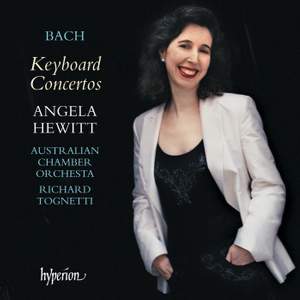
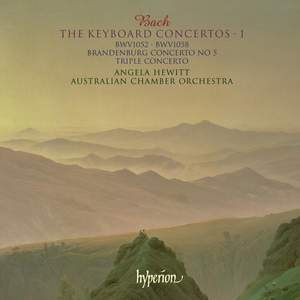
| |  | J.S Bach: The Keyboard Concertos 1
Together with its companion Volume 2, these CDs contain all Bach’s extant concertos that feature a solo keyboard. Most were written in the 1730s and are thought to be arrangements of earlier concertos, many of which are now lost (though two will be recognized as Bach’s E major and A minor violin concertos and the sixth is an arrangement of the fourth Brandenburg). The fifth Brandenburg Concerto, with harpsichord, flute and violin soloists, dates from 1721 and is generally regarded as the first concerto for a solo keyboard instrument ever written. Bach made the keyboard part particularly brilliant and included a huge cadenza; he certainly knew how to establish a genre with a bang! Hewitt’s Bach is by now self-recommending but only after playing Bach across the world with numerous ensembles did Angela decide that the Australian Chamber Orchestra were the perfect collaborators. After a month of concerts across Australia these recordings were set down in Sydney in February of this year and the frisson of artists operating at the peak of their form is clear for all to hear. One is immediately struck by the quality of chamber-music playing as phrases are passed from soloist to orchestra and, in the case of Brandenburg Concerto No 5 and the Triple Concerto, between all three soloists. Rhythms are buoyant, tempos lively, the spirit of dance is never far away in the fast movements and a perfectly vocal quality pervades the sung lines of the slow movements. These CDs will surely be the jewels in the crown of Angela Hewitt’s magnificent Bach series. “These are not entirely modern-instrument performances. Angela Hewitt includes, as she says, 'a harpsichord in its traditional role as continuo'. Combining old and new isn't unusual because in the early years of period performing practices, the likes of Thurston Dart, Raymond Leppard and George Malcolm married a harpsichord to modern strings and wind. What's unusual here is the melding of two different types of keyboard, one sharply transient, the other ductile; and just how their functions dovetail with one another may be heard in the slow movement of the Brandenburg Concerto No 5. Hewitt also adds a cello to the continuo while contributing notes inégales, appogiature and other embellishments to her own line. The result is a potent artistic synergy between the musicians. Hewitt doesn't slavishly follow a formula, though. In the Adagio of No 1 and the Adagio epiano sempre of No 3 (where she is most intense because both remind her of Passion music), she omits the keyboard's bass notes for the exposition of the theme but only in No 1 does she play them for its return at the end. In these instances, in the Andante of No 7 and elsewhere, she also varies the prominence of her left hand to give the ripieno string bass a strong presence too, while delineating the right hand melody most feelingly. Interpretative decisions are intelligently applied; and Hewitt is at her best in the slow movements, all of which are played with the finest sensibility. If a more sinewy approach to a few of the outer movements might not have come amiss, her ability to gauge the critical notes of phrases so as to maintain an elastically accented rhythm offers ample compensation; and the consummate Australian Chamber Orchestra is with her every step of the way. The flute is placed backward in BWV1044 but otherwise recorded balance and sound ensure unimpeded concentration on the performances. Small changes in level between some works are easily adjusted. A superb pair of discs.” Gramophone Classical Music Guide, 2010 | | | In stock - usually despatched within 1 working day. |
|
|
| |  | J.S Bach: The Keyboard Concertos 1
These CDs contain all Bach’s extant concertos that feature a solo keyboard. Most were written in the 1730s and are thought to be arrangements of earlier concertos, many of which are now lost (though two will be recognized as Bach’s E major and A minor violin concertos and the sixth is an arrangement of the fourth Brandenburg). The fifth Brandenburg Concerto, with harpsichord, flute and violin soloists, dates from 1721 and is generally regarded as the first concerto for a solo keyboard instrument ever written. Bach made the keyboard part particularly brilliant and included a huge cadenza; he certainly knew how to establish a genre with a bang! Hewitt’s Bach is by now self-recommending but only after playing Bach across the world with numerous ensembles did Angela decide that the Australian Chamber Orchestra were the perfect collaborators. After a month of concerts across Australia these recordings were set down in Sydney in February of this year and the frisson of artists operating at the peak of their form is clear for all to hear. One is immediately struck by the quality of chamber-music playing as phrases are passed from soloist to orchestra and, in the case of Brandenburg Concerto No 5 and the Triple Concerto, between all three soloists. Rhythms are buoyant, tempos lively, the spirit of dance is never far away in the fast movements and a perfectly vocal quality pervades the sung lines of the slow movements. These CDs will surely be the jewels in the crown of Angela Hewitt’s magnificent Bach series. | | | In stock - usually despatched within 1 working day. |
|
|
| |  | Bach & Telemann: Recorder Concertos
Michala Petri (recorder) Berliner Barock Solisten, Rainer Kussmaul (leader) | | | In stock - usually despatched within 1 working day. |
|
|
| |
|