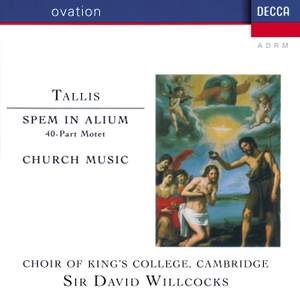
All recordingsPrices shown exclude VAT. (UK tax is not payable for deliveries to United States.) See Terms & Conditions for p&p rates. | |  | Tallis: Spem in aliumand other choral works
“A thrilling large scale performance” CD Review “Never before has Spem in alium, Tallis's great 40-part motet, so closely resembled The Last Judgement as it does in this vast and awesome performance” Gramophone Magazine | | | In stock - usually despatched within 1 working day. |
|
|
| |  | Music for Compline
Aston, H: | Gaude, virgo mater Christi | Byrd: | Christe qui Lux Miserere mihi, Domini Nunc dimittis | Gregorian Chant: | Salva nos, Domine Miserere mihi, Domine Veni Domine | Sheppard, J: | Libera nos 1 & II In pace in idipsum Jesu salvator saeculi, verbum In manus tuas I, II & III | Tallis: | In manus tuas Miserere nostri, motet for 7 voices, P. 207 In pace in idipsum Te lucis ante terminum | White, Robert: | Christe qui lux es et dies |
Helen Ashby, Kate Ashby, Alison Hill (sopranos), Emma Ashby, Eleanor Harries, Carris Jones,Timothy Wayne-Wright (altos), Peter Asprey, Andrew Griffiths,Tom Herford (tenors) & Oliver Hunt, Matthew O' Donovan, David Wright (basses) Stile Antico Vocal ensemble Stile Antico made its harmonia mundi début with this programme of 16th- and 17th-century polyphony written by some of England's greatest composers for the office of Compline, last of the daily hours and a form of night prayer. It went on to become one of the year's best sellers and achieved worldwide critical acclaim. “This outstanding release … features absolutely ravishing performances by Stile Antico… This is an extraordinary recording: In its debut on Harmonia Mundi Stile Antico has given choral music lovers everywhere a reason to
celebrate what looks like the beginning of another beautiful relationship!” Classics Today 10/10 “The singing is staggeringly beautiful, the balance meticulous.” Sunday Times “Debut recordings rarely come as impressive as this sequence of 16th-century English music for the evening service that concluded the daily monastic round of prayer. It suggests that Stile Antico have a future as
bright as their pure and crystalline soprano sound, which is heard to special advantage in the pieces by John Sheppard, the most lavishly represented composer on the disc.” The Telegraph | | | In stock - usually despatched within 1 working day. |
|
|
| |  | The Tallis Scholars sing Thomas Tallis
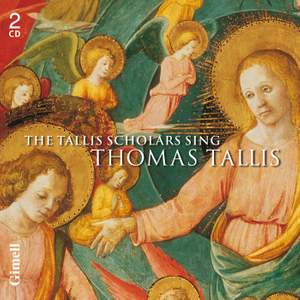
“The Tallis Scholars produce a distilled, transparent sound and the spiritual tone of their performance is one of serene contemplation through which the Requiem's ecstatic 'external light' shines.” BBC Music Magazine, September 2005 ***** | | | In stock - usually despatched within 1 working day. |
|
|
| |  | The Essential Tallis Scholars
| | | In stock - usually despatched within 1 working day. |
|
|
| |  | Tallis - Lamentations of Jeremiah
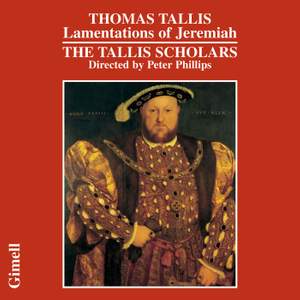
“This, the third volume of the survey by The Tallis Scholars of the music of the Tudor composer, Thomas Tallis, contains the well-known Lamentations, eight motets, and the extended motet Salve intemerata virgo. The Lamentations and motets are typical of the style of late Renaissance English composers. The overall mood is one of considerable austerity and their simplicity is indicative of the probability of their having been written for the private use of loyal Catholics rather than for formal ritual. Salve intemeratavirgo, on the other hand, looks back to the glories of the late 15th century. In particular, Tallis's use of the phrygian mode gives the work as a whole a strong sense of the medieval. Despite this disparity of styles the Tallis Scholars acquit themselves, as always, with great distinction. In the Lamentations and motets they achieve an appropriate sense of intimacy, while in Salve intermerata virgo they rise fully to the challenges of one of the more extended and demanding examples of Tudor choral composition. In addition the formidable challenges which this latter work sets for the conductor, such as the sense of pace, variation of dynamics, and overall architecture of the work, are all extremely well handled by Peter Phillips. The recording is very fine.” Gramophone Classical Music Guide, 2010 | | | In stock - usually despatched within 1 working day. |
|
|
| |  | Exultate Deo
| | | In stock - usually despatched within 1 working day. |
|
|
| |  | Tallis: Mass for Four Voices & Motets
“Another success for Jeremy Summerly's Oxford Camerata.” BBC Music Magazine | | | (also available to download from $6.00) | In stock - usually despatched within 1 working day. |
|
|
| |  | Tallis & Byrd: Cantiones Sacrae 1575
Byrd: | Emendemus in melius Libera me, Domine, et pone Peccantem me quotidie Aspice, Domine quia facta est Attollite portas O Lux beata Trinitas Laudate, pueri, Dominum Memento homo Siderum rector SCTBarB Libera me Domine de morte Tribue, Domine Te deprecor Gloria patri qui creavit Miserere mihi, Domini Diliges Dominum Domine secundum actum meum Da mihi auxilium | Tallis: | Salvator mundi, salva nos 1 & 2 Absterge Domine In manus tuas Mihi autem nimis O nata lux de lumine 5vv O sacrum convivium Derelinquat impius Dum transisset sabbatum Honor, Virtus et Potestas Sermone blando angelus Te lucis ante terminum Miserere nostri, motet for 7 voices, P. 207 Suscipe quaeso Domine Si enim iniquitates In ieiunio et fletu Candidi Facti Sunt Te lucis ante terminum |
In 1575 'Thomas 'Tallis then an 'aged man', and his pupil and friend William Byrd, who was in his mid to late 30s, paid tribute to Elizabeth 1 by selecting 17 motets each for their Cantiones Sacrae ('Sacred Songs'), the first major printed collection of music to be published in England. Many of these works have since become staple in the repertoire of church and chamber choirs throughout the world. This is the first recording to present the Cantiones in their entirety, by the same group of singers, and in the composers' original order of publication. “Contrasts abound: Byrd’s florid three-section Tribue Domine is almost Marian in its vastness, while Tallis’s hymn setting O nata lux de lumine is brevity itself...The dozen singers perform expressively and blend beautifully throughout, while Skinner, who adopts a commonsense approach to pitch standards, injects passion into every note.” Sunday Times, 30th January 2011 **** “They use solo voices throughout, mixed voices with a fairly open sound that brings with it more vibrato than we are used to hearing in such music nowadays...That results in performances that are refreshingly free of self-indulgence. Some of the big Byrd pieces in particular are very good indeed.” Gramophone Magazine, March 2011 “The prevailing mood is penitential, but the pieces are never dull; there's much delight to be had in listening to the way the individual voice parts weave in and out...Skinner gets his singers to bring [the false relations] out so that they send shivers down your spine...[He] shapes the music extremely well.” Classic FM Magazine, March 2011 **** “Homophonic passages impress with their splendour, enriched here by the chestnut hues of basses William Gaunt and Robert Macdonald. The clarity of line lays bare the ingenuity of counterpoint, no matter how thick the texture becomes - a formidable achievement in Byrd's 'double imitation' motets.” BBC Music Magazine, March 2011 *** “This is the first time the Cantiones Sacrae has been recorded complete and 'in the original order intended by the composers themselves'...An auspicious beginning to a mighty undertaking.” International Record Review, May 2011 | | | (also available to download from $21.00) | Usually despatched in 2 - 3 working days. (Available now to download.) |
|
|
| |  | Music for Queen Elizabeth
Thomas Tallis served four English monarchs during his long life. A Catholic, he survived the tumultuous religious and political upheavals and persecutions of Edward VI and Mary I. He adapted to the demands of the new reformed church, the Church of England under Henry VIII, self appointed ‘Defender of the Faith’. Under Elizabeth I a more tolerant approach to religion emerged – even the ever-present threat of invasion by Catholic Spain did not deter the Queen from allowing her subjects freedom of worship and expression. Elizabeth’s tolerance may have been dueto the fact that she herself was raised as a Catholic, and it is possible that she missed the pomp and ceremony of the Mass compared to the plain and simple Protestant services of her father’s new Church. Tallis had seen most of the old choirs of the monasteries disbanded, and the music destroyed in the dissolution. He had learned his trade in this world, and to younger colleagues such as William Byrd he must have appeared as if from a bygone age. However, the great survivor was also very open to new compositional techniques from the continent. He adapted many of his Latin settings for the new Church – this practice called ‘contrafactum’ saw many older works given new life. This extended to his masterwork, the huge 40-part motet Spem in alium (which opens this CD) from 1573. Possibly written to celebrate Elizabeth’s 40th anniversary on the throne, it reappeared as Sing and glorify heaven’s high majesty, in which form it was used in 1616 at the investiture of the future Charles I as Prince of Wales. | | | Usually despatched in 4 - 5 working days. |
|
|
| |  | Music For Great CathedralsThe soaring sounds of choral music
English Renaissance, Michael Stoddart | | | (also available to download from $10.50) | Usually despatched in 2 - 3 working days. (Available now to download.) |
|
|
| |
|