Prices shown exclude VAT. (UK tax is not payable for deliveries to United States.) See Terms & Conditions for p&p rates. | |  |
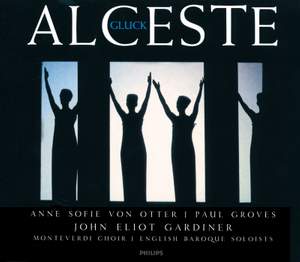
Stage production: Robert Wilson Subtitles: French, English, German When the historic Theatre du Chatelet in Paris re-opened after a period of extensive refurbishment, the first two productions mounted in the theatre were Gluck’s Alceste and Orphée et Eurydice. Both operas were sung in their French versions and were mounted and designed by Robert Wilson and conducted by John Eliot Gardiner. This was the first time Wilson and Gardiner had collaborated and their individual credentials combined to produce an exceptional result. American polymath Wilson was responsible for some of the most ambitious avant-garde performance projects of the 1970s and 80s.Since the mid-1980s he has increasingly brought his prodigious creativity to works fiom the standard dramatic and operatic repertoire, transforming them into his own unmistakably minimalist yet grandiose visions. His styled, classical interpretations of Alceste and Orphée bear his trademarks of an uncluttered stage and the arresting use of colour and light. They are not so much timeless as, in Robert Wilson’s words, “full of time”. With their minutely rehearsed gestures, at once formal and poetic, the singers have the grace and elegance of Balanchine or Martha Graham dancers. A key figure in the revival of Early Music, John Eliot Gardiner has long been a champion of Gluck’s French operas and is a great Gluck conductor. He received enormous critical acclaim for his musical direction of both Orphée and Alceste at the Chatelet, as did his orchestras and chorus. He sought to rid the operas of any vestiges of remoteness or venerable respectability and to release the huge emotional charge that lies behind the beauty of Gluck’s classical sobriety. The stories are, after all, he says, not only poignant and deeply moving, they have an immediate and contemporary relevance: they portray two married couples striving to protect their union and their love, plumbing the very depths of their emotional strength and summoning the courage to make huge personal sacrifices. “If presented in a way that’s immediate and with tremendous intensity and truth of expression then all the dross and superficiality of the stage action falls away and you’re left with what’s actually a very visceral connection between two living people.” Television’s top opera director, Brian Large, worked closely with Robert Wilson and John Eliot Gardiner to ensure that the translation of live performance to the small screen is of the highest artistic and techcal standard. John Eliot Gardiner chose Gluck’s 1776 French version of Alceste for Robert Wilson’s production, conducting the piece for the first time with his period-instrument ensemble, the English Baroque Soloists. The excellent Monteverdi Choir provides the chorus and, unusually, they sing fiom the pit, with dancers taking their place on stage. They give magnificently persuasive expression to the horror and compassion demanded by the drama. The ‘Greek geometric perfection of Robert Wilson’s various tableaux is beautifully realised, with his eye for striking theatrical symbol creating an intriguing visual arena for one of Gluck’s most elevated and sublime works. Soprano Anne Sofie von Otter, one of the finest singers of her generation, takes the title role of Alceste, Queen of Thessaly, who offers to die at the hands of the gods in place of her husband, Admete (Paul Groves), so that the people will not lose their king. To universal astonishment, she is saved from the Underworld by Hercule (Dietrich Henschel), whose action is sanctioned by Apollon (Ludovic Tézier) in a dramatic deus ex machina. “Gardiner turns the full beam of his historically informed performance knowledge to the score, illuminating its subtle colours and harmonic inflections with a pace and power that never threaten to become too far, too fast. He's superbly abetted by mezzo-soprano Anne Sofie von Otter, whose perceptive performance as Alceste is one of emotional sincerity and spot-on vocal accuracy.” Andrew McGregor, bbc.co.uk, 20th November 2002 “Anne Sofie von Otter, severe, hair scraped back, is the picture of regal dignity at her first appearance. Later, unable to look at the husband for whom she is sacrificing her life, her pain is palpable; at the end, after Apollo has descended with the reprieve, the camera focuses on the gentle smile that she permits herself. Paul Groves as Admetus is almost as eloquent, and Dietrich Henschel, swinging an imaginary club, makes a hearty, no-nonsense Hercules.” Gramophone Magazine, June 2009 | | | In stock - usually despatched within 1 working day. |
|
|
| |  |
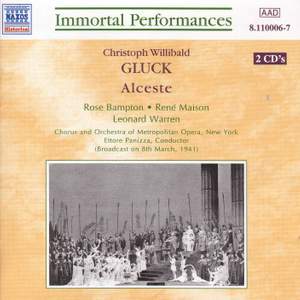
Rose Bampton (Alceste), René Maison (Admète), Leonard Warren (High Priest), George Cehanovsky (Herald), Alessio De Paolis (Evandre), Arthur Kent (Voice of Apollon), Marita Farell (Woman), Maxine Stellman, Helen Olheim, Wilfred Engelman (Leaders of the People) New York Metropolitan Opera Orchestra & Chorus, Ettore Panizza Recorded 9th March, 1941 | | | (also available to download from $16.50) | In stock - usually despatched within 1 working day. |
|
|
| |  | Tragic Opera in three Acts; Sung in French; 1776 Paris Version
Catherine Naglestad (Alceste), Donald Kaasch (Admète), Bernhard Schneider (Evandre), Catriona Smith (Le Coryphée), Johan Rydh (Grand Prêtre d'Apollon/Dieu infernal), Nam Soo Kim (La voix de l'Oracle), Motti Kastón (Apollon), Michael Ebbecke (Hercule), Wolfgang Probst (Un Héraut) Staatsopernchor Stuttgart & Staatsorchester Stuttgart, Constantinos Carydis, directed by Jossi Wieler and Sergio Morabito Recording Date: 2006
Place of recording: Live from the Staatsoper Stuttgart
Running Time: 165 min
Picture Format: 16:9
Sound Format: PCM Stereo
Language: F
Menu Languages NTSC: D, F, GB, SP
Subtitle Languages NTSC: D, F, GB, I, SP
“Naglestad's Alceste is passionate and torn, voluptuous of voice and compelling on stage. Carydis delivers wonderfully tasteful, intelligent Gluck, full of detail and exquisitely phrased. The rest of the cast is solid, and all of the acting is superb” Financial Times | | | Usually despatched in 2 - 3 working days. |
|
|
| |  | Recorded 1952, Sung in English
| | | Usually despatched in 3 - 4 working days. |
|
|
| |  | Sung in English
Recorded in New York on 11th February 1961 | | | Usually despatched in 2 - 3 working days. |
|
|
| |  | 1767 Italian version, ed. Geraint Jones
Kirsten Flagstad, Raoul Jobin & Alexander Young The Geraint Jones Singers & Orchestra, Geraint Jones ‘I’m a classical girl, you know,’ wrote the legendary soprano Kirsten Flagstad in her memoirs, The Flagstad Manuscript, co-authored with Louis Biancolli. ‘Whatever Wagner may be, other music gives a different satisfaction: the music of Gluck, for example, or Handel. It’s the precise and orderly mind of these composers that I think appeals to me. The balanced style, the regular sections, everything in place. All of that appealed to my sense of tidiness.’ Though her return to the Met during the 1950-51 season was announced as her farewell, the new general manager, Rudolf Bing (later Sir Rudolf) lured her back for one more season by offering her Alceste, one day at lunch. ‘It was too great a temptation, and Mr. Bing knew it,’ she later recalled. Opening night, 4 March 1952, was a triumph. The composer Virgil Thomson reviewed it for the New York Herald Tribune and found her the ‘ultimate in stylishness. No singer living could have sung Alcestis’s arias with more sumptuous beauty of voice or a more impeccable respect for the classic line, their expressive rhetoric.’ In April 1956 Flagstad relearned the role for a BBC broadcast of the Italian version. Decca decided to record the opera a few days later using the same cast and version. Unfortunately Flagstad was suffering from a very heavy cold and was not at her best. The producer of this recording, John Culshaw, wrote in his book Putting the Record Straight, ‘I tried to persuade her to abandon Alceste despite the considerable expense to Decca of such a write-off, but her loyalty to her fellow artists prevailed.’ Flagstad in, perhaps, less that her usual stellar voice is still an extraordinary, mesmerizing artist, as listeners to Decca’s classic recording can attest. This reissue features an informative note by Paul Thomason on the genesis of the Gluck opera in Flagstad’s many and multi-lingual performances of this opera. | | | In stock - usually despatched within 1 working day. |
|
|
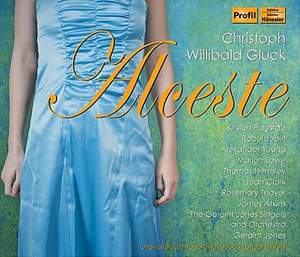
| |  | Vienna version
Kirsten Flagstad (Alceste), Raoul Jobin (Admeto), Alexander Young (Evandro), Marion Lowe (Ismene), Thomas Hemsley (Sommo Pontifice/Apollo/Infernal Spirit), Joan Clark (Eumelo), Rosemary Thayer (Aspasia), James Atkins (Herald/Oracle) The Geraint Jones Singers and Orchestra, Geraint Jones Gluck was the first great opera reformer, who restored opera to the principles that governed the true pioneers a century and a half earlier. This new disc on Profil is an original studio recording made by Decca in 1956 which aimed to mark the relationship between Gluck and the other great reformer, Richard Wagner, by appointing the title role to the great Brünnhilde and Isolde of the day, Kirsten Flagstad. “[Flagstad] handles the words effectively…to make you feel for this rather chilling heroine. Best of all are the great choral tableaux, which Geraint Jones conducts with due weight and solemnity.” Gramophone “It would not be idle to assert that Flagstad sounds like a young woman. Her top notes are strained and her intonation is often shaky. But she handles the words effectively enough to make you feel for this rather chilly heroine. Best… are the great choral tableaux, which Geraint Jones conducts with due weight and solemnity.” Gramophone Magazine, Awards Issue 2008 | | | (also available to download from $24.75) | In stock - usually despatched within 1 working day. |
|
|
| |  |
Ethel Semser (Alceste), Enzo Seri (Admète), Jean Mollien (Evandre), Lucien Mans (La voix de l'Oracle), Bernard Demigny (Grand Prêtre d'Apollon), Jean Hoffman (Un Héraut/Hercule), Jean-Pierre Rampal (flute) Paris Philharmonia Orchestra, Paris Philharmonic Orchestra, Paris Philharmonic Chorus, Rene Leibowitz | |
|
| |  | Vienna version
Kirsten Flagstad (Alceste), Raoul Jobin (Admeto), Thomas Hemsley (Apollo/Sommo Pontifice), Alexander Young (Evandro), James Atkins (Herald/Oracle), Marion Lowe (Ismene), Joan Clark (Eumelo), Rosemary Thayer (Aspasia) Geraint Jones Singers, Geraint Jones Orchestra, Geraint Jones | |
|
| |  | Vienna version
| | | Usually despatched in 3 - 4 working days. |
|
|
| |
|