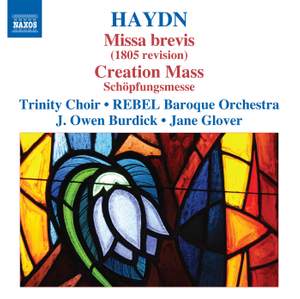
Prices shown exclude VAT. (UK tax is not payable for deliveries to United States.) See Terms & Conditions for p&p rates. | |  | Haydn: Missa brevis (1805 revised version) & SchöpfungmesseMasses Volume 7
Trinity Choir & Rebel Baroque Orchestra, J. Owen Burdick & Jane Glover In 1805, towards the end of his immensely productive and successful career, Haydn significantly expanded the youthful Missa brevis setting he had composed over fifty years earlier, enriching the orchestration with flute, clarinets, bassoons, trumpets and timpani. The other work on this disc, his Mass in B flat major of 1801, gained its nickname ‘Creation Mass’ from a short quotation taken from his most famous oratorio. Although this upset the Empress Marie Therese, audiences to this day smile in recognition at this musical phrase. | | | (also available to download from $6.00) | Usually despatched in 2 - 3 working days. (Available now to download.) |
|
|
| |  | Haydn & Gatti - Creation Masses
The Creation Masses by Luigi Gatti and Joseph Haydn both allude to Haydn’s Schöpfung. This is a live recording from the Frauenkirche Dresden and is a world premiere recording of the Gatti. | | | (also available to download from $10.50) | Usually despatched in 2 - 3 working days. (Available now to download.) |
|
|
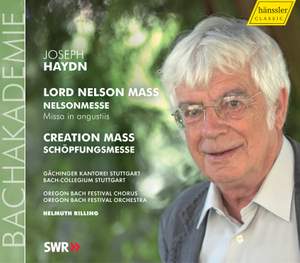
| |  |
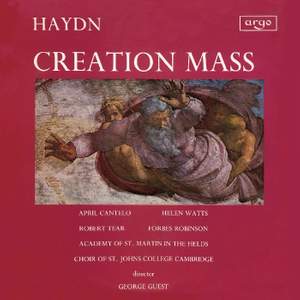
The so-called "Lord Nelson" Mass dates from 1798 when the composer was 66 and in the middle of an autumnal creative outburst that included "The Seasons", "The Creation" and the three great late Masses. Two stories explaining the origins of the popular nick-name for the dramatic Missa in angustiis (Mass in time of anguish) exist - one that the work was written at the time of the sea battle at Aboukir Bay, another that the great Admiral himself attended a performance in 1800. Haydn's Mass in B-flat Major, which he wrote in 1801 to celebrate the name day of Princess Maria Hermenegild Esterhazy whose husband, Prince Nikolaus Esterhazy, employed Haydn as his Kapellmeister. Written for orchestra, choir and soloists, this mass was nicknamed the "Creation Mass" because it quotes a few measures from Haydn's "The Creation" oratorio. | | | (also available to download from $10.50) | Usually despatched in 2 - 3 working days. (Available now to download.) |
|
|
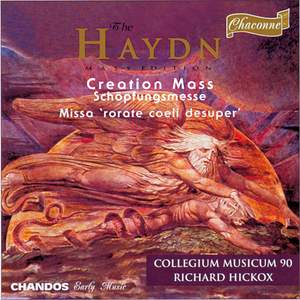
| |  | Haydn - Creation Mass
“The Creation Mass is no less resplendent or searching than, say, the Nelson Mass or the Harmoniemesse, a glorious affirmation of Haydn's reverent, optimistic yet by no means naive faith. Even by Haydn's standards, the work is startling in its exploitation of colourful and dramatic key contrasts, as in the sudden swerve from F major to an apocalyptic fortissimo D flat at 'Judicare vivos'; the Benedictus, characteristically, moves from serene pastoral innocence (shades of 'With verdure clad' from The Creation) to urgent intensity in its central development; and the sublime G major Agnus Dei has a profound supplicatory fervour extraordinary even among the composer's many memorable settings of this text. This reading eclipses previous recordings in the quality of its choir and soloists, the subtlety of Hickox's direction and the vividness and transparency of the recorded sound. In faster movements like the Kyrie and the openings of the Gloria and Credo Hickox strikes just the right balance between dignity and happy, pulsing energy, relishing each of Haydn's dramatic coups; and he brings a marvellous clarity and verve, and a sure sense of climax, to the chromatically inflected fugues in the Gloria and at 'Dona nobis pacem'. Abetted by his first-rate orchestra, Hickox is always alive to the felicities of Haydn's scoring, while the 24-strong professional choir is superbly responsive throughout. We also get the alternative version of the Gloria, and the ultra-compressed (6'49") and instantly forgettable Missa rorate coeli desuper, which David Wyn Jones, in his excellent note, wryly describes as 'a reminder of how perfunctory church music in 18th-century Austria could be'. It's neatly dispatched by Hickox and his forces, but inevitably comes as an anticlimax.” Gramophone Classical Music Guide, 2010 | | | (also available to download from $10.50) | Usually despatched in 2 - 3 working days. (Available now to download.) |
|
|
| |  | Haydn Edition Volume 5 - Masses
Haydn: | Mass, Hob. XXII: 9 in C major 'Paukenmesse' Mass, Hob. XXII:11 in D minor 'Nelsonmesse' Mass, Hob. XXII:14 in B flat major 'Harmoniemesse' Te Deum, Hob. XXIIIc:1 Mass, Hob. XXII:13 in B flat major 'Schöpfungmesse' Stabat Mater The Seven Last Words of Our Saviour on the Cross, Hob XX/2 (Choral version) Salve Regina in G minor, Hob. XXIIIb:2 Qual dubbio ormai Te Deum, Hob. XXIIIc:2 'Grosses Te Deum' | Schubert: | Magnificat in C major, D486 Offertorium 'Intende voci', D963 |
“Harnoncourt’s sense of pace in Haydn is unerring and makes it a pick – highly recommended!” BBC Music Magazine “Harnoncourt’s reading… scores consistently in breadth, intensity and physical power” Gramophone Magazine | | | Usually despatched in 4 - 5 working days. |
|
|
| |  | Haydn - The Masses
Haydn: | Mass, Hob. XXII: 9 in C major 'Paukenmesse' Mass, Hob. XXII:11 in D minor 'Nelsonmesse' Mass, Hob. XXII:14 in B flat major 'Harmoniemesse' Te Deum, Hob. XXIIIc:1 Mass, Hob. XXII:13 in B flat major 'Schöpfungmesse' Stabat Mater The Seven Last Words of Our Saviour on the Cross, Hob XX/2 (Choral version) Salve Regina in G minor, Hob. XXIIIb:2 Qual dubbio ormai Te Deum, Hob. XXIIIc:2 'Grosses Te Deum' | Schubert: | Magnificat in C major, D486 Offertorium 'Intende voci', D963 |
“Harnoncourt’s sense of pace in Haydn is unerring and makes it a pick – highly recommended!” BBC Music Magazine | | | Usually despatched in 4 - 5 working days. |
|
|
| |  | Haydn - The Complete Mass Edition
Haydn: | Mass, Hob. XXII: 4 in E flat major 'Große Orgelmesse' Mass, Hob. XXII: 8 in C major - Missa Cellensis 'Mariazellermesse' Mass, Hob. XXII:10 in B flat major 'Heiligmesse' Mass, Hob. XXII: 6 in G major 'Nicolaimesse' Mass, Hob. XXII:12 in B flat major 'Theresienmesse' Mass, Hob. XXII: 7 in B flat major 'Kleine Orgelmesse' Mass, Hob. XXII:11 in D minor 'Nelsonmesse' Ave Regina (Hob. XXIIIb:3) Mass, Hob. XXII: 1 in F major 'Missa brevis' Te Deum, Hob. XXIIIc:1 Mass, Hob. XXII: 9 in C major 'Paukenmesse' Incidental music to 'Alfred, König der Angelsachsen' Te Deum, Hob. XXIIIc:2 'Grosses Te Deum' Mass, Hob. XXII:14 in B flat major 'Harmoniemesse' Mass, Hob. XXII:13 in B flat major 'Schöpfungmesse' Mass, Hob. XXII: 3 in G major 'Missa rorate coeli desuper' Mass, Hob. XXII: 5 in C major 'Cäcilienmesse' Mass, Hob. XXII: 2 'Missa sunt bona mixta malis' Schöpfungsmesse - alternative Gloria for Marie Therese Te Deum, Hob. XXIIIc:1 Mass, Hob. XXII: 7 in B flat major 'Kleine Orgelmesse' |
Period instrument performances | | | In stock - usually despatched within 1 working day. |
|
|
| |  | The Complete Haydn Masses
Haydn: | Stabat Mater Mass, Hob. XXII: 5 in C major 'Cäcilienmesse' Mass, Hob. XXII: 6 in G major 'Nicolaimesse' Mass, Hob. XXII:11 in D minor 'Nelsonmesse' Mass, Hob. XXII: 8 in C major - Missa Cellensis 'Mariazellermesse' Mass, Hob. XXII: 9 in C major 'Paukenmesse' Mass, Hob. XXII: 4 in E flat major 'Große Orgelmesse' Mass, Hob. XXII:10 in B flat major 'Heiligmesse' Mass, Hob. XXII:14 in B flat major 'Harmoniemesse' Mass, Hob. XXII:13 in B flat major 'Schöpfungmesse' 1805 revision Mass, Hob. XXII: 7 in B flat major 'Kleine Orgelmesse' Mass, Hob. XXII:12 in B flat major 'Theresienmesse' |
Trinity Choir & REBEL Baroque Orchestra, J. Owen Burdick & Jane Glover Today Haydn is viewed mainly in the light of his string quartets and symphonies, yet his first and last compositions were Mass settings. They encompassed an extraordinary musical output, within which his Masses shine as uplifting and deeply satisfying sacred works. Whilst acknowledging the Viennese traditions of church music, these Masses are infused with the kind of inspiration and originality that make Haydn an undisputed master in so many genres. This collection by Trinity Choir includes all the complete and authenticated Masses by Haydn as well as his early Stabat Mater. “The choir sings with accuracy, musicality and fervour which it would be hard to beat. The orchestra, sometimes listed as the REBEL Baroque Orchestra are a period instrument group who play with real character.” MusicWeb International | | | (also available to download from $24.75) | Usually despatched in 2 - 3 working days. (Available now to download.) |
|
|
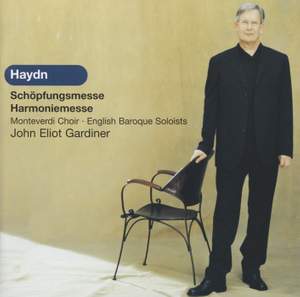
| |  | Haydn: Die grossen Chorwerke (Great Choral Works)
When the subject of Haydn's choral works comes up nowadays, we think first and foremost of The Creation (1798) and The Seasons (1801). But no less important are his late settings of the Mass, which pave the way for the individual adaptation of liturgical texts in the Romantic period. Moreover, many of Haydn's sacred compositions are still used in church services today. Haydn had got to know the oratorios written by Handel during his two visits to London (1791/92 and 1794/95), and adopted from them the idea of an independent oratorio art with texts in the vernacular. He planned to establish this as successor to the Italian oratorios that had been customary in Vienna hitherto. His comrade-in-arms on this project was the same Baron van Swieten in whose house, as Mozart noted, "nothing but bach and handl" was played – something of an exotic musical preference in Austria at the time. Haydn takes up this tradition, not least with the large-scale fugues found in both oratorios, thus attesting to the continuity of a Christian view of the world in the 18th century. But at the same time he strikes up an entirely new tone in the catchy melodies of many arias and choruses: the expression of feelings is direct rather than codified. This stylistic mix set the standard for all subsequent German oratorios up to the middle of the 19th century. However, the choral version of Die sieben letzten Worte unseres Erlösers am Kreuze (Seven last words of Our Saviour on the Cross) is a special case: the work was originally planned as purely orchestral music for a Good Friday service in Cádiz Cathedral, but in the same year (1787), Haydn then arranged the sequence of seven adagio movements and a presto (for the earthquake when Jesus died) for string quartet. For the oratorio version of 1796, vocal parts were composed and then added to the original orchestral setting. Gottfried van Swieten supplied the texts for Haydn's oratorios, texts that may seem unbearably parochial to the modern listener: van Swieten relabels the angels in The Creation "citizens of heaven", while in The Seasons he makes the farmers into an ideal of bourgeois demureness. This notwithstanding, Haydn found inspiration in the wealth of naïve images and the new-found self-confidence with which people were emerging from the shackles of the ancien régime. In the meantime, a bourgeois musical culture had begun to evolve even in Imperial Vienna, a city which, as it turned out, was not to be an imperial capital for much longer: only five years after the first performance of The Seasons, Napoleon forced Emperor Franz II to abdicate. And when Haydn died at a ripe old age in 1809, Napoleon's troops were again at the gates of Vienna, which they then took shortly afterwards. One thing is clear: much as Haydn had grown out of his courtier's livery and was striving to establish himself as a member of the bourgoisie, he was no revolutionary. In his eyes, Napoleon was a menace and a usurper – a belief that Bonaparte surely confirmed when he had himself crowned Emperor in 1804. Before this, in 1798, Haydn celebrated in his so-called "Nelson Mass" the victory of the British admiral over Napoleon at the battle of Abukir. At least, it seems safe to assume so, for the work already appears under this title in 1809 in the inventory of the composer's estate. However, the original title was Missa in angustiis (Mass for times of distress). But Lord Nelson may well have appeared to Haydn to be the man who (temporarily) saved Europe from distress: there is no other credible explanation for the unusual form of the Benedictus, where Haydn substitutes a martial choral movement with trumpets and timpani for the customary idyllic solo quartet. Another work of Haydn's also belongs to this context: the Großes Te Deum of 1800 was first performed when Lord Nelson and Lady Hamilton paid a visit to Prince Esterhazy, for whom Haydn was working part-time as kapellmeister. There is a similar martial background to Haydn's Paukenmesse (Kettledrum Mass) of 1796, originally known as Missa in tempore belli (Mass in time of war). Here, the solo entry of the drums in the Agnus Dei stands for the urgent plea for peace in the light of the ongoing war against the French revolutionary army, which was to lead to Napoleon's first invasion of Austria in 1797. The "call for peace at home and abroad" that functions as the Agnus Dei of Beethoven's Missa Solemnis is directly based on the Haydn. Both these settings of the Mass belong to Haydn's cycle of six late masses. These were written at the request of Prince Nikolaus II Esterhazy for the name-day of Princess Maria Josepha Hermenegild in each case. Nikolaus II had inherited the fondness for music and ceremonial display from his grandfather, Nikolaus I, in whose service Haydn worked as kapellmeister from 1762-90. However, his father Prince Anton, who succeeded Nikolaus I in 1790, had no taste for music: he disbanded the court orchestra and pensioned Haydn off, thus giving the composer the freedom to travel to Vienna and London, establishing a new career for himself in the emerging bourgeois music scene. The philistine Anton only reigned for a few years, and after Nikolaus II succeeded him, Haydn returned to the employ of the Esterhazy family, and the settings of the Mass written for them are thus not simply reworkings of the standard liturgical model, either more or less original, but aim for individual solutions, while retaining the function and the outer form. Ever greater weight is given to the symphonically treated orchestra, and Haydn's masses thus became as much a source of stylistic influence for the 19th century as his oratorios were. In this context, we shouldn't forget Haydn's earlier sacred compositions, where the way is paved for many of the later developments in this oeuvre: in the graceful pragmatism of commissions like the Corpus Christi responsories (1767), in the Kleine Orgelsolomesse of 1775 or the almost Late Baroque splendour of the Cäcilienmesse (1766/1773). Most of these recordings were made under the baton of Sir Neville Marriner, without a doubt one of the best experts on Haydn's choral music among the major conductors. In the Nelson Mass he pays attention to the original instrumentation, which provides for trumpets, timpani and an obbligato organ in addition to the strings. Two of the best German choirs are represented here, namely the Stuttgart Chamber Choir under Frieder Bernius and the South-West German Madrigal Choir. The CD box also contains two important recordings from the 1960's: the Cäcilienmesse with the boys' choir Stuttgarter Hymnuschorknaben, and the Te Deum conducted by the legendary director of music at Berlin Cathedral, Karl Forster. | | | In stock - usually despatched within 1 working day. |
|
|
| |
|