All recordingsPrices shown exclude VAT. (UK tax is not payable for deliveries to United States.) See Terms & Conditions for p&p rates. | |  | Salute To Percy Grainger
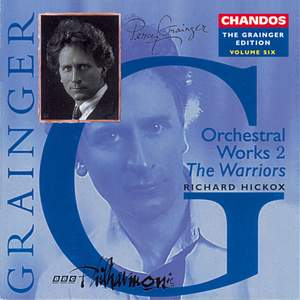
Recording locations: ‘The Maltings’ Concert Hall, Snape, UK, December 1968 (CD 1: 1-14), November 1972 (CD 1: 15-19, CD 2: 1-3, 5-7, 9-10), March 1976 (CD 2: 4); unknown location, May 1927 (CD1: 8); All Hallows, Gospel Oak, London, UK, February 1994 (The Warriors) A composer with an extraordinary ear for sonority, original in his outlook, sometimes misunderstood, now revered, Percy Grainger is one of Australia’s most unique sons, and, in the words of Sir Peter Pears, one of its “most independent and single-minded spirits”. Many of these recordings, of vocal and chamber orchestra pieces, were made by Decca in 1968 and 1972 and issued, together with a 1927 recording of Grainger playing his Country Gardens and of Peter Pears and Osian Ellis performing Six Dukes wenta-fishin’ in two volumes, with the title Salute to Percy Grainger. The title is retained for this anthology and to it is added Sir John Eliot Gardiner’s Deutsche Grammophon recording of The Warriors, presenting nearly two hours of some of Grainger’s finest utterances in some of their earliest (and best) performances to be captured on record. Ten of these items [CD2: 1-10] make their first appearance on CD. The performers are a Who’s Who of great Decca artists. Benjamin Britten and Steuart Bedford share the conducting duties on the Decca recordings, and the vocalists include Sir Peter Pears, Anna Reynolds and John Shirley-Quirk, together with the Ambrosian Singers and the Wandsworth Boys’ Choir. The notes are written by celebrities too – Sir Peter Pears and Grainger scholar, John Bird – and include affectionate reminiscences. Complete song texts are included. "This is an altogether delightful anthology, beautifully played and recorded by these distinguished artists … the recording is an extremely good one” Penguin Guide *** “the enchantments remain … will surely give pleasure” Gramophone “This two-CD collection includes Britten's classic 1968 recording, which is one of the best of all Grainger recitals in itself...Dazzling sound.” Penguin Guide, 2011 edition “The performances by Britten, the tenor Peter Pears and the glorious baritone of John Shirley-Quirk, not to mention the Ambrosian Singers, Linden Singers and Wandsworth Boys’ Choir, have a finesse that defines an imperilled English musical tradition we are in danger of losing.” Sunday Times, 31st October 2010 **** | | | In stock - usually despatched within 1 working day. |
|
|
| |  | British Music for Concert Band
Music for Concert Band, played by one of the finest military bands, the Central Band of the RAF. All of the music featured here was originally composed for wind band including the ever-popular Holst Suites, Vaughan Williams’ English Folk Suite and an array of works by Percy Grainger. | | | In stock - usually despatched within 1 working day. |
|
|
| |  | An introduction to Percy Grainger
"Hickox is very, very good in this repertoire. Each tug at the heart-strings is brought off with taste and style."
The Gramophone | | | (also available to download from $10.50) | In stock - usually despatched within 1 working day. |
|
|
| |  | The Irish Piano
Acclaimed Irish pianist Michael McHale’s début solo album features a delightful selection of piano miniatures inspired by Ireland’s rich musical heritage. The Irish Piano explores the influence of both Irish traditional and European classical music on this country’s composers and musicians. The Irish Piano opens with Michael’s own arrangement of one of the earliest notated Irish melodies dating from the 16th century, Cailín ó cois tSuire Mé (I am a girl from the banks of the river Suir). In the English-speaking world it was known as ‘Callino Custurame’ and was originally believed to be of Italian origin. Following on from this are two nocturnes by John Field, who coined the term and did so much to raise the bar for Irish classical music in Europe. These are complemented by Samuel Barber’s Nocturne, written as an homage to Field, and a first ever recording of the young Arnold Bax’s Nocturne, as well as music from another Irish-influenced composer Percy Grainger and the Waterford-born virtuoso William Vincent Wallace. More first recordings on The Irish Piano of pieces by Bill Whelan, Ian Wilson and Philip Hammond are testament to the diversity of musical styles and voices that can be found in Irish contemporary piano music today. Add to these Michael McHale’s own unique arrangements of some of the country’s best loved traditional airs, and you a CD that is an accessible and engaging must-buy for anyone interested in Irish music. Michael McHale says in his booklet notes to the collection: Altogether I hope it provides and interesting cross-section of the many different facets, musical styles and personalities that form the world of ‘The Irish Piano’. “an elegant sensibility, and bright, even-fingered articulation that was instantly engaging” The Times “[McHale] finds a range of keyboard colours [in these works], making their individual sound-worlds seem unexpectedly subtle and rich” BBC Music Magazine “all of the music comes to life through the singing sensibility of McHale's sensitive and polished pianism, captured in a warmly ambient recording. In short, it's easy to recommend such a highly distinctive and imaginatively presented release.” Gramophone Magazine, March 2013 | 
| | | Usually despatched in 4 - 5 working days. |
|
|
| |  | Grainger: Folk-Inspired Works for Piano Duet and Duo
Caroline Weichert & Clemens Rave (piano) The essence of Grainger’s music is most evident in his piano pieces, having taken ownership of traditional and popular influences and rejecting outdated conventions. Grainger’s ingenious variation, textures and moods can be heard throughout, ranging from the fantastically popular Country Gardens to the elaborate fantasy on Porgy and Bess. “The Bilder Duo, pianists Caroline Weichert and Clemens Rave, are frankly impeccable in this repertoire, technically spot-on and a lot of fun for the ears. They’ve been a duo since 2007, and they clearly enjoy this music... it all comes down to how you like your Grainger: if you like it on keyboards, run out and grab this.” MusicWeb International, March 2013 | | | (also available to download from $10.50) | Usually despatched in 2 - 3 working days. (Available now to download.) |
|
|
| |  | Grainger: Country Gardens and Other Favourites
| |
|
| |  | Clarinet Thunder
Sarah Bushey (clarinet), Jenny Maclay (clarinet), Ricky Williams (clarinet), Joshua Duermeyer (clarinet), Amanda Mihalik (clarinet), Erin Cushing (clarinet in E flat) University of Florida Clarinet Ensemble, Mitchell Estrin, David Waybright | |
|
| |  | Lincolnshire Posy: Music for Band
The Arts District Chorale, Dallas Wind Symphony, Jerry Junkin Showcasing the wind band music of Percy Grainger, including favourites Lincolnshire Posy and Irish Tune from County Derry (“Danny Boy”). Australia considers Grainger its greatest composer; the U.S., where he lived most of his life, praises him as a music educator, composer and arranger of band music; and England considers him supremely important in the preservation and arrangement of British folk songs. Grainger’s gems are performed to perfection by America’s only full-time professional wind band, conducted by Jerry Junkin. Grainger specified many unusual, optional instruments, and this recording has them all. rec. Meyerson Symphony Centre, Dallas, Texas, August 2008 “played with appropriate gusto but also, where required, delicacy of spirit by the Dallas Wind Symphony under Jerry Junkin.” MusicWeb International | | | Usually despatched in 2 - 3 working days. |
|
|
| |  | Hallé Favourites - Volume 1
Beecham had his 'lollipops', short works he used as encores and Sir John Barbirolli had his favourites, too, but more often than not he included them in his lighter Hallé programmes or as Promenade Concert encores. He never regarded popular pieces as beneath his notice or in any snobbish light – they were pieces thousands of people liked to hear and their popularity was a sign of how good they were as music. He grew up in Edwardian London where the theatre orchestras revelled in the music of Edward German and Lionel Monckton. As a child he listened to the band playing in Lincoln’s Inn Gardens and that was where he decided he wanted to be a conductor. We can be sure that it was there he first heard the William Tell ballet music, the Intermezzo from Cavalleria Rusticana and the Dance of the Hours. He loved them then and he loved them all his life. So when he conducted them – as the performances on this disc eloquently testify – he lavished as much artistry on them as he did on symphonies by Elgar and Mahler. No one in the audience could fail to know that he loved these pieces, he communicated his affection with a smile, with a little extra touch of showmanship, with a glance round at the audience to see if they were enjoying it as much as he was. The last two tracks of this disc comprise a brief snatch of Sir John rehearsing for a stereophonic test ‘take’ of Shepherd’s Hey, which is here issued for the first time. | | | Usually despatched in 4 - 5 working days. |
|
|
| |  | American Virtuosa: Tribute to Maud Powell
Bauer, M: | Up the Ocklawaha, tone picture for violin, Op. 6 | Beach: | Romance for violin & piano, Op. 23 | Bellstedt: | Caprice on Dixie, for unaccompanied violin | Burleigh, C: | Four Rocky Mountain Sketches, Op. 11 | Chopin: | Waltz No. 6 in D flat major, Op. 64 No. 1 'Minute Waltz' | Coleridge-Taylor: | Deep River | Danks: | Silver Threads Among the Gold | Dvorak: | Songs My Mother Taught Me, Op. 55 No. 4 Humoresque in G flat major, Op. 101 No. 7 | Gilbert, H M: | Marionettes | Grainger: | Molly on the Shore | Huss: | Romance | Liebling: | Fantasia on Sousa Themes | Massenet: | Crépuscule | Palmgren: | May Night, Op. 27 No. 4 | Sibelius: | King Kristian II, incidental music, Op. 27: Musette | trad.: | Nobody knows the trouble I seen (African-American spiritual melody, arranged by J Rosamond Johnson) | Venth: | Aria |
| | | Usually despatched in 2 - 3 working days. |
|
|
| |
|