All recordingsPrices shown exclude VAT. (UK tax is not payable for deliveries to United States.) See Terms & Conditions for p&p rates. | |  | Finzi - Dies Natalis
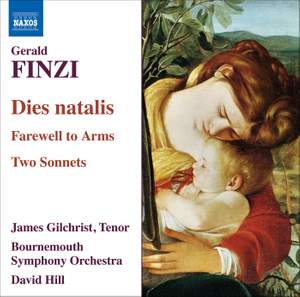
Quintessentially Finzi, the tender yet radiant Dies natalis, a setting of texts by the 17th-century poet Thomas Traherne, depicts both the first sensations of a child as it enters the world, and life’s tarnishing experience of the innocence of childhood. In Farewell to Arms, a further example of Finzi’s enthusiasm for 17th-century poets, the steady but inevitable tramp of time, symbolized by the measured bass and the tenor’s sad, arching melody, becomes a poignant symbol for the brevity of life as expressed in lines such as ‘O time too swift, O swiftness never ceasing’. Finzi knew all too well that ‘Beauty, strength, youth are flowers but fading seen’. “As so often, Finzi's word-setting is wonderful - a gift to any singer with a feeling for words as well as notes. James Gilchrist plainly enjoys both aspects of this work. His phrasing is typically musical and he points key syllables with great care.” BBC Music Magazine, June 2008 **** “James Gilchrist's singing is guided by a refined (yet passionate) sensibility, just right for Finzi, and his voice has substantial reserves of resonance and power.” Gramophone Magazine, August 2008 “Competition on disc, for this solo cantata, is strong. But James Gilchrist's performance, if not quite as lyrically unbuttoned as the classic EMI recording by Wilfred Brown with the composer's son conducting, is perfectly judged, while David Hill's moulding of the opening string Intrada sets the tone exactly. The rest of the disc is made up of odds and ends. The Prelude for string orchestra is all that survives of Finzi's plan to compose a chamber symphony, while The Fall of the Leaf was to be the central panel of an orchestral triptych. Farewell to Arms, a pair of settings of 17th-century poems, neatly complements the Traherne, and Gilchrist treats them with as much care.” The Guardian, 25th April 2008 **** “With his clear, even tone, unaffected sensitivity to the text and eloquent phrasing of Finzi's long, floating melodies, James Gilchrist again proves an ideally sympathetic interpreter of the composer. David Hill draws supple, fine-textured playing from the Bournemouth orchestra and, crucially, never allows Finzi's music to meander.” The Telegraph, 26th April 2008 | | | (also available to download from $5.75) | In stock - usually despatched within 1 working day. |
|
|
| |  | Finzi: Violin & Cello Concertos
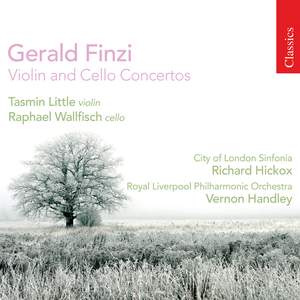
“Keenly felt, emotional reading…performance is passionate…” BBC Music Magazine | | | In stock - usually despatched within 1 working day. |
|
|
| |  |
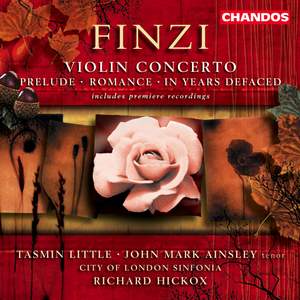
“Finzi began work on his Concerto for small orchestra and solo violin in 1925, dedicating it to Sybil Eaton, a talented young violinist and the object of the 24-year-old composer's unrequited love. He harboured considerable doubts about the opening movement, however, and when Eaton eventually gave the premiere in 1927 under Sargent, the Queen's Hall audience heard only the second and third movements. When Vaughan Williams programmed the concerto the following year, Finzi penned another first movement. Neither he nor the critics found much to please them, though, and the work wasn't heard again in its entirety until the present artists revived it in 1999. The highlight is the central, characteristically rapt Molto sereno that Finzi later recast as his Op 6 Introit. Of the two vigorous flanking movements, the finale leaves the stronger impression, but the concerto thoroughly deserves its new lease of life, and Little and Hickox's sparkling and stylish advocacy will win it many new friends. There's another first recording in the guise of the song cycle, In Years Defaced. Only one number, the 1928-32 setting of Hardy's 'When I set out for Lyonnesse', was actually orchestrated by Finzi, and, in an effort to place it in a more programme-friendly context, the Finzi Trust commissioned five contemporary composers to choose a song that might benefit from the extra colour an orchestral palette can provide. The resulting sequence is a joy from start to finish. Ainsley is a potent, irreproachably sensitive presence throughout this imaginative and rewarding creation. Again, Hickox and the City of London Sinfonia accompany to the manner born. Lovely, airy sound further enhances the appeal of this disc.” Gramophone Classical Music Guide, 2010 | | | (also available to download from $10.50) | In stock - usually despatched within 1 working day. |
|
|
| |  | By Footpath and Stile
The award-winning Finzi Quartet make their debut recording here with a stunning selection of works by the great English composer Gerald Finzi (1901-1956). Included is Finzi's song cycle for baritone and string quartet By Footpath and Stile, Op. 2, featuring the acclaimed young baritone Marcus Farnsworth. The recording also features Finzi’s Interlude for oboe and string quartet with oboist Ruth Bolister and four arrangements for string quartet by Christian Alexander, including the popular Five Bagatelles with clarinettist Robert Plane, recorded here for the first time. “this is a release of real quality...Soloists Marcus Farnsworth and Ruth Bolister excel in each work.” BBC Music Magazine, October 2012 **** | |
|
| |  | Tower Power The organ of St Mary-le-Tower, Ipswich
| | | Usually despatched in 4 - 5 working days. |
|
|
| |  |
| | | Usually despatched in 4 - 5 working days. |
|
|
| |  | English String Miniatures, Vol. 3
"The third installment in this series is another big winner. David Lloyd-Jones has a sure hand with the Royal Ballet Sinfonia in music of this type... The sound is captured in St. Paul's, New Southgate, London is just about as good as it gets. A distinguished release."
- Bill Marsh The Delian March 2002 | | | (also available to download from $5.75) | Usually despatched in 2 - 3 working days. (Available now to download.) |
|
|
| |  | Finzi - A Centenary Collection
“Several other Finzi issues available include the Clarinet Concerto. Alan Hacker, however, encompasses all his colleagues' virtues, providing special insights and revelling in the brilliant writing. He also adds something extra – an almost mystical realisation of the music's poetic vision which is deeply moving. This is in spite of the fact that the string playing sometimes lacks polish and precision. Finzi wrote incidental music for a BBC production of Love's Labour's Lost and expanded it for a later open-air production. It's tuneful, graceful music, but one can't feel that the stage was Finzi's world. The disc is completed by two interesting early pieces for strings, the Prelude and Romance, both wholly characteristic of the composer and very well played.” Gramophone Classical Music Guide, 2010 | | | Usually despatched in 4 - 5 working days. |
|
|
| |
|