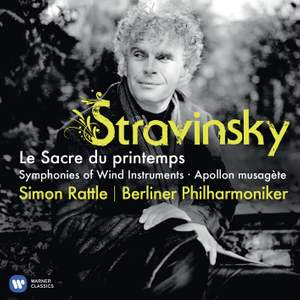
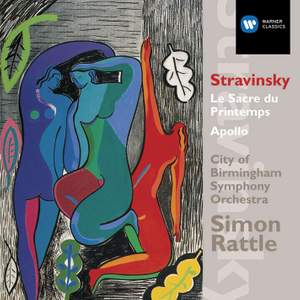
All recordingsPrices shown exclude VAT. (UK tax is not payable for deliveries to United States.) See Terms & Conditions for p&p rates. | |  | Stravinsky: Le sacre du printemps
Sir Simon Rattle and the Berliner Philharmoniker, whose Grammy® award-winning accounts of Stravinsky’s Symphony in C and Symphony of Psalms are among Gramophone magazine’s Top 10 Stravinsky Recordings (2011), return to the composer with a recording of the ground-breaking ballet Le Sacre du printemps, whose premiere a century ago marked a turning point in 20th century music history. The programme on this release also includes new recordings of Stravinsky’s Symphonies of Wind Instruments and Apollon Musagète, another of the Russian master’s breathtaking ballets. Although the premiere of Igor Stravinsky’s Le Sacre du printemps in Paris on 29th May 1913 famously set off a near-riot, the work quickly became recognised as one of the most influential musical works of the 20th century. The 100th anniversary of the premiere will be commemorated with performances all over the world in 2013 and, no doubt, with some new recordings. On record and in performance, Simon Rattle has championed the orchestral works of Stravinsky with insight and dedication over many years and this latest recording is an important addition to his Stravinsky discography. “The performances all have the sense of utter security, tonal depth and fabulous dynamic range that are characteristic of the Berlin Philharmonic in Rattle's era...The Berliners are so much on top of their parts that there is something almost too secure about the result...It's a superbly judged performance, with just the right balance between individuality in the wind playing and immaculate ensemble” The Guardian, 21st March 2013 **** “Stravinsky famously disliked Karajan’s supersmooth 1960s account with this orchestra, but he surely would have responded more positively to Rattle, who never allows sheer beauty of sound to undermine the rhythmic pulsing...The Berliners’ strings may be plusher than Birmingham’s, and the woodwind soloists are instrumental royalty, but Rattle preserves the visceral barbarism of this ever-astonishing score.” Sunday Times, 31st March 2013 “it is the suavity of the score that startles, especially in Rattle's subtle use of rubato (stolen time) and the cool sensuality of the woodwind solos. Those woodwind players – currently vying with the principals of the Concertgebouw for the title of world's finest – shine again in Stravinsky's Symphonies of Wind Instruments.” The Independent, 30th March 2013 ***** “Beautiful, all beautiful. But beauty is not enough. We also need the primitive and rude: ingredients that Rattle and the suave Berliners tend to deliver wearing kid gloves...If you’re after an interpretation in love with the score’s quieter corners, go for Rattle with confidence; if you want Stravinsky red in tooth and claw, he’s often hard to find.” The Times, 5th April 2013 *** “You could be forgiven for thinking this was still Herbert von Karajan’s orchestra, such is the depth of colour in The Rite of Spring and weight of string sonority in Apollon Musagète.” Financial Times, 6th April 2013 *** “the physical impact here of maximum Berlin Philharmonic firepower is part of what the music itself calls for...Compared to the clotted cream sonorities in evidence here, Rattle's CBSO recording is far truer to the music's poised incisiveness and grace. But his new reading of The Rite of Spring with the Berlin Philharmonic is a formidable achievement.” BBC Music Magazine, May 2013 ***** “It’s indecently luxuriant and played with a confidence which almost borders on complacency...This recording is full of...sounds which will have you dusting down your miniature score in disbelief. Rarely has the second half’s intro sounded so decadent and sweaty, and I whooped for joy at hearing a normally inaudible low horn rasp a few minutes near the close.” The Arts Desk, 6th April 2013 “This is a pretty considerable account of Le Sacre. I think there is, at times, a degree of greater urgency than was the case in 1987 - perhaps the presence of an audience helped; perhaps it’s the fact that an even more experienced Rattle is now at the helm of a virtuoso orchestra...a refined and excellent performance of Apollon Musagète which benefits not only from the virtuosity of the Berlin string players but also from the fastidious ear of their conductor.” MusicWeb International, April 2013 “[Stravinsky] would surely have warmed to this new version. Rattle’s sense of pacing and proportion is unerring, and the sound has a startling vividness that makes this familiar piece seem new. One hears thickets of ticking, twittering inner parts that normally stay in the background.” The Telegraph, 19th April 2013 **** BBC Music Magazine
Orchestral Choice - May 2013 |
| 
| | | In stock - usually despatched within 1 working day. |
|
|
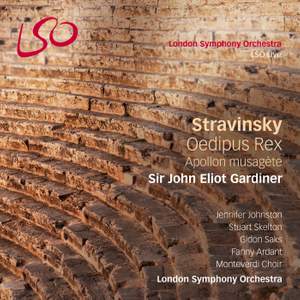
| |  | Stravinsky: Oedipus Rex
This recording of three of Stravinsky’s major works of the period was made in 1951 at the new radio station in Cologne, and features the composer himself conducting the Cologne Radio Symphony Orchestra in performances of Apollon Musagète, the Symphonies of Wind Instruments, and Oedipus Rex. The soloists in Oedipus Rex included Peter Pears and Martha Mödl. On October 8 1951 the newly built state-of-the-art complex “Funkhaus” at Wallraffplatz in Cologne put on a very special concert. No less a figure than Igor Stravinsky was called in as the godfather of the new “great broadcasting hall”. The programme performed consisted of three of Stravinsky’s recent works, “Apollon musagète”, “Oedipus-Rex” and, as a German debut, the “Symphonies of Wind Instruments”. The Radio Orchestra was conducted by the composer himself, and the soloists in Oedipus Rex were Peter Pears, Martha Mödl, Heinz Rehfuss, Otto von Rohr, and Helmut Krebs. The narrator was Werner Hessenland and chorus was an augmented version of the male voice choir of the NWDR. The recordings on this album were made in the studio on the day before the concert. | 
| | | (also available to download from $10.50) | In stock - usually despatched within 1 working day. |
|
|
| |  | Stravinsky - The Ballets
The Ballet Edition is a series of 2 CD sets drawn from the catalogues of EMI Classics, presenting the best-loved and most popular ballets, performed by the world’s leading orchestras and conductors. “Vital and colourful recordings from the 1980s, when Simon Rattle was at the height of his powers with the CBSO.” BBC Music Magazine, August 2010 **** | | | In stock - usually despatched within 1 working day. |
|
|
| |  | Igor StravinskyRecorded: Royal Festival Hall, London, 10 December 1958
The iconic Igor Stravinsky conducting his own works ‘live’ is a major event, and the 1958 gala event was no exception. ‘Music and Musicians’ wrote “even Stravinsky, apostle of clarity, could not complain of the brilliance of the BBC Symphony Orchestra’s attack or clean and faultless line of its phrasing. Seized as it was on this night with a sense of occasion, it can play like a band of angels.” Both the ballet scores, ‘Agon’ and ‘Apollo’ (formerly named ‘Apollon Musagète), were recorded by Stravinsky in the studio after their respective premieres in 1957 and 1950, and then again in the 1960s. The ‘Symphony in 3 Movements’ was first recorded in the studio by Stravinsky in 1946. There are some European air-checks of ‘Agon’ and ‘Apollo’ but the BBC’s own master tapes are of superb quality. Stravinsky concluded the concert with three excerpts from the 1945 ‘Firebird’, but timing only permitted the Finale to be included here. “Conducting his own music on a visit to London in 1958, he gives his recently composed ballet music Agon a fiercely angular reading, full of snap and fizz.
The Symphony is given a similarly committed performance by the BBC Symphony Orchestra, though they seem at moments to escape the composer's baton. Only in the neo-classical Apollo is a little lyricism allowed to round the edges” The Telegraph, 18th February 2009 “Agon was then new, and is not the easiest work to play even now...but the performance... generally does its marvellous inventions justice, showing again that annexing serial techniques only made Stravinsky more characteristically and inimitably himself. The BBC strings’ Apollo, if not the most elegant in the world, is warm-hearted and full of life. The end of Firebird, played as an encore, rounds off a truly historic disc.” Sunday Times, 1st March 2009 **** “Having only four rehearsals at his disposal, Stravinsky achieved remarkable results… Although the performance of Agon is hardly pristine, there's a greater sense of rhythmic tension in the performance than the more technically secure studio recording made by the composer...” BBC Music Magazine, June 2009 **** “Their tense astringency is compelling, and the sense of a very special occasion is palpable from the start.” The Guardian, 27th March 2009 | | | (also available to download from $10.50) | In stock - usually despatched within 1 working day. |
|
|
| |  | Simon Rattle conducts Stravinsky
| | | In stock - usually despatched within 1 working day. |
|
|
| |  | The Very Best of Stravinsky
| | | In stock - usually despatched within 1 working day. |
|
|
| |  | Stravinsky - The Great Ballets
| | | In stock - usually despatched within 1 working day. |
|
|
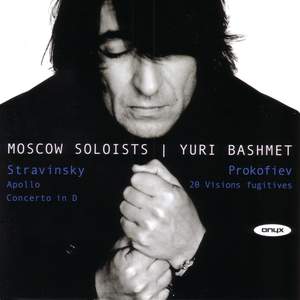
| |  | Stravinsky & Prokofiev
“The 'rainbow colours' hinted at in Prokofiev's inspiration, lines by the poet Konstantin Balmont, are fully captured in this chameleonic performance. There are mysteries and passing hints of the numinous in this Apollo, too. Some may prefer the opulence of Karajan's full orchestral strings in the ballet (DG), but the lean Apollonian nimbleness of this Moscow ensemble, cleanly recorded, is surely a more authentic realisation.” BBC Music Magazine, April 2007 ***** | | | In stock - usually despatched within 1 working day. |
|
|
| |  | Stravinsky: The Ballets
This collection brings together four great ballets by Stravinsky – The Firebird, Petrushka, The Rite of Spring and Apollon musagète, in definitive performances, stunningly recorded, by Antal Dorati and the Detroit Symphony Orchestra. Also included is the early orchestral work Scherzo fantastique, which was first performed as a ballet by the New York City Ballet in 1972 with choreography by Jerome Robbins. Stravinsky first made a name for himself with his colourful score for the ballet The Firebird, influenced by his teacher Rimsky-Korsakov, but already giving an indication of things to come. His next ballet, Petrushka, showed significant development, but hardly prepared audiences for the premiere of The Rite of Spring in Paris on 29 May 1913, which caused a riot. It was the most significant event in 20th century classical music and the shock of this revolutionary score can still be felt today. | | | (Sorry, download not available in your country) | Usually despatched in 2 - 3 working days. |
|
|
| |  | Sandor Vegh conducts Bartok, Berg and Stravinsky
| |
|
| |
|