All recordingsPrices shown exclude VAT. (UK tax is not payable for deliveries to United States.) See Terms & Conditions for p&p rates. | |  | Stravinsky - Symphony in C
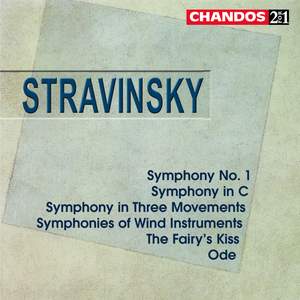
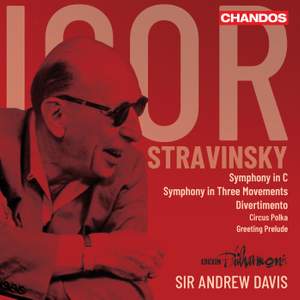
Stravinsky showed with his Symphony in C that great music could still be composed with the simplest means, recalling Beethoven’s achievement yet with his own rhythmic vitality, grace and refinement. Also written during World War II, the Symphony in Three Movements reaches a martial conclusion enlivened by jubilant Latin American rhythms. Secretly dedicated to his mistress, later wife, Vera de Bosset, the Octet was Stravinsky’s first completely neo-classical work and the happiest of his earliest pieces. In Dumbarton Oaks pays tribute to Bach’s 3rd Brandenburg Concerto. “Robert Craft's best rostrum work involves relatively small forces and transparent textures, such as the Octet, which is here given a crisp, dapper performance, biting where needs be and bursting with life. Musical line and clear projection are invariable Craft priorities and both in the Octet and in the post-Baroque Dumbarton Oaks Concerto the pulse is kept moving and the musical journey is always clearly directed with generally superb execution from the New York players. All these selections were previously available. An earlier Craft-led version of the Symphony in Three Movements (from 1991) is marginally swifter than this 1999 Philharmonia remake, leaner too with a sharper edge (notably from the brass) but the finale on the new version is very appealing, with the incisive snap of woodwinds against eerily winding strings. The tighter, more astringent language of the Symphony in C suits Craft better, though the outer movements occasionally sound rushed. In the Symphony in C Craft's approach is all animation and nervous energy. As ever with him, there's the feeling that the mind in charge knows exactly what this music is about, and with generally excellent sound makes for a thoroughly reliable programme, while in the case of the two chamber works the effect is decidedly impressive. Needless to say, Craft's own programme- notes are a mine of relevant information.” Gramophone Classical Music Guide, 2010 “Musical line and clear projection are invariable Craft priorities and both in the Octet and in the post-Baroque Dumbarton Oaks Concerto the pulse is kept moving and the musical journey is always clearly directed with generally superb execution from the New York players. As ever with him, there's the feeling that the mind in charge knows exactly what this music is about...” Gramophone Magazine, March 2009 | | | (also available to download from $6.00) | In stock - usually despatched within 1 working day. |
|
|
| |  | Simon Rattle conducts StravinskyRecorded Live in September 2007
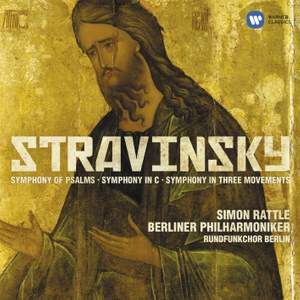
The album comprises three of the five works by Stravinsky which contain the word ‘symphony’ in their titles, including the Symphony in C which Sir Simon has never before performed and which the BPO haven’t played for over 20 years. “As one might expect from these forces, the asceticism of neo-Classical Stravinsky plays second fiddle to the orchestra's natural plushness. But while the textures sound a little weightier than we are used to, Simon Rattle's mastery in orchestral balancing ensures that nothing is compromised.
There is some delectable playing here, especially from the woodwind in the Bachian counterpoint at the heart of the Symphony of Psalms, where the Berlin Radio Chorus also excels. And the richness of sound does nothing to dampen the rhythmic vitality that is at the heart of the two purely instrumental works” Matthew Rye, The Telegraph, 28th June 2008 “Rattle's performances, all taken from concerts in Berlin's Philharmonie, are as energised and impeccably played as one would expect, with the woodwind contributions a particular delight. Predictably, it's the last of the trilogy, the stark Symphony in Three Movements from 1946, that makes the biggest impression, with Rattle channelling its energy and athleticism uncompromisingly. Yet all three works have a litheness and confidence, a perfect balance between the sections, and, in the Symphony of Psalms, between the orchestra and the superbly groomed choir, that give the music a transparent, "classical" feel. Rattle's performance of the Symphony of Psalms gets the balance between celebratory exuberance and liturgical grandeur exactly right, releasing the energy of the finale in a controlled display of orchestral virtuosity.” The Guardian, 20th June 2008 **** “Rattle gives [the woodwind] Mozartian prominence above the transparent strings, and this is music to which the British conductor brings a special empathy. In the Psalm settings, the Rundfunkchor Berlin, now under Simon Halsey, give exemplary accounts of their music. These are luxury interpretations in every sense, sumptuously recorded.” Sunday Times, 15th June 2008 **** “The real highlight of this CD is Rattle's pressing but never impatient account of what in my view is Stravinsky's greatest symphony, the terse and poignant Symphony in C… Stravinsky himself is faster and lighter… but Rattle gives us both urgency and tonal body. Henceforth, his is a digital front-runner.” Gramophone Magazine, August 2008 “The slow movements of both the Symphony in Three Movements and the Symphony in C are beautifully done.” BBC Music Magazine, Proms 2008 *** “The Berliners are adept at finding exactly the right mode for each work –perkily antiquated for the Symphony in C, muscular and athletic for the Symphony in Three Movements and intense for the Symphony of Psalms. I wasn’t sure Simon Rattle could do spiritual, but here he proves he can.” The Telegraph, 14th July 2009 **** “The Symphony in Three Movements doesn't so much start as erupt and Sir Simon Rattle's second recording of it has impressive immediacy, richer tonally than his rougher-edged 1980s recording with the CBSO, but textually warmer and with more refined solos. Interesting points of comparison arise at around 4'00” into the first movement (chamber-like textures involving strings and winds) and the serene passage for strings and harp at 2'08” into the second movement, the relative earnestness of the earlier version replaced here by a true but 'terrible beauty'. In comparison with conductors like Boulez and Gielen, Rattle offers the most polished option, mindful of both mood and structure and beautifully engineered, but don't forget Stravinsky's own 1946 (New York Philharmonic) version, which reflects a new-born masterpiece in the heat of its creation. Rattle's Symphony of Psalms is very sensitively traced, with a rowdy account of the reveille-style 'Laudate Dominum' passage in the last movement. However, the real highlight of this CD is Rattle's pressing but never impatient account of what in my view is Stravinsky's greatest symphony, the terse and poignant Symphony in C, music forged in the wake of illness and death but that only ever suggests anguish, never confesses it. Tchaikovsky's spirit looms large, especially in the first movement, at the onset of the angry central climax where Rattle and his Berliners achieve considerable intensity. Rattle focuses each episode without sounding episodic and shapes the Larghetto's opening most poetically. Stravinsky himself is faster and lighter (especially on his second, stereo, recording) but Rattle gives us both urgency and tonal body. Henceforth, his is a digital front-runner. (And if purchased as a download, a finely observed account of the Symphonies of Wind Instruments is thrown in as a generous bonus.)” Gramophone Classical Music Guide, 2010 | | | In stock - usually despatched within 1 working day. |
|
|
| |  |
| | | (also available to download from $21.00) | In stock - usually despatched within 1 working day. |
|
|
| |  | Stravinsky: The Firebird
Stravinsky's ongoing Russian inspiration, clad in the opulence of Rimsky-Korsakov's orchestration in 1910 and then moving towards a more dodecaphonic writing (1966, Requiem Canticles), not forgetting the consummate Les Noces - "not a ballet but a divertissement...in two parts" (to quote the composer). A unique blend of earthy rusticity, profund humanity and religious faith. | | | Usually despatched in 3 - 4 working days. |
|
|
| |  | Stokowski conducts Stravinsky, Hindemith, Hartmann and others
This is the second release in our Historical series of Leopold Stokowski conducting premieres of important twentieth-century symphonies. On this unique two-CD set, we have six symphonies, by Stravinsky, Hindemith, Hanson, Harris, Karl Amadeus Hartmann and Alan Hovhaness, further examples of the conducting genius that was Leopold Stokowski, amongst which is the uniquely valuable only surviving recording of Roy Harris's impressive Seventh Symphony - the work was extensively revised after this performance took place. The performance of Hartmann's Second Symphony 'Adagio' with the Cologne Radio Symphony Orchestra from 1955 earned the composer's total admiration. This is a superb and immensely valuable issue. | | | Usually despatched in 8 - 10 working days. |
|
|
| |  |
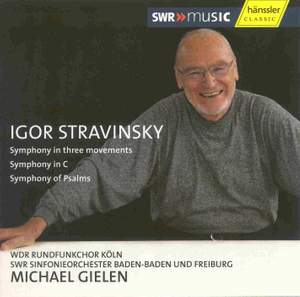
Maestro Michael Gielen presents the three Symphonies of Stravinsky in is certain to become one of the definitive interpretations for our time. The Symphony in Three Movements was composed during the height of WWII (1942-45), and reflects the composer’s impressions, mostly gained through cinematic representations, of the ongoing war. The Symphony in C was composed during one of the darkest periods in Stravinsky’s – years marked by illness and the death of his mother, his wife and a daughter. However, in trying to focus on formal concerns in the music, Stravinsky tried to keep his personal feelings out of the symphony. The first two movements were composed in Europe and reflect more of a traditional style. The third and fourth movements were composed after Stravinsky moved to America and herald his growing experiments with rhythmic meter change. The final composition on this CD, Symphony of Psalms, is based on various psalms from the Bible and consists of three parts. The score’s inscription à la gloire de Dieu, “to the glory of God,” reveals Stravinsky’s purpose for the work. The text, in Latin, is based on Psalm 150, which exhorts worship through the music of several different instruments, and Psalm 40, a prayer of supplication. | | | (also available to download from $10.50) | Usually despatched in 2 - 3 working days. (Available now to download.) |
|
|
| | | |  |
| | | Usually despatched in 8 - 10 working days. |
|
|
| |  |
“This Naxos disc is more than a bargain: it's a find.” Fanfare | | | (also available to download from $6.00) | Usually despatched in 2 - 3 working days. (Available now to download.) |
|
|
| |  | The Essential Stravinsky
| | | (also available to download from $16.25) | Usually despatched in 2 - 3 working days. (Available now to download.) |
|
|
| |
|