All recordingsPrices shown exclude VAT. (UK tax is not payable for deliveries to United States.) See Terms & Conditions for p&p rates. | |  | Josef Špaček plays Smetana, Janáček & ProkofievRecorded at the Dvořák Hall of the Rudolfinum, Prague, December 2012.
Janáček, Smetana, Prokofiev – Josef Špaček’s “Slavonic debut”. Still only 26, the violinist Josef Špaček has already covered an enormous amount of ground. After completing his studies at the Curtis Institute of Music in Philadelphia, he attended Itzhak Perlman’s class at the Juilliard School in New York, and he has given solo performances under the baton of outstanding conductors (Bělohlávek, Eschenbach, Honeck, Hrůša). In 2009 he won the Michael Hill International Violin Competition (New Zealand), in May 2012 he became a laureate of the closely observed Queen Elisabeth Competition in Brussels and in the same year led the Czech Philharmonic Orchestra as concert master at the chief conductor Jiří Bělohlávek’s inauguration concerts. For his Supraphon debut, Josef Špaček has chosen works by Slavonic composers. The two duets from Smetana’s From My Homeland are considered the counterpart to his cycle My Country, while Janáček’s Sonata, which was introduced to the world by Paul Hindemith as a soloist, is evidently the most frequently performed Czech violin sonata. And when it comes to Prokofiev, the Russian master’s music is a truly heartfelt matter for Špaček (as a soloist, he has executed both of his concertos). The pianist Miroslav Sekera is a wonderful partner to Špaček on the recording, as are the superb and inspiring acoustics of the Dvořák Hall of Prague’s Rudolfinum. | 
| | | In stock - usually despatched within 1 working day. |
|
|
| |  | Janacek: Violin Sonata
This programme comprises three major 20th-century chamber works, all of them deeply rooted in the musical world of Central Europe. The pieces by Janac•ek and Szymanowski are exactly contemporary. Composed respectively at the beginning and the end of the 20th century, Szymanowski's 'Mythes' and Lutoslawski's 'Partita' constitute two landmarks of Polish music. “An exquisitely shaded performance of the Janacek Sonata sets up heady takes on Szymanowski's Mythes and the fizzing virtuosity of Lutoslawski's Partita.” BBC Music Magazine, March 2013 ***** | 
| | | In stock - usually despatched within 1 working day. |
|
|
| |  | Violon Passion
Laurent Korcia (violin), Jean-Marc Luisada (piano) Bourges Philharmonic | | | In stock - usually despatched within 1 working day. |
|
|
| |  | Dohnányi & Janácek - Violin Sonatas
Hagai Shaham and Arnon Erez have been enthusiastically acclaimed for their dazzling duo performances: their infectiously relaxed bravado and continual flexibility belying their impeccable ensemble. For their latest disc they turn to two composers who are seminal figures in the development of Eastern European music during the early twentieth century. Dohnányi was one of the pivotal figures in Hungary’s musical life. He composed a number of significant pieces for the violin, including two violin concertos; his most important chamber work for violin and piano is the Violin Sonata in C sharp minor Op 21, composed in 1912. Dohnányi was by then thirty-five years of age, and the Sonata is a fully mature work showing his individual development of stylistic traits of Brahms and Liszt combined with a structural economy which reflects the close study of Brahms’s sonatas. Also recorded here is Dohnányi’s most overtly folk-influenced work, Ruralia hungarica, and a movement from his First Orchestral Suite, in F sharp minor Op 19, Romanza, arranged as a thoroughly idiomatic piece for violin and piano by Jascha Heifetz. In the first days of World War I Dohnányi’s native Hungary was invaded by the Russian army, which seemed for a time to herald the end of Austrian dominance in the region. This portentous event provided the creative spark for Leoš Janácek’s Violin Sonata (his only surviving violin sonata; two very early ones he composed in Dresden and Vienna in 1880 are lost), at least according to Janácek himself. Other works by Janácek heard in this recital include early pieces from his student years, and an arrangement of the delicate mood study ‘A blown-away Leaf’ from the celebrated piano work On the Overgrown Path. “Ruralia Hungarica draws the most compelling performance, Shaham negotiating the challenging violin pyrotechnics of the outer movements with powerhouse playing as well as delivering a wonderfully atmospheric Andante rubato alla Zingaresca.” BBC Music Magazine, May 2010 ***** “Shaham is in his element [in the Ruralia hungarica pieces] - the brilliant final piece carefree and dashing in style, the preceding, improvisatory Andante rubato alla zingaresca graceful and stylish...these are all appealing, finely-judged performances.” Gramophone Magazine, July 2010 | | | In stock - usually despatched within 1 working day. |
|
|
| |  | Janacek - Glagolitic Mass, Sinfonietta, Piano Works & Songs
Janacek: | Sinfonietta Philharmonia Orchestra, Simon Rattle Glagolitic Mass Felicity Palmer, Ameral Gunson, John Mitchinson, Malcolm King & Jane Parker-Smith CBSO Chorus & City of Birmingham Symphony Orchestra, Simon Rattle Concertino, JW VII/11 Mikhail Rudy (piano) Soloists of the Opéra National de Paris, Sir Charles Mackerras The Diary of One Who Disappeared with Ian Bostridge, Thomas Adès, Ruby Philogene, Diane Atherton, Deryn Edwards & Susan Flannery Reminiscence, JW 8/32 Thomas Adès (piano) In memorium Thomas Adès (piano) Andante Thomas Adès (piano) Moderato Thomas Adès (piano) Der goldene Ring (1928) Thomas Adès (piano) Ich erwarte Dich (1928) Thomas Adès (piano) Christ the Lord is born Thomas Adès (piano) Violin Sonata Pierre Amoyal (violin) & Mikhail Rudy (piano) Capriccio for piano (left hand) & chamber ensemble, JW VII/12 'Vzdor' with Mikhail Rudy Soloists of the Opéra National de Paris, Sir Charles Mackerras |
“Full marks for breadth in a compilation balancing the familiar (an effortful Sinfonietta and wiry Glagolitic) with chamber music and Bostridge's Diary. Like the diarist, alas, the texts have disappeared too!” BBC Music Magazine, May 2009 **** | | | In stock - usually despatched within 1 working day. |
|
|
| |  |
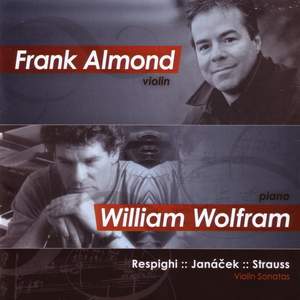
Frank Almond (violin) & William Wolfram (piano) The Milwaukee Symphony Orchestra's leader Frank Almond steps forth with a robust recital recording of three 20th-century sonatas by composers primarily known for their mastery of the orchestra. These works by Strauss, Respighi and Janácek were all written within 30 years of each other, yet inhabit three distinct musical worlds. Juilliard graduate Almond is one of the youngest prizewinners in the history of the Paganini Competition in Genoa, Italy. Prior to moving to Milwaukee, he held positions as leader of the Rotterdam and London Philharmonic Orchestras. He was also a prizewinner at the Tchaikovsky Competition, as was his collaborator William Wolfram, who also picked up medals in both the William Kapell and the Naumberg International Piano Competitions. Recorded July 29-31, 2005 at the Milwaukee Youth Arts Center, Milwaukee, Wisconsin “unassailable technical mastery and absolute temperamental harmonisation. Some sort of standard is offered by Perlman and Ashkenazy; Almond and Wolfram are not out of place in such company.” BBC Music Magazine | | | In stock - usually despatched within 1 working day. |
|
|
| | Tzigane: Musique d'Europe Central
| | | In stock - usually despatched within 1 working day. |
|
|
| |
| | | In stock - usually despatched within 1 working day. |
|
|
| |  |
Thomas Hlawatsch (piano), Ildiko Line (violin), Istvan Balint (tuba), Zsolt Czegledi (trumpet), Istvan Racz (flute), Istvan Somorjai (trumpet) Tamas Benedek | | | (also available to download from $6.00) | In stock - usually despatched within 1 working day. |
|
|
| |  | Prokofiev, Poulenc & Janacek: Sonatas for Violin and Piano
Louise Chisson (violin) & Tamara Atschba (piano) On this recording, the French violinist Louise Chisson presents major violin sonatas of the 20th century. Whereas Poulenc’s and Prokofiev’s sonatas date from the Second World War, Leoš Janáček’s sonata was written in 1914, at the beginning of the First World War. The works evince Impressionist elements, stylistic ruptures and a preparation of Modernism. Against the backdrop of the dates of composition of these works, it is surprising that there is also scope for lightness and beauty besides death, gloom and despair. Together with the Georgian pianist Tamara Atschba, Chisson effortless manages to walk a tightrope and convey the most expressive emotions from the darkest years of the past century. | 
| | | Usually despatched in 2 - 3 working days. |
|
|
| |
|