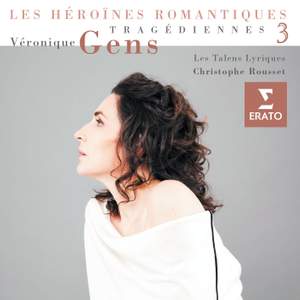
Prices shown exclude VAT. (UK tax is not payable for deliveries to United States.) See Terms & Conditions for p&p rates. | |  | Véronique Gens: Tragediennes 3 (Les Héroïnes Romantiques)
In her third ‘Tragédiennes’ album for Virgin Classics, French soprano Véronique Gens continues her exploration of the highways and byways of the French operatic repertoire, this time covering the late 18th and 19th centuries and with a prime focus on roles for the deeper, darker-toned female voice. The French soprano Véronique Gens, joined once again by Christophe Rousset and Les Talens Lyriques, continues her exploration of the highways and byways of the French operatic repertoire with this, her third ‘Tragédiennes’ album. It covers the late 18th and 19th centuries and travels from Carthage and Palestine to the Pyrenees, Tudor England and 16th century Germany, and alongside such names as Gluck, Berlioz, Meyerbeer, Verdi (his Don Carlos, written in French for Paris), Saint-Saëns (his rarely heard Henri VIII rather than Samson et Dalila) and Massenet, features composers who no longer hold a place on the world’s operatic stages: Gossec, Méhul (much admired by Berlioz), Mermet and Kreutzer (the violinist and dedicatee of Beethoven’s sonata). Perhaps surprisingly, Gens’ main emphasis in this recital is on arias written for mezzo soprano, but there have always been darker shades in Gens’ timbre and French composers of opera created some of their most impressive roles and arias for the deeper-toned female voice. In fact, this recital makes explicit tribute to a series of Parisian divas would today probably be classified as mezzo sopranos: Marie-Thérèse Maillard, Cornélie Falcon (who gave her name to a particular sub-category of voice – a high mezzo/deep soprano), Rosina Stoltz and Pauline Viardot. Even Marie-Constance Sass, the first singer of the magnificent soprano aria ‘Toi qui sus le néant’ from Verdi’s Don Carlos – better known in its Italian version, ‘Tu che la vanità’ and now often sung by lyric sopranos – was also the creator of the sultry ‘falcon’ role of Sélika in Meyerbeer’s l’Africaine. That Gens can hold her own in such exalted historic company becomes clear from the BBC Music Magazine‘s assessment of her last ‘Tragédiennes’ album: “Passion, ardour, rage, tenderness – the full gamut of human expression emerges in this selection of works created for French operatic femmes fatales … Music director Christophe Rousset and soprano Véronique Gens’s second disc of musical ‘Tragediénnes’ is a thrilling mix of the familiar … and the little known … The whole makes a wonderful odyssey … Gens’s agile voice is the perfect vehicle to cope with these emotional extremes, from the enchanting to the chilling. She is never afraid to sacrifice pure beauty of sound in favour of rhetorical and dramatic effect, giving due weight to the plights, laments and plangent outpourings of these timeless, tragic heroines. Rousset coaxes some crack playing from Les Talens Lyriques, combining the immediacy and intimacy of chamber music with all the colours and intensity of a large-scale symphony orchestra.” “Though many of these arias were written with a mezzo-soprano range in mind, their dark shades are generally a good match for Gens's sultry voice...Rousset directs throughout with bracing energy: rhythms are razor-sharp, orchestral colours vivid. His period orchestra never overwhelms the soloist, so Gens's every word cuts through with thrilling, and often chilling, drama. Virgin's recording sound is clean and detailed. In short, intense but compelling listening.” BBC Music Magazine, December 2011 ***** “she tackles roles usually assigned to mezzo-sopranos, such as Fidès in Meyerbeer’s Le Prophète, Didon in Berlioz’s Les Troyens and Massenet’s Hérodiade, but her shining soprano is especially gorgeous in the rarities...Rousset’s period band supplies luxury support.” Sunday Times, 23rd October 2011 “Her focused timbre brings piercing clarity to a raft of rarities...[in the Don Carlos aria] the superb open, pure brass and wind of Les talens lyriques under Christophe Rousset make one yearn for this whole opera on old instruments.” The Guardian, 17th November 2011 | | | In stock - usually despatched within 1 working day. |
|
|
| |  | Ne me refuse pas: French Opera Arias
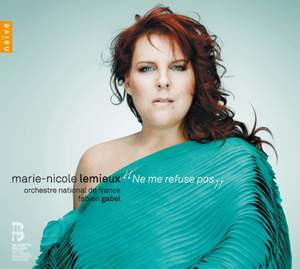
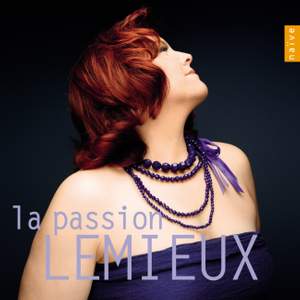
In 2000 the contralto Marie-Nicole Lemieux became the first Canadian to win the First Prize as well as the Special Prize for Lieder at the Queen Elisabeth International Music Competition in Belgium. She has recorded for numerous labels, and now enjoys an exclusive contract with the Naïve label, for which she has recorded the title roles in Vivaldi’s operas Griselda and Orlando furioso. Her first recital CD of French mélodies (L’Heure exquise) was much praised by the critics. In 2008 Naïve released a recording of Vivaldi sacred works in which she sings the famous Stabat Mater. This was followed by the same composer’s La fida ninfa. In 2009 Naïve released a recital of Schumann songs with the pianist Daniel Blumenthal and a programme of Vivaldi arias with the Ensemble Matheus under Jean-Christophe Spinosi. The programme chosen for this recording by Marie-Nicole Lemieux is dedicated to the finest arias from the French opera, recorded with one of the finest orchestras in this repertoire and featuring both popular and more specialised works by, amongst others, Massenet, Berlioz, Saint-Saëns, and Bizet. “The programme is formidably intelligent: well-known items are placed alongside some terrific music by composers we rarely hear (Halévy and Wormser, for instance), the aim being to remind us that the dividing line between success and oblivion can sometimes be painfully thin.” The Guardian, 11th November 2010 *** “This is an attractive record and its appeal may well be felt before a note of it is heard. Many who take a particular interest in singing find themselves drawn to the French repertoire...and this young singer - perhaps still new to some - so provocatively classified as "contralto" also has the kind of name and background that attract the attention of traditional record collectors.” Gramophone Magazine, March 2011 “[In the Letter Scene] Lemieux is awake to the changes of mood as she moves between a lovely quiet opening section to more ecstatic utterances. The interpretation is first-rate...The wistfulness and sense of longing with which Lemieux recalls Mignon's past are feelingly expressed...The playing under Fabien Gabel is fine all through.” International Record Review, March 2011 “This procession of femmes fatales, schemers and innocents has a point to make, and it's not just the singer's ability to get under their skin...it shows them as part of a larger movement: the rise of the 19th-century French mezzo...Marie-Nicole Lemieux is equal to them all, adjusting vibrato and shading an essentially contralto colour according to dramatic demands.” BBC Music Magazine, April 2011 ***** | | | (also available to download from $10.50) | In stock - usually despatched within 1 working day. |
|
|
| |  | Vesselina Kasarova: A Portrait & French Opera Arias
Bellini: | Ascolta! Se Romeo t'uccise un figlio...La tremenda ultrice spada (from I Capuleti) | Berlioz: | Ah! Je vais mourir (from Les Troyens) | Donizetti: | Fia dunque vero…O mio Fernando (from La Favorita) Sposa a Percy...Per questa fiamma indomita (from Anna Bolena) | Gluck: | Che faro' senza Euridice? (from Orfeo ed Euridice) | Gounod: | Ô ma lyre immortelle (from Sapho) Depuis hier je cherche en vain mon maître...Que fais-tu, blanche tourterelle (from Roméo et Juliette) Nuit resplendissante (from Cinq-Mars) | Handel: | Or la tromba (Rinaldo) | Lalo: | De tous côtes j'apercois...Lorsque je t'ai vu soudain (from Le Roi d'Ys) | Massenet: | De cet affreux combat…Pleurez, mes yeux ! (from Le Cid) | Meyerbeer: | Non, non, non, vous n'avais jamais, je gage (from Les Huguenots) Donnez, donnez (from Le Prophète) | Mozart: | Voi che sapete (from Le nozze di Figaro) Batti, batti, o bel Masetto (from Don Giovanni) | Rossini: | Nacqui all'affanno, al pianto...Non più mesta (from La Cenerentola) Pensa alla patria (from L'Italiana in Algeri) Una voce poco fa (from Il barbiere di Siviglia) | Saint-Saëns: | Amour, viens aider ma faiblesse (Samson et Dalila) | Thomas, Ambroise: | Connais-tu le pays (from Mignon) |
“[Portrait] is the stuff of legends: I can't recall the last time I heard a debut opera recital that has given me so much pleasure. The vibrant richness of Kasarova's tone allied to her totally uninhibited manner before the microphone allow her to bring to astonishing life each of the characters portrayed within.” Gramophone Magazine, February 2007 | | | In stock - usually despatched within 1 working day. |
|
|
| |  | Royal Opera Gala
Beethoven: | Mir ist so wunderbar (Quartet) (Fidelio) Elizabeth Robson (soprano), Dame Gwyneth Jones (soprano), John Dobson (tenor), David Kelly (bass) Sir Georg Solti | Berlioz: | Ah! Je vais mourir (from Les Troyens) Josephine Veasey (mezzo) Rafael Kubelik | Bizet: | Carmen: Prelude to Act I Sir Georg Solti | Britten: | Helena! Hermia! Demetrius! Lysander! (from A Midsummer Night's Dream) Delme Bryn-Jones (baritone), Kenneth McDonald (tenor), Elizabeth Robson (soprano), Anne Howells (mezzo) Sir Georg Solti O beauty, handsomeness, goodness (from Billy Budd) Forbes Robinson (bass) Sir Georg Solti | Donizetti: | Pour ce contrat fatal...Salut à la France (from La fille du régiment) Joan Sutherland (soprano) Richard Bonynge | Gounod: | Faust - Ballet Music Sir Georg Solti | Mozart: | Dove sono i bei momenti (from Le nozze di Figaro) Joan Carlyle (soprano) Sir Georg Solti | Mussorgsky: | Skorbit dusha! (from Boris Godunov) Joseph Rouleau (bass), John Lanigan (tenor) Sir Edward Downes | Offenbach: | Barcarolle (from Les Contes d'Hoffmann ) Sir Georg Solti | Ponchielli: | Dance of the Hours (from La Gioconda) Sir Georg Solti | Puccini: | Addio dolce svegliare (from La Bohème) Elizabeth Vaughan (soprano), Maria Pellegrini (soprano), Jean Bonhomme (tenor), Delme Bryn-Jones (baritone) Sir Edward Downes | Rossini: | L'Italiana in Algeri Overture Sir Georg Solti Semiramide Overture Sir Georg Solti | Strauss, R: | Da … Herr Kavalier! (from Der Rosenkavalier) Yvonne Minton (mezzo), Michael Langdon (bass) Sir Georg Solti Allein. Weh' ganz allein (from Elektra) Amy Shuard (soprano) Sir Edward Downes | Tippett: | O rich soiled land (from King Priam) Richard Lewis (tenor), John Williams (guitar) | Verdi: | Fuoco di gioia (from Otello) Tito Gobbi (baritone), John Lanigan (tenor), John Dobson (tenor) Sir Georg Solti Eh! Taverniere … Mondo ladro (from Falstaff) Sir Geraint Evans (baritone) Sir Edward Downes La traviata: Prelude to Act 1 Sir Georg Solti La traviata: Prelude to Act 3 Sir Georg Solti | Wagner: | Abendlich strahlt der Sonne Auge (from Das Rheingold) David Ward (bass) Reginald Goodall | Walton: | How can I sleep? (from Troilus and Cressida) Marie Collier (soprano), Sir Peter Pears (tenor) Sir William Walton |
| | | In stock - usually despatched within 1 working day. |
|
|
| |
|