All recordingsPrices shown exclude VAT. (UK tax is not payable for deliveries to United States.) See Terms & Conditions for p&p rates. | |  | Barcarole: Favourite Orchestral Pieces
Sir Neville Marriner is one of the most versatile conductors of our time. Alongside his recordings of Baroque and Classical repertoire, he has also made a name for himself as an interpreter of Romantic orchestral music, as this compilation shows: it contains popular works from the highly colourful French and Russian repertoire, including new discoveries like Tchaikovsky's Barcarole, which can certainly hold a candle to the famous work of the same name by Offenbach, and the Berceuse by opera composer Benjamin Godard. | 
| | | In stock - usually despatched within 1 working day. |
|
|
| |  | Dances and Waves: Sommernachtskonzert Schonbrunn 2012
Gustavo Dudamel, Gramophone magazine’s "Artist of the Year" 2011 and Grammy award winner 2012, leads the classical summer live and TV event of 2012: The Summer Night Concert with the Vienna Philharmonic. The concert takes place on June 7th in the gardens of Schönbrunn Palace. Last year’s Summer Night Concert was a huge success. In 2012 a total of 62 countries on five continents will share in the spectacle, including a BBC4 broadcast in the UK. This year the main theme is Dances and Waves, a programme showcasing symphonic and operatic highlights. “Dudamel conducts a popular but substantial programme, evoking the VPO's vividness and warmth” BBC Music Magazine, Christmas 2012 ***** | | | In stock - usually despatched within 1 working day. |
|
|
| |  | Dances and Waves: Sommernachtskonzert Schonbrunn 2012
Gustavo Dudamel, Gramophone magazine’s "Artist of the Year" 2011 and Grammy award winner 2012, leads the classical summer live and TV event of 2012: The Summer Night Concert with the Vienna Philharmonic. The concert takes place on June 7th in the gardens of Schönbrunn Palace. Last year’s Summer Night Concert was a huge success. In 2012 a total of 62 countries on five continents will share in the spectacle, including a BBC4 broadcast in the UK. This year the main theme is Dances and Waves, a programme showcasing symphonic and operatic highlights. “Dudamel conducts a popular but substantial programme, evoking the VPO's vividness and warmth.” BBC Music Magazine, Christmas 2012 ***** | | | In stock - usually despatched within 1 working day. |
|
|
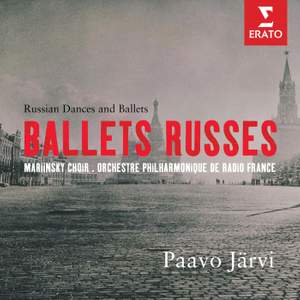
| |  | Ballets RussesRussian Dances and Ballets
Although folk dances have a special place in Russian music, being raised to the status of character dances in works for the stage, the more classical forms taken over from the west are not neglected. During the nineteenth century the waltz, for example, tended more and more towards ‘pure’ music, giving rise to some highly virtuosic works in the manner of those by Weber or Liszt. Thus, in 1856 Glinka (1804-1857), founder of the Russian nationalist school, produced the definitive version of a Valse which had already aroused the enthusiasm of Berlioz. Its slightly melancholy principal theme reappears as a refrain between episodes in various keys, which give rise to passages of instrumental dialogue and to such bold strokes such as the cantabile for solo trombone in the third episode. Witty or ironic comments by the flutes or strings turn it virtually into a fantasia – which Shostakovich was to recall later. Scenes at parties and balls abound in opera. Tchaikovsky composed the waltz for Act Two of Eugene Onegin (1877) – with a chorus in its original version – so as to reflect the humdrum pretentiousness of the lesser, countrified aristocracy: it is closer to the waltz in Faust than to those he was to write for his ballets. This is in clear contrast to the majestic Act Three Polonaise, with its trio incorporating the traditional mazurka, which as the dance of aristocratic St Petersburg receptions is in a different class altogether. Marius Petipa, who became chief ballet master at the imperial ballet in 1869, restored to the art of dance the nobility and charm which had been killed off by an emphasis on technique. Tchaikovsky provided him with music suffused with the poetic inspiration lacking in the more straightforwardly rhythmic scores of composers like Drigo and Pugni. He was, however, criticised by those ballet-lovers who found his music too symphonic; his waltzes, refined rather than brilliant and frivolous, are often tinged with dramatic lyricism, even a sense of anxiety. The unusual flavour of the Waltz of the Flowers from The Nutcracker (1892) is largely created by the mysterious other-worldly horn-calls answered by rippling clarinet figures. Raymonda (1898) is a medieval romance choreographed by Petipa to music by Glazunov. Always melodious, subtle and graceful, it is sometimes highly evocative, as in the trance-like atmosphere in the dreamy slow-motion accompanying the heroine’s sleep (andante sostenuto) in the interlude before the second scene. The tradition of the grand ballet d’action persisted right up to the revolution brought about by Sergei Diaghilev. Reacting against the ‘double pirouettes and detestable sets of thirty-two fouettés’, the director of the Ballets Russes sought the character of the various folk-dances of Russia and other countries, which he remodelled for the stage using a basically classical technique. In his Parisian season in 1909 he presented the second act of Prince Igor (1887) against the background of a tawny-coloured desert steppe. The Polovtsian Dances, alternating spellbinding movements for the women and pounding, savage rhythms for the warriors, were directed by Mikhail Fokine: when a tumultuous wave of dancers rushed downstage at the end, stopping dead just short of the footlights, it brought the house down! Even Anatole Liadov, the composer of backwoods Russia, gave in to the infatuation of the Russian intelligentsia of around 1900 with ancient Greece. His Dance of the Amazon (1910), for Ida Rubinstein, employs two Greek chants, heavily reworked: the first theme suggests the Amazon riding on horseback, the second (meno mosso) emphasises the oriental atmosphere; brass and percussion suggest warlike activity – ushered in by a fanfare. After the 1917 Revolution it was thought that the creations of the Tsarist era would be unappealing to the sensibilities of the new Bolshevik listener. New themes and characters – stadiums and factories, sportsmen and workers – figured in ‘futurist’ (that is, revolutionary) musical experiments. In Shostakovich’s ballet The Golden Age (1930), which portrays the misadventures of a Soviet football team in a capitalist country, a clownish polka caricatures decadent western society. In Tahiti Trot (1928) Shostakovich pulled off the challenge of re-orchestrating Vincent Youmans’ Tea for Two in record time, and in so doing exploited all the expressive and comic possibilities, as well as the shock tactics, of avant-garde experiments. But offerings like these, from an enfant terrible ‘who had nothing to say to the people’, led the Communist Party, around 1932, to rein back cultural activity and reinstate a classical, academic aesthetic, which also extended to opera and ballet. The music of Prokofiev’s Love for Three Oranges (Chicago, 1921; Leningrad, 1927), precise, sturdily constructed and freshly coloured – as in the festive march from Act Two – was perfectly accessible, and yet it was later ignored in the USSR because of its libretto, which makes a feature of absurdity. Romeo and Juliet (1935/6, staged in 1940), on the other hand, with its universal subject, gained unanimous acceptance. The characterisation was exemplary: in the sombre, hieratic Dance of the Knights, with its great sweeps of sound, the menacing thrusts of the basses and brass powerfully convey the arrogance of a clan – as against the fresh sensitivity of youth portrayed by the central theme. Although Khachaturian was also suspected of ‘formalism’, his artistic approach always coincided with that of the regime. His incidental music for a 1940 production of Lermontov’s The Masked Ball portrays well the spiritual emptiness of imperial society: the entirely unsentimental waltz turns like a roundabout, relentlessly driven forward by the pursuit of pleasure. With Gayaneh (1943) Khachaturian goes back to his native Armenia. Part of the ballet’s final celebrations honouring the upbeat heroine of the ‘happy collective farm’ is the frenzied Sabre Dance, the middle section of which recalls an earlier pas de deux. It is an authentic piece of Transcaucasian folklore. Following his Lady Macbeth of the Mtsensk district, Shostakovich had fallen victim, in 1936, to official criticism. He attempted to redeem himself, or at least to behave himself, by writing lighter works, frothier, more facile – i.e. proletarian – for films, ballets, variety stages and what the USSR referred to as ‘jazz’ orchestras, which are more like our light music ensembles. The Suite No.2 for jazz orchestra (1938) was composed for one such group, run by Victor Knushevitsky. The main, somewhat sentimental, theme in its Waltz No.2, played on the saxophone, ends in a sort of good-natured refrain. This piece was used as music for film commercials in the West – and then as title music for Stanley Kubrick’s last film: what finer example of popularity could there be? | | | In stock - usually despatched within 1 working day. |
|
|
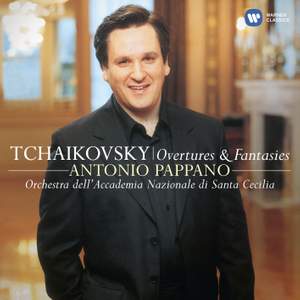
| |  | Tchaikovsky - Overtures & Fantasies
“A generous Tchaikovsky spectacular in masterly hands” BBC Music Magazine, October 2009 “With chorus added in the 1812 as well as the Waltz from Eugene Onegin, this is an exceptional Tchaikovsky collection, a fine start for Antonio Pappano's recordings with his Italian orchestra. What is very striking is how refreshing the 1812 is when played with such incisiveness and care for detail, with textures clearly defined. It starts with the chorus singing the opening hymn, expanding thrillingly from an extreme pianissimo to a full-throated fortissimo. A women's chorus then comes in very effectively, twice over, for one of the folk-themes, and at the end the full chorus sings the Tsar's Hymn amid the usual percussion and bells, though Pappano avoids extraneous effects, leaving everything in the hands of the orchestral instruments. It is equally refreshing to have the Waltz from Eugene Onegin in the full vocal version from the opera, again wonderfully pointed, as is the Polonaise which follows. What comes out in all the items is the way that Pappano, in his control of flexible rubato, is just as persuasive here as he is in Puccini, demonstrating what links there are between these two supreme melodists. So he builds the big melodies into richly emotional climaxes without any hint of vulgarity, strikingly so in both Francesca da Rimini and Romeo and Juliet. Pappano is impressive in bringing out the fantasy element in Francesca, and in Romeo the high dynamic contrasts add to the impact of the performance. There have been many Tchaikovsky collections like this, but with well balanced sound, outstandingly rich and ripe in the brass section, this is among the finest.” Gramophone Classical Music Guide, 2010 “Like the very best music directors, you can’t pigeon-hole Antonio Pappano. He may have made his name with Puccini but he’s got an instinctive feel for structure and for style that makes him good at most things. His Tchaikovsky doesn’t disappoint, full of vigour, of tunefulness” Gramophone Magazine | | | In stock - usually despatched within 1 working day. |
|
|
| |  | Ballets RussesRussian Dances and Ballets
| | | In stock - usually despatched within 1 working day. |
|
|
| |  | Tchaikovsky: Ballet at the Opera
Well known for his three great ballet masterpieces, Tchaikovsky also inserted some of the most colourful orchestral balletic numbers into his operas. Sir Colin Davis and the Orchestra of the Royal Opera House, Covent Garden, recorded a selection of these in 1977 and both, for its vibrancy of colour as well as for its stunning (analogue) sound, this has been a priceless Tchaikovsky recording, long sought out by collectors. | | | In stock - usually despatched within 1 working day. |
|
|
| |  |
If you think you know these pieces, then listen again! Stokowski, the magician, sprinkles star-dust over the Nutcracker and gives the orchestra a jolly old workout in a couple of places. The Serenade has been considered one of the best ever recorded and the Capriccio Italien is brazenly sunlit. The recordings, originally issued on Philips' mid-price "The Early Years" series, have long been unavailable and make a welcome return to the catalogue at super-budget price. | | | In stock - usually despatched within 1 working day. |
|
|
| |  | Cello Elegies and Romances Volume 1
Penelope Lynex (cello) & Alexander Wells (piano) Penelope and Alexander present a selection of the most attractive and interesting cello and piano works in the current repertoire, from the more well-known soulful Elegies to the more moving works such as David Wilde’s commemoration of a bombing in Sarajevo, and Dickinson’s Threnody. | | | Usually despatched in 2 - 3 working days. |
|
|
| |  | Berliner Philharmoniker: Gala From Berlin – Songs of Love and DesireLive Recording from the Philharmonie Berlin, 1998
Berlioz: | Le carnaval romain Overture, Op. 9 | Bizet: | L'Arlesienne Suite No. 1: IV. Carillon L'Arlesienne Suite No. 2: IV. Farandole | Mozart: | Le nozze di Figaro, K492: Overture Deh vieni, non tardar (from Le nozze di Figaro) Christine Schäfer (soprano) Deh! vieni alla finestra (from Don Giovanni) Simon Keenlyside (baritone) Bei Männern, welche Liebe fühlen (from Die Zauberflöte) Christine Schäfer (soprano), Simon Keenlyside (baritone) La ci darem la mano (from Don Giovanni) Christine Schäfer (soprano), Simon Keenlyside (baritone) Fin ch'han dal vino (from Don Giovanni) Simon Keenlyside (baritone) | Rossini: | La gazza ladra Overture | Tchaikovsky: | Polonaise (from Eugene Onegin, Op. 24) Puskay pogibnu ya 'Tatiana's Letter Scene' (from Eugene Onegin) Mirella Freni (soprano) | Verdi: | Addio, addio, speranza ed anima (from Rigoletto) Christine Schäfer (soprano), Marcelo Alvarez (tenor) Caro nome (from Rigoletto) Christine Schäfer (soprano) La donna è mobile (from Rigoletto) Marcelo Alvarez (tenor) Libiamo, ne' lieti calici (from La Traviata) Christine Schäfer (soprano), Marcelo Alvarez (tenor) |
Love is the motto of the 1998 New Year‘s Eve Concert. And who wrote better music about love than Mozart and Verdi? Maestro Claudio Abbado has chosen two of the best Mozart interpreters of our day, Christine Schäfer and Simon Keenlyside, for this traditionally meaningful event. Marcelo Álvarez from Argentina, compared by some to a young Domingo, sings highlights of the tenor repertoire, and Italian Primadonna Mirella Freni tops the occasion with a breathtaking performance of the Letter scene of Tchaikovsky‘s Eugene Onegin. Sound Format: PCM STEREO, DD 5.1 Picture Format: 16:9 DVD Format: DVD 9, PAL Running Time: 90 mins FSK: 0 Directed by Hans Hulscher | | | Usually despatched in 2 - 3 working days. |
|
|
| |
|