Prices shown exclude VAT. (UK tax is not payable for deliveries to United States.) See Terms & Conditions for p&p rates. | |  | Ravel & Bartók: Rhapsody
Rosanne Philippens (violin) & Yuri van Nieuwkerk (piano) If there's one period to which we feel specially attracted, it's the time when Ravel and Bartók wrote their sonatas and rhapsodies. Music styles from all corners of the world were blowing across the European continent, taking root as folk dances, blues rhythms and exotic melodies in the hearts of classically trained musicians. How very similar to our own situation! We were formed by Beethoven and Schubert, but with American colleagues, Indonesian forefathers and pop and jazz musicians as close friends our musical world was equally determined by Radiohead, Brad Mehldau and Indonesian gamelan. Bartók and Ravel show us how traditional craftsmanship can be combined with the sounds of other cultures. In their music we can give full rein to our craft, the flame of our ensemble playing and our love for our instruments. At the same time, we recognize in it the groove, the catch in the voice and the raw expression, which captivate us beyond the concert hall. All these elements are brought together in masterly fashion. And so this CD is not only a homage to Ravel and Bartók, but also to the unbounded world of music, in which we both feel free and happy. Enjoy our recording! Rosanne Philippens & Yuri van Nieuwkerk In 2001 Yuri and Rosanne met at a summer school high up in the mountains of Switzerland. Playing together, it became clear that they had much in common in their musicianship. On returning to Holland they decided to form a duo, and this has been a great success. Today they continue to play together and their musicianship - both as individuals and as a duo - is recognised increasingly. The duo was awarded the Netherlands Programming Foundation Duo Prize at the National Violin Competition, and has broadcast on Dutch classical radio and TV. At the latest Vriendenkrans/het Debuut they won Het Debuut, and with it a grant for further studies and a series of ten concerts at leading chamber music venues in Holland in 2013. The duo has also performed in Switzerland, Germany and Liechtenstein. | 
| | | In stock - usually despatched within 1 working day. |
|
|
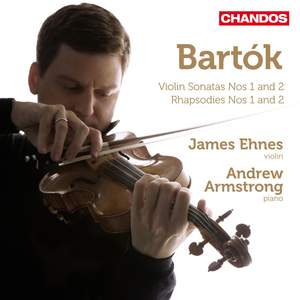
| |  | Bartók: Violin Sonatas Nos. 1 & 2
Bartók: | Violin Sonata No. 1, BB 84, Sz. 75 Violin Sonata No. 2, BB 85, Sz. 76 Rhapsody for Violin & Piano No. 1, BB 94a, Sz. 86 Rhapsody for Violin & Piano No. 2, BB 96a, Sz. 89 Andante in A major, DD 70, BB 26 |
This is the second volume in a series devoted to the works for strings by Béla Bartók, with James Ehnes the featured soloist. Earlier this year, Ehnes recorded the Violin and Viola Concertos (CHAN10690), which was made Disc of the Month in Gramophone magazine. On this new recording, he turns to the Violin Sonatas and Rhapsodies, complemented by the earliest surviving work by Bartók for violin and piano, an Andante. He is accompanied by the pianist Andrew Armstrong. Dedicated to the Hungarian violinist Adila d’Arányi, the sonatas for violin and piano were composed in 1921 – 22, around the same time as the highly successful ballet score The Miraculous Mandarin. Of the two works, the Sonata in C sharp minor is the more traditional in terms of its structure, and characterised by a mood that is sometimes exhilarated, sometimes turbulent – but always virtuosic. The finale builds from a series of increasingly wild dances, folk-like in style but entirely expressionistic. In the Sonata in C major, Bartók removes himself from classical form and traditional tonal practice, calling on the violinist to distance himself from the romantic manner of playing. At several points, for example, the violin is played without vibrato, producing an ethereally cool and distant sound. The improvisatory character is strong throughout, as the work repeatedly alternates between the quiet and thoughtful, and the stormy and strident. The ending, in contrast to the earlier sonata, is understated, emotional, and expressive. Bartók’s two rhapsodies for piano and violin, dedicated respectively to Joseph Szigeti and Zoltán Székely, are steeped in the tradition of Hungarian folk music. Exuberant and infectious, the works are heavily inspired by the csárdás, the national dance of Hungary, and display the traditional pairing of lassú (slow) and friss (lively) movements. “The performances are assertive but never excessively forceful, tonally sweet (useful in this often acerbic music) and, from Andrew Armstrong's standpoint, almost impressionist in their projection of nuance and tonal shading...an exceedingly generous programme (80'30''), expertly engineered, well planned, beautifully executed.” Gramophone Magazine, March 2012 “They are performances of outstanding musical insight and technical brilliance...James Ehnes and Andrew Armstrong perfectly encapsulate the anxieties projecting in both works...But they also find room for repose and reflection...As with Ehnes's recording of the Concertos, the present collection sweeps the board in terms of performance and generosity alike.” BBC Music Magazine, March 2012 ***** “Ehnes has the measure of the fractured sonata design of the Allegro appassionato [in No. 1]...[He] gives a tellingly understated account of the preludial Molto moderato [in No. 2], dovetailing into a main Allegretto which open out its thematic and expressive potential so the work as a whole seems to unfold seamlessly towards a rapt and unifying postlude.” International Record Review, February 2012 “This is a magnificent disc, wonderful playing captured in fantastic sound, and a fine way to begin an exploration of Bartók’s work in this genre. Roll on Volume Two.” MusicWeb International, June 2012 | | | (also available to download from $10.50) | In stock - usually despatched within 1 working day. |
|
|
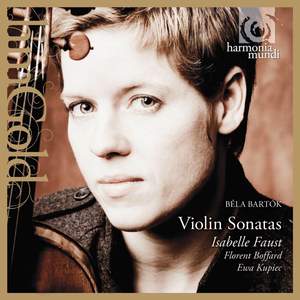
| |  | Bartok - Violin Sonatas
“…outstanding…full of grit and fantasy” BBC Music Magazine, August 2010 | | | In stock - usually despatched within 1 working day. |
|
|
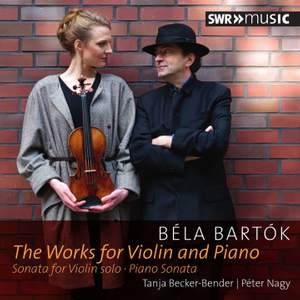
| |  | Bartók: Complete Works for Violin Volume 3Violin Sonatas and Rhapsodies
Antal Zalai (violin) & József Balog (piano) In the first half of the 20th century, Béla Bartók was one of the principal ambassadors of Hungarian music. He was influenced by the folk music of Eastern Europe and strove to break the confines of the traditions of Western Classical music, in order to create harmonies, rhythms and performance practices that were more relevant to his turbulent era. While the two sonatas differ in their relation to the Classical model, the influence of Eastern Europe can be heard in both: the arpeggios at the beginning of No.1 imitate the sound of the Hungarian cimbalom, and there is evidence of Hungarian folk music in its dance‐like finale as well as in the hor lunga‐style melody of the Romanian peasant music in No.2, which recurs several times throughout the piece. The two Rhapsodies similarly share the influence; the slow ‘Lassú’ movement of No.1, for example, uses an exotic Transylvanian melody followed by a much more cheerful ‘Friss’ movement. Exoticism returns in the ‘Lassú’ of No.2, combined with a hint of melancholy, which is counteracted by the riotous dance of the ‘Friss’ thanks to its improvisatory nature and use of six separate tunes. The disc features Antal Zalai, praised by Igor Oistrakh as ‘an exceptional violinist who has a perfect technique, beautiful large tone, real musical finesse and maturity as well as a noble personality’. Joining him is József Balog, one of the most celebrated pianists of his generation and winner of the 2005 Annie Fischer Award. | 
| | | Usually despatched in 4 - 5 working days. |
|
|
| |  | Rhapsodies For Violin & Piano
Bartók: | Andante in A major, DD 70, BB 26 Romanian Folk Dances, Sz.56 (arr. Székely for violin & piano) Rhapsody for Violin & Orchestra No. 1, BB 94b, Sz. 87 Rhapsody for Violin & Piano No. 2, BB 96a, Sz. 89 | Liszt: | Die Zelle in Nonnenwerth, S382 Romance oubliée, for viola/cello/violin & piano, S. 132 La Lugubre Gondola for cello & piano, S134 arr. for violin & piano | Ravel: | Tzigane | Sarasate: | Zigeunerweisen, Op. 20 |
Barnabás Kelemen, Gold Medallist of the 2002 International Violin Competition of Indianapolis, has established himself as one of the leading violinists of his generation, appearing regularly as a concerto soloist, recitalist, and chamber musician at many of the world’s major musical venues and festivals. He has toured extensively throughout Europe, North and South America, South Africa, Japan and Taiwan. In September 2005 he was appointed Professor of Violin at the Franz Liszt Music Academy in Budapest. | |
|
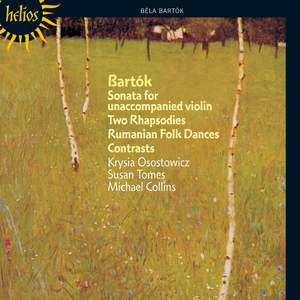
| |  | Bartók - Chamber Works
Bartók: | Sonata for Solo Violin, BB 124, Sz. 117 Contrasts for violin, clarinet & piano, BB 116, Sz. 111 Romanian Folk Dances, Sz.56 (arr. Székely for violin & piano) Rhapsody for Violin & Piano No. 1, BB 94a, Sz. 86 Rhapsody for Violin & Piano No. 2, BB 96a, Sz. 89 |
'An outstandingly successful and enjoyable issue' (Gramophone) “Unusually for a composer who wrote so much fine chamber music Bartók wasn't himself a string player. But he did enjoy close artistic understanding with a succession of prominent violin virtuosos, including the Hungarians Jelly d'Arányi, Joseph Szigeti and Zoltán Székely, and, towards the end of his life, Yehudi Menuhin. It was Menuhin who commissioned the Sonata for solo violin, but Bartók died before he could hear him play it – Menuhin was unhappy with the occasional passages in quarter-tones and the composer had reserved judgement on his proposal to omit them. It was Menuhin's edition which was later printed and which has been most often played and recorded; but Krysia Osostowicz returns to the original and, more importantly, plays the whole work with intelligence, imaginative flair and consummate skill. The Sonata is the most substantial work on this disc, but the rest of the programme is no less thoughtfully prepared or idiomatically delivered. There's the additional attraction of an extremely well balanced and natural-sounding recording. As a complement to the string quartets, which are at the very heart of Bartók's output, this is a most recommendable disc.” Gramophone Classical Music Guide, 2010 | | | Usually despatched in 2 - 3 working days. |
|
|
| |  | Béla Bartók - Rhapsodies
Bartók: | Rhapsody for Violin & Piano No. 2, BB 96a, Sz. 89 Hungarian Folk Songs (1947), Sz 42 Hungarian Folksongs (1931), Sz 42 Sonatina, BB 69, Sz. 55 transcribed for violin and piano by Endre Gertler (1931) Hungarian Folksongs (1927), Sz.42 Romanian Folk Dances, Sz.56 (arr. Székely for violin & piano) Rhapsody for Violin & Piano No. 1, BB 94a, Sz. 86 |
| | | Usually despatched in 3 - 4 working days. |
|
|
| |  |
| | | (also available to download from $6.00) | Usually despatched in 2 - 3 working days. (Available now to download.) |
|
|
| |  |
Georg Mönch (Violin), Massimiliano Damerini (Piano) | | | Usually despatched in 2 - 3 working days. |
|
|
| |  | Other Side - TúlpartonBartók's music and its folk roots
| | Nem arról hajnallik, amerrõl hajnallott (The sun rises not where it used to rise) Árva vagyok apa nélkül (I am but a fatherless orphan) Zöldkeserves (Green lament) Korcsos, Forgatós (Mongrel, Turner and Krucena) Hej, dobrý vecer, pani krcmárka (Hey, good night) Meggyújtom a csumám (I light my fire) Két szál pünkösdrózsa (Two peonies) Kicsi a hordócska (The barrel is little) Péterfali halastóban (In the fishpond at Péterfala) Felültem a kemencére - Bozse Mári libája (I sat on the hearth - Mári Bozse’s goose) Uccu dárom, danárom - Megfogtam egy szúnyogot (Uccu dárom, danárom - I caught a mosquito) Ruszin vándornóta és kolomejka (Ruthenian wanderer’s song and kolomeika) Kétegyházi és eleki lunga | Bartók: | 44 Duos for Two Violins, BB 104, Sz. 98 (extracts) Rhapsody for Violin & Piano No. 1, BB 94a, Sz. 86 Rhapsody for Violin & Piano No. 2, BB 96a, Sz. 89 |
Vilmos Szabadi (violin), Márta Gulyás (piano) Fonó Ensemble | | | Usually despatched in 4 - 5 working days. |
|
|
| |
|