All recordingsPrices shown exclude VAT. (UK tax is not payable for deliveries to United States.) See Terms & Conditions for p&p rates. | |  | Lieder
“This is an unusual and wholly absorbing recital by a soprano often, mistakenly, considered no more than a singer with a lovely voice. In 1972, at the height of her appreciable powers, Janowitz impressed her Salzburg audience with this, her first recital at the Festival. Her discerning choice comprises some notable songs by Schubert rarely heard in recital and ones by his contemporary Hüttenbrenner, which Janowitz sang from manuscript copies, seldom performed since the composer's day. These are surely their first recordings. Has there ever been such a lovely, poised account of the great Schiller-inspired song, DieGötter Griechenlands or such an ingratiating one of Sehnsucht, the Mayrhofer setting? The first offering, Im Freien, has its winning cantilena filled with gloriously sustained, long-breathed tone. The programme ends with Einsamkeit. This grandly imaginative if slightly impersonal quasi-cantata, to a Mayrhofer text, a composition that Schubert himself thought so highly of, is a kind of a panorama of a life, ending in a wonderfully reposeful final section. Janowitz and her impressive partner perform it with total conviction, sustaining interest throughout. Although not in Schubert's class – who is? – Hüttenbrenner reveals a talent apparently well able to encompass the meaning of poems in fluent and often imaginative writing. Orfeo provide no texts, let alone translations, but the delightful Spinnerlied must be about spinning: it's an artlessly charming song. Der Hügel is obviously about more serious matters, and in its sad course comes closes to Schubert in depth of feeling. Frühlingsliedchen has a simple, spring-like joy to it, and an appealingly varied, strophic form. Janowitz takes the measure of them all, and adds to a gently vibrant tone many tints and touches of half-voice. They could not have a better advocate. The recording catches the full glow of the singer's voice. The only drawback, that absence of texts, isn't serious enough to stop acquiring this issue, given that Janowitz virtually tells you in her utterance what the songs are about.” Gramophone Classical Music Guide, 2010 | | | Usually despatched in 3 - 4 working days. |
|
|
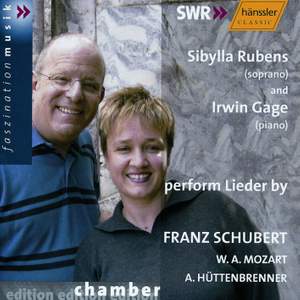
| |  | Lieder by Mozart, Schubert & Hüttenbrenner
Hüttenbrenner, A: | Der Hügel Die Seefahrt Die Sterne Lerchenlied | Mozart: | Das Lied der Trennung, K519 Abendempfindung an Laura, K523 Als Luise die Briefe, K520 An Chloë, K524 Un moto di gioia, K579 Sei du mein Trost, K391 Das Veilchen, K476 Die Verschweigung, K518 | Schubert: | Raste Krieger, Krieg ist aus (Ellens Gesang I), D837 Jäger, ruhe von der Jagd (Ellens Gesang II), D838 Ave Maria, D839 Der blinde Knabe D833 Heiss mich nicht reden, D877/2 Mignon (So lasst mich scheinen), D469B Lied der Anne Lyle, D830 Nur wer die Sehnsucht kennt D310 |
| | | (also available to download from $10.50) | Usually despatched in 2 - 3 working days. (Available now to download.) |
|
|
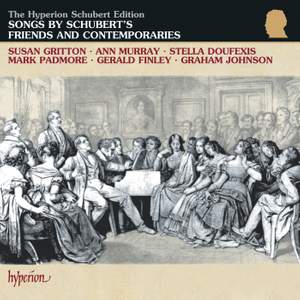
| |  | Songs by Schubert’s friends and contemporariesEighty-one songs by forty composers who lived and worked during Schubert’s lifetime
Banck: | Der Leiermann | Beethoven: | Abendlied unter'm gestirten Himmel, WoO 150 An die ferne Geliebte (To the distant beloved), Op. 98 | Berger, L: | Des Müllers Wanderlied Müllers Blumen Am Maienfeste Der Müller Rose, die Müllerin Müllers trockne Blumen Des Baches Lied | Bürde: | Der Berghirt | Dietrichstein: | Wonne der Wehmut | Eberwein, M: | Rastlose Liebe | Franz, S: | Abschied nach Wien 1813 | Gyrowetz: | Die Einsame | Haydn: | Der Greis Hob | Hiller, F: | Wandrers Nachtlied | Hummel, J: | Zur Logenfeier | Hüttenbrenner, A: | Lerchenlied | Kreutzer, K: | Winterreise Abreise Heimkehr Der Lindenbaum Frühlingstraum Die Post Der Pilgrim | Krufft: | Lied aus Wilhelm Meisters Lehrjahre | Lachner, F: | Ständchen Das Fischermädchen, Op. 33, No. 10 Der Schmied Nachtigall Herbst | Liszt: | Es rauschen die Winde, S294 | Loewe, C: | Gesang der Geister Der Erlkönig, Op. 1 No. 3 (Goethe) | Mendelssohn: | Minnelied im Mai 'Holder klingt der Vogelsang', Op. 8 No. 1 | Mendelssohn, Fanny: | Die frühen Gräber, Op. 9 No. 4 (Text: Friedrich Wilhelm Klopstock) | Meyerbeer: | Komm! | Neukomm: | Trost in Tränen Klage an den Mond Sehnsucht | Randhartinger: | Suleika Rastloses Wandern | Reichardt, J F: | Sehnsucht Rastlose Liebe Erlkönig Monolog der Iphegenia | Reichardt, L: | Aus Novalis Hymnen an die Nacht | Rossini: | Beltà crudele | Salieri: | Ich denke dein | Schubert of Dresden Sr.: | Die Lebensgefährten | Schumann: | Lied für XXX | Sechter: | Gute Nacht | Spohr: | Mignon's Lied Op. 37:1 Erlkönig | Tomásek: | Meeres Stille Heidenröslein | Unger: | Die Nachtigall | Unger-Sabatier: | Frühlingsglaube | Vesque von Püttlingen: | Der Herbstabend Der Doppelgänger Der Fischer | Vogl: | Lied der Desdemona | Weber: | Gebet während der Schlacht | Weigl, J: | Wenn sie mich nur von weitem sieht | Weyrauch, A H: | Adieu! | Zelter: | Erlkönig Erster Verlust Um Mitternacht Klage Harfenspieler III Rastlose Liebe | Zumsteeg: | Die Erwartung Thekla |
“Abetted by Johnson's lucid pianism, the singers nicely judge the scale and character of their allotted songs. Susan Gritton, her timbre, richer and more flavoursome than a decade ago, is equally admirable in the insouciant trilling of Johann Unger's Die Nachtigall and the dramatic declamation of Reichardt's Monolog der Iphigenie. Gerald Finley is a graphic story-teller in the various Erlkönig settings and a honeyed-toned seducer in Meyerbeer's Komm, while Mark Padmore makes a persuasive case for Zumsteeg's pleasantly rambling ballad Die Erwartung... This enterprising, often revelatory set should intrigue and delight anyone interested in the development of the Lied.” Gramophone Magazine, July 2006 | | | In stock - usually despatched within 1 working day. |
|
|
| |
|