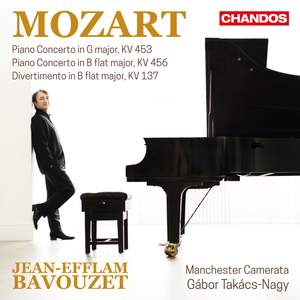
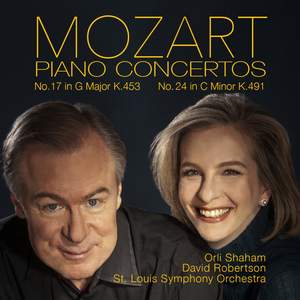
Mozart: Piano Concerto No. 17 in G major, K453

This page lists all recordings of Piano Concerto No. 17 in G major, K453, by Wolfgang Amadeus Mozart (1756-91) on CD, SACD, DVD & download (MP3 & FLAC). Generally, more recent releases are listed first, but with priority given to those that are in stock.

Recommendations

Orchestral Choice
April 2006
First Choice
May 2011
4 starRosetteRosette

All recordings

Prices shown exclude VAT. (UK tax is not payable for deliveries to United States.)
See Terms & Conditions for p&p rates.

Mozart: Piano Concertos Nos. 14, 17, 21, 26

Mozart: Piano Concertos Nos. 14, 17, 21, 26


Mozart:

Piano Concerto No. 14 in E flat major, K449

Cadenza: W.A. Mozart

Wiener Philharmoniker

Piano Concerto No. 26 in D major, K537 'Coronation'

Cadenza: V.P. Badura-Skoda

Wiener Philharmoniker

Piano Concerto No. 17 in G major, K453

Cadenzas: W. A. Mozart

Chamber Orchestra of Europe

Piano Concerto No. 21 in C major, K467 'Elvira Madigan'

Cadenza: Rudolf Serkin

Chamber Orchestra of Europe


Released or re-released in last 6 months

DG Duo - 4791435

(CD - 2 discs)

$15.00

(Sorry, download not available in your country)

In stock - usually despatched within 1 working day.

Mozart: Piano Concertos Nos. 17 & 27

Mozart: Piano Concertos Nos. 17 & 27


Mozart:

Piano Concerto No. 17 in G major, K453

Piano Concerto No. 27 in B flat major, K595


Angela Hewitt (piano)

Orchestra da Camera di Mantova, Hannu Lintu

Angela Hewitt turns to two of Mozart’s greatest and most popular concertos for her latest album. Together with her frequent collaborators, the Orchestra da Camera di Mantova and brilliant Finnish conductor Hannu Lintu, she presents these works in performances which are both elegantly stylish and profoundly felt. This release is completed by a personal reflection on the music by Hewitt herself in the accompanying booklet.

“[the Presto of K453] is brilliantly done, anmd this is a brilliant performance all round.” International Record Review, May 2013

“The sound is wonderfully clean and focused, with an ideal balance between Hewitt’s customary Fazioli piano and the orchestra...a Mozart release to cherish.” The Telegraph, 10th May 2013

“[Hewitt] weights the finale [of K491] to reflect rumination or melancholia, and propounds it supremely well too...Yet the Andante evokes the finest in her, its trajectory exposed through pathos and proud gesture.” Gramophone Magazine, June 2013

Released or re-released in last 6 months

Hyperion - CDA67919

(CD)

Normally: $16.75

Special: $15.00

In stock - usually despatched within 1 working day.

Mozart: Piano Concertos Nos. 17 & 22

Mozart: Piano Concertos Nos. 17 & 22


Mozart:

Piano Concerto No. 17 in G major, K453

Piano Concerto No. 22 in E flat major, K482

Rondo for Piano & Orchestra in A major, K386


Kristian Bezuidenhout [fortepiano: Paul McNulty, Divisov, Czech Republic, 2009, after Anton Walter & Sohn, Vienna, 1805]

Freiburger Barockorchester, Petra Müllejans

"Early on in the planning of these sessions, we decided that the microphone placement would be very different from traditional set-ups. After much experimentation, we opted for a layout very much like theatre in the round, with the keyboard in the very centre, winds in a line facing the solo instrument, and the strings as a sort of envelope all around and behind the piano. Crucially, it brings the winds – such operatic characters in Mozart’s Viennese concertos – very much to the fore of the sonic picture; it also encourages a much more natural and vivid interplay between the piano and the wind band. It has meant that the kind of keyboard-dominated sound one sometimes encounters, has been replaced by what E. T. A. Hoffmann described as a symphony with piano obbligato – the piano, playing both solo and continuo, darts in and out of the lush orchestral texture; at times, incredibly prominent, at other moments, purely accompanimental. Mozart’s sensational gifts as an improviser are well known by now, and indeed there are frequent places in the piano part where embellishment is an obligatory element of the stylistic grammar. Our feeling was that this spirit of spontaneity should extend to the orchestra as well. One will notice that the solo wind instruments depart from the text on numerous occasions; these ornaments were partly pre-planned, partly refined and revised by the wonderful wind principals of the FBO. After all, Mozart was writing for some of the most gifted and wellrespected wind soloists of the time, and although it is hard to prove, I find it difficult to imagine that he would have frowned on his collaborators’ natural tendency to introduce subtle embellishments." Kristian Bezuidenhout

Kristian Bezuidenhout's next release on harmonia mundi USA will be Volume 4 of his solo Mozart project which has received unanimously good, sometimes great, reviews, including IRR Outstanding, Gramophone Recommends, CD Review Disc of the Week and a BBC Music Magazine Choice.

“Bezuidenhout plays with his usual brilliance and subtlety and with inventive ornamentation. But the instrument’s meagre tone, in comparison with the orchestra, is all too apparent...the Freiburg players’ splendidly forceful, incisive tuttis only underline the disparity.” Sunday Times, 4th November 2012

“'s the irrepressible imagination and vitality of Bezuidenhout's playing, the range of colour and touch he obtains from his keyboard, and the way he uses it to throw new light on detail that give these performances their really distinctive flavour.” The Guardian, 8th November 2012 ****

“the fortepiano’s most persuasive performer...Bezuidenhout still shapes and shades this music with almost romantic finesse, and releases the historic instrument’s full expressive potential. In every register the sound changes: proudly growling down in the bass, bird-bright in the treble reaches, round and velvety in the middle.” The Times, 23rd November 2012 ****

“This is a bold, even uncompromising issue, and may not be one for the faint-hearted...Articulation is ultra-crisp, and forte often feels like sforzando...The net effect throughout is vivid, always interesting, sometimes exciting, occasionally prissy, even a little didactic: for all that, I have greatly enjoyed it” International Record Review, December 2012

“I found this immediately thrilling; the extreme textural and dynamic variations give the music terrific bite … his playing is always imaginative and constantly engaging” International Piano, January/February 2013

“Bezuidenhout [has] carved out [a] considerable reputation in this repertoire.” Early Music Review, December 2012

“remarkably consistent in relation to the previous three volumes, regarding the fortepianist's superb technical acumen and musical intelligence, as well as interpretative affectations that seem more precious than stylish...however, Bezuidenhout's spirited style and authoritative fingerwork never operate at less than world-class standards.” Gramophone Magazine, January 2013

“Bezuidenhout gives us characteristically thought-provoking performances of two of the great Mozart Concertos. Particularly felicitous is his use of solo orchestra strings for some of the music's most intimate moments...Altogether a rewarding disc and one that Bezuidenhout's many admirers will not want to be without.” BBC Music Magazine, February 2013 ****

Harmonia Mundi - HMC902147

(CD)

$17.50

In stock - usually despatched within 1 working day.

Mozart: Piano Concertos Nos. 17 & 26

Mozart: Piano Concertos Nos. 17 & 26


Mozart:

Piano Concerto No. 17 in G major, K453

Piano Concerto No. 26 in D major, K537 'Coronation'


Ronald Brautigam (fortepiano)

Die Kölner Akademie, Michael Alexander Willens

Ronald Brautigam returns with the third instalment in his series of Mozart’s piano concertos and is joined again by Die Kölner Akademie conducted by Michael Alexander Willens.

The present disc includes Piano Concerto No.26 in D major, K 537, nicknamed the ‘Coronation Concerto’. Although the title page stated the work was ‘performed by the composer at Frankfurt-am-Main on the occasion of the Coronation of Emperor Leopold II’, the concert took place a week after the actual coronation, and was not part of the official festivities.

It is here preceded by Piano Concerto No.17 in G major, K 453, one of the rare concertos that Mozart composed with another soloist than himself in mind – in this case his student Barbara Ployer.

“This is a really fine performance [of K453], with the slow movement's sublime interplay between piano and winds perfectly judged, and the wit and drama of the variation finale vividly handled - especially in the opera buffa coda, where you can almost smell the greasepaint.” BBC Music Magazine, January 2013 ****

“Brautigam's sinuous reading of K453, which makes much of Mozart's long, lolloping lines, has elegance to spare. But he doesn't lose sight of the more mischievous elements either...[the fortepiano] has tremendous clarity throughout its range” Gramophone Magazine, April 2013

“His playing has energy, sparkle, grace and clarity - points are never laboured but there is real personality. The dialogue between the soloist and orchestra is effortlessly managed thanks to careful balance, and there's a feeling of joyous engagement throughout the performance...The SACD sound is superb: open, clear and always in focus” International Record Review, December 2012

Super Audio CD

Format:

Hybrid Multi-channel

BIS - BIS1944

(SACD)

$16.75

(also available to download from $10.50)

In stock - usually despatched within 1 working day.

Mozart: Piano Concertos Nos. 10 & 17

Mozart: Piano Concertos Nos. 10 & 17


Mozart:

Piano Concerto No. 17 in G major, K453

Vienna State Opera Orchestra, Paul Angerer

Concerto for 2 Pianos and Orchestra No. 10 in E flat, K365

with Walter Klein (piano)

Vienna State Opera Orchestra, Paul Angerer

Sonata for 2 pianos in D major, K448

with Walter Klein (piano)


Brendel’s Mozart credentials are very much in evidence in these performances. The 17th concerto was highly acclaimed when it first appeared on the Vox label in the 1960s and it is arguable that his collaboration with Walter Klein in recording the concerto and sonata for two pianos has never been surpassed.

“The transfer might leave the Vienna Volksoper orchestra (not the Staatsoper as credited) sounding a little glassy, but Brendel and Klein are suavely matched in the give-and-take of the two-piano works.” BBC Music Magazine, July 2012 ****

“What is at once astonishing and delightful about these performances is that the constant technical problem of ensemble between the two pianos is never allowed to take precedence over the business of music-making. Some of the rival versions of the concerto may in fact keep even more impeccably together, but none presents us with such consistently beautiful—and meaningful— phrasing.” Gramophone Magazine (Concerto for Two Pianos)

Regis - RRC1388

(CD)

$7.25

In stock - usually despatched within 1 working day.

Mozart: Piano Concertos Nos. 14, 17, 25 & 26

Mozart: Piano Concertos Nos. 14, 17, 25 & 26


Mozart:

Piano Concerto No. 14 in E flat major, K449

London Symphony Orchestra, Anthony Collins

Piano Concerto No. 25 in C major, K503

New Symphony Orchestra, Anthony Collins

Piano Concerto No. 26 in D major, K537 'Coronation'

New Symphony Orchestra, Anthony Collins

Piano Sonata No. 18 in D major, K576 'Hunt'

Piano Concerto No. 17 in G major, K453

Orchestra, Paul Angerer

Rondo in D major, K485

Piano Sonata No. 8 in A minor, K310


Friedrich Gulda has become something of a cult figure in the music world. This 2CD set presents him in Mozart recordings – both concertos and solo works – largely for Decca, with one item, the Piano Concerto No. 17, recorded for Amadeo.

Born in Vienna in 1930, Gulda began formal lessons aged seven with Felix Pazofsky, and within five years had graduated to the Vienna Music Academy. The Viennese classics – especially Mozart and Beethoven – quickly established themselves at the heart of Gulda’s performing repertoire but he was also a remarkable jazz performer. It was while he was rapidly absorbing jazz into his musical bloodstream that Gulda cut his first Mozart concerto recordings for Decca, starting in 1954 with KV 449. His accompanists, as on the coupling of KV 505 and 537 recorded almost exactly a year later, were the New Symphony Orchestra of London, a studio ensemble of hand-picked players, and conductor-composer Anthony Collins, who during the same period recorded the first complete cycle of Sibelius’s symphonies with the London Symphony Orchestra. What strikes one in particular about these recordings is their surprisingly ‘modern’ approach, free of Romantic rhetoric, with speeds effortlessly maintained and rhythms kept buoyant and sparkling, matched by a beguiling textural clarity and staccato precision.

The more overtly affectionate Viennese recording of KV 453 dates from 1960 and features another ad-hoc group, this time selected by Gulda himself, under Paul Angerer, a Hans Swarowsky protégé who was then rapidly establishing his conducting credentials having spent the early part of his career playing viola in the Orchestre de la Suisse Romande and Vienna Symphony Orchestra.

Mozart’s piano sonatas are often treated as second-class citizens by comparison with the concertos, yet for Gulda they were an essential part of his creative output. ‘The sonatas are private preliminary conversations leading to the operas,’ he reasoned. Gulda’s first recordings for Decca were captured in 1947 and the following year he turned his hands to Chopin and Mozart’s KV 576 Sonata, a reading whose micro-inflected tonal purity and seamless cantabile is reminiscent of Dinu Lipatti.

Bringing Gulda’s lifelong devotion to Mozart full close, he once expressed a peculiar desire to die on Mozart’s birthday. Remarkably, on 27 January 2000, exactly 244 years after Mozart was born, Gulda passed away, aged 69.

“Friedrich Gulda is in attentive mode in this predominantly well-behaved Mozart. There's delicacy and bite by turn, though little of the spontaneity one hopes for.” BBC Music Magazine, May 2012 ***

“Gulda's playing is impeccable … The orchestral playing is distinctly good … The recording is first-rate” Gramophone Magazine (Concertos 25 & 26)

“In the Andantino and the finale, the pianist’s neat, deft playing, his sure sense of balance and admirable control, bear their rewards … Mozart’s music is allowed to speak for itself, and does so, eloquently.” Gramophone Magazine (Concerto No. 14)

“Admirably clean, well balanced, true recording of a wise-like (i.e. gracious-cum-judicious) performance” Gramophone Magazine (Sonata No. 18)

Australian Eloquence - 4803442

(CD - 2 discs)

$14.00

In stock - usually despatched within 1 working day.

Mozart - Piano Concertos Nos. 17 & 27

Mozart - Piano Concertos Nos. 17 & 27


Mozart:

Piano Concerto No. 17 in G major, K453

Piano Concerto No. 27 in B flat major, K595


Alfred Brendel (piano)

Vienna Volksoper Orchestra, Paul Angerer

Alto - ALC1114

(CD)

$7.25

In stock - usually despatched within 1 working day.

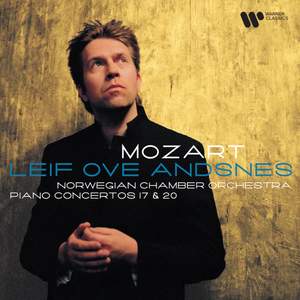
Mozart - Piano Concertos Nos. 17 & 20

Mozart - Piano Concertos Nos. 17 & 20


Mozart:

Piano Concerto No. 17 in G major, K453

Piano Concerto No. 20 in D minor, K466


“In Leif Ove Andsnes's hands the D minor Concerto K466 is every bit as demonic as it ought to be, and he's greatly helped by fine playing from the Norwegian Chamber Orchestra, with its trumpets cutting through the texture to thrilling effect.” BBC Music Magazine, March 2008 *****

“…his enviably natural, unforced clarity and musicianship shine through every bar and subtle ambiguity. Very much primus inter pares, Andsnes's sense of give and take as both soloist and director of the Norwegian Chamer Orchestra is as remarkable as his unfailing musical grace.” Gramophone Magazine, April 2008

“After this first foray, Mr. Andsnes may get pressure from Mozart lovers to record them all…his stylish accounts of these concertos are among the most revelatory Mozart records of the year.” New York Times

Penguin Guide

Rosette Winner

EMI - 5002812

(CD)

$12.50

In stock - usually despatched within 1 working day.

Mozart - Piano Concertos Nos. 17 & 20

Mozart - Piano Concertos Nos. 17 & 20


Mozart:

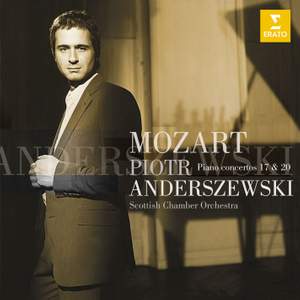
Piano Concerto No. 17 in G major, K453

Piano Concerto No. 20 in D minor, K466


“What immediately impressed about these performances is not only the limpidness and unpretentious expressive quality of Anderszewski's playing, but also the care he's obviously lavished on orchestral detail - beautifully realised by the Scottish Chamber Orchestra.” BBC Music Magazine, April 2006 *****

“Mozart performed the K466 Concerto at the Mehlgrube Casino on February 11, 1785. It is hard to imagine what the Viennese made of its dark, brooding D minor opening. Piotr Anderszewski superbly captures the uneasy mingling of melancholic passion and revolutionary fervour.
This dynamic and impressively balanced performance is full of powerful arguments and emotional pressure.
Anderszewski's well-proportioned playing is in equal partnership with the SCO (perhaps the cohesive blend is a benefit of Anderszewski's directing from the keyboard). The central Romanze flows unhindered by saccharine sweetness, and the finale is lean and muscular, though lacking nothing in gracefulness.
In Concerto No 17 Anderszewski's navigation of the piano is articulate, bold and beautiful. His direction is admirably paced, although one imagines that these transparent textures have benefited from the orchestra's lessons in period style from Sir Charles Mackerras: clean-toned strings, precise timpani and brass, and eloquent woodwind flourishes contribute plenty to this attractive disc.”
Gramophone Classical Music Guide, 2010

“Mozart performed the K466 Concerto at the Mehlgrube Casino on February 11, 1785. Piotr Anderszewski superbly captures the uneasy mingling of melancholic passion and revolutionary fervour. This dynamic and impressively balanced performance is full of powerful arguments and emotional pressure. Mozart is known to have played the Concerto No 17 in a concert on February 13, 1785... Anderszewski's navigation of the piano is articulate, bold and beautiful. His direction is admirably paced, although one imagines that these transparent textures have benefited from the orchestra's lessons in period style from Sir Charles Mackerras: clean-toned strings, precise timpani and brass, and eloquent woodwind flourishes contribute plenty to this attractive disc.” Gramophone Magazine, May 2006

BBC Music Magazine

Orchestral Choice - April 2006

Virgin - 3446962

(CD)

$12.50

In stock - usually despatched within 1 working day.

Mozart - Piano Concertos Nos. 14, 17 & 21

Mozart - Piano Concertos Nos. 14, 17 & 21


Mozart:

Piano Concerto No. 14 in E flat major, K449

Piano Concerto No. 17 in G major, K453

Piano Concerto No. 21 in C major, K467 'Elvira Madigan'


Building a Library

First Choice - May 2011

DG - The Mozart Collection - E4775747

(CD)

$11.25

In stock - usually despatched within 1 working day.

Page: 

 1   2   3   4   5   6   7   8   9 

 Next >>

Copyright © 2002-13 Presto Classical Limited, all rights reserved.