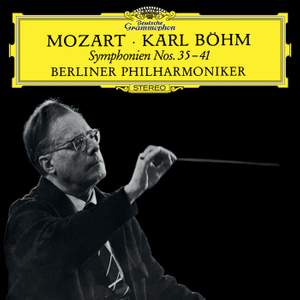
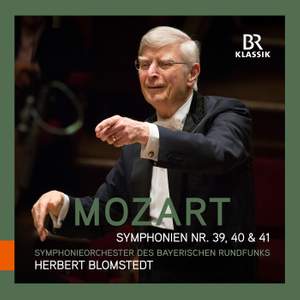
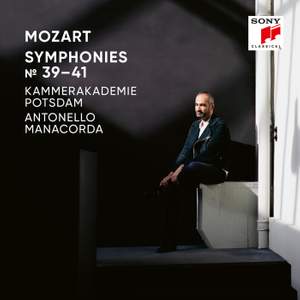
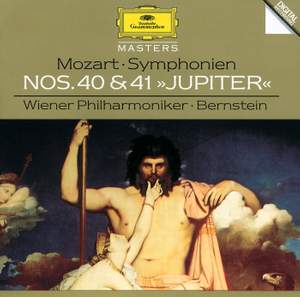
All recordingsPrices shown exclude VAT. (UK tax is not payable for deliveries to United States.) See Terms & Conditions for p&p rates. | |  | Mozart: Symphonies Nos. 40 & 41 ‘Jupiter’
| 
| | | In stock - usually despatched within 1 working day. |
|
|
| |  | Otto Klemperer conducts Bruckner & MozartRecorded live at the Royal Festival Hall, London, November 1965
The first symphonic work by Mozart that Klemperer ever conducted was K.550. The Kölnische Zeitung noted that his use of a reduced string section emphasised the dark aspects of the score and the work was played ‘con espressione, yet with a translucency and a rhythmic and dynamic finesse in the true classical style’. His 1956 recording of the symphony for EMI drew praise from Gramophone magazine’s conductor/critic Trevor Harvey – ‘for me easily the most satisfying recorded performance. I wouldn’t want a bar altered anywhere. The Philharmonia give Klemperer the most lovely playing, especially in the quiet string tone...’. In later years Klemperer liked to couple the Mozart G minor with Bruckner’s Seventh Symphony (soon after this 1965 London concert he gave the same programme in Hamburg, his mother’s birthplace). He had first conducted the Bruckner in 1921. It became a work that he used to champion the composer’s music where it was less known and which he liked to perform for his own début engagements in Europe and America. After a concert with the New York Philharmonic Symphony Orchestra in 1927 the critics rejected the music but noted drily that Klemperer was applauded ‘as, it is safe to say, no conductor of a Bruckner symphony has ever been applauded in New York’. Much the same story (appreciative audience, hostile critics) repeated itself in Rome in 1931 and in London. In February 1958 Klemperer returned to the Symphony in Vienna where the concert began with another of his Mozart favourites, the A major Symphony K.201. The critics, thrilled that Klemperer could now conduct standing up – recovery from a hip operation had kept him seated for a decade before, built up a romantic picture of triumph over physical adversity and, for the Bruckner Seven, bordered on the ecstatic. One writer recalled how Klemperer was actually named in Thomas Mann’s Dr Faustus novel as composer Leverkühn’s conductor of choice for the première of his Apokalypse. Others hailed his ‘great deeds’, ‘style of interpretation which made the music into a spiritual power’, his awareness of ‘music’s highest sense, its role as a spiritual discipline’ and his handling of the symphony as ‘song-like, full of streaming lyricism and powerfully shaped climaxes’. | 
| | | In stock - usually despatched within 1 working day. |
|
|
| |  | Benjamin Britten conducts Mozart & BrittenFairfield Halls, Croydon, London, 20th December 1964
‘The point of Britten’s conducting was never how he looked when doing it; instead it was about the sheer musicality he brought to the task…’ (Paul Kildea). The revelatory films presented on this DVD feature Britten with his favoured English Chamber Orchestra performing at two very different times of his life, with equal value. Filmed at Christmas 1964, the main programme of Mozart’s Symphony No.40 and Britten’s own Nocturne shows a man in his prime. The Mozart was a particular favourite of Britten’s and his admiration for it certainly comes across in the performance. This DVD release is a major addition to his discography as the symphony was previously only available on LP. The footage is modern in its approach and captures Britten close-up in a way that had not been seen before. In the Nocturne, we see and hear Peter Pears in fresh voice, performing one of many pieces that were written for him, and which Britten and Pears had recorded four years previously. With this DVD we are able to see the closeness between composer and performer. An original review of the piece in Gramophone comments: ‘I cannot think of any settings of English words more imaginative than these of Britten’s.’ The bonus is a colour film from mid-1970, with Britten at home in Snape Maltings for a gala re-opening of the concert hall, performing Mendelssohn’s ‘Scottish’ Symphony. The physical difference is clear to see, though all his trademarks are still in evidence and the quality of the music remains undiminished. It is of particular interest as it is the only known recording of this work with Britten. This is the first release of this material on DVD. Sound format: Enhanced Mono DVD format: NTSC Picture format: 4:3 Running time: 67’ Subtitles: n/a Menu languages: English Booklet languages: E/F/G Region code: 0 Territory Restrictions: None “from the very opening bars of the Mozart it's evident that the conductor is absolutely in control, delivering wonderfully instinctive melodic phrasing, and inspiring the English Chamber Orchestra to project tremendous rhythmic exhilaration in the Finale. The performance of the Nocturne is no less enthralling, with Peter Pears in excellent voice.” BBC Music Magazine, January 2013 **** | | | In stock - usually despatched within 1 working day. |
|
|
| |  | Mozart: Symphonies Nos. 39-41
When compared to the many German conductors whose discographical archives have in recent years been rediscovered enthusiastically, Eugen Jochum has been somewhat left behind. And this is despite his having left his mark on two of the world’s leading orchestras of both his day and ours, for he was chief conductor of the Bavarian Radio Symphony Orchestra in Munich and later of the Concertgebouw Orchestra in Amsterdam. And he was furthermore one of the hand-picked group of conductors who re-founded the Bayreuth Festival in the years after the Second World War. Nor was Jochum successful just with Wagner or Bruckner, but also with contemporary works and with 'classics' in the truest sense of the word. In short, his repertoire was all-encompassing. The trilogy of the last Mozart symphonies that he recorded with the Bamberg Symphony in 1982 offers eloquent testimony of his style of music-making, which had nothing trendy about it, but was timeless and captivating. Neither in his dynamics nor in his tempi did Jochum seek the extremes that some of his colleagues did but when it came to clarity and variety of the orchestral voices and colours, Jochum was supreme. The Jupiter Symphony KV551 is convincing in its cheerful exuberance, just as are the two previous symphonies from the year 1788. The dark colours of the G-minor Symphony KV550 and the slow introduction of the E-flat Symphony KV543 are played in a manner that audibly emphasises their proximity to the music of the Magic Flute, and they remain fixed in one’s memory. This re-issue as a digipak for the price of a single CD is topped up with the rarely heard Masonic Funeral Music KV477, which is particularly moving here – another, highly expressive late work by Mozart that was written in honour of two brethren who died in 1785. It corresponds perfectly to Jochum’s approach to the Salzburg master – serious and without any airs and graces – and it forms a fine close to this welcome re-acquaintance with Jochum’s art. | | | In stock - usually despatched within 1 working day. |
|
|
| |  | Mozart: Symphonies Nos. 40 & 41
| | | In stock - usually despatched within 1 working day. |
|
|
| |  | Mozart: Symphonies Nos. 29 & 40
The symphonies Mozart wrote in his youth bear witness to the remarkable assurance of a composer whose genius was already in full flower. In 1773, on returning to Salzburg after spending several months in Italy, the seventeen-year-old Mozart resumed his position as Konzertmeister at the court of the archbishop. He had brought back from his stay in Italy a profound grasp of the art of instrumental writing, and it is from this period that his four-movement Symphony No.29 in A major (K201) dates. By turns energetic, nostalgic and witty, this work is imbued with a new spirit. The celebrated Symphony No.40 in G minor (K550) dates from 1788 and is one of the most dramatic of all Mozart’s works. This symphony dispenses with any kind of slow introduction, plunging the listener straight into a dark-toned and restless Molto allegro that is full of contrasts, sparely orchestrated and shot through with bold modulations. This is followed by a meditative, almost desolate Andante. The down-to-earth humour of the robust Menuetto was remarked on by Berlioz, and the symphony ends with an Allegro assai that is permeated by an anguish and a profundity that look forward to German romanticism. Completed on 10 August 1787, Eine kleine Nachtmusik (K525) is one of Mozart’s most frequently played serenades. Its four movements are models of balance, elegance and poetry. | | | In stock - usually despatched within 1 working day. |
|
|
| |  | Mozart: Symphonies Nos. 25 & 40
| | | In stock - usually despatched within 1 working day. |
|
|
| |  | Mozart - Symphonies Nos. 39 & 40
After a decade immersed in the great Mozart Operas (to universal critical acclaim) René Jacobs returns to the late symphonies with his outstanding Freiburg Baroque. As with his previous recordings, his unique approach to these works from an operatic perspective brings new life to these scores, particularly in terms of phrasing and the clarity of texture. In his own words: "A lot of people think period instrument performance means everything fast. I stick very much to the drama and the delivery of speech. I know that, say, Mozart's own tempi were faster than what is now usual, but, on the other hand, there are also moments when time must stand still." “There is simply one word for Jacobs’ musical direction – enchanting.” The Independent “Mr. Jacobs, more than anyone else, blows away the prim domesticity of our classical music world, and shows us past centuries as they really might have been.” The Wall Street Journal “René Jacobs’s Mozart opera series [is] one of the recorded marvels of our time” James Jolly, Gramophone, February 2009 “The G minor, some eccentric dynamics apart, is splendid — the outer movements very fiery, the Andante done with real love...The wind are admirably prominent, with flute, clarinet and horn particularly good” Sunday Times, 28th March 2010 *** “Two of Mozart’s great symphonies of 1788 are coupled here in performances that radiate René Jacobs’s characteristically effervescent spirit without compromising the seriousness of discourse...The result is a disc of unalloyed freshness, in which the Freiburg players share Jacobs’s joy in music-making.” The Telegraph, 7th April 2010 ***** “...deep understanding, individual interpretations, vivacious performances and, for the most part, a playful approach to this music. What you also hear is a particular sensitivity to the exquisite layering of Mozart's scoring...a recording that is though-provoking and always compelling.” Gramophone Magazine, August 2010 “Surprisingly crisp and spry these readings may be, but the result sounds and feels authentically Mozartian, Jacobs coaxing alert and alive playing from a band on the very top of their form.” Michael Quinn, bbc.co.uk, 2nd August 2010 | | | In stock - usually despatched within 1 working day. |
|
|
| |  | Ferenc Fricsay conducts Mozart & Debussy
The conductor Ferenc Fricsay studied under Bartok, Kodaly and Dohnyani. He conducted many orchestras and opera companies including Houston Symphony, Bavarian State Opera, Deutsche Oper Berlin and the Berlin Philharmonic. These recordings were made between 1957 and 1959. | | | In stock - usually despatched within 1 working day. |
|
|
| |  | Fritz Reiner conducts MozartStudio Recordings, 1946, 1947 & 1954
Born in Budapest, Fritz Reiner was undoubtedly one of the most important US musicians of the last century. He conducted the Pittsburg Symphony Orchestra and was the musical director of the Chicago Symphony Orchestra. Mainly known for his interpretations of the romantic and late-romantic Central-European repertoire, Reiner was more of an eclectic conductor than he is nowadays being credited. His artistry, marked by that rhythmic incisiveness typical of the Hungarian school possessed, in fact, the expressive dryness and formal control that are ideal for the classic Viennese repertoire. The Mozart recordings featured in this CD offer a clear picture of how modern and emotionally restrained this conductor’s approach to the classic music tradition could be. | | | In stock - usually despatched within 1 working day. |
|
|
| |
|